

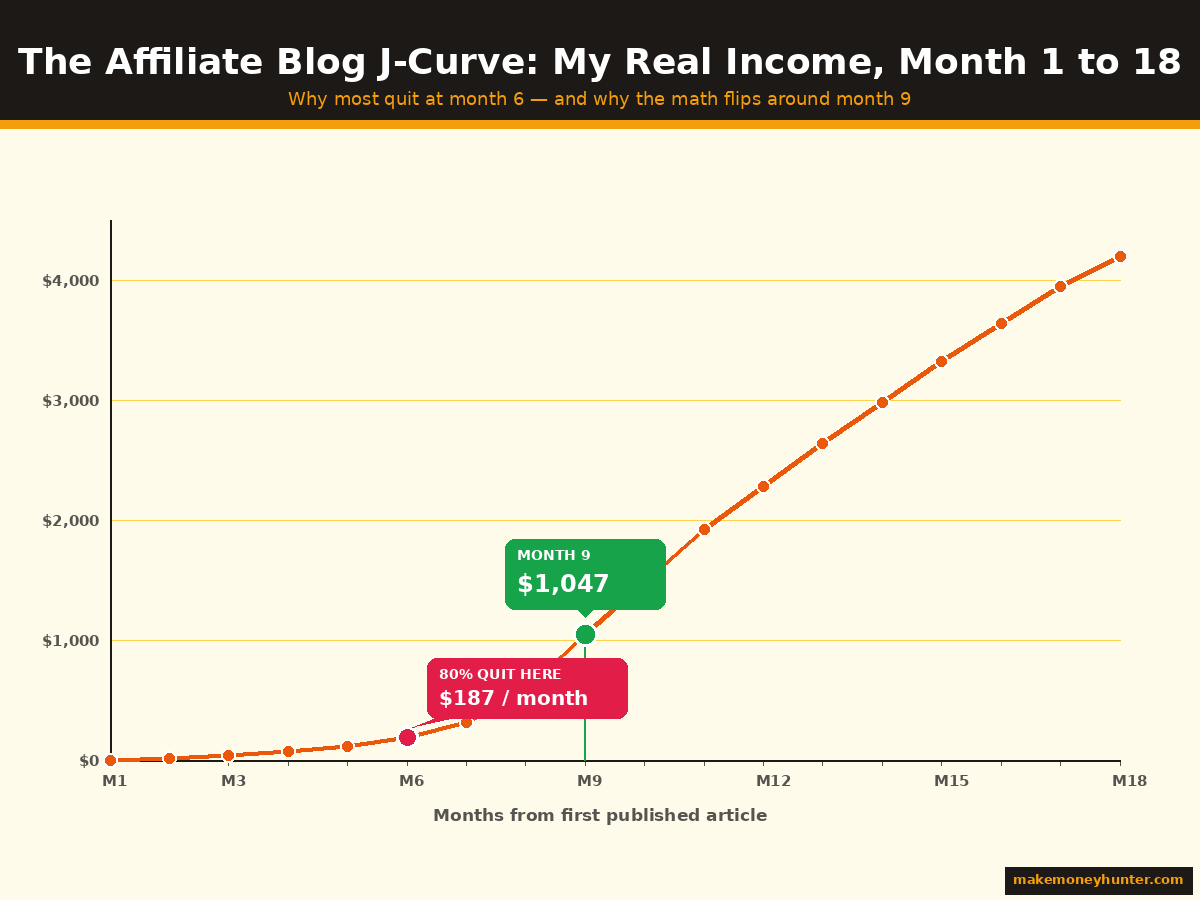
My affiliate marketing income hit exactly $1,047 in month 9. Not month 1. Not month 3. Month 9 — and that was after I’d already spent the prior eight months making between $0 and $312 a month, mostly thinking the whole thing was broken.
I’m telling you this because almost every guide to “how to make 1000 a month side hustle” lies about the timeline. They show you the destination and skip the part where you walk there. So this guide does the opposite: 8 side hustles that genuinely produce $1,000/month, with a realistic timeline for each, the variable costs that eat into that number, and the one I personally rebuilt my income from after a layoff in 2018. No screenshots of someone else’s PayPal. Just the math.
Here’s the short answer if you only have 30 seconds: the fastest paths to $1,000/month are freelance services (4-8 weeks), the slowest but most durable are content businesses (6-12 months), and the most overhyped is dropshipping. Pick based on whether you have time or money to invest — not both, just one.
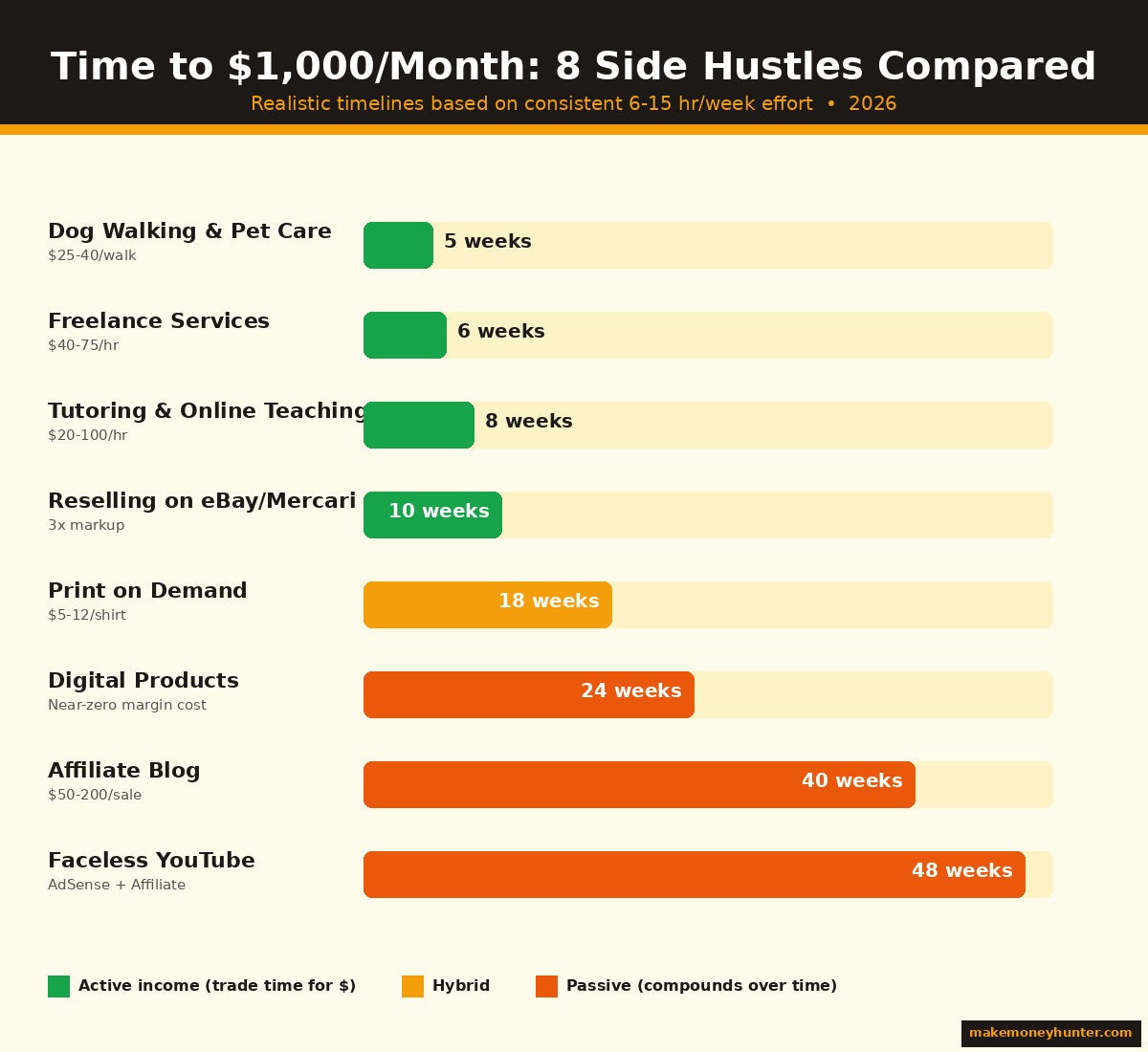
What “$1,000 a Month” Actually Means (And Why Most Guides Get It Wrong)
Before picking a method, get clear on the number. There’s a big difference between $1,000 in gross revenue and $1,000 in your pocket. A reseller doing $1,000/month in sales might keep $300 after inventory cost. A freelance writer charging $1,000/month keeps about $850 after software and self-employment tax.
When I say “$1,000 a month” in this guide, I mean net take-home, not gross. Every method below is calibrated to that. Most blogs add costs as a footnote — I’m pulling them to the front.
Also: $1,000/month is roughly $33 a day, or $12,000 a year. In 2026 that’s enough to cover a car payment, a grocery run for a family of three, or a Roth IRA contribution. It’s not retirement money. But it’s the threshold where a side hustle stops being a hobby and starts being a real second income — and once you’ve hit it, doubling it usually takes a fraction of the original effort.
The 8 Side Hustles That Actually Hit $1,000/Month
Here’s the honest ranking. I’ve ordered these by time-to-first-$1,000-month, not by lifetime earnings potential. Faster ≠ better — but if you need the money soon, start at the top.
1. Freelance Services (4-8 Weeks to $1,000/Month)
This is the fastest legal path I know. If you have any skill someone pays for at a job — writing, design, bookkeeping, coding, video editing, social media management — you can sell that same skill freelance.
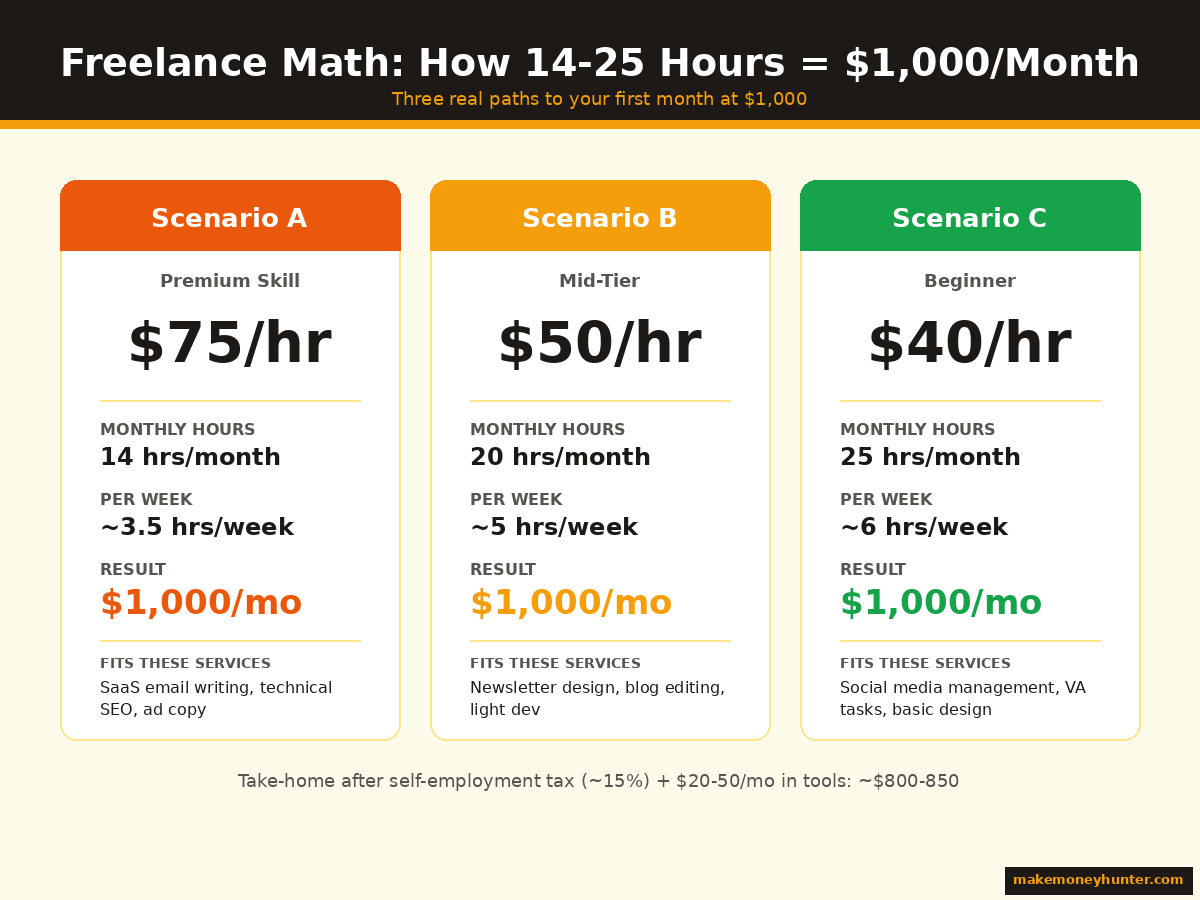
The math: $1,000/month = 1 retainer client at $1,000, or 2 clients at $500, or 4 projects at $250. Most beginners undercharge wildly. A reasonable starting rate for almost any service skill in 2026 is $40-75/hour, which means you need about 14-25 billable hours a month to clear $1,000.
To see how this looks in the wild: search any specific freelance service on a marketplace like Fiverr and you’ll find the going rates immediately. Here’s a snapshot of newsletter and email design gigs — note the range from $10 to $200+ and the visible review counts that signal who’s actually been hired:
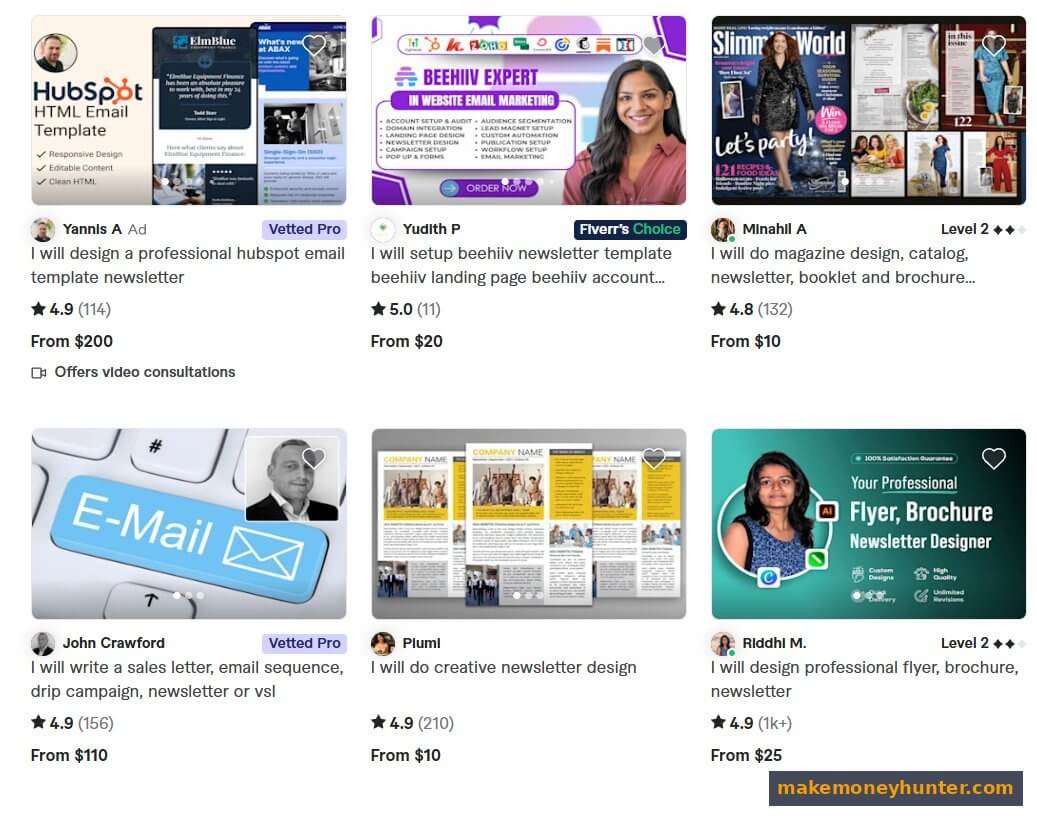
Notice something? The “Vetted Pro” and “Fiverr’s Choice” sellers at the top of the list aren’t necessarily the cheapest — they’re the ones who specialized. “I will set up beehiiv newsletter” beats “I will design newsletters” every time. The narrower your service, the easier it is to price higher and rank higher in the platform’s algorithm.
Realistic path to $1,000:
- Week 1-2: Pick one specific service (not “marketing” — “email newsletter writing for SaaS companies”). Set up a one-page portfolio site or even just a polished LinkedIn.
- Week 2-4: Pitch 5-10 cold prospects per day on LinkedIn, Upwork, or directly via email.
- Week 4-8: Close your first 1-2 clients. The first one almost always closes through someone who already knows you.
What eats into the $1,000: About 15% self-employment tax in the US, plus $20-50/month in tools (Notion, invoicing software). Real take-home: ~$800-850.
The honest catch: This is trading time for money. It scales linearly until you raise rates or productize. Most people stall at $2,000-3,000/month here because they can’t push past the ceiling of “1 person, 1 hour at a time.”
2. Reselling on eBay/Mercari/Facebook Marketplace (6-12 Weeks to $1,000/Month)
The model: buy underpriced items from thrift stores, estate sales, garage sales, retail clearance, or Facebook Marketplace and resell them at retail value. The category matters enormously — sneakers, vintage clothing, video games, books, kitchen gear, and tools are all stable categories with predictable demand.
Real numbers from a friend who runs this as a true side hustle: He spends about 5 hours a week sourcing and 3-4 hours listing/shipping. He averages a 3x markup. To hit $1,000 in profit, he needs about $1,500 in sales (after eBay fees of roughly 13% and shipping costs).
What eats into the $1,000: Platform fees (eBay 13%, Mercari 10%, Poshmark 20%), shipping supplies, and inventory cost. If you’re not careful, you’ll have $4,000 worth of inventory and $200 in profit. Real take-home: ~$700-850 if you’re disciplined.
The honest catch: Reselling has a “garage problem.” Your house fills up. Unsold items become dead weight. The people who scale past $1,000/month treat it like inventory management — they cut losses on slow-moving items aggressively and double down on what sells fast.
3. Print on Demand (3-6 Months to $1,000/Month)
You design graphics, upload them to platforms like Etsy, Redbubble, or Amazon Merch, and the platform handles printing and shipping when someone buys. Your job is design and SEO inside the platform.
The brutal truth most guides skip: most POD stores never make a dollar. The ones that work follow one of two strategies — either they go super-niche (designs for a specific hobby, profession, or fandom no one else is serving) or they upload high volume (200+ designs in a focused category and let the math win).
Here’s what “super-niche” actually looks like. Search Redbubble for “retired postal employee” — a tiny, specific audience most designers ignore — and you’ll find over 1,000 listings still pulling sales:
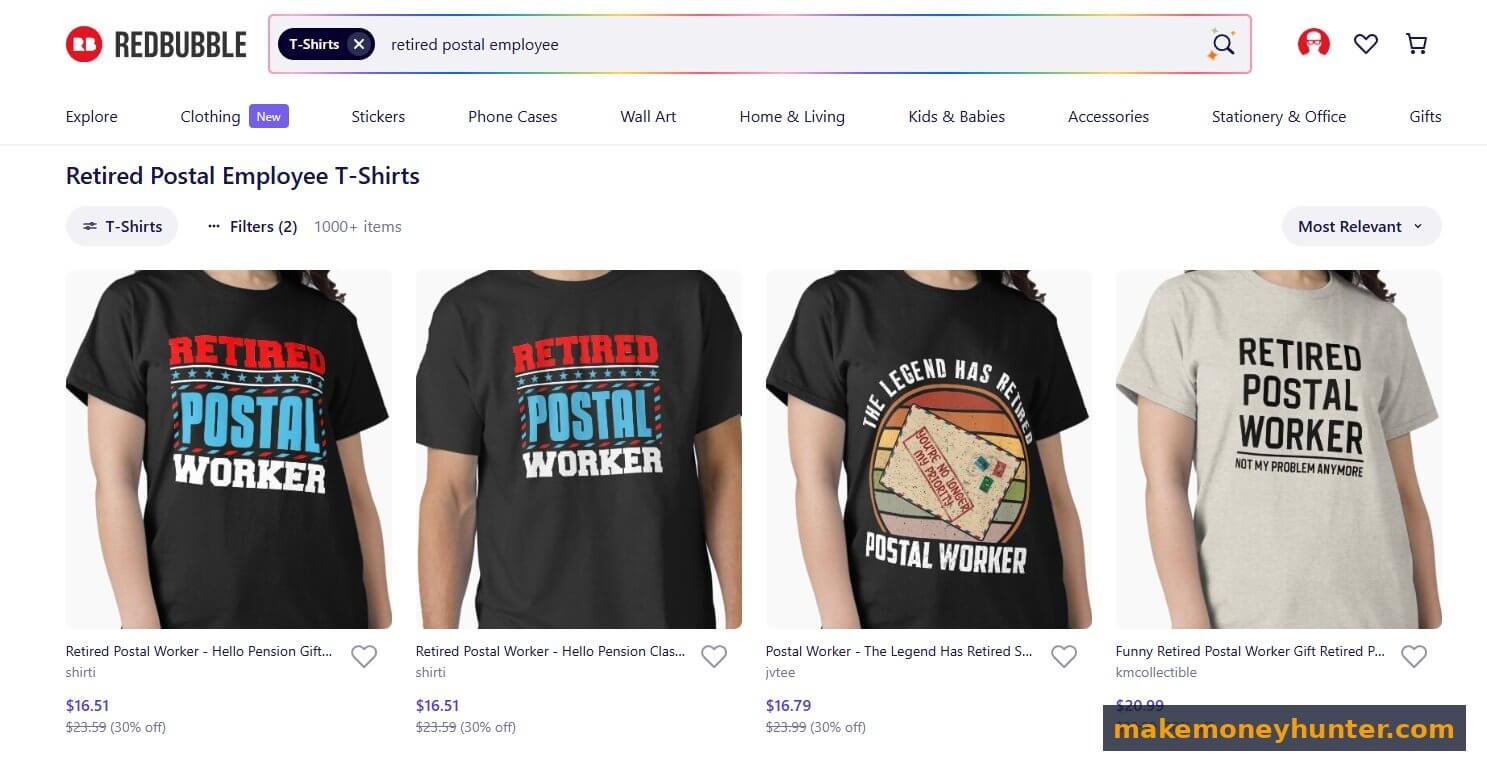
Three things to notice here: the audience size is tiny (retired postal workers, not “everyone”), the designs all hit one specific emotional beat (relief, humor, pension life), and they sell at $16-20 with 30% discounts running. That’s $5-12 net per shirt after the platform fee — exactly the margin you’ll need to work backward from when planning your store.
Realistic path to $1,000:
- Month 1: Pick a niche (not “funny shirts” — “shirts for retired postal workers”). Research what’s already selling on Etsy.
- Month 2-3: Upload 50-100 designs. Use Canva or hire a designer from Fiverr at $5-15 a design.
- Month 4-6: Analyze which designs sell. Make 20 more in that direction. Cut the dead ones.
What eats into the $1,000: Platform fees (Etsy takes ~10% in transaction + listing fees), design costs if outsourced, and ads if you run them. Margin per shirt is usually $5-12. To clear $1,000, you need to sell 100-150 shirts a month. Real take-home: ~$750-900.
If you want to go deeper on Etsy specifically — which is where most beginners get their first POD sales — I’ve written a full guide to making money on Etsy with niche products that walks through listing optimization and pricing.
4. Affiliate Marketing via a Niche Blog (6-12 Months to $1,000/Month)
This is the one I personally rebuilt my income with. It’s the slowest of the 8 to start paying, but it’s also the most genuinely passive once it works. You write articles that rank in Google for buying-intent keywords (“best X for Y”), recommend products with affiliate links, and earn commission when readers buy.
The math is harsh in months 1-6 and beautiful in months 9-18. In month 1, your site gets maybe 50 visitors and earns $0. In month 9, mine hit $1,047. By month 18 it was $4,200. The leverage compounds because old articles keep earning while you write new ones.
What does an article like this actually look like once it’s earning? It’s almost always a hosting review, software comparison, or “best X for Y” post — with a clearly placed affiliate CTA button after enough genuine value has been delivered:
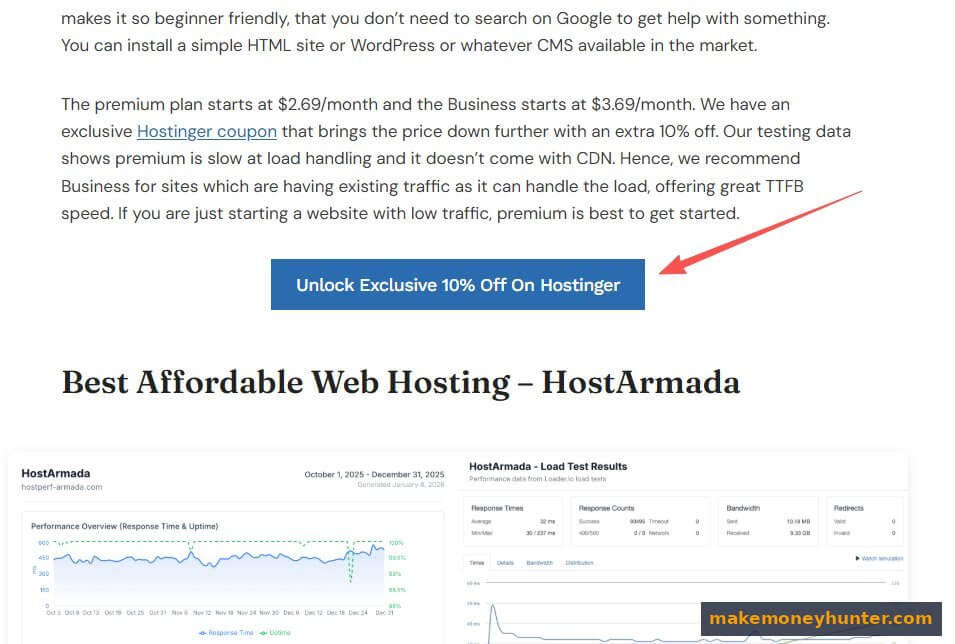
That CTA button isn’t random. It appears after the author has explained pricing, recommended a specific plan, and given a real reason to choose one option over another. The “10% off” hook works because the affiliate link includes a tracked coupon — the reader saves money, the author earns commission, and the host gets a sale. Three-way win, no manipulation needed. This is the kind of article you’re trying to write 20-30 of in your first 6 months.
Realistic path to $1,000:
- Month 1-2: Pick a niche where products have decent commission (web hosting, software, courses, finance tools — all $50-200+ per sale).
- Month 2-4: Write 20-30 articles targeting low-competition keywords (KD under 20).
- Month 4-8: Google starts ranking your articles. Traffic trickles in. First $50 month happens around month 5-7 for most.
- Month 9-12: If your keyword research was solid, you cross $1,000.
What eats into the $1,000: Hosting ($10-30/month), domain ($12/year), maybe a keyword tool ($30-100/month if you don’t use free alternatives). Real take-home: ~$850-950.
The honest catch: 80% of people quit before month 6 because the income stays at $0-$50 for what feels like forever. The ones who push through past month 8 almost always hit $1,000 eventually — but you have to be okay with delayed gratification. If you’re considering this path, my step-by-step affiliate marketing for beginners walkthrough covers niche selection and your first 90 days in detail.
5. Selling Digital Products (3-9 Months to $1,000/Month)
Templates, ebooks, Notion templates, Lightroom presets, courses, printables, spreadsheet tools — anything you build once and sell repeatedly. Platforms like Gumroad, Etsy, or your own site handle the delivery.
The killer advantage: near-zero marginal cost. Selling 100 copies of a $10 Notion template takes the same effort as selling 10 copies. The challenge is that you need an audience or a traffic source — digital products don’t sell themselves.
To get a sense of the volume that’s actually moving on these platforms, look at one specific product category — Lightroom presets on Etsy. The screenshot below shows over 5,500 active listings, with bestsellers carrying 1,800+ five-star reviews:
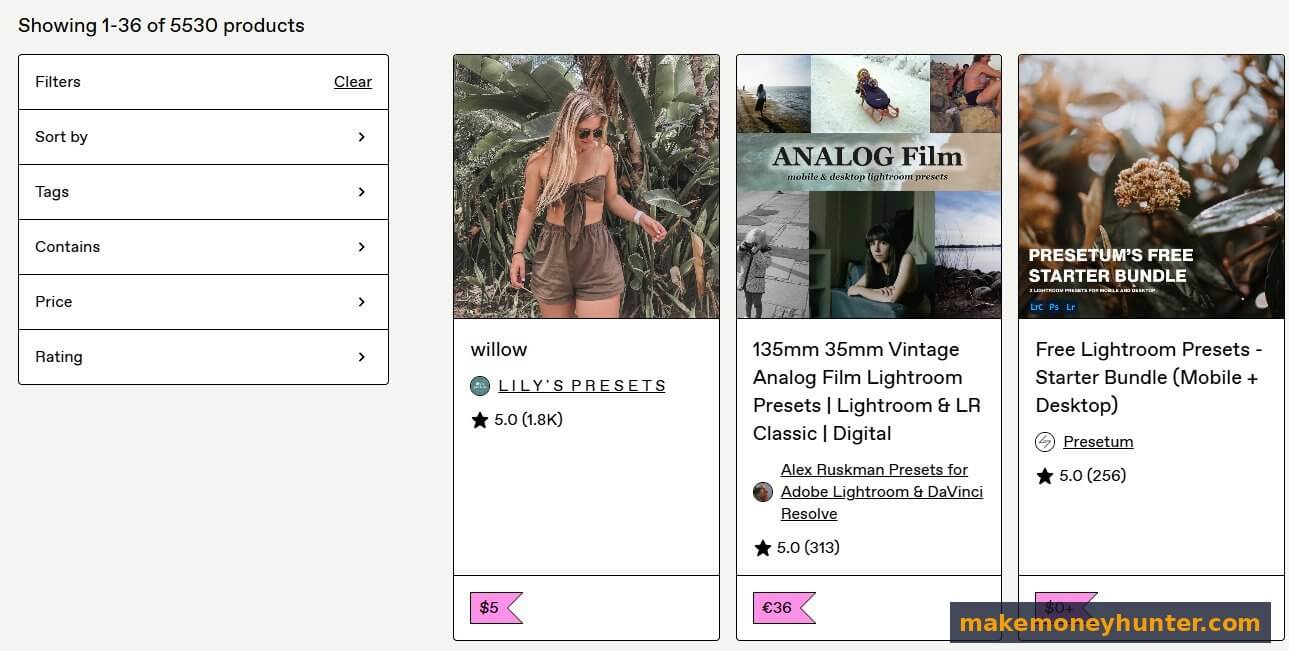
Pricing tells the story: presets sell at $5, bundles at €36, and “free starter bundle” lead magnets feed paid upgrades. That last one is the real secret — successful digital product sellers almost never rely on a single $10 product. They build a ladder: a free or $5 entry point, a $20-40 main offer, and a $100+ premium bundle for the customers who already love the cheap stuff.
Real-world example: An Etsy seller I follow makes about $1,800/month selling wedding planning printables at $9 each. That’s 200 sales/month, driven mostly by Etsy SEO and Pinterest. She spent 3 months building the catalog and 2 more months tweaking listings before she crossed $1,000.
What eats into the $1,000: Platform fees (Gumroad 10% + payment processing, Etsy similar), refunds (1-3% of revenue), and the time to make customer support sustainable. Real take-home: ~$800-900.
The honest catch: Customers expect updates, support, and improvements. A digital product is rarely truly “finished” — it’s an ongoing micro-business. If you’re weighing this against other passive paths, my broader list of passive income ideas compares the timelines and effort curves side by side.
6. Tutoring & Online Teaching (6-10 Weeks to $1,000/Month)
If you know a subject well enough to teach it — math, English as a second language, music, test prep, coding, design — you can tutor 1-on-1 or in small groups via Wyzant, Preply, Outschool, or directly through your own network.
Rates range from $20-100/hour depending on subject and credentials. SAT prep and test prep tutors often charge $75+/hour. To hit $1,000/month at $50/hour, you need 20 billable hours — about 5 hours a week.
Realistic path to $1,000: List on 2-3 platforms simultaneously. Build a profile, ask for reviews from your first 2-3 free sessions, and price competitively until you have 5+ reviews. Most tutors I know hit consistent $1,000/month around week 8-10.
What eats into the $1,000: Platform commission (Wyzant takes ~25%, Preply takes 18-33%). If you can find direct clients via Facebook groups or local schools, you skip the cut. Real take-home: ~$700-1,000.
7. Dog Walking, House Sitting & Pet Care (4-6 Weeks to $1,000/Month)
The most underrated entry on this list. Rover, Wag, and direct neighborhood gigs pay well, the demand is enormous, and the barrier to entry is essentially zero.
Numbers from a Rover sitter I know in suburban Atlanta: $25-40 per dog walk (30 min), $50-80 per night for overnight pet sitting. She does 4-5 walks per weekday and 2-3 overnights per month. Hits about $1,400-1,800/month.
What eats into the $1,000: Rover takes 15-25%. Direct clients are 100% yours but require trust-building. Real take-home: ~$750-900 on Rover, much higher direct.
The honest catch: This is true active income. You can’t scale without hiring — and at that point you’re running a small business, not a side hustle.
8. Faceless YouTube / Niche Content Channels (8-14 Months to $1,000/Month)
YouTube channels in niches like personal finance, productivity, history, or AI tutorials can hit $1,000/month from AdSense + affiliate revenue once they cross about 30,000-50,000 monthly views. “Faceless” channels (voiceover + stock footage + scripted content) are increasingly popular because AI tools have lowered the production cost dramatically.
Here’s a real example of what a faceless channel in the AI niche looks like once it’s working — 17.4K subscribers, 250K+ views on a single tutorial, monetized through ad revenue plus a Discord community funnel:
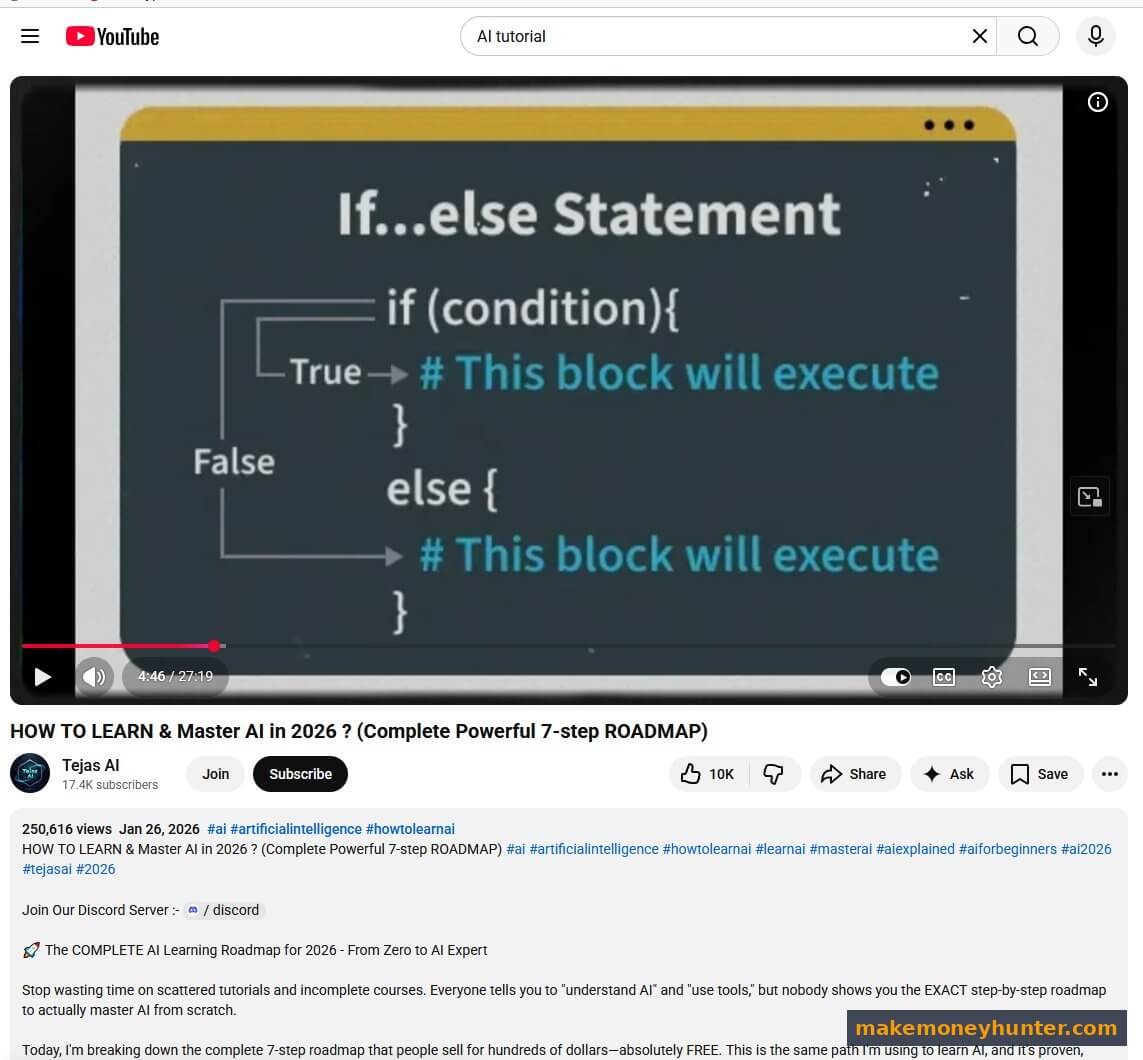
Look at the title formula: “HOW TO LEARN & Master AI in 2026? (Complete Powerful 7-step ROADMAP)”. It hits every YouTube SEO signal — a question, a year, a specific number, and a promise of completeness. The hashtag stack (#ai #aiforbeginners #ai2026) covers both broad and niche search terms. And the description opens with a pain hook (“Stop wasting time on scattered tutorials”). None of this is accidental — it’s the YouTube playbook every faceless channel uses once they figure out what works.
The slow part: YouTube monetization requires 1,000 subscribers and 4,000 watch hours. Most channels take 6-12 months to clear that bar, then another 2-4 months to grow into $1,000/month range.
What eats into the $1,000: AI tools ($20-60/month for voiceover, stock footage, editing software), occasional outsourced editing. Real take-home: ~$800-900.
The honest catch: 90% of channels never reach monetization. The ones that do almost always pick a sharp niche (not “personal finance” — “personal finance for software engineers”) and post consistently for at least 6 months before seeing real traction.
How to Choose the Right Side Hustle for You
Here’s the decision tree I’d use if I were starting fresh today.
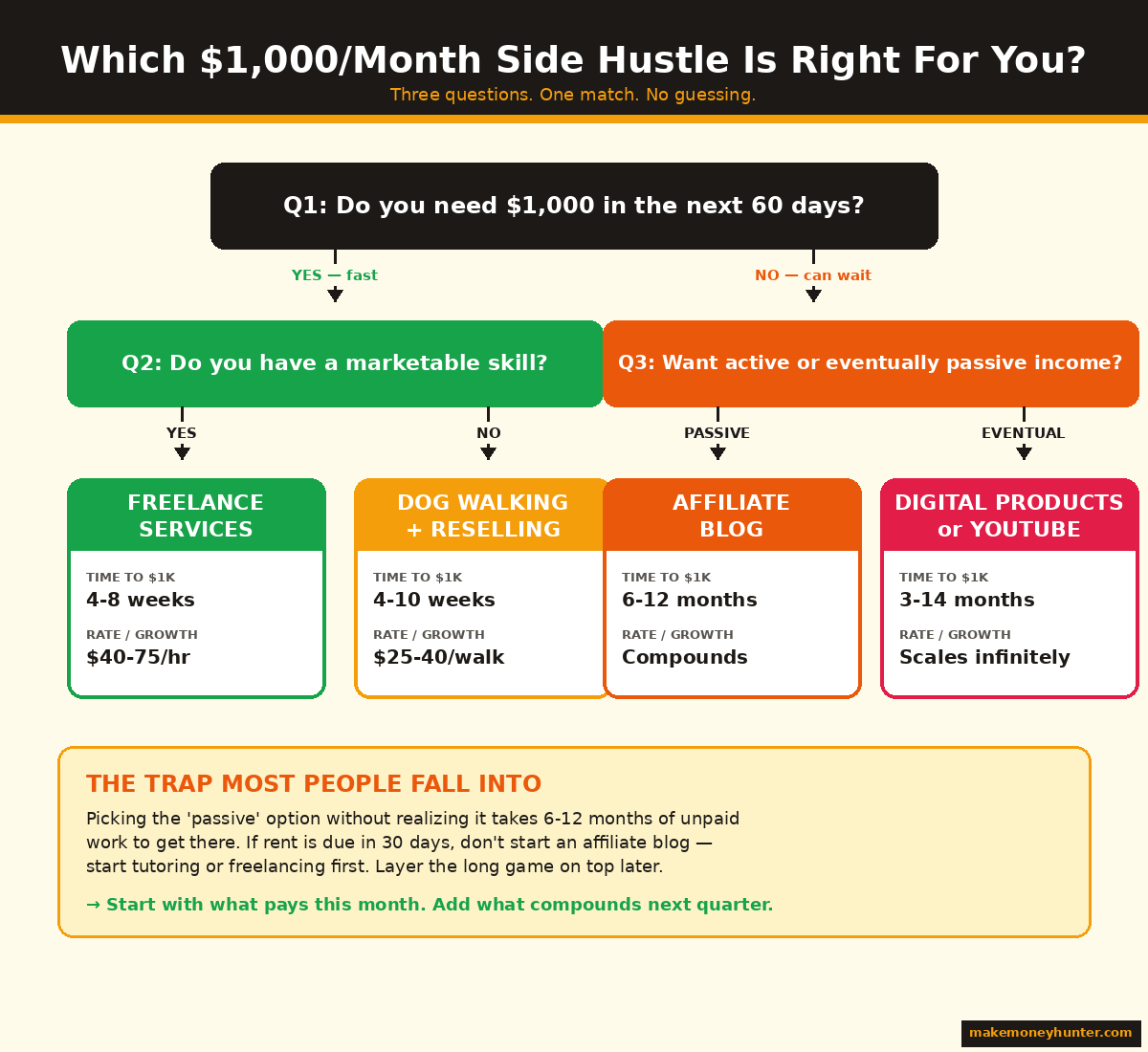
Question 1: Do you need $1,000 in the next 60 days, or can you wait 6+ months?
- Need it fast → Freelance services, tutoring, dog walking, or reselling. These all have proven 4-12 week paths.
- Can wait → Affiliate blog, digital products, or YouTube. Higher ceilings, more leverage long-term.
Question 2: Do you have a marketable skill already?
- Yes → Freelancing is the obvious lever. You’ll earn more, faster.
- Not really → Reselling or dog walking require almost no upfront skill, just consistency.
Question 3: Do you want active income or passive income?
- Active is fine → Freelancing, tutoring, pet care, reselling.
- Want eventual passive → Affiliate blog, digital products, YouTube. These all hurt in the early months but pay you while you sleep eventually.
The trap most people fall into is picking the “passive” option without realizing it takes 6-12 months of unpaid work to get there. If you have rent due in 30 days, don’t start an affiliate blog. Start tutoring. You can always layer the long-term play on top once your bills are covered. If you want a more targeted breakdown by audience, my list of the best side hustles for men goes deeper on the active-income paths that fit a 9-to-5 schedule.
The Mistakes That Cost Me 18 Months
When I rebuilt my income after my 2018 layoff, I made every mistake on this list. So here’s what I wish someone had told me.
Mistake 1: Chasing multiple side hustles at once. In my first 6 months I tried affiliate marketing, dropshipping, freelance writing, and a Shopify store simultaneously. Net income: about $310 across all four. When I dropped 3 and put 100% of my time into affiliate marketing, I crossed $1,000/month within 4 months. Focus beats variety every time.
Mistake 2: Treating it like a hobby instead of a business. If you “work on it when you feel like it,” it’ll pay you when it feels like it — which is usually never. Block calendar time. Treat the side hustle as a non-negotiable appointment for 6-10 hours a week minimum.
Mistake 3: Refusing to charge real rates. My first freelance client paid me $35 for an article that took me 4 hours. I was charging $8.75/hour while telling myself I was “building a portfolio.” Just charge a real rate from the start. Confidence comes from results, not from waiting for permission.
Mistake 4: Ignoring SEO and audience-building for years. The side hustles that compound (affiliate blogs, YouTube, digital products) compound because of accumulating traffic. Every week you delay starting is a week your future self doesn’t have. If you’re going the content route, my on-page SEO checklist for new bloggers walks through the exact pre-publish workflow that cut my time-to-rank in half.
The Tools That Actually Matter
You don’t need a fancy stack. Here’s the minimum to get to $1,000/month in any of these categories:
- A simple website (for freelance, affiliate, or digital products): A WordPress site on a budget host runs $3-10/month. Check our breakdown of the best hosting options for beginners (affiliate) if you’re starting from scratch.
- One accounting tool: Wave (free) or QuickBooks Self-Employed ($15/month). Track expenses from day one — your future self filing taxes will thank you.
- One marketing channel, not five. Pinterest if you sell digital products. LinkedIn if you sell services. SEO if you write content. Pick one and go deep before adding a second.
- A spreadsheet for income tracking, not an app. Anything that makes you look at your weekly numbers will outperform a fancy dashboard you never check.
The people I see waste the most money are the ones who buy 6 courses and 4 tools before they make their first dollar. Buy nothing until you’ve made your first $100 in the niche. If a blog is part of your plan, my full breakdown of how to actually make money blogging lays out the monetization sequence in the order you should attack it.
FAQ: How to Make $1,000 a Month with a Side Hustle
How realistic is making $1,000 a month from a side hustle in 2026?
Very realistic, but the timeline is what most people get wrong. Active service hustles (freelancing, tutoring, dog walking) can clear $1,000/month within 6-10 weeks with consistent effort. Passive income hustles (blogs, YouTube, digital products) usually take 6-12 months. The income itself is real and sustainable — what kills most people is quitting before the path matures.
What’s the easiest side hustle to make $1,000 a month?
For most people, freelance services or dog walking. Both require near-zero upfront investment, have proven demand, and pay reasonable hourly rates ($25-75/hour range). The “easy” side hustle is the one that matches a skill or asset you already have — not the one that looks easiest from the outside.
How many hours per week do I need to hit $1,000 a month?
For service-based hustles, about 6-15 hours/week depending on your hourly rate. For content businesses (blogs, YouTube), expect 10-15 hours/week for 6-12 months before income matches that effort. Total time invested is similar in the end — the difference is when you get paid.
What side hustle has the lowest startup cost to reach $1,000 a month?
Dog walking and freelance services tie for lowest startup cost — under $50 to get going. Reselling can be done for under $100 if you start with items you already own. Affiliate blogging needs about $100-200 in year one (hosting, domain, a basic keyword tool).
Can I make $1,000 a month from a side hustle while working full-time?
Yes, and most people in these categories are doing exactly that. The key is treating your side hustle as a non-negotiable calendar block (early mornings, evenings, or one full weekend day), not “if I have time.” 8-12 focused hours a week is enough for most paths above.
Final Thoughts
When I crossed $1,000/month for the first time, I made $1,047. Eighteen months later it was $4,200. Three years later it was something I don’t even like to mention because it sounds like a brag. The only difference between month 9 and month 1 was consistency — same person, same hours, just more accumulated work behind me.
Pick one method from the list above. Not three. Not the one your friend swears by. The one that matches your timeline and current skill set. Then put 6-10 hours a week into it for the full duration of its honest timeline. If you do that, you’ll hit $1,000/month — and once you do, you’ll never wonder again whether this stuff actually works.