

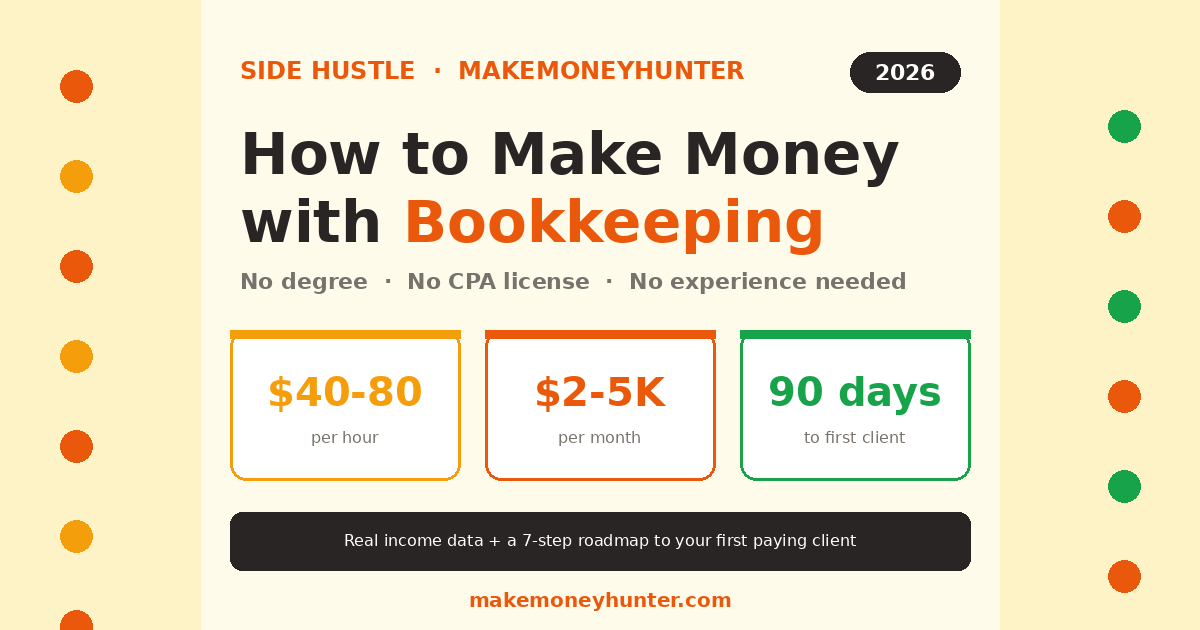
The freelance bookkeepers I’ve researched are quietly charging $40–$80 an hour while everyone else chases trendy side hustles. No degree. No CPA license. No expensive software stack. Just one laptop, one specialized skill, and a small list of recurring clients who’d rather pay someone else than wrestle with QuickBooks at 11 p.m.
If you can balance a checkbook and you’re not afraid of spreadsheets, you can realistically build a $2,000–$5,000/month bookkeeping side hustle within 6–12 months. The math works because every small business in the U.S. is legally required to keep accurate books — and roughly 82% of them outsource the work instead of doing it themselves.
This guide walks you through the exact path: what bookkeeping actually is, how much you can earn at each skill level, the 7 steps to land your first paying client within 90 days, and the rookie mistakes that kept me from raising my rates for an extra year longer than I should have.
What Is Bookkeeping, Really?
Bookkeeping is the day-to-day recording of a business’s financial transactions — sales, expenses, payroll, bank reconciliations, invoices. It’s not the same as accounting, even though most people use the words interchangeably.
Here’s the difference in plain English:
- Bookkeepers record what happens. They categorize transactions, reconcile bank statements, send invoices, and produce monthly financial reports.
- Accountants interpret what happened. They file taxes, advise on tax strategy, and sign off on audited financials.
You don’t need a CPA license to be a bookkeeper. You don’t need a degree. In the U.S. and Canada, there are no required certifications to legally offer bookkeeping services. What you do need is competence — and the willingness to be more organized than the small business owners hiring you.
That last part is the entire opportunity. Most freelancers, Etsy sellers, contractors, and solo founders are objectively terrible at keeping their books clean. They miss receipts. They mix personal and business expenses. They wait until tax season to look at their numbers. You become the person who fixes that mess — for a monthly retainer.
How Much Money Can You Make with Bookkeeping?
Real numbers, based on industry data and a survey of working freelance bookkeepers in 2025:
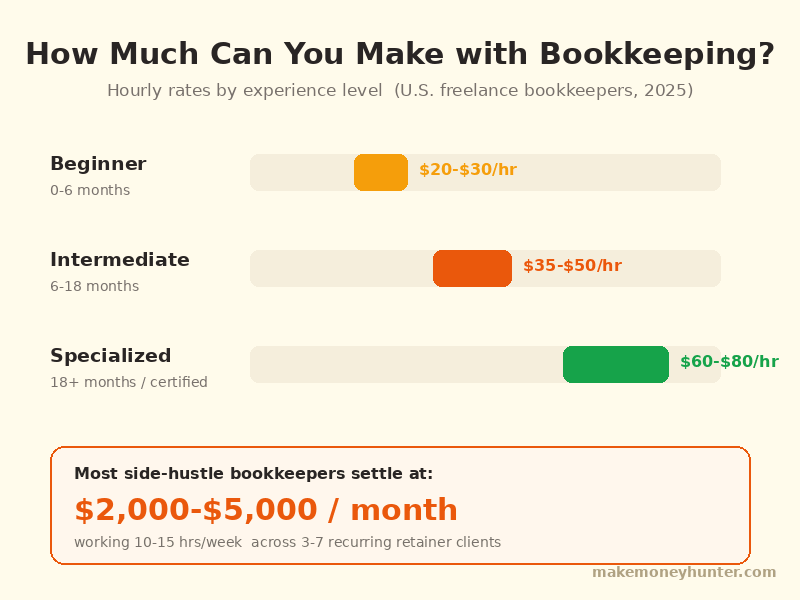
- Beginner (0–6 months): $20–$30/hour. Basic transaction categorization and bank reconciliations for very small clients.
- Intermediate (6–18 months): $35–$50/hour. Multiple clients, monthly reporting, light cleanup work.
- Specialized/certified (18+ months): $60–$80/hour. Niche expertise (e-commerce, real estate, restaurants) or advanced services like payroll and tax prep.
- Bookkeeping firm owner: $100K–$300K/year. Multiple bookkeepers under you, retainer-based clients, you sell systems instead of hours.
Most side-hustle bookkeepers settle into a comfortable $2,000–$5,000/month range working 10–15 hours per week — usually 3–7 retainer clients paying $300–$800/month each.
Here’s what makes the math attractive compared to other online side hustles: bookkeeping income is recurring. Every client pays you every month for the same work. You don’t have to constantly find new customers. Compare that to freelance writing, where a $2,000 client this month might be a $0 client next month.
What Do Bookkeepers Actually Charge? (Real Marketplace Data)
The hourly rates I gave you above aren’t theoretical. Take a look at what bookkeepers are charging right now on freelance marketplaces like Fiverr:
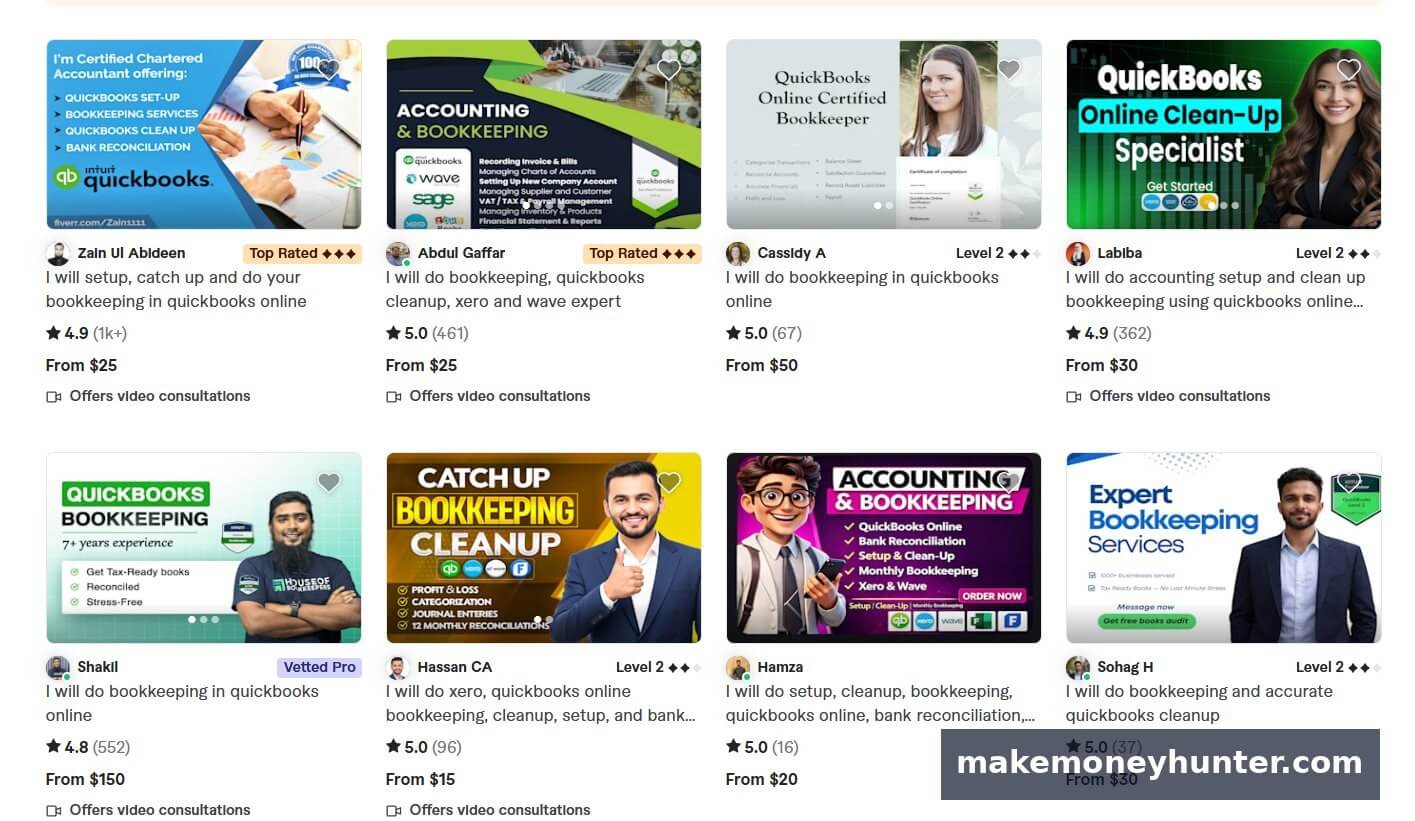
Notice the spread. Entry-level gigs start as low as $15–$30, while bookkeepers who position themselves as “Top Rated” or specialists charge $50, $150, and up. Same skill. Wildly different pricing. The difference isn’t the credential — it’s the positioning, the niche, and the reviews.
This is also a warning. Marketplace platforms are a brutal race to the bottom for beginners. They’re useful for getting your first two or three reviews, but the real money in bookkeeping is in direct retainer clients you find yourself — not in underbidding strangers on a gig platform. Use Fiverr or Upwork as a stepping stone, not a destination.
Do You Need a Degree or Certification?
Short answer: no degree required. Certification is optional but worth it.
You don’t need accounting credentials to charge professional rates. Clients pay for clean, accurate books — not for letters after your name. That said, certifications help in two ways: they accelerate your learning curve, and they give you credibility to charge higher rates faster.
The certifications worth considering in 2026:
- QuickBooks Online ProAdvisor — Free. Run by Intuit. Gets you listed in their directory where small businesses search for bookkeepers. This is the highest-ROI free credential I’d recommend starting with.
- Bookkeeper Launch (by Ben Robinson) — Paid course. Goes beyond the technical skills to teach you the business side: pricing, finding clients, scaling to 6 figures. The most respected program in the side hustle bookkeeper community.
- Certified Bookkeeper (AIPB) or Certified Public Bookkeeper (NACPB) — Formal industry credentials. Useful if you eventually want to take on larger clients or move into accounting firm work.
If you want a structured program that handles both the technical training and the business setup, Bookkeeper Launch is the best-known option. Here’s what their flagship course positioning looks like:
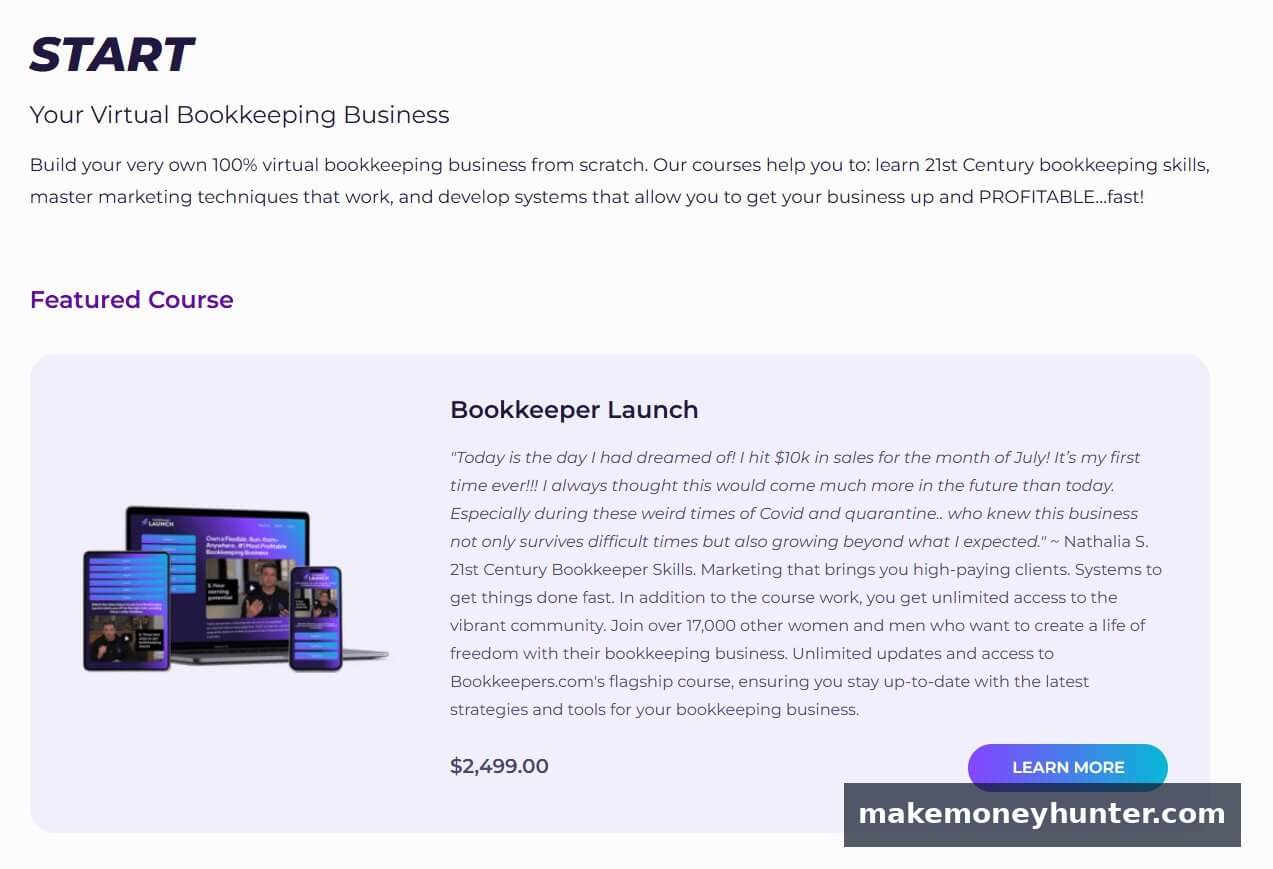
The course runs around $2,000–$2,500 — not cheap. Whether it’s worth it depends entirely on you. If you’re disciplined enough to learn from free resources and figure out the business side yourself, you can absolutely skip it. If you want a done-for-you curriculum and a community of 17,000+ other people building the same thing, it shortens the path. Either way, don’t let “I need to buy the course first” become your excuse not to start. Plenty of working bookkeepers learned entirely for free.
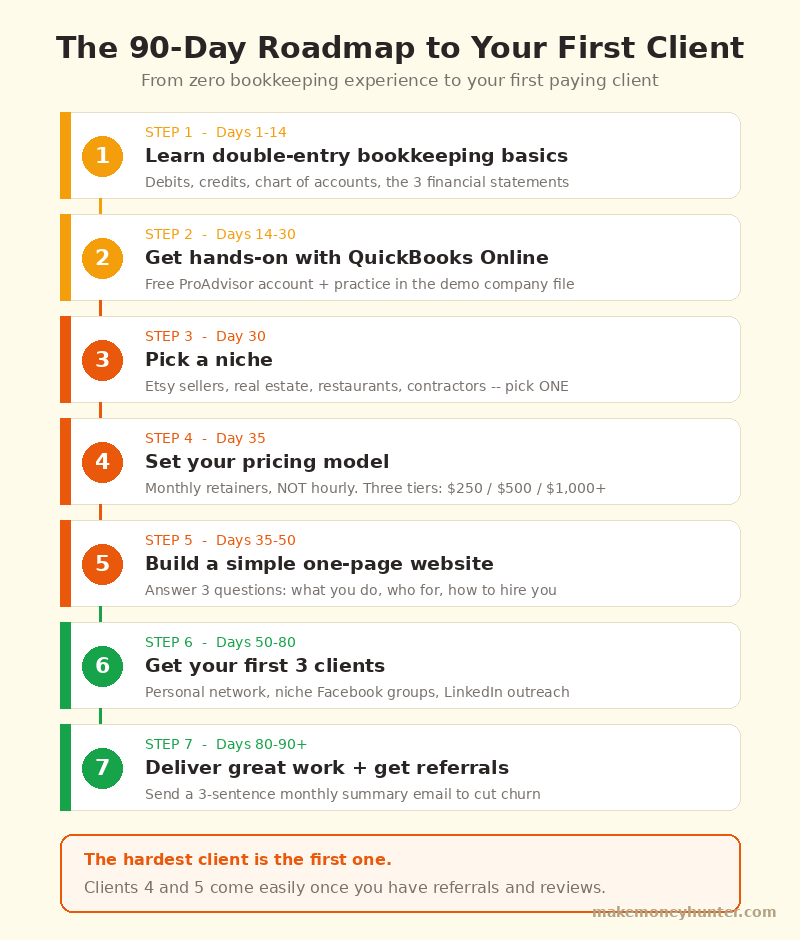
The 7-Step Roadmap from Zero to Your First Paying Client (Within 90 Days)
Most “how to start a bookkeeping business” guides skip the part you actually care about: how do you get your first client when nobody knows you exist? Here’s the realistic path, based on what’s actually working for beginners in 2025–2026. If you’ve been browsing other side hustle options and keep coming back to bookkeeping, this is the part that turns it from idea into income.
Step 1: Learn Double-Entry Bookkeeping Basics (Days 1–14)
You need to understand debits and credits, the chart of accounts, the difference between cash-basis and accrual-basis accounting, and how the three financial statements (income statement, balance sheet, cash flow statement) connect.
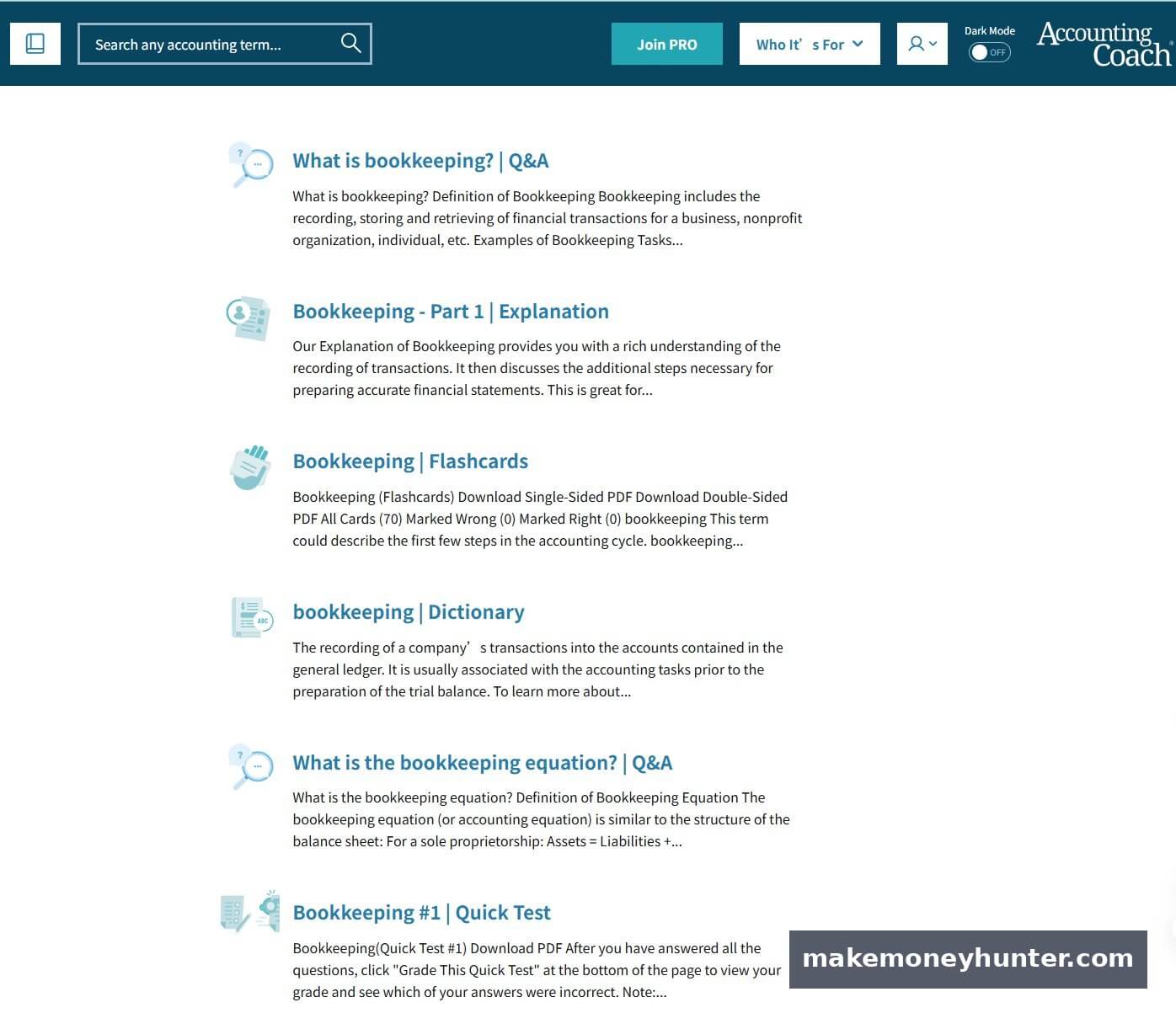
You don’t need to pay for this. One of the best free resources is AccountingCoach — a genuinely comprehensive, well-organized course that covers the fundamentals without trying to upsell you at every turn:
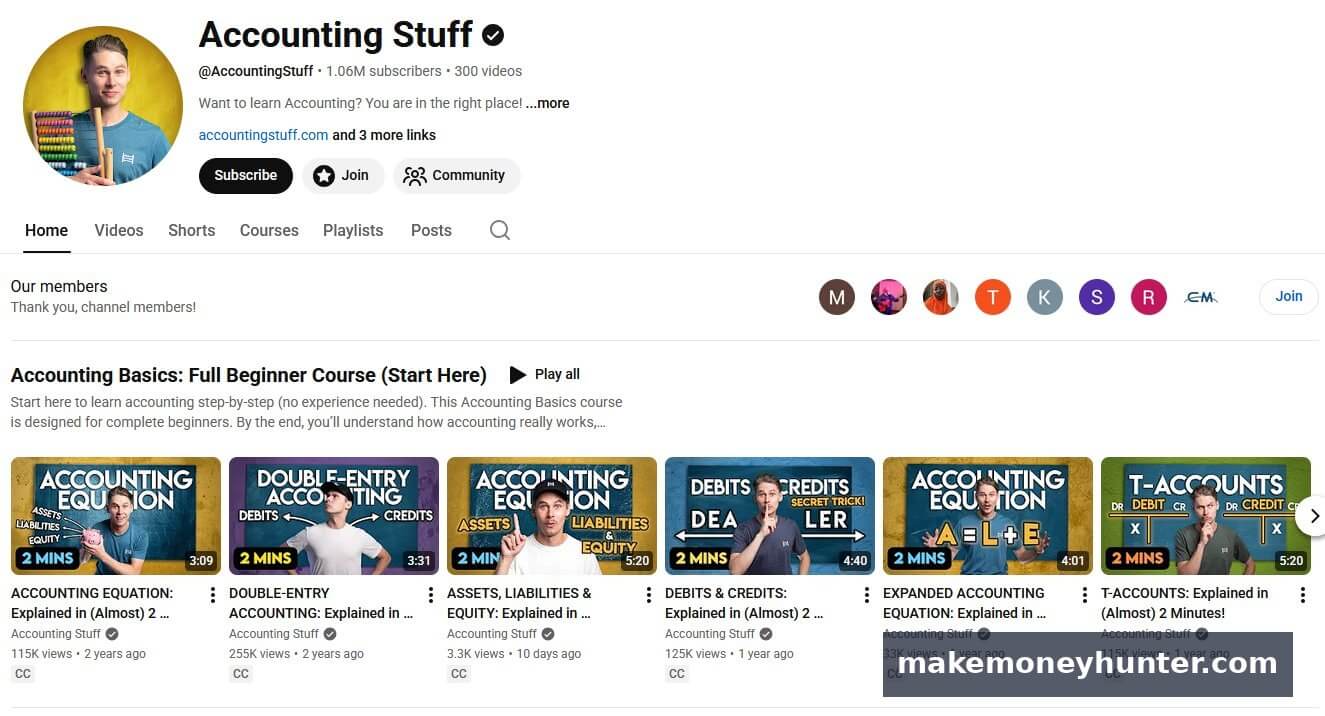
If you learn better from video, the YouTube channel “Accounting Stuff” is another free, beginner-friendly option. It has over a million subscribers and a full beginner course built specifically for people with zero accounting background:
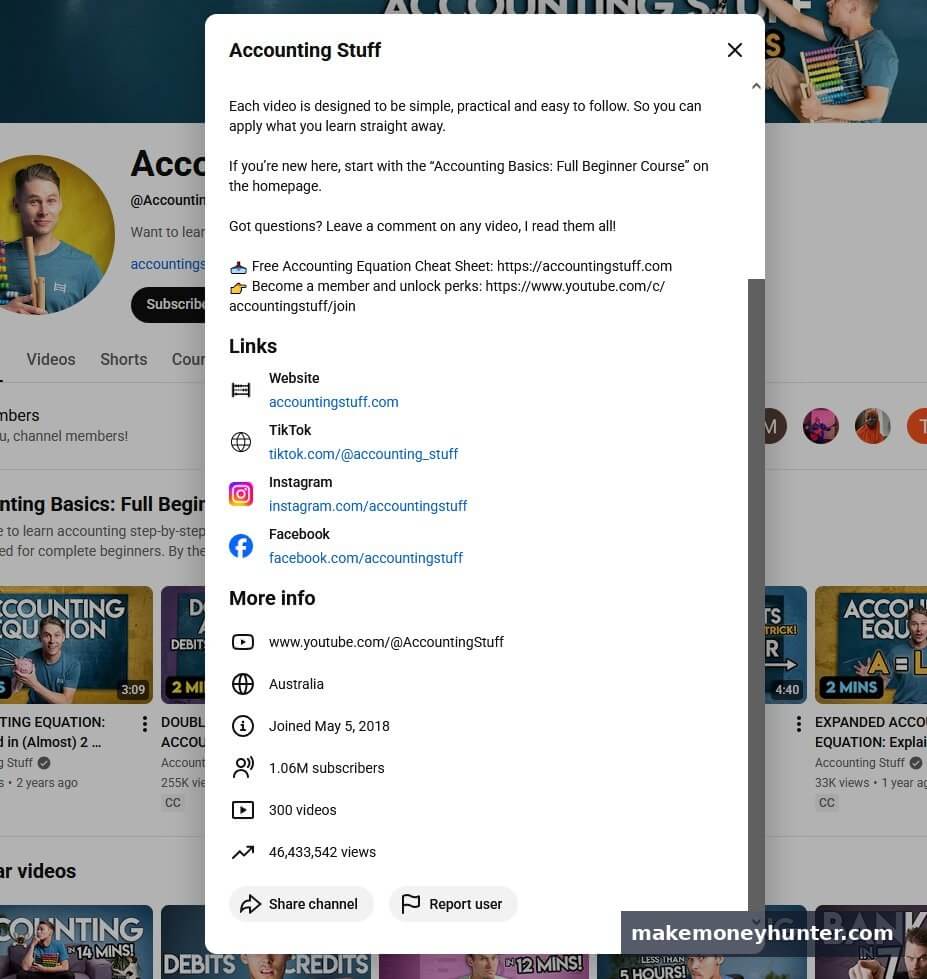
What makes it work for total beginners is the format — short, practical videos you can apply right away. The channel openly tells new viewers exactly where to start:
Don’t get stuck here. You don’t need to master everything before moving on. You need enough to confidently handle a 20-transaction-per-month sole proprietor.
Step 2: Get Hands-On with QuickBooks Online (Days 14–30)
QuickBooks Online owns about 80% of the small business bookkeeping software market. If you only learn one tool, learn this one. You can also pick up FreshBooks as a secondary option for service-based freelance clients who prefer it for simpler invoicing.
Sign up for a free QuickBooks ProAdvisor account. It gives you access to:
- Free training and certification exam
- A demo company file where you can practice without risk
- Listing in the QuickBooks Find-a-ProAdvisor directory (real clients actually search there)
- Discounted subscriptions you can pass to your clients
Spend two weeks practicing in the demo file. Add transactions. Run reconciliations. Generate reports. Make mistakes. The goal is to feel comfortable navigating the software before a real client’s money is involved.
Step 3: Pick a Niche (Day 30)
This is where most beginner bookkeepers go wrong. They market themselves as “bookkeeping for anyone” and stay invisible. Pick a specific type of client and become known for that niche.
High-demand niches in 2026 where small businesses actively need bookkeepers:
- Etsy and Shopify e-commerce sellers
- Real estate agents and small property investors
- Restaurants and food trucks
- Construction contractors and trades
- Therapists, coaches, and other solo professionals
- YouTubers, course creators, and content creators
- Law firms and small medical practices
Which niche should you pick? Follow the demand. Here’s a useful trick: marketplace search data tells you where people are actively looking for help. On Etsy alone, “bookkeeping” pulls hundreds of monthly searches from sellers who need their numbers sorted:
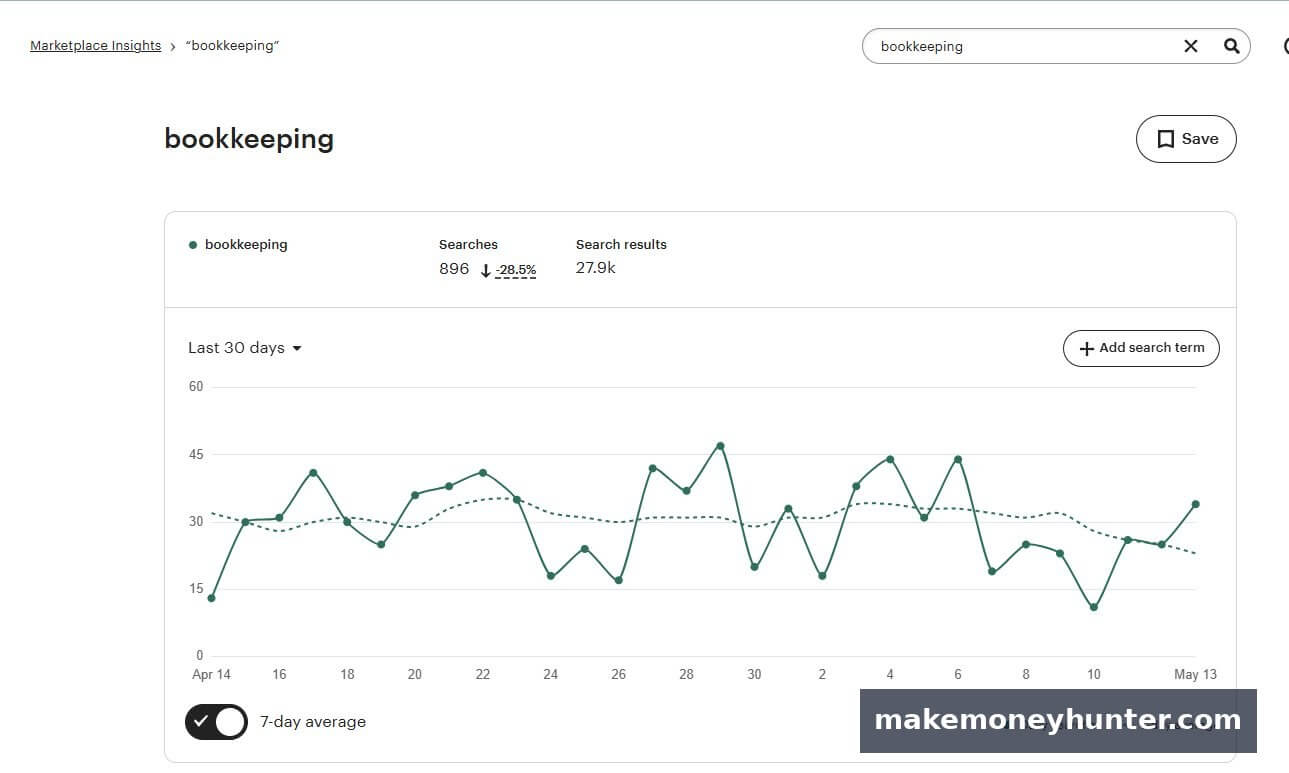
That’s nearly 900 searches a month on a single platform — and Etsy sellers are notorious for messy books because they’re juggling materials costs, platform fees, shipping, and sales tax. A bookkeeper who specializes in Etsy sellers walks into a niche with built-in demand and a clear, repeatable problem to solve. If e-commerce isn’t your thing, you can find similar demand signals in whatever niche you’re considering — the point is to pick one, even if it feels limiting. A niche bookkeeper charging $500/month per client beats a generalist charging $200/month, because the niche bookkeeper learns the specific tax quirks, the typical chart of accounts, and the platform integrations that matter for that industry.
Step 4: Set Your Pricing Model (Day 35)
Don’t charge hourly. I’ll say it again because it’s the single biggest mistake new bookkeepers make: don’t charge hourly.
Hourly pricing caps your income and punishes you for getting faster. A bookkeeper who takes 8 hours to do a job earns more than one who takes 3 hours — even though the faster bookkeeper is clearly more skilled. That’s backwards.
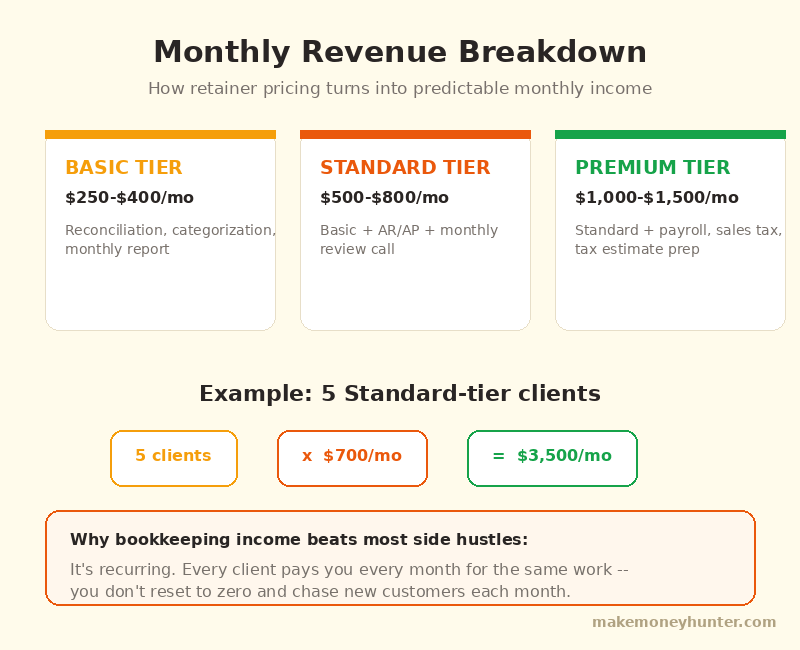
Use monthly retainer pricing instead. A typical structure that works for beginners:
- Basic Tier — $250–$400/month: Bank and credit card reconciliation, transaction categorization, monthly financial report. Up to 100 transactions/month.
- Standard Tier — $500–$800/month: Everything in Basic + accounts receivable/payable, monthly review call with the client. Up to 300 transactions/month.
- Premium Tier — $1,000–$1,500/month: Everything in Standard + payroll, sales tax filing, quarterly tax estimate prep. Up to 500 transactions/month.
This pricing serves a real freelancer or microbusiness without giving away your time. With 5 Standard-tier clients, you’re at $3,500/month working roughly 12 hours per week.
Step 5: Build a Simple Website and One-Page Service Description (Days 35–50)
You don’t need a fancy website. You need a one-page site that answers three questions a potential client has:
- What exactly do you do?
- Who do you do it for?
- How do they hire you?
Headline example for a niche bookkeeper: “Clean Books for Etsy Sellers — So You Can Focus on Your Shop, Not Your Spreadsheets.”
Below that: a short description of your packages, one or two screenshots of sample reports you’d deliver, and a contact button. That’s it. Done in a weekend.
If you don’t want to build a site yet, even a polished LinkedIn profile with a clear headline and service description works. Many bookkeepers I’ve researched got their first 3 clients without a website at all.
Step 6: Get Your First 3 Clients (Days 50–80)
The hardest client is the first one. The 4th and 5th are easy once you have referrals. Here’s where first-time bookkeepers actually find paying clients:
- Your personal network. Tell 30 people that you’re now offering bookkeeping services for [your niche]. Ask them to forward your message to anyone who fits. This alone landed many bookkeepers their first 1–2 clients.
- Facebook groups in your niche. If your niche is Etsy sellers, join 5–10 active Etsy seller groups. Don’t pitch. Answer bookkeeping questions when people ask them. Over 60–90 days, you become “the bookkeeping person” in those groups.
- LinkedIn outreach. Identify 50 small business owners in your niche. Send a personalized message that asks one good question about their business — not a sales pitch. Build a real conversation. About 1 in 20 turns into a discovery call.
- QuickBooks Find-a-ProAdvisor. Once you’re certified, your profile is searchable. Small businesses do search there. Optimize the profile with your niche and your photo.
- Freelance marketplaces (lower priority). Useful for getting your first few reviews, but the bidding race is brutal and rates are lower. Better as a stepping stone than a long-term strategy.
Bookkeeping is also one of the better options if you want client work that doesn’t involve a phone headset all day. If that appeals to you, it sits alongside other non-customer-service jobs that pay well without a degree — quiet, focused, and done on your own schedule.
Step 7: Deliver Great Work and Get Referrals (Days 80–90+)
Once you have a client, the single most important thing you do — beyond clean books — is communicate consistently. Send a short monthly summary email: three sentences about what their numbers say. Cash position, profit trend, anything they should know about.
That five-minute habit dramatically reduces client churn. It also turns clients into referrers, because they actually understand the value they’re getting. Most bookkeepers do the work invisibly and then wonder why clients leave.
The Tools You Need (and What to Skip)
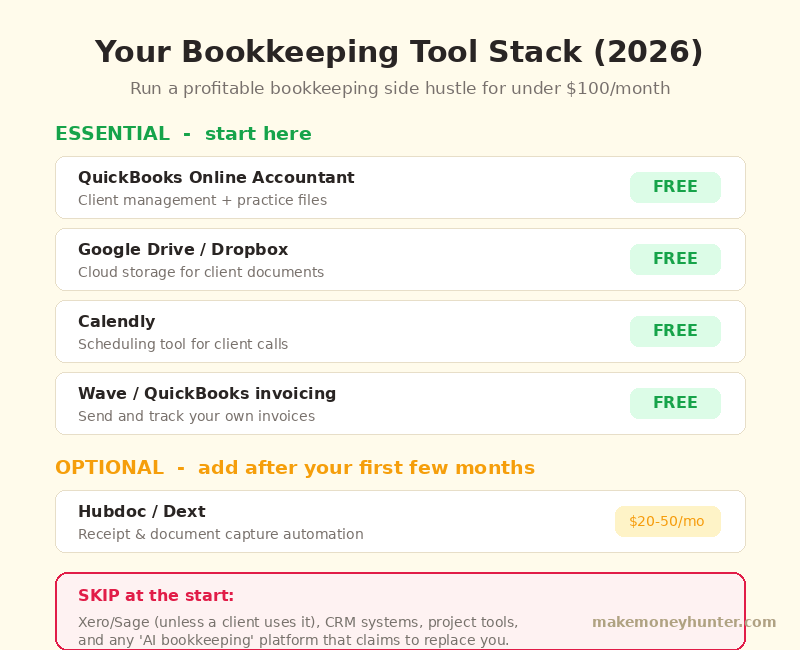
You can run a bookkeeping side hustle with less than $100/month in software. Here’s the essential stack:
- QuickBooks Online Accountant — Free for bookkeepers. Includes practice files plus the ability to manage all your clients’ books from one dashboard. Non-negotiable.
- Cloud storage — Google Drive or Dropbox for client documents. Free tier works fine.
- Hubdoc or Dext — Receipt and document capture. $20–$50/month. Optional in your first few months.
- Calendly — Free scheduling tool for client calls.
- A simple invoicing tool — Either QuickBooks itself or something like Wave (free).
What to skip in the beginning: expensive accounting software like Xero or Sage (only if your client uses it), CRM systems, project management tools, and any “AI bookkeeping” platform claiming to replace you. Lean. Simple. Profitable.
Common Mistakes That Keep Bookkeepers Stuck at $1,000/Month
I want to be honest about this part — partly because I made some of these mistakes by analogy in my own business years ago, before I figured out that the principles apply across service businesses.
Mistake 1: Marketing as “bookkeeping for everyone.” You become invisible. Pick a niche even if it feels uncomfortably narrow.
Mistake 2: Charging by the hour. You cap your income and you punish yourself for getting better. Move to monthly retainers as fast as possible — even with your first client.
Mistake 3: Undercharging because you don’t have a CPA. Clients don’t pay you for your credential. They pay you for clean, accurate, on-time books. A $400/month bookkeeper without certification delivers more value to a $200K/year Etsy seller than a $40/hour generalist working 10 sloppy hours.
Mistake 4: Doing the work but not communicating. The bookkeepers who keep clients longest send a short monthly summary email. Three sentences. Takes five minutes. Reduces churn by an enormous margin.
Mistake 5: Not setting a client cap. Bookkeeping work expands to fill available time. Decide upfront: I will not take more than 8 clients before raising rates or hiring help. Otherwise you end up working 50 hours a week for $4,000/month.
Mistake 6: Trying to do tax returns without proper training. Bookkeeping is unregulated. Tax preparation is regulated and has real liability. Stay in your lane until you’re properly trained and insured.
Pros and Cons of a Bookkeeping Side Hustle
Let me be straight about both sides.
What works:
- Recurring monthly income — you don’t reset to zero each month
- Low startup costs — under $100 to get going
- Remote and flexible — work from anywhere with internet
- Steady demand — every business needs books, regardless of the economy
- Clear path to scaling — solo, then small firm, then sellable business
What’s hard:
- The first client is genuinely difficult to land — most people quit before they do
- Some clients are messy and demanding — you’ll need to fire a few
- Tax season (January–April) can be intense if you do bookkeeping for clients with tax prep needs
- It’s not passive income — you trade time for money until you scale to a firm
- Learning the software has a real learning curve in the first 30–60 days
If you’ve watched 50 YouTube videos about side hustles and you’re still at $0, the issue isn’t motivation — it’s that most “side hustle” content is fluff. Bookkeeping isn’t sexy, but the math works. That’s why it keeps showing up in actual income reports from real working freelancers. It’s also a strong fit if you want something you can run quietly from home — in the same category as the best side hustles for introverts.
Frequently Asked Questions
How long does it take to make money with bookkeeping?
Most people who follow a structured approach land their first paying client within 60–120 days of starting. Hitting $2,000–$3,000/month typically takes 6–12 months of consistent client outreach. The biggest variable is how aggressively you reach out to potential clients in the first 90 days.
Can you do bookkeeping with no experience at all?
Yes, but you need to invest 30–60 hours upfront learning double-entry bookkeeping basics and the core QuickBooks Online workflow. After that initial learning curve, you can handle simple clients while you continue building skills with more complex ones.
Is bookkeeping going to be replaced by AI?
AI tools are automating parts of bookkeeping — transaction categorization, receipt scanning, basic reconciliations. But the human judgment work (catching errors, advising clients, handling exceptions, communicating with the business owner) isn’t going anywhere. Bookkeepers who use AI tools to be more efficient will earn more, not less. Bookkeepers who refuse to learn AI tools will fall behind.
What’s the difference between a bookkeeper and an accountant?
Bookkeepers record financial transactions and produce monthly reports. Accountants interpret those reports, advise on tax strategy, and file tax returns. You can earn a great income as a bookkeeper without being an accountant. Many bookkeepers eventually expand into tax prep, but it’s not required.
How many clients do I need to make $3,000/month?
Roughly 4–6 retainer clients at $500–$800/month each, working about 10–12 hours per week. Or 3 clients at $1,000+/month if you’re delivering Premium-tier services with payroll and tax estimate prep.
Final Thoughts
When I look at the freelance bookkeepers earning $5,000+/month, the pattern is almost embarrassingly simple. They picked a niche. They charged monthly retainers. They sent a three-sentence email to each client every month. That’s roughly the entire playbook.
Start today. Sign up for the free QuickBooks ProAdvisor program, pick your niche this weekend, and tell 30 people in your network what you’re now offering. Twelve months from now, look at your bank statements and see how much $40/hour adds up to when it’s recurring. The number tends to surprise people.