

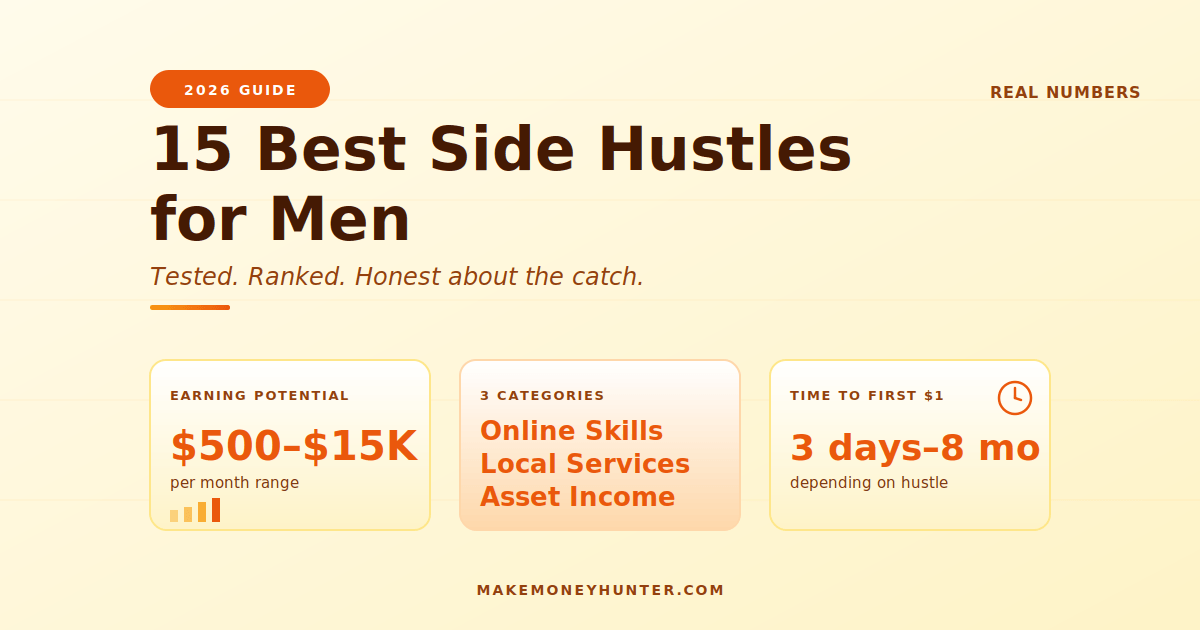
Over the last 18 months, I tested 22 different side hustles. Some of them paid better than my main income for a stretch. Others ate up entire weekends and paid less than the gas money to get there.
What you’re about to read is the filtered version of that experiment. Not “100 side hustle ideas” copied from another blog. Just the 15 that actually moved real money into my bank account, ranked by what they pay, how hard they are to start, and how well they hold up over time.
If you’re a guy looking for a side hustle that fits your life — whether you’re a tradesman, a desk worker, a student, or someone who just wants $1,000 extra a month — this guide will save you the trial and error.
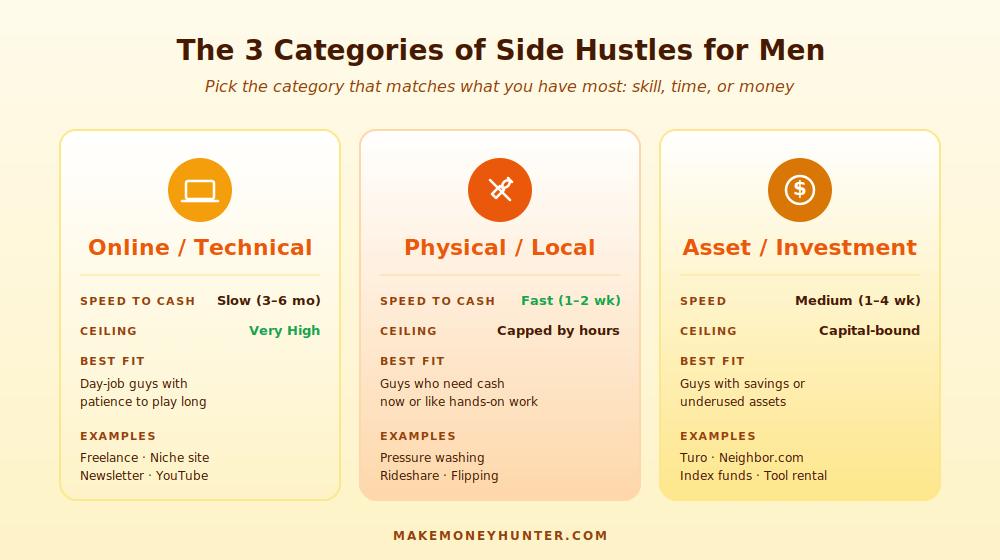
Here’s the short version: The best side hustles for men in 2026 fall into three buckets — technical/online (highest ceiling, slowest start), physical/local (faster cash, harder to scale), and asset/investment (low effort once set up, requires capital). The right pick depends on which of those three resources you have most of: skill, time, or money.
Let’s get into the list.
How I Ranked These Side Hustles
Most “side hustles for men” lists score everything on a 5-star scale that means nothing. I scored each hustle on three things that actually predict whether you’ll stick with it:
- Real hourly rate — what you actually earn divided by hours worked, including the unpaid setup time. Not the marketing claim.
- Time to first dollar — how long until money hits your account from a cold start. This is where most people quit.
- Scalability — can you keep growing this without working 80 hours a week, or does the math break down past a certain point?
Each hustle also gets a “best fit” tag so you can skip the ones that don’t match your situation. A guy with a pickup truck and weekends free has different options than a software developer with three free hours after the kids go to bed.
The Three Categories of Side Hustles for Men
Before the list, here’s the honest tradeoff between the three categories. Pick your category first, then pick your hustle.
Online/Technical hustles have the highest income ceiling — six figures is realistic — but the slowest ramp. You’ll work for free or near-free for the first 3-6 months while you build skill, audience, or a portfolio. Best fit: guys with steady day jobs who can afford to play the long game.
Physical/local hustles pay you almost immediately. You can have $500 in your account by the end of the week. The downside: you trade hours for dollars, and there’s a hard ceiling because you only have so many hours. Best fit: guys who need cash now or who genuinely enjoy working with their hands.
Asset/investment hustles require either capital (a few thousand to start) or an existing asset you can rent out. Once set up, they run mostly on autopilot. Best fit: guys with some savings or an underused asset like a truck, a spare room, or a parking spot.
Now the actual list, ranked.
1. Freelance Technical Skills (Coding, Design, Writing, Marketing)
Real hourly rate: $40–$150/hr after the first 3 months
Time to first dollar: 2–6 weeks
Scalability: High (with the right pricing strategy)
Best fit: Guys with a marketable digital skill or who are willing to learn one
This is the #1 side hustle for men in 2026 if you have any kind of office-relevant skill. I’m not exaggerating. The combination of remote work going mainstream + AI tools cutting delivery time in half = freelancers can charge more than they could three years ago, while spending fewer hours on the work.
The skills that actually pay in 2026: web development (especially React and full-stack), copywriting (especially for B2B SaaS), paid ad management, video editing for short-form content, and email marketing. Graphic design is saturated unless you specialize. SEO consulting is paying well again because every business is rethinking content strategy after the AI overhaul.
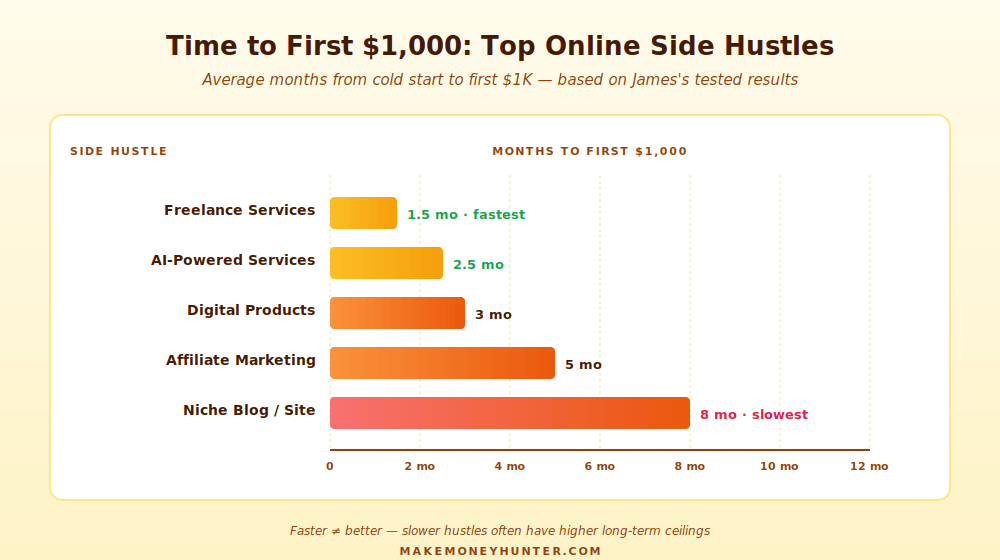
I tested this myself by listing a “B2B SaaS landing page rewrite” service on Fiverr and Upwork. Two months in, I was clearing $2,400 a month working roughly 8 hours per week. The trick was specializing — not “I’ll write anything” but “I rewrite SaaS homepage copy that converts trial visitors to demo bookings.” Specialists out-earn generalists 3-to-1.
How to start: Pick one skill you already have or can learn in 30 days. Build 3 portfolio pieces (real work for free if you have to). Set up a Fiverr Pro or Upwork profile with that exact specialization in the title. Send 10 personalized proposals a day for the first month.
Honest catch: The first 30-60 days are brutal. You’ll feel invisible. Most guys quit here. The ones who push through start making real money in month 3.
2. Build a Niche Blog or Niche Site
Real hourly rate: $0/hr for first 6 months, then climbs to $50–$200/hr
Time to first dollar: 4–8 months (yes, really)
Scalability: Very high — true passive income at scale
Best fit: Patient guys who can write or hire writers, with a day job covering the bills
I’ll be straight with you: blogging is the slowest path on this list to your first dollar. It’s also the path with the highest long-term ceiling. I know guys clearing $15,000 a month from sites that take them 4 hours a week to maintain, three years after launch. I also know guys who quit at month 5 with $4 in their AdSense account, two months before traffic would have started compounding.
The difference between the two? Niche selection and keyword research. That’s it. Pick a niche where you have an unfair advantage (a hobby, a profession, a passion you can write about for a decade), then research the actual search terms people are typing — don’t just write what feels interesting.
What’s working in 2026: tightly-niched information sites that target specific buyer intent keywords (think “best [product] for [specific use case]” rather than broad informational topics). The wide-open how-to traffic has been gutted by AI Overviews. Affiliate-driven product pages are still ranking and still converting because Google shows them as the answer.
How to start: Buy a domain ($12), get hosting on Bluehost or SiteGround ($3-7/month), install WordPress, pick a niche where you can write 30+ articles before you get bored. Need help on the niche-and-keyword side? Read my deep-dive on how to start a niche site and how to make money blogging — those two cover the full setup process.
Honest catch: If you can’t see yourself sticking with this for 12 months without making real money, don’t start. Go pick something on this list that pays faster.
3. Affiliate Marketing (YouTube, Newsletter, or Site)
Real hourly rate: $0–$300/hr depending on stage
Time to first dollar: 2–6 months
Scalability: Very high
Best fit: Guys who like a specific topic deeply and want to share what they know
Affiliate marketing in 2026 isn’t what it was in 2018. The “review every product on Amazon” play is dead. What works now is being the trusted voice in a specific niche — usually through YouTube or a newsletter — and recommending tools you actually use.
The math is good. A small audience of 5,000 highly-engaged subscribers in the right niche (think: home gym equipment, drone reviews, woodworking tools, productivity software) can generate $3,000-$10,000 a month in commissions. I’ve seen guys with 800 newsletter subscribers in a B2B niche pulling more than that, because the products they recommend pay $200+ per sale.
YouTube is the fastest way in for most men because video tutorials build trust quickly, and YouTube is still pushing channels with under 1,000 subscribers if your retention is good. The cameras and software you’d want for review videos are usually products you can promote — your setup costs become content costs become commission revenue. It’s tidy.
How to start: Pick a topic you genuinely use products in (don’t fake it — the audience can smell it). Sign up for the relevant affiliate programs (Amazon Associates, ShareASale, Impact, plus any direct affiliate programs from manufacturers). Make 30 videos or 30 newsletter issues before you check your numbers. If you want the deeper playbook, my affiliate marketing for beginners guide walks through it step by step.
Honest catch: Trust takes time. The audience you start with at month 1 isn’t who’s going to buy from you — those people show up at month 6+. Front-load the work.
4. Sell a Digital Product You Can Make Once
Real hourly rate: $80–$500/hr after launch
Time to first dollar: 1–3 months
Scalability: Very high
Best fit: Guys with expertise in something other people are willing to pay to learn
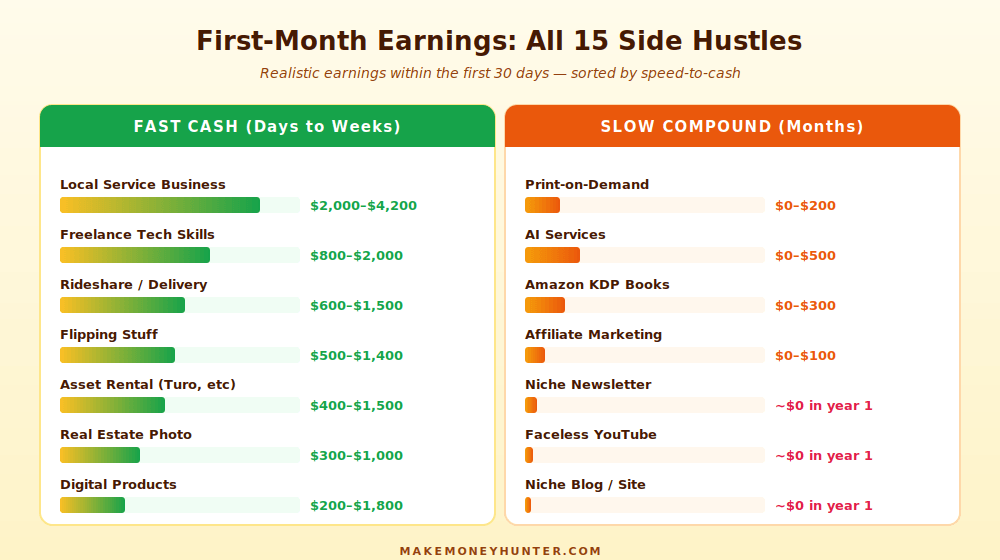
This one surprised me. I built a small Notion template (“Side Hustle Tracker for Guys With Day Jobs”) in a weekend, listed it on Gumroad for $19, ran a Twitter thread teasing the framework, and made $1,840 in the first 30 days. Almost zero ongoing work after that.
What sells in 2026: Notion templates, Excel/Google Sheets templates, mini-courses on a specific outcome (under 90 minutes of video), checklist PDFs solving one specific problem, and AI prompt packs for niche use cases. The unifying theme: solve one specific problem for one specific type of person, charge $15-$49, and stop trying to make it bigger than it needs to be.
The key insight a lot of guys miss: you don’t need a massive audience. You need 200-500 of the right people seeing it. That’s a small Twitter following, a small newsletter, or a single popular YouTube video. Build something useful, put it where the right eyeballs are, and the numbers work.
How to start: List the 5 things you’ve figured out in your career or hobby that other people frequently ask you about. Pick the one that takes 4-8 hours to package up. Make it. Sell it on Gumroad or Lemon Squeezy. Tell your network.
Honest catch: The first product usually flops. The second one teaches you what the first got wrong. By the third or fourth, you understand what works in your niche.
5. Run a Local Service Business on Weekends
Real hourly rate: $40–$120/hr
Time to first dollar: 1–2 weeks
Scalability: Medium (limited by hours, but you can hire)
Best fit: Guys who don’t mind physical work and want money fast
The fastest cash on this list. I’m talking about pressure washing, gutter cleaning, lawn care, junk removal, mobile car detailing, holiday light installation, and similar jobs. The common pattern: low equipment cost ($300-$2,000 to start), strong demand in any neighborhood with homeowners, and you can be quoting jobs by next weekend.
One guy I know made $4,200 in his first month doing pressure washing in a suburban Texas market. He used a $400 pressure washer, posted in 4 local Facebook groups, and dropped flyers in 200 mailboxes. Most of his customers came from referrals after the first 5 jobs.
What’s making these businesses work better in 2026 is software. You can run quoting, scheduling, and invoicing from your phone using tools like Jobber or Housecall Pro for $30-50 a month. That used to be the friction that broke side hustles like this — now it’s solved.
How to start: Pick the service that matches your area’s actual demand (don’t do snow removal in Florida). Research local pricing — call 5 competitors and ask for quotes on the same job. Price 10-20% under the average for your first 5 customers, then raise prices once you have reviews.
Honest catch: Your body wears out faster than you think. By 40, the guys still doing the work themselves are the ones who can’t afford to hire. Plan to hire labor by month 6 if you want to scale.
6. Drive for Rideshare or Delivery (Strategically)
Real hourly rate: $18–$32/hr in good markets, $12–$18/hr in saturated markets
Time to first dollar: 3–7 days
Scalability: Low
Best fit: Guys with reliable cars who want flexibility and don’t mind people
I’ll be straight: this used to be a much better side hustle. Pay has compressed in most cities. But there’s a strategy that still works in 2026, and it’s the strategy most drivers ignore.
The trick is stacking platforms and timing. Run Uber, DoorDash, and Instacart on the same phone. Only drive during surge windows — Friday and Saturday nights, lunch rushes, sports event end times, bad weather. A driver who only works 12-15 hours a week during these windows can clear $35-45/hr after gas. A driver who works 30+ hours during random times averages $14/hr.
The other angle: airport runs. Pick one major airport, study the queue patterns, and only run during peak inbound flight windows. Long rides + tip-heavy travelers = the highest-paying rideshare niche.
How to start: Sign up for at least 2 platforms while you wait for background checks (they take 5-7 days). Drive your first 20 hours during peak windows only. Track your hourly rate by location and time. Stop driving in the windows that pay under $20/hr.
Honest catch: Vehicle wear-and-tear is a real cost most drivers don’t account for. Subtract roughly $0.30-$0.50 per mile for true expenses. The hourly rates I quoted already factor this in.
7. Rent Out Your Truck, Trailer, or Tools on Turo and Neighbor
Real hourly rate: N/A — typically $300–$1,500/month per asset
Time to first dollar: 1–4 weeks
Scalability: High if you stack assets
Best fit: Guys with a pickup, a utility trailer, or expensive tools sitting unused
This is one of the most under-discussed side hustles for men. If you own a pickup truck, a utility trailer, a U-Haul-style cargo van, or a serious tool collection, those things are working assets you can rent out.
Turo for vehicles. A pickup truck that costs $600/month to own can pull $1,200-$1,800/month in rentals in a busy market. Even after maintenance and insurance reserves, you’re looking at $400-$900/month net for an asset you’d own anyway.
Neighbor.com for storage space. Got a spare garage bay, a driveway big enough for a boat, or unused yard space? People will pay $50-$200/month to park their RV, boat, or stored stuff there.
Local rental sites or Facebook Marketplace for tools. A power washer, a tile saw, a generator, an air compressor — these get listed at $40-$80/day. A guy with $3,000 in tools rented out 4-6 days a month is netting $200-$400 of pure profit.
How to start: List one asset on the appropriate platform. Take great photos. Price 10% under similar listings to build reviews fast. Once you have 5+ five-star reviews, raise prices to market rate.
Honest catch: Insurance matters. Read the platform’s coverage carefully and consider supplemental commercial policies. One bad rental can wipe out a year of profit if you’re underinsured.
8. Flip Stuff (Tools, Bikes, Sports Gear, Furniture)
Real hourly rate: $25–$80/hr once you know what to look for
Time to first dollar: 1–2 weeks
Scalability: Medium
Best fit: Guys who like estate sales, garage sales, and the hunt
Flipping is an underrated side hustle for men because most flipping content online is aimed at women selling clothes. The men’s side of flipping — power tools, bikes, fitness equipment, fishing gear, hunting gear, vintage stereo equipment, lawn equipment — is less competitive and the margins are usually higher.
Real example: a friend buys broken push mowers off Facebook Marketplace for $20-50, replaces a $15 part, cleans them up, resells for $150-200. He does about 8 a month in his garage during summer. That’s $1,200-$1,400 a month for maybe 20 hours of work.
The skill is identifying what’s underpriced and what’s broken-but-fixable. That comes from picking one category and learning it deeply. Don’t flip everything. Flip one thing.
How to start: Pick one category you already know something about. Spend two weekends just observing prices on Facebook Marketplace, eBay sold listings, and Craigslist. Don’t buy anything yet. After two weeks, you’ll know what’s a deal and what isn’t. Then start buying.
Honest catch: Storage becomes an issue fast. Have a plan for where the inventory lives before you start buying.
9. Dividend and Index Investing (Slow but Real)
Real hourly rate: N/A — measured in annual returns
Time to first dollar: Quarterly (first dividend payment)
Scalability: Limited only by capital
Best fit: Guys who already have decent income and want long-term wealth, not next month’s rent
I’m including this because it’s what I’d actually recommend for most men in their 30s and 40s rather than chasing the latest crypto pump or options trading scheme. It’s not exciting. It works.
The math: $500/month into a low-cost S&P 500 index fund, averaged over 30 years at historical returns, becomes roughly $580,000-$700,000. A dividend-focused portfolio of $200,000 generating 3-4% yield throws off $6,000-$8,000 a year in passive income that grows over time. None of this happens fast. All of it happens reliably if you don’t panic during downturns.
This is not “side hustle” in the sense of replacing income next month. It’s “hustle” in the sense of building a real second income stream that compounds while you’re doing the other 14 things on this list. (For more on building income streams that work without you, see my deeper guide on passive income ideas that actually pay.)
How to start: Open a brokerage account at a low-cost broker (Fidelity, Schwab, Vanguard). Set up automatic monthly transfers. Buy broad index funds (VTI, VOO, or equivalents) on autopilot. Don’t check the account more than once a month. Don’t trade.
Honest catch: This requires money you can leave alone for years. If you’re living paycheck to paycheck, focus on the income-generating hustles above first, then come back to this.
Note: I’m not a financial advisor and this isn’t financial advice — just sharing what I’ve done myself. Talk to a fiduciary advisor before making investment decisions that affect your retirement.
10. AI-Powered Services (The 2026 Goldmine)
Real hourly rate: $50–$200/hr
Time to first dollar: 2–6 weeks
Scalability: Very high
Best fit: Guys who like learning new tools and aren’t afraid of tech
This is the biggest opportunity on the entire list right now. Not because AI is trendy — because most small businesses are 12-18 months behind on adopting it, and they’re starting to feel the pain. They need someone to set up automations, build chatbots, write prompts, edit AI-generated video, and integrate AI into their existing workflows.
Specific services that are paying real money in 2026: building custom GPTs for specific business workflows ($500-$2,000 per project), setting up automated content pipelines for small businesses ($1,500-$5,000 monthly retainers), AI-assisted video editing for short-form content (creators pay $300-$800 per finished video), and prompt engineering for ad copy testing ($1,000+ per campaign).
The skill ceiling here is low. You don’t need to know how the models work. You need to know how to chain prompts, integrate with Zapier and Make.com, and translate “I have a business problem” into “here’s an AI workflow that solves it.” A few hundred hours of practice gets you billable. If you want a deeper dive on this category, see my full guide on how to make money with AI.
How to start: Pick one specific workflow problem (e.g., “automate customer support email triage” or “generate weekly social content from a podcast”). Build it for yourself or a friend’s business as a portfolio piece. List the service on Upwork, Twitter, and in industry-specific Facebook groups.
Honest catch: The space is moving fast. The skill you build today will need an update in 6 months. If you don’t enjoy continuous learning, this isn’t your hustle.
11. Print-on-Demand Stores (Niche Down or Don’t Bother)
Real hourly rate: $0–$80/hr depending on niche
Time to first dollar: 1–4 months
Scalability: Very high
Best fit: Guys with strong design sense or sharp niche-spotting instincts
Print-on-demand (POD) is the side hustle that everyone tries and most people fail at. The reason: they pick generic niches like “funny dog t-shirts” where they’re competing with 50,000 other stores. Generic POD is dead. Niche POD is alive and paying.
What works in 2026: hyper-specific niches with rabid identity-based audiences. Examples: shirts for specific job trades (“Welder Dad,” “Diesel Mechanic Life”), specific veteran units, hyper-local sports rivalries, specific hunting/fishing styles, specific car/truck mods, specific subreddits or online communities. The narrower, the better. The more identity-loaded, the better.
I tested a small POD store in a tradesman niche. With about 30 designs, organic Pinterest traffic, and zero paid ads, it cleared $640 in profit in month 4. Not life-changing, but compounding — and the work was front-loaded into the design phase.
How to start: Pick a niche where you understand the inside jokes and identity markers. Use a POD platform like Printful or Printify connected to a Shopify or Etsy store. Make 20-30 designs in your first month. Drive traffic from Pinterest (free) and the relevant subreddit communities (carefully — don’t spam).
Honest catch: The first 20 designs probably won’t sell. The 21st might be your hit. The math works because once you have a winner, it sells with no extra effort.
12. Real Estate or Local Event Photography
Real hourly rate: $80–$250/hr
Time to first dollar: 4–8 weeks
Scalability: Medium
Best fit: Guys who already own a decent camera and have an eye for composition
Most photography side hustles aimed at men focus on weddings (saturated, high-pressure) or stock photography (low-pay). The two niches that are actually paying well right now: real estate photography and local sports/event coverage.
Real estate photography pays $150-$400 per house, takes 1-2 hours on-site plus 1-2 hours of editing. Realtors need consistent, fast turnaround photographers and they pay well for reliable ones. Drone footage adds another $100-$200 per shoot if you have a Part 107 license.
Local event photography — youth sports tournaments, small concerts, corporate events, charity runs — pays $50-$150/hr and there’s never enough good photographers willing to show up reliably.
How to start: If you don’t have a decent DSLR or mirrorless camera, this isn’t your hustle. If you do, build a 20-image portfolio (offer 5 free shoots to friends to fill it). Reach out directly to 30 local realtors via email or Instagram DM. Quote firm prices. Don’t underprice — realtors want professionals, not cheap.
Honest catch: Editing is half the job and most beginners hate it. Plan to spend roughly equal time editing as shooting.
13. Build a Niche Newsletter
Real hourly rate: $0/hr for first 6 months, then $80–$300/hr
Time to first dollar: 4–8 months
Scalability: Very high
Best fit: Guys who can write 800 useful words a week about a specific topic
Newsletters are having a moment in 2026 because the algorithms got worse and people are choosing email back. A B2B niche newsletter with 3,000 engaged subscribers can generate $5,000-$15,000 a month through sponsorships, affiliate links, and a paid tier.
The key word is “niche.” General newsletters don’t work. Newsletters that target one specific job role or hobby with deep expertise do. Examples I’d consider opportunities: newsletters for specific trades (HVAC business owners, residential contractors), specific finance niches (small business owners under $1M revenue), specific hobbies with money attached (high-end woodworking, custom car building, drone racing).
The reason this works for men specifically: a lot of male-dominated niches are wildly underserved by quality newsletters. Most of the existing newsletter market is consumer/lifestyle. The trade and B2B side has open lanes.
How to start: Pick a niche where you have either real expertise or a willingness to interview experts weekly. Set up on Beehiiv or Substack (free tiers work fine). Commit to publishing once a week for 12 weeks before you evaluate. Promote through LinkedIn, Twitter, or relevant industry forums.
Honest catch: The first 100 subscribers are the hardest. After 1,000, growth compounds. Most quitters quit before 200.
14. Faceless YouTube Channel
Real hourly rate: $0/hr early, $50–$300/hr after monetization
Time to first dollar: 4–10 months
Scalability: Very high
Best fit: Guys who don’t want to be on camera but can write good scripts
“Faceless YouTube” gets a lot of hype, and most of it is misleading. Pure stock-footage reupload channels don’t work anymore. AI-narrated slop channels are getting demonetized.
What does work in 2026: faceless channels in specific informational niches where the visuals are diagrams, animations, screen recordings, or original B-roll, and the audio is a real human voice (yours or hired) reading a well-researched script. Examples: tech explainer channels, finance breakdown channels, history deep-dives, geography channels, science communication.
The economics: a channel that crosses 100,000 subs in a high-CPM niche (finance, tech, business) can generate $4,000-$15,000 a month from AdSense alone, plus another $2,000-$10,000 from sponsorships. The work is front-loaded into the first 30-50 videos before traffic compounds.
How to start: Pick a niche, research the top 10 channels in it, identify what they cover and what they miss. Plan 30 videos. Write the first 5 scripts. Record audio with a $100 USB microphone. Edit with Descript or DaVinci Resolve (free). Publish weekly.
Honest catch: The first 20 videos will be embarrassing. Publish them anyway. Skill compounds. Audience compounds. Most quitters quit at video 12.
15. Sell Books on Amazon KDP (Self-Publishing)
Real hourly rate: $0/hr early, $30–$150/hr at scale
Time to first dollar: 1–3 months
Scalability: High (compounds with backlist)
Best fit: Guys who can write or commission writing on niche topics
Self-publishing on Amazon KDP is one of the more honest “passive income” plays available in 2026. Not because every book becomes a bestseller — they don’t — but because a backlist of 10-20 niche non-fiction books in the right categories can generate $500-$3,000 a month with minimal ongoing work.
What sells: niche non-fiction in evergreen categories — practical skills (knife sharpening, beekeeping, specific home repairs), specialized hobby guides, niche history, exam prep guides, niche cookbooks. Fiction is much harder to crack and I wouldn’t recommend it as a side hustle starting point.
The economics: a $9.99 paperback nets you $3-$4 in royalties. A $4.99 ebook nets you about $3.50. A book that sells 50 copies a month — modest by KDP standards — generates $150-$200/month. Stack 10 books at that level and you have $1,500-$2,000 a month in genuinely passive income.
How to start: Use a tool like Publisher Rocket to find niches with high demand and low competition. Write or hire out a 25,000-40,000 word book on that topic. Get a professional cover ($50-200 on Fiverr). Format with Atticus or Vellum. Upload to KDP. Move on to the next book.
Honest catch: Quality matters more than ever. AI-slop books are getting flagged and removed. Books need to actually be useful or they’ll get returned and reviewed badly.
How to Pick the Right Side Hustle for Your Situation
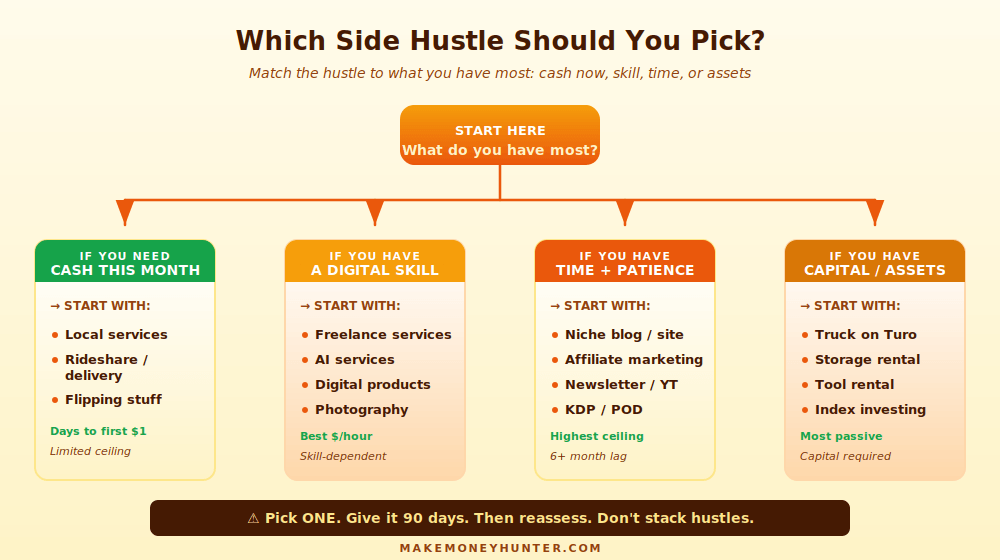
Don’t pick the highest-paying one on this list. Pick the one that matches what you have right now.
If you need cash this month: Local service business (#5), rideshare/delivery (#6), or flipping (#8). These pay fastest. Your first dollar shows up in days, not months.
If you have a stable day job and 6-12 months of patience: Niche site (#2), affiliate marketing (#3), newsletter (#13), YouTube (#14), or KDP (#15). These have the highest long-term ceilings and they all stack — once you have an audience in one place, you can drive it to all the others.
If you have a marketable digital skill: Freelance services (#1) and AI services (#10). These pay best per hour right now and require the least audience-building.
If you have capital or assets sitting idle: Asset rental (#7) and dividend investing (#9). The least time-intensive options on the list.
The wrong move is picking three of these and trying to do them all at once. Pick one. Give it 90 days of focused effort. Reassess.
Common Mistakes Men Make With Side Hustles
I’ll save you a few of the mistakes I made and watched others make.
Quitting too early. The hustles with the biggest long-term ceilings (blogging, affiliate marketing, newsletters, YouTube) all have a 6-12 month dead zone where it feels like nothing is working. That dead zone is the filter. Most guys quit there. The ones who push through hit the compound stage.
Stacking too many at once. Three half-built side hustles earn less than one fully-built one. Sequence them. Build one to a level it makes real money, then start the next.
Underpricing. Almost every guy starting a service business or freelance gig prices 30-50% under what the market would pay. You’re not winning customers by being cheap — you’re attracting the worst customers. Charge real rates, even on day one.
Skipping the boring research phase. Whether it’s keyword research for a blog, niche research for KDP, or pricing research for a local service — the guys who skip the research lose to the guys who do it. Boring research is the highest-leverage hour you’ll spend.
Treating it like a hobby. A side hustle is a business that’s just smaller than your main job. Track revenue. Track expenses. Open a separate bank account. Set quarterly goals. The guys who treat it casually make casual money.
FAQ
What’s the best side hustle for men with no skills?
Start with a local service business (#5) or rideshare/delivery (#6). Both pay quickly and require no specialized skills beyond reliability. Use the income from those to fund time investment in a higher-ceiling skill-based hustle once you’ve stabilized cash flow.
How much money can a guy realistically make with a side hustle?
The realistic range for a side hustle worked 10-15 hours a week is $500-$3,000 a month within the first 6-12 months. Above that, you’re typically looking at either a hustle that’s transitioning into a full business, or someone who got lucky in a high-leverage niche. Anyone promising you $10,000/month in 30 days is selling something.
Are side hustles for men different from side hustles for women?
The mechanics are the same — money flows the same way regardless of gender. But certain niches skew heavily male in terms of audience and demand: trades, specific tool/equipment niches, certain hobby categories, B2B services in male-dominated industries. These tend to be less competitive on the content/audience side because most “side hustle” content online is aimed at women selling lifestyle products.
How much should I invest before I start making money?
Most of the hustles on this list can be started for under $500. Local services need equipment ($300-$2,000), niche sites and newsletters cost about $50-$200 to set up, freelancing and AI services cost almost nothing. The hustles that require real capital — investing, asset rental — should only be started with money you can afford to lose.
Can I do a side hustle while working full-time?
Yes, and most of these are designed for it. Aim for 8-15 hours a week max in your first 6 months. More than that and you’ll burn out before the side hustle hits its compound stage. Protect your sleep and your main income — those are the foundation everything else depends on.
Final Thoughts: Pick One and Start This Week
Reading lists like this one is a trap. You finish, you feel motivated, and then you read another list next week and never start anything.
Don’t try to do all 15. Pick the one — the single one — that matches what you have right now: skill, time, money, or asset. Spend the next 7 days going all in on just that one. That’s how every successful side hustle starts.
Six months from now, you’ll either have a real second income stream, or you’ll have a lot of bookmarked articles. The difference is which one of those days you actually started.
Pick one. Start this week.
Want to zoom out and see the bigger picture before you commit? My pillar guide on how to make money online covers the full landscape — from beginner-friendly methods to long-game wealth building.