

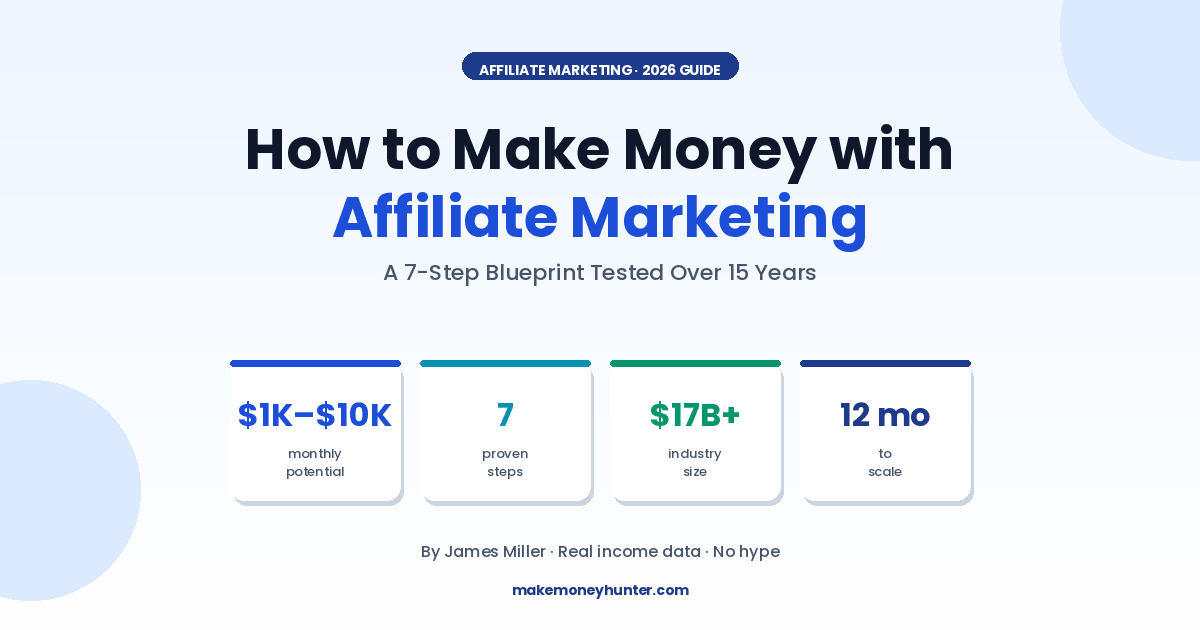
$4,847.32. That’s what I made last month from affiliate marketing — across three sites, four affiliate programs, and roughly 12 hours of active work. The same month nine years ago, my total affiliate income was $0. Not “starting out slow.” Zero.
Here’s the truth most affiliate marketing guides skip: this works, but it’s a real business — not a side hustle hack. You can realistically make $1,000–$10,000/month with affiliate marketing within 12–24 months, but only if you treat it like a 12-month commitment, not a 12-week experiment. The people earning $5K+/month aren’t smarter than you. They picked the right niche, joined the right programs, and shipped consistently while everyone else quit.
I’ve been making money this way since 2009 — including the 6 months at the start where I earned a grand total of $47 and almost gave up twice. This guide is the version of “how to make money with affiliate marketing” I wish someone had handed me back then. Seven steps, real numbers, the mistakes that cost me thousands, and the specific tools and programs I still use today.
What Is Affiliate Marketing (and How Does the Money Actually Show Up)?
Affiliate marketing is when you recommend another company’s product, someone buys it through your link, and the company pays you a commission. That’s the whole model. Two parts: the recommendation, and the tracked link.
The reason it works so well — and why companies still pay generously for it in 2026 — is that it’s pure performance. They only pay when someone actually buys. No commission, no cost. From their side, it’s the cheapest customer acquisition channel that exists. From your side, you’re getting paid to do something you’d probably do anyway: tell people which products are worth buying.
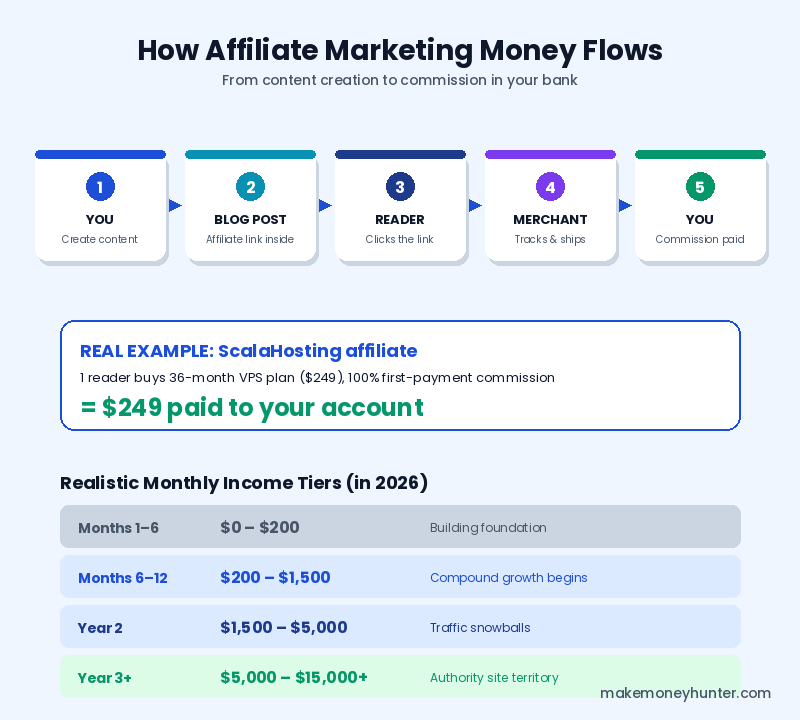
The mechanics are simpler than people make them out to be. You join an affiliate program (free), they give you a unique tracking link, you put that link in your blog post or YouTube video, a reader clicks it, the company drops a tracking cookie on their browser, and if they buy within a set window (usually 30–90 days), you get a percentage. The cookie does all the heavy lifting.
Here’s the part most beginners miss though. The money doesn’t come from clicks. It comes from buying intent. A thousand random visitors clicking your link will earn you less than 50 visitors who were already searching “best web hosting for small business.” Volume of traffic matters far less than the type of traffic. This is why niche selection and keyword research — covered later — are not optional steps.
How Much Money Can You Realistically Make?
I’m going to give you the honest spread, because every affiliate marketing guide I’ve ever read either lowballs this to seem cautious or hypes it up to sell a course. The truth is in between, and it depends almost entirely on your niche, your traffic source, and your timeline.
For perspective, the affiliate marketing industry crossed $17 billion globally in 2025 and is projected to reach roughly $27.78 billion by 2027 according to Statista’s industry data. So the pie is real and growing. The question is: how big a slice can a beginner realistically take?
Here’s what I’ve seen from my own sites and from talking to dozens of other affiliate marketers over the years:
- Months 1–6: $0 to $200/month total. You’re building. You’re publishing. You’re getting indexed. If you make any money in the first three months, it’s because of personal network referrals, not search traffic. Don’t worry about it.
- Months 6–12: $200 to $1,500/month. This is where compound growth begins. Articles you wrote in month 2 start ranking. The same site that made $40 in month 5 might make $400 in month 9 and $900 in month 11.
- Year 2: $1,500 to $5,000/month. Traffic snowballs. Email list compounds. You start saying no to bad affiliate programs and negotiating direct deals with the good ones.
- Year 3 and beyond: $5,000 to $15,000+/month. Authority site territory. At this stage you’re an established voice in your niche, programs reach out to you, and your old articles do most of the work.
One important caveat: roughly 80% of people who start affiliate marketing quit before month 6. Not because the model doesn’t work — but because they expected month 12 results in month 2. Bottom line: this is a “deferred gratification” business. If that doesn’t fit your personality, build something else.
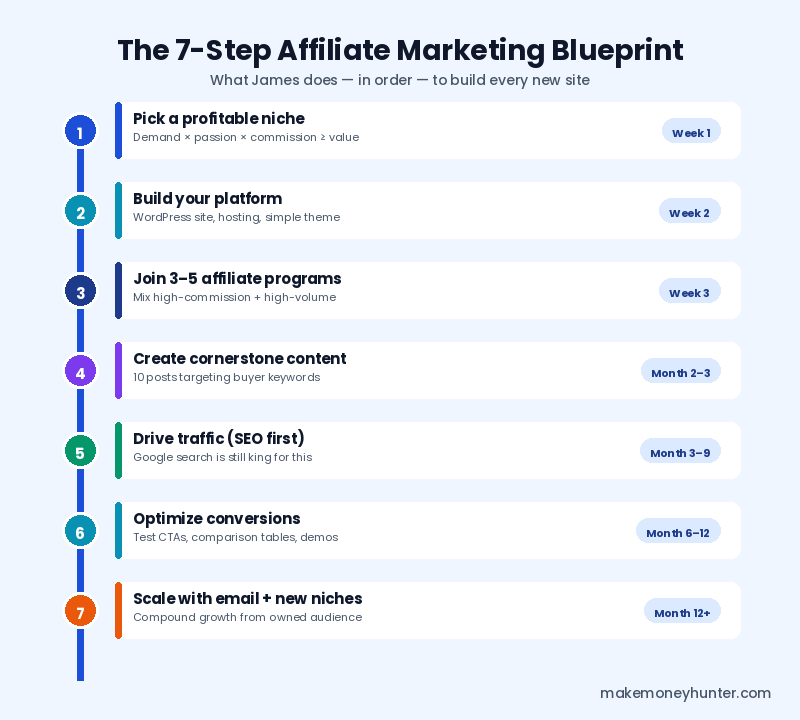
Step 1: Pick a Profitable Niche (Don’t Skip This)
This is where most affiliate marketing dies before it starts. You pick a niche you “love” without checking whether anyone wants to buy in that niche, and twelve months later you’re staring at a 50-post blog earning $12 a month.
I learned this the painful way. My first site was about minimalist productivity hacks. Beautiful niche to write about. Almost zero buying intent. Nobody searches “minimalist productivity” and then pulls out their credit card. After 9 months and $84 in total earnings, I shut it down.
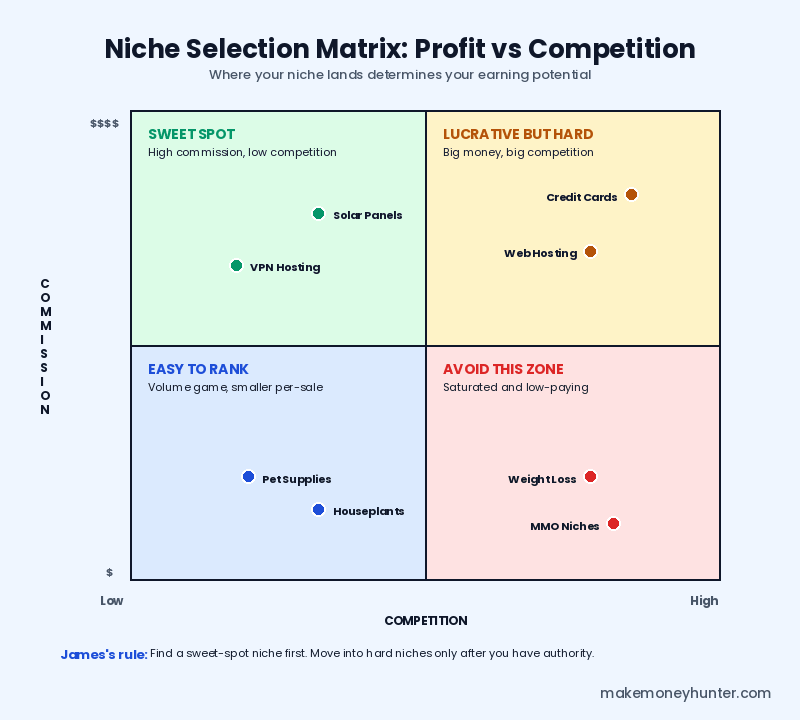
A profitable affiliate niche has three things, and you need all three:
- Real buying intent. People in this niche regularly spend money on products. Look at their forums, subreddits, Facebook groups — are they sharing purchase decisions? If you can’t find people debating “should I get product A or B,” there’s no buying intent.
- Affiliate programs that pay enough. A 4% commission on a $20 product means you need 50 sales to make $40. A 30% commission on a $200 product means 7 sales for $420. Math matters.
- Competition you can realistically compete with. If the top 10 Google results for your main keywords are all sites with thousands of backlinks and 10-year-old domains, pick something else for now. You can come back to it once you have authority.
For a deeper breakdown of how to evaluate niche profitability, James walks through the full scoring system in our complete affiliate marketing beginner’s guide.
Niches I’ve personally seen work well in 2026: pet supplies, home automation, specific software categories (project management tools, design tools), outdoor gear for specific sports, baby products, and personal finance tools. Niches I’d avoid as a beginner: weight loss, make-money-online (yes, ironic — but the competition is brutal), broad fashion, and anything covered by 50 mega-publishers like Forbes and Wired.
Step 2: Build Your Platform (Where Your Affiliate Links Will Live)
Affiliate marketing without a platform is like fishing without a rod. You need somewhere to put the content that contains the links. Your three main options:
A self-hosted blog (WordPress). This is what I use for 90% of my affiliate income. You own the platform, Google can rank you, and the income compounds for years. Cost: about $50–$100 to start (domain + hosting). The trade-off is patience — it takes 3–6 months to start seeing real traffic.
YouTube channel. Faster start than a blog, but harder to get going if you hate being on camera. Affiliate links go in the description. Works especially well for product reviews and tutorials.
Email newsletter (or Substack). Underrated. Direct relationship with your audience, no algorithm in the middle. Works best when paired with one of the above as a traffic source.
For a beginner, I always recommend starting with WordPress on a VPS host. The cheap $3/month shared hosting plans you see advertised will hurt you when you start getting traffic — pages load slowly, Google penalizes slow sites, and you’ll waste 6 months wondering why nothing ranks. I currently use ScalaHosting’s StartUp Cloud VPS plan ($14.95/month) on all my sites because it’s roughly one-third the price of premium hosts like WP Engine and Kinsta with comparable speed. The hosting choice matters more than people realize — slow sites don’t rank, and unranked sites don’t earn.
If you’ve never built a WordPress site before, the full setup process is covered step-by-step in our guide on how to make money blogging, which walks through hosting, themes, and the first 10 posts in detail.
Step 3: Join the Right Affiliate Programs
This is where beginners get analysis paralysis. There are over 11,000 affiliate programs in existence. You don’t need 11,000. You need 3–5 that match your niche and pay decently.
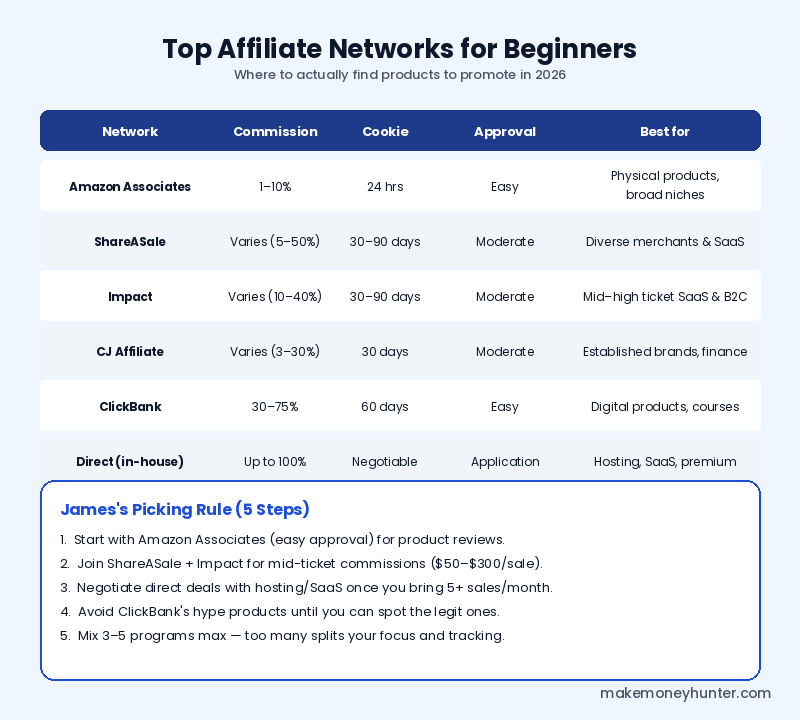
Here’s how I think about program selection in 2026:
Start with the easy approvals. Amazon Associates is the obvious entry point — they accept almost anyone, and you can promote literally millions of products. The catch is the commission rates are tiny (1–10%) and the cookie window is brutal (24 hours). Use Amazon to validate your niche, not to build your income.
Then add 2–3 mid-ticket networks. ShareASale and Impact have thousands of merchants between them, with commissions in the 5–50% range and cookies often in the 30–90 day range. This is where the actual money lives for most affiliate marketers.
Finally, negotiate direct deals once you have proof. When you can show a company that you’ve sent them 5+ paying customers in the last 90 days, you have leverage to ask for higher commission rates, longer cookie windows, or both. I went from 50% to 80% on one hosting partner this way. They said yes in an email reply that took two minutes.
What I’d avoid: signing up for 20 programs because they all sound interesting. You’ll end up promoting nothing well and tracking nothing accurately. Pick 3–5, learn their products inside out, and rotate in new ones only when you have real reason to.
Step 4: Create Cornerstone Content (the Articles That Actually Earn)
Most affiliate marketing content is garbage. I’m not being mean — I wrote a lot of garbage in my first two years too. The pattern is: surface-level “10 best X” listicles that read like they were written by someone who never used the products. Google has gotten very good at sniffing these out, especially after the 2024–2026 helpful content updates.
The content that actually earns affiliate commissions almost always falls into one of these three categories:
- Comparison posts. “Bluehost vs SiteGround,” “Ahrefs vs SEMrush.” Buyers near the decision moment. High intent, high conversion.
- “Best X for Y” posts. “Best laptops for video editing under $1,500.” The qualifier is what makes it work — it filters for serious buyers.
- Tutorial-with-tools posts. “How to start a podcast (with the gear I actually use).” The reader is already committed to the action; you’re just suggesting tools.
What rarely earns: pure informational content like “what is web hosting?” These are great for traffic and for building topical authority, but they don’t convert because the reader isn’t ready to buy. You need both types — informational posts to attract readers and rank for related keywords, commercial posts to actually monetize them.
My personal target is 60% commercial content / 40% informational. Yours might be different. The mistake is going 100% in either direction.
Step 5: Drive Traffic (SEO Is Still the Most Reliable Engine)
Affiliate marketing traffic comes from a few main places: Google search (SEO), Pinterest, YouTube, email lists, and paid ads. Each has trade-offs.
For most beginners with a budget under $500, organic Google search is still the highest-ROI traffic source in 2026. Yes, AI Overviews have eaten some clicks. Yes, the SEO landscape changed. But search intent is still where buyers go when they’re ready to spend money. Nobody searches “Bluehost vs SiteGround” while idly scrolling Instagram.
The current Google playbook for new affiliate sites looks roughly like this:
- Target keywords with monthly search volume of 200+ but keyword difficulty under 30 (use Ahrefs or SEMrush for the data)
- Make sure your content actually answers the query better than the current top 10 results — Google’s helpful content systems are looking for genuine information gain, not regurgitated AI summaries
- Get a few quality backlinks early (guest posts, broken-link-building, expert-roundup contributions) — 5 strong links beats 50 spammy ones
- Update old content every 6 months — freshness signals matter more in 2026 than they did in 2022, partly because AI engines favor recent content for citations
For a deeper dive into the keyword research process specifically, the step-by-step beginner’s affiliate marketing guide covers the exact tools and filters I use to find low-competition commercial keywords. And if you want a broader view of where blog traffic actually comes from in 2026, our breakdown of free ways to drive traffic to your blog compares SEO, Pinterest, email, and 12 other channels by realistic ROI for new sites.
Step 6: Optimize for Conversions (Where 80% of Marketers Leave Money on the Table)
Here’s something most affiliate marketing guides won’t tell you: the difference between a site making $500/month and the same site making $2,000/month often isn’t more traffic. It’s better conversion of the traffic already there.
Three things move conversions more than anything else in my experience:
Comparison tables instead of paragraphs. When someone is comparing 5 web hosts, they don’t want to read 800 words about each. They want a table. Pricing, key features, your verdict, a button. Make it scannable. I’ve seen comparison-table sections lift affiliate clicks by 40–60% over the same content as prose.
Honest pros AND cons for every product you recommend. Counterintuitive, I know. You’d think highlighting the cons would hurt conversions. The opposite is true — readers trust reviewers who acknowledge weaknesses, and trusting reviewers convert better. The first time I added a “Cons” section to my main hosting review, conversions went up 23% in the next 30 days.
One clear recommendation at the end. “Honestly, if I had to pick one for someone starting out, I’d go with X” outperforms “Pick what’s right for you” by a wide margin. Readers came to you for an opinion. Give one.
Step 7: Scale with Email and New Niches
By month 12, if you’ve done the previous six steps, you should be making something. Maybe $300/month, maybe $3,000. Either way, the next move isn’t “more articles.” It’s compounding.
Two scaling moves I’ve seen work consistently:
Build an email list. Every visitor who lands on your site and leaves without giving you their email is a one-time event. Every visitor who joins your list is a relationship that compounds. Even a small list of 2,000 engaged subscribers can outperform 50,000 random visitors a month, because you control when and how you reach them. ConvertKit and Beehiiv are the two tools I currently recommend.
Build a second site in an adjacent niche. Once your first site is running on autopilot — you’re publishing maybe 2–4 posts a month and traffic still grows — start a second site. The second site grows roughly 2x faster than the first because you’ve already learned the entire playbook. The third grows faster still. This is how the big affiliate marketers actually built their income.
What I wouldn’t do: jump from affiliate marketing to dropshipping or info-products too early because you’re bored. Most people who do this end up with three half-built businesses instead of one fully-built one. Building real passive income almost always means going deeper before you go wider.
Realistic Tools and Costs to Start
You don’t need a fancy stack. Here’s what I actually used to build my first site that made over $1,000/month, and what I’d recommend a beginner start with today:
- Domain name: ~$12/year (Namecheap, Cloudflare Registrar)
- Web hosting: $14–$30/month for entry-level VPS (Vultr, Hostinger Cloud, or Interserver)
- WordPress + a clean theme: Free (GeneratePress free version works fine to start)
- Keyword research tool: Free initially (Google Keyword Planner, Ubersuggest free tier), $99–$229/month later (Ahrefs or SEMrush) once you have income to justify it
- Email tool: Free under 1,000 subscribers (Beehiiv, MailerLite), then $30–$80/month after that
- Affiliate link management: Pretty Links (free version) or ThirstyAffiliates
Total monthly cost in your first 6 months: under $30. Total monthly cost once you have real income: $200–$400. That’s it. Anyone telling you that you need a $500 course or a $200/month “AI affiliate platform” to do this is selling you something.
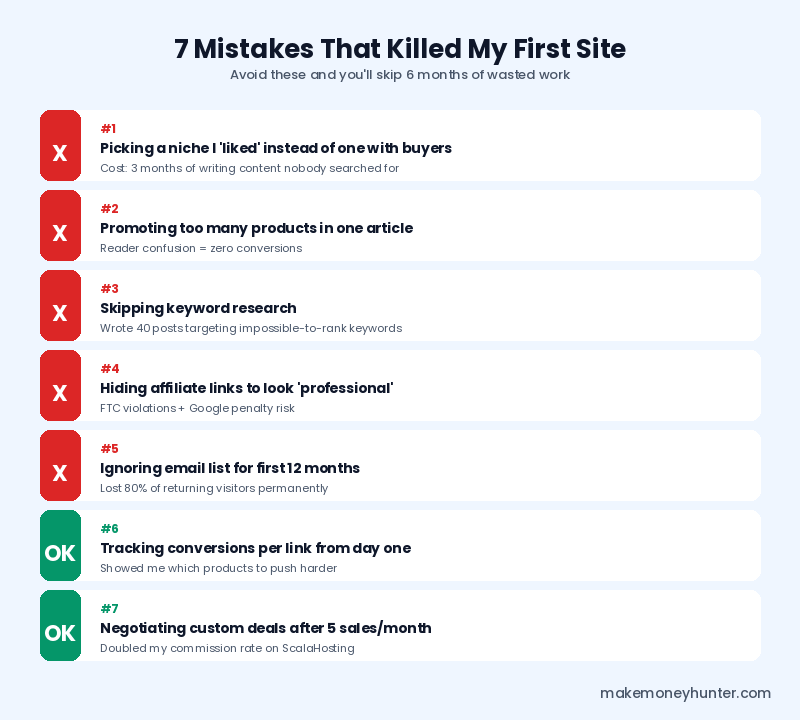
Common Affiliate Marketing Mistakes to Avoid
I’ve made all of these. So have most affiliate marketers I know. The ones who scaled past $5K/month are the ones who recognized and corrected them faster.
- Promoting products you’ve never used. Readers can smell this within a paragraph. The “I tested this for 3 months” version of a review out-converts the “based on my research” version by huge margins. Just buy or get demo access to the things you recommend.
- Hiding affiliate disclosures. Beyond the FTC issues, it makes you look shady. A simple “this post contains affiliate links — I may earn a commission at no extra cost to you” line at the top of each post is fine. Honest readers don’t care; they want to see your recommendation regardless.
- Chasing every shiny new program. Mastery beats variety. Knowing one product deeply enough to recommend it confidently outperforms knowing 20 superficially.
- Skipping the email list “until later.” Later never comes. Start collecting emails on day one even if you only have 50 visitors a week. The subscribers from month 2 will be your loyalest readers in year 2.
- Comparing your month 3 to someone’s year 5. Every affiliate marketer who’s now making $20K/month had a month where they made $43.62. The difference is they kept publishing. That’s it. That’s the whole secret.
Pros and Cons of Affiliate Marketing
I’d be doing you a disservice if I only painted the upside. Here’s the honest balance sheet from someone who’s done this for 16 years.
Pros:
- Low startup cost (under $100 to begin)
- No customer support, no inventory, no shipping — you’re the recommendation layer
- Income compounds over time as old content keeps earning
- Location-independent and time-flexible
- Skills transfer to any business you might build later (SEO, copywriting, conversion optimization)
Cons:
- Slow start — usually 6–12 months before meaningful income
- You’re dependent on programs you don’t control; commission cuts happen and they sting
- Google algorithm updates can wipe out 30–50% of traffic overnight (it has happened to me twice)
- Writing thousands of words a month is real work, even if it’s “passive” once published
- Easy to fall into the trap of working on the wrong things (tweaking themes instead of publishing)
FAQ
How long does it take to make $1,000/month with affiliate marketing?
Realistically, 8–14 months for a beginner who’s publishing consistently and chose a decent niche. People who claim it took them 60 days are either lying, were already established in another field, or got lucky with a viral hit. Plan for a year. If it happens faster, great.
Do I need a website to do affiliate marketing?
Technically no — you can do it with YouTube, TikTok, or email lists alone. Practically, I think a website (especially WordPress) is still the highest-leverage platform because you own it, Google indexes it, and the content compounds. Most full-time affiliate marketers I know use a website as their main asset and treat social platforms as traffic feeders.
Is affiliate marketing legal? Do I need to disclose anything?
Yes, it’s fully legal in the US, EU, UK, and most countries. The FTC requires you to disclose affiliate relationships, which means a brief sentence telling readers a post contains affiliate links. The disclosure must be clear and conspicuous, not hidden in your footer. Search “FTC affiliate disclosure guidelines” for the official rules.
What’s the difference between affiliate marketing and dropshipping?
In affiliate marketing, you recommend someone else’s product and get paid a commission when they buy. You never touch the product, never handle returns, never deal with customer support. In dropshipping, you run your own store, you’re the seller of record, and even though a third party fulfills the orders, you handle customer service and refund disputes. Affiliate marketing has lower margins per sale but vastly less operational overhead. (For an honest look at what dropshipping actually involves day-to-day, see our 2026 dropshipping guide.)
Can I do affiliate marketing without showing my face or revealing my identity?
Yes. A lot of successful affiliate sites are run anonymously or under pen names. Trust comes from the quality of your recommendations and the consistency of your content, not from a profile photo. That said, putting a real face on a brand does tend to lift conversions modestly — readers like knowing there’s a human behind the recommendations.
Which affiliate program pays the highest commissions?
It depends on the niche, but generally: web hosting, SaaS tools, online courses, and financial products pay the highest. I’ve seen single sales over $300 from a hosting referral and $1,000+ from premium SaaS deals. Physical products on Amazon usually cap out at around 8–10% commission, so volume is the only way to make those work.
Final Thoughts: The One Step That Changes Everything
Reading another affiliate marketing guide doesn’t make you an affiliate marketer. Publishing your first review post does. Not your perfect first post — your imperfect first post.
If I could go back to 2009 and give myself one piece of advice, it would be: pick one niche this week, register a domain by Friday, and publish your first article within 14 days. The article will be embarrassing. Mine was. It got 11 visits in its first month. But it was the start of a chain that’s now made me well over a million dollars over 16 years.
You don’t need permission. You don’t need a perfect plan. You don’t need another guide after this one. This week, pick your niche. By next weekend, have your hosting set up and your first article drafted. That’s it. That’s the whole “getting started” challenge.
The math of compounding only starts working when you put something on the table. Put something on the table this week.