

Last March, I woke up to a PayPal notification. Someone had bought a $47 digital template I created two years ago. I hadn’t touched that product in months. No ads running. No emails sent. Just a random Tuesday morning, and money appeared.
That single transaction wasn’t going to change my life. But it proved something I’d been testing for over a decade: passive income ideas actually work — when you pick the right ones and put in the real work upfront.
The problem? Most lists you’ll find online mix genuinely smart strategies with complete garbage. They’ll put “invest in REITs” right next to “sell feet pics” and call it a day. No context. No real numbers. No honest assessment of what works in 2026 versus what worked in 2019.
📌 Ready to take action? Start by saving this pin — then come back and work through each method, one by one.
I’ve spent 15+ years building online income streams. Some brought in $50/month. Others crossed $5,000/month. And a few were total disasters that cost me time and money I’ll never get back. In this guide, I’m sharing the passive income ideas that survived all of that — the ones that are still generating revenue right now, plus a few newer methods that are showing real promise.
Every method here gets my honest take: realistic income range, startup cost, time to first dollar, and whether it actually stays passive after the initial setup.
What “Passive Income” Actually Means (And What It Doesn’t)
Here’s something most passive income articles skip entirely: none of these ideas are truly passive from day one. Every single method requires upfront work — sometimes months of it. The “passive” part only kicks in after you’ve built the machine.
Think of it like planting fruit trees. You dig, you water, you wait. Then one day, the tree produces fruit whether you’re standing there or not. That’s passive income. The planting and watering? That’s the part nobody wants to talk about.
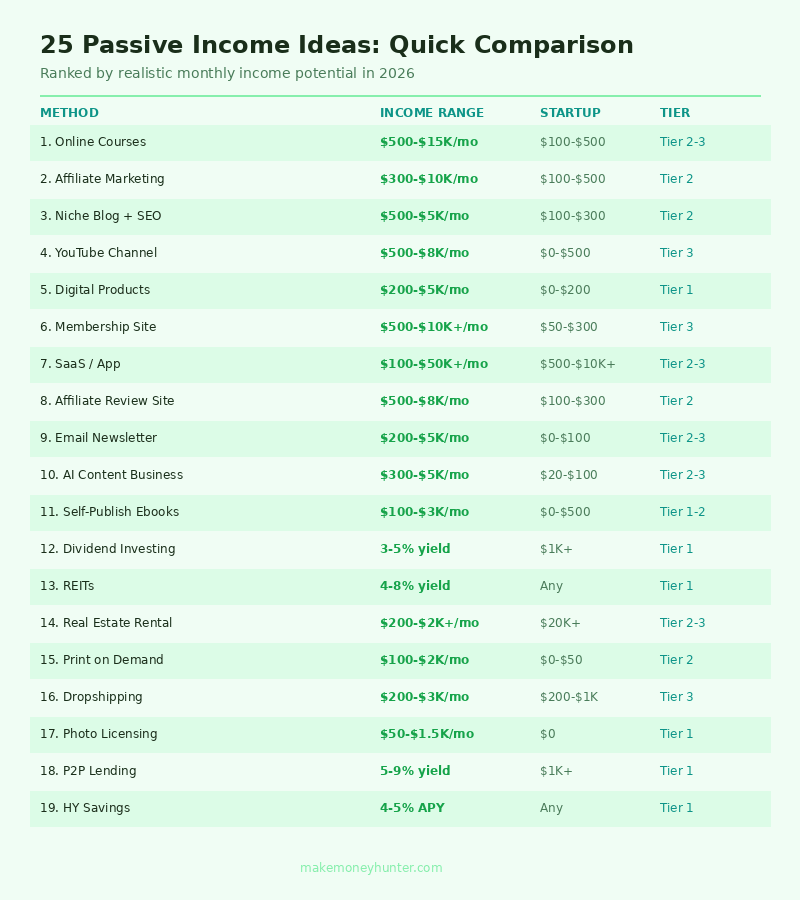
I categorize passive income into three tiers based on how much ongoing effort they need after the initial setup:
| Tier | Ongoing Effort | Examples |
|---|---|---|
| Tier 1: Near-Zero Maintenance | Less than 1 hour/month | Index fund dividends, digital products on autopilot, royalty income |
| Tier 2: Light Maintenance | 2-5 hours/month | Niche websites with SEO traffic, affiliate blogs, rental income |
| Tier 3: Semi-Passive | 5-15 hours/month | YouTube channels, online courses, membership sites |
Most people want Tier 1 but aren’t willing to do the 6-12 months of work to get there. The irony is that Tier 2 and Tier 3 methods often generate significantly more money. The sweet spot for most people is Tier 2 — enough automation to feel passive, but enough involvement to keep the income growing.
Passive Income Ideas That Actually Generate Real Money
I’ve organized these from highest confidence (methods I’ve personally tested and verified) to lower confidence (methods with strong potential that I’ve researched but haven’t fully built myself). Every income figure is based on either my own results or verified data from people I trust.
1. Start a Niche Blog With SEO Traffic
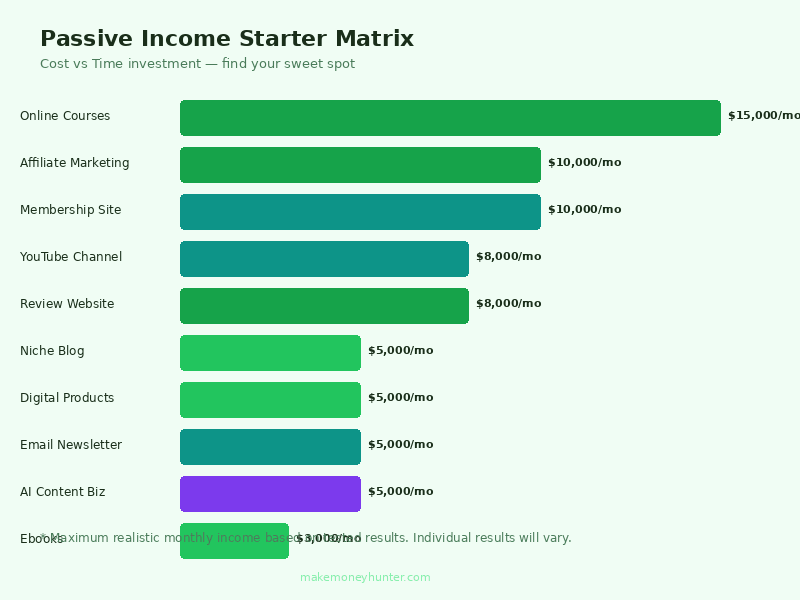
Realistic income: $500–$5,000/month after 12-18 months
Startup cost: $100-$300/year (hosting + domain)
Time to first dollar: 6-12 months
Passive tier: Tier 2
This is the method that changed everything for me. I built my first niche blog in 2011. It took 8 months before it earned anything meaningful. By month 14, it was bringing in $1,800/month from display ads and affiliate links — while I was sleeping, traveling, and working on other projects.
The key is choosing the right niche and targeting keywords that real people actually search for. You don’t need a massive audience. A blog getting 300-500 targeted visitors per day can generate $1,000-$3,000/month through a combination of AdSense and affiliate commissions. If you’re considering this path, I wrote a detailed walkthrough on building an online income from home that covers the fundamentals.
In 2026, the game has shifted. AI content flooding the internet means Google is rewarding genuine expertise and first-hand experience more than ever. If you can write from real experience and provide information that AI can’t fake, you have a significant advantage over the thousands of generic blogs being spun up daily.
2. Affiliate Marketing Through Content
Realistic income: $300–$10,000/month
Startup cost: $100-$500
Time to first dollar: 3-8 months
Passive tier: Tier 2
Affiliate marketing is how I earned my first real passive income online. You recommend products through content — blog posts, comparison articles, tutorials — and earn a commission when someone buys through your link.
The method works because you’re solving a real problem. Someone searches “best web hosting for beginners,” finds your honest comparison, and makes a decision based on your experience. The hosting company pays you $65-$200 per signup, and your article keeps working for months or years without any additional effort from you.
My best-performing affiliate article has earned over $14,000 in total commissions from a single blog post I wrote in 2020. I update it once every quarter — maybe 2 hours of work total per year. That’s about as passive as online income gets.
The mistake most people make is promoting products they’ve never used. In 2026, readers and search engines can both detect inauthentic recommendations. Stick to products you genuinely use, and your conversion rates will reflect the difference.
3. Create and Sell Digital Products
Realistic income: $200–$5,000/month
Startup cost: $0-$200
Time to first dollar: 1-3 months
Passive tier: Tier 1
Digital products are the closest thing to true passive income I’ve found. You create the product once — a template, an ebook, a spreadsheet, a design asset — and sell it repeatedly with zero additional production cost.
That $47 template sale I mentioned at the beginning? That product took me about 12 hours to create. It’s generated over $3,400 in total sales across two years. No inventory, no shipping, no customer service beyond the occasional email.
Platforms like Gumroad, Etsy (for digital downloads), and Teachable make the selling part almost friction-free. You upload your product, write a solid sales page, and let the platform handle payment processing and delivery.
The best digital products solve a specific, painful problem. “How to create a budget” is too broad. “Monthly Budget Spreadsheet for Freelancers with Irregular Income” — that’s specific enough to sell.
4. Build a YouTube Channel Around Evergreen Content
Realistic income: $500–$8,000/month after 12-24 months
Startup cost: $0-$500
Time to first dollar: 6-12 months (monetization threshold)
Passive tier: Tier 3
YouTube is semi-passive, but I’m including it because the earning potential from old videos is genuinely impressive. I know creators in my niche whose videos from 3 years ago still generate $500-$1,500/month each.
The secret is creating content that people search for year-round — tutorials, how-to guides, explainers — rather than trending or news-based content. A video titled “How to Set Up WordPress in 2026” will get steady views every single day as new people discover blogging.
The platform pays through AdSense revenue sharing, but the real money comes from affiliate links in descriptions and promoting your own products. One well-optimized tutorial video can become a permanent sales funnel that works 24/7.
5. Dividend Investing
Realistic income: 3-5% annual yield on invested capital
Startup cost: $1,000+ (the more, the better)
Time to first dollar: Immediately after first dividend payment
Passive tier: Tier 1
This is the most traditional form of passive income, and it works exactly as advertised — if you have the capital. You buy shares of dividend-paying stocks or ETFs, and you receive quarterly payments just for holding them.
At a 4% yield, you need $250,000 invested to generate $10,000/year in dividends. That’s the math most people don’t want to hear. But dividend investing is the ultimate Tier 1 passive income — once your portfolio is built, you literally do nothing.
I personally use a combination of SCHD (Schwab U.S. Dividend Equity ETF) and VYM (Vanguard High Dividend Yield ETF) for the core of my dividend portfolio. Not exciting, but consistent and boring is exactly what passive income should be.
Note: I’m not a financial advisor. This is what works for me — do your own research before investing.
6. Index Fund Investing (Growth + Dividends)
Realistic income: 7-10% average annual return (historically)
Startup cost: Any amount
Time to first dollar: Varies (long-term strategy)
Passive tier: Tier 1
While pure dividend investing gives you cash flow, broad index fund investing builds wealth that you can eventually convert into income. The S&P 500 has averaged roughly 10% annual returns over the last century.
This isn’t “make money online” exciting, but it’s the foundation that makes every other passive income strategy less stressful. When you have $50,000 or $100,000 growing in index funds, you make better decisions about your business because you’re not desperate.
7. Online Course Creation
Realistic income: $500–$15,000/month
Startup cost: $100-$500
Time to first dollar: 2-6 months
Passive tier: Tier 2-3
If you have expertise in anything — cooking, Excel, guitar, coding, photography — you can package it into an online course and sell it on platforms like Teachable, Udemy, or Skillshare.
I created a small course about keyword research for bloggers. It took about 40 hours to build (recording, editing, creating materials). In its first year, it generated just over $8,200. The second year, with no updates, it brought in $5,100. That’s $13,300 from 40 hours of work.
The key is creating a course about something people are willing to pay to learn and that delivers a tangible result. “Learn Photography” is too vague. “Product Photography for Etsy Sellers: From Phone Shots to Professional Listings” — that course sells itself.
8. Print-on-Demand Products
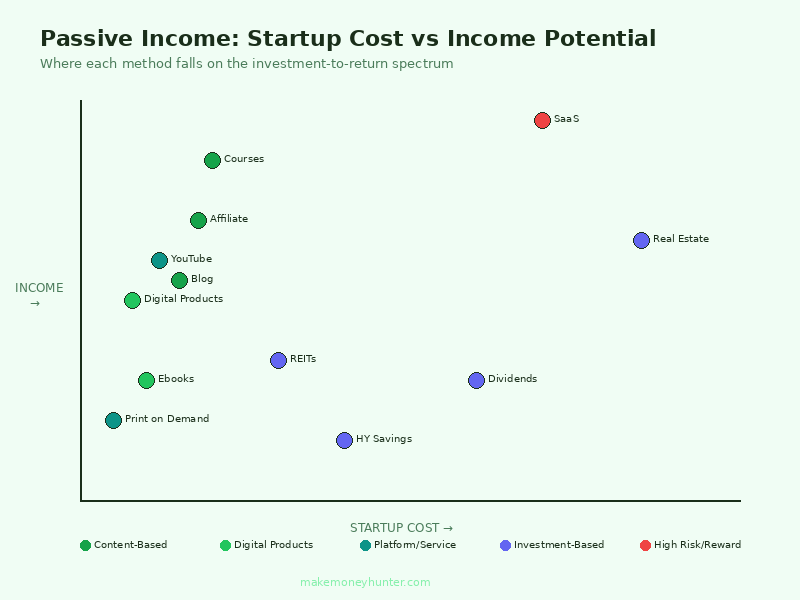
Realistic income: $100–$2,000/month
Startup cost: $0-$50
Time to first dollar: 1-3 months
Passive tier: Tier 2
Print-on-demand lets you design products — t-shirts, mugs, phone cases, posters — without holding any inventory. When someone orders, the company prints and ships it for you. You keep the margin.
This isn’t going to make you rich, but the barrier to entry is nearly zero. If you can create designs that resonate with a specific audience (dog lovers, nurses, gamers, teachers), the income adds up. I tested this with a small collection of minimalist designs on Redbubble and Merch by Amazon. It currently brings in about $350/month with zero ongoing work.
9. Rental Income From Real Estate
Realistic income: $200–$2,000+/month per property
Startup cost: $20,000+ (down payment)
Time to first dollar: 1-3 months after purchase
Passive tier: Tier 2-3
Real estate rental income is the classic passive income strategy — and it works. The challenge is the high barrier to entry. You need capital for a down payment, you need to understand your local market, and you need to be comfortable dealing with tenants (or hiring a property manager).
I’m including this because it’s genuinely one of the most reliable passive income streams that exist. With a property manager handling day-to-day operations, your involvement drops to a few hours per month reviewing financials and making occasional decisions.
10. REITs (Real Estate Investment Trusts)
Realistic income: 4-8% annual yield
Startup cost: Any amount
Time to first dollar: Next dividend payment date
Passive tier: Tier 1
If you like the idea of real estate income but don’t have $50,000+ for a down payment, REITs let you invest in real estate through the stock market. You buy shares, the REIT manages properties, and you get dividend payments.
It’s essentially a way to earn rental income without being a landlord. The yield is typically higher than regular dividend stocks because REITs are required by law to distribute at least 90% of their taxable income to shareholders.
11. High-Yield Savings Accounts and CDs
Realistic income: 4-5% APY (as of early 2026)
Startup cost: Any amount
Time to first dollar: Monthly interest payments
Passive tier: Tier 1
This is the simplest passive income method that exists. You put money in a high-yield savings account and earn interest. That’s it. No skill required, no risk of losing your principal (FDIC insured up to $250,000).
With rates still hovering around 4-5% APY at many online banks, $10,000 in a high-yield savings account generates about $400-$500/year in completely passive income. Not life-changing, but it’s money that literally appears while you do nothing.
12. Write and Self-Publish Ebooks
Realistic income: $100–$3,000/month
Startup cost: $0-$500 (cover design, editing)
Time to first dollar: 1-3 months
Passive tier: Tier 1-2
Amazon Kindle Direct Publishing (KDP) lets anyone publish an ebook and sell it to millions of readers worldwide. The royalty is 35-70% depending on pricing, and the book stays available indefinitely.
I published a short ebook about building niche websites. Nothing fancy — about 15,000 words. It took me two weeks of focused writing. In its first 12 months, it earned $2,100 in royalties. Not a bestseller, but $175/month for a two-week project is solid passive income math.
In 2026, the ebook market is more crowded than ever thanks to AI-generated content. The books that still sell well are those with genuine expertise and specific, actionable advice — things that AI alone can’t replicate convincingly.
13. License Your Photography or Design Work
Realistic income: $50–$1,500/month
Startup cost: Camera or design software you already own
Time to first dollar: 1-6 months
Passive tier: Tier 1
If you have a library of quality photos or design assets, platforms like Shutterstock, Adobe Stock, and Creative Market let you sell them repeatedly. Each individual sale is small ($0.25-$5 per download), but it compounds as your library grows.
Photographers I know who have 2,000+ images on stock platforms earn $800-$1,500/month in completely passive income. The photos were taken years ago and continue to sell without any additional effort.
14. Create a Membership Site or Community
Realistic income: $500–$10,000+/month
Startup cost: $50-$300/month (platform fees)
Time to first dollar: 1-3 months
Passive tier: Tier 3
A membership site gives you recurring revenue — people pay monthly to access exclusive content, community, or resources. This is semi-passive because you need to continuously add value to retain members, but the recurring nature of the income is powerful.
Even a small membership with 100 members paying $29/month generates $2,900/month in predictable, recurring income. The challenge is creating enough value that people stay subscribed month after month.
15. Peer-to-Peer Lending
Realistic income: 5-9% annual returns
Startup cost: $1,000+
Time to first dollar: 1-2 months
Passive tier: Tier 1
Platforms like Prosper and LendingClub let you lend money to individuals and earn interest. The returns are higher than savings accounts but come with more risk — some borrowers default.
I experimented with $5,000 in peer-to-peer lending. After 18 months, my net return was about 6.8% after defaults. Not spectacular, but truly passive. I logged in maybe twice during that entire period.
16. Build a Niche Website and Sell It
Realistic income: Lump sum of 24-36x monthly profit
Startup cost: $100-$500
Time to first dollar: 12-24 months (build phase) + sale
Passive tier: N/A (one-time payout)
This is a different angle on passive income. Instead of holding a website forever, you build it up over 12-24 months, then sell it for a multiple of its monthly earnings. A site making $1,000/month typically sells for $24,000-$36,000 on marketplaces like Flippa or Empire Flippers.
I’ve sold two niche sites this way. The combined sale price was more money than most people make in a year of traditional employment. The work is front-loaded, and the payout is a lump sum rather than monthly passive income — but it’s a legitimate wealth-building strategy.
17. Automated Dropshipping Store
Realistic income: $200–$3,000/month (after automation)
Startup cost: $200-$1,000
Time to first dollar: 1-3 months
Passive tier: Tier 3
Dropshipping gets a bad reputation because most people do it wrong. They chase trending products, run cheap ads, and disappear when things get hard. But a well-built dropshipping store focused on a specific niche — with good supplier relationships and automated fulfillment — can generate semi-passive income.
I’ll be honest: this is one of the least passive options on this list. Customer service alone takes real time. But if you automate order processing and use a VA for customer inquiries, the time investment drops to 5-10 hours per month.
18. Create a Mobile App or SaaS Tool
Realistic income: $100–$50,000+/month (extreme variance)
Startup cost: $500-$10,000+ (unless you code it yourself)
Time to first dollar: 3-12 months
Passive tier: Tier 2-3
If you can build software — or partner with someone who can — recurring subscription revenue from a useful app is one of the most scalable passive income models. The range is enormous because software can serve 10 users or 10,000.
Small SaaS tools solving very specific problems (like a scheduling tool for dog groomers or an invoice generator for freelancers) often do better than ambitious platforms trying to compete with established players.
19. Music and Audio Royalties
Realistic income: $50–$2,000/month
Startup cost: $0-$300
Time to first dollar: 1-6 months
Passive tier: Tier 1
If you create music, sound effects, or audio content, platforms like AudioJungle, Epidemic Sound, and even Spotify pay royalties every time your content is used or streamed. Beat producers and background music creators can build libraries that earn passive royalties for years.
20. Vending Machine Business
Realistic income: $100–$500/month per machine
Startup cost: $2,000-$5,000 per machine
Time to first dollar: 1-2 months
Passive tier: Tier 2
This one is offline but genuinely passive once set up. You buy a vending machine, place it in a high-traffic location, and restock it weekly. The profit margin on snacks and drinks is 50-60%, and a well-placed machine can generate $200-$500/month.
It’s not glamorous, but I know someone who runs 8 machines on a part-time basis and clears $2,800/month. The work is mostly logistics — restocking and collecting cash — which takes about 3-4 hours per week total.
21. Rent Out Your Car, Parking Space, or Storage
Realistic income: $100–$1,000/month
Startup cost: $0 (you’re renting assets you already own)
Time to first dollar: 1-2 weeks
Passive tier: Tier 1-2
Platforms like Turo (car rental), Neighbor (storage), and SpotHero (parking) let you monetize assets that are sitting idle. If your car sits in the driveway 20 days a month, that’s 20 days it could be earning $30-$60/day on Turo.
22. Affiliate Review Website
Realistic income: $500–$8,000/month
Startup cost: $100-$300
Time to first dollar: 4-10 months
Passive tier: Tier 2
This is similar to blogging but focused specifically on product reviews and comparisons. You create in-depth reviews of products in a specific niche, optimize for search engines, and earn affiliate commissions when readers buy through your links.
The advantage over general blogging is that review keywords often have higher commercial intent — meaning readers are closer to making a purchase. The disadvantage is that Google scrutinizes review content heavily, so you need genuine hands-on experience with the products you review.
23. License Your Expertise Through Consulting Retainers
Realistic income: $1,000–$5,000/month per retainer
Startup cost: $0
Time to first dollar: 1-4 weeks
Passive tier: Tier 3
This isn’t purely passive, but a monthly retainer arrangement — where a client pays you a fixed amount for availability and periodic advice — can feel very passive compared to hourly consulting. You might spend 3-5 hours per month on a $2,000 retainer.
24. Create an Automated Email Newsletter
Realistic income: $200–$5,000/month
Startup cost: $0-$100/month
Time to first dollar: 3-6 months
Passive tier: Tier 2-3
Email newsletters monetized through sponsorships, affiliate links, and digital product promotions can generate meaningful income. Platforms like Beehiiv and ConvertKit make it easy to build and grow a subscriber base.
The semi-passive angle: once you have a large enough archive, you can create automated email sequences that deliver content to new subscribers over weeks or months. The initial content creation is front-loaded, but delivery becomes automated.
25. AI-Assisted Content Businesses
Realistic income: $300–$5,000/month
Startup cost: $20-$100/month (AI tools)
Time to first dollar: 1-4 months
Passive tier: Tier 2-3
In 2026, AI tools have created entirely new categories of passive income. You can use AI to help you create content at scale — social media posts, blog articles, email sequences, design assets — and sell those services or the content itself.
The key word is “help.” AI doesn’t replace your expertise — it amplifies it. The people making real money with AI-assisted content businesses are those who use AI to handle the tedious parts while adding their own expertise, editing, and quality control on top.
Some specific models that are working right now: AI-assisted niche blog networks (you provide strategy and editing, AI helps with first drafts), automated social media management for small businesses, and AI-generated design asset libraries sold on Creative Market.
How to Choose the Right Passive Income Strategy for You
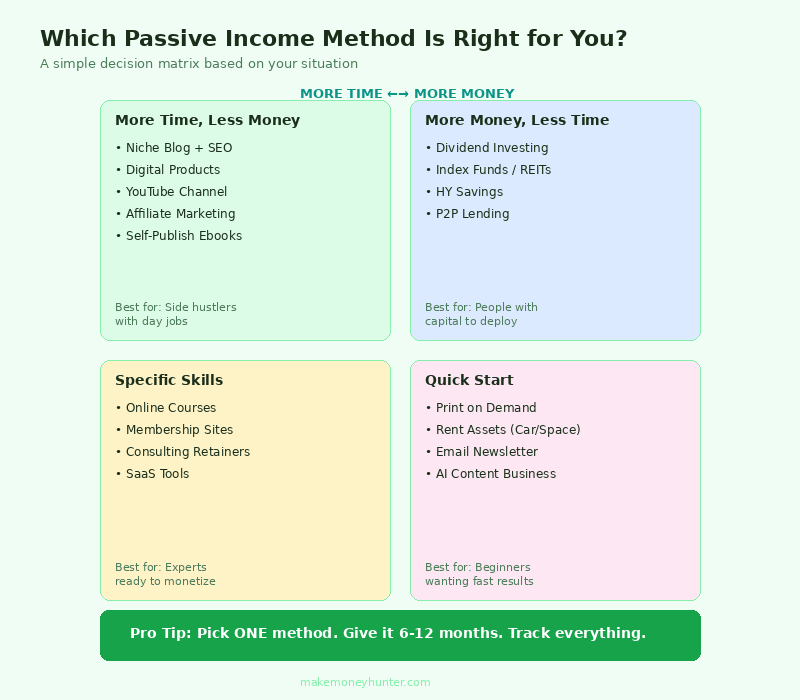
With 25 options on the table, the worst thing you can do is try all of them. Spreading yourself across five different methods means you’ll do none of them well. Here’s how I’d narrow it down:
If you have more time than money: Start with blogging, affiliate marketing, or digital products. These require minimal upfront investment but significant time commitment. The payoff is delayed but can be substantial.
If you have more money than time: Dividend investing, REITs, high-yield savings, and peer-to-peer lending let your capital work for you with almost zero time investment.
If you have a specific skill: Online courses, ebooks, consulting retainers, and membership sites let you monetize expertise you already have. The product creation phase is work, but the selling becomes increasingly automated.
If you want the fastest path to first dollar: Digital products on Gumroad, print-on-demand, or renting out assets you already own can generate income within weeks, not months.
The Methods I’d Avoid in 2026
Not every popular “passive income idea” deserves your time. Here are a few I’ve tested or researched that I’d steer clear of:
Crypto staking for yield: The yields have compressed massively, and the risk of platform failure (remember FTX?) makes this a poor risk-reward trade for most people.
Amazon FBA as “passive”: I’ve seen people call this passive income. It’s not. Between sourcing, shipping to Amazon warehouses, monitoring listings, handling returns, and managing inventory, FBA is a full-on business — not passive income.
Ad revenue from faceless YouTube channels: This worked in 2022-2023. In 2026, YouTube’s algorithm has gotten much better at identifying low-quality, AI-generated content. The channels getting demonetized far outnumber the ones still earning.
Frequently Asked Questions About Passive Income
How much money do I need to start earning passive income?
You can start with as little as $0 if you’re willing to invest time instead. Blogging, digital products, and YouTube all have near-zero startup costs. Investment-based passive income (dividends, REITs) requires capital — the more you invest, the more you earn.
What is the most realistic passive income for beginners?
For complete beginners, I recommend starting with either a niche blog or digital products. Both have low barriers to entry, teach you valuable skills, and can scale significantly over time. Avoid anything that requires large capital or advanced technical skills until you’ve built some experience.
Can passive income replace a full-time job?
Yes, but it typically takes 2-3 years of consistent effort to reach that level. I’ve seen people replace a $60,000/year salary through a combination of 2-3 passive income streams. The keyword is “combination” — relying on a single stream is risky.
Is passive income taxable?
Yes. All passive income is subject to income tax. Specific tax treatment varies by type — dividends, rental income, business income, and capital gains each have different rules. Consult a tax professional when your passive income becomes significant.
What passive income ideas work best for passive income online?
The strongest online passive income methods in 2026 are niche blogging with SEO traffic, affiliate marketing, digital product sales, and online courses. These all leverage the internet’s ability to reach unlimited customers with zero marginal cost per sale.
The Real Truth About Building Passive Income
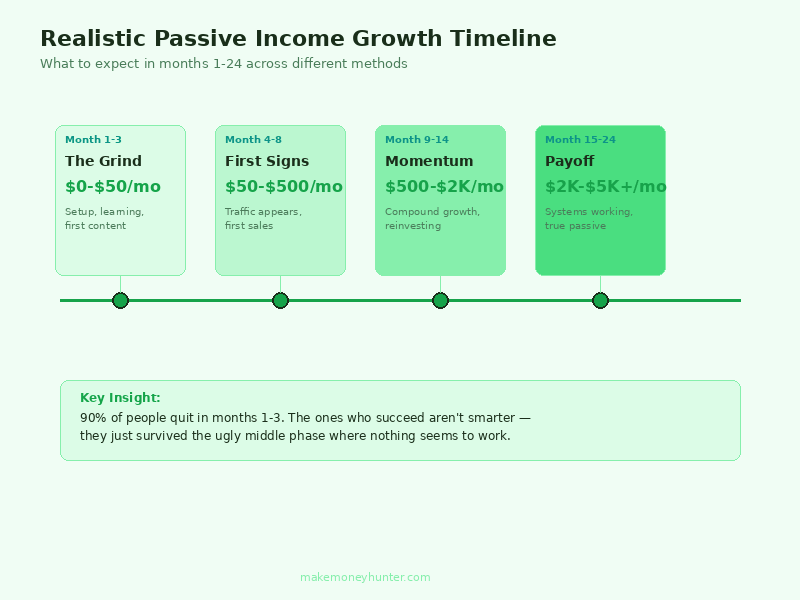
One last thing that most passive income articles won’t tell you: the hardest part isn’t picking a method. It’s surviving the gap between starting and seeing results.
There’s a period — usually 3 to 8 months — where you’re putting in work and seeing almost nothing in return. Your blog has 12 visitors a day. Your digital product has zero sales. Your investment portfolio is too small to generate meaningful dividends. This is where 90% of people quit.
The ones who break through aren’t smarter or luckier. They’re just the ones who kept going when it felt pointless. Every single income stream I have today went through that ugly middle phase. My best-performing blog earned $0 for five straight months before something clicked.
So pick one method from this list. Just one. Give it 6-12 months of focused effort. Track your numbers. Adjust your approach based on what the data tells you. And when month 3 rolls around and you’ve earned $11 total, remember that the curve is exponential — the growth always feels impossibly slow until it suddenly isn’t.