

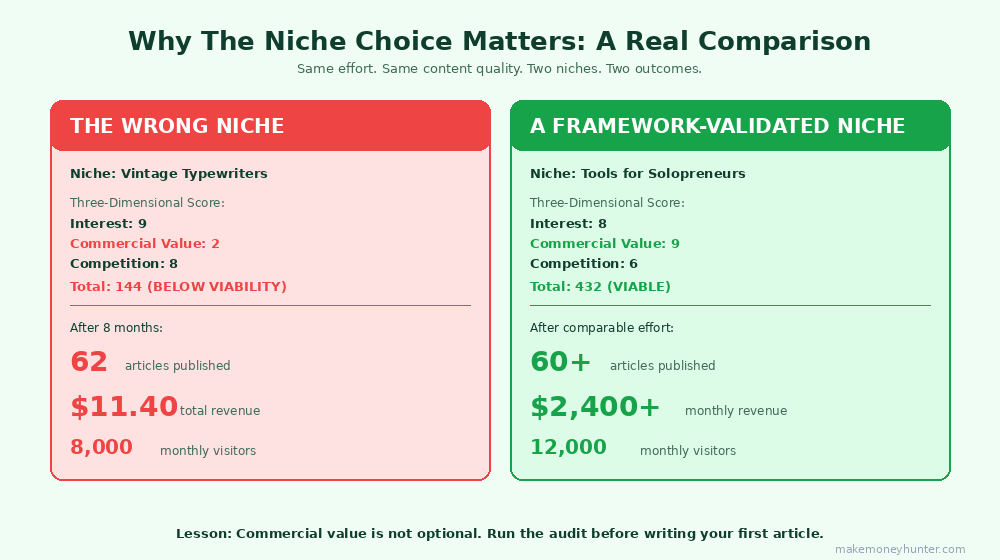
In 2014, I picked a blog niche I was passionate about — vintage typewriters. Eight months and 62 articles later, I had earned a grand total of $11.40 in affiliate commissions. The traffic was real. The readers were genuinely interested. There was just one problem: nobody in that audience was buying anything online, and the few products that existed paid 4% commission on $30 typewriter ribbons. I had picked a niche I loved, but it wasn’t a niche that paid.
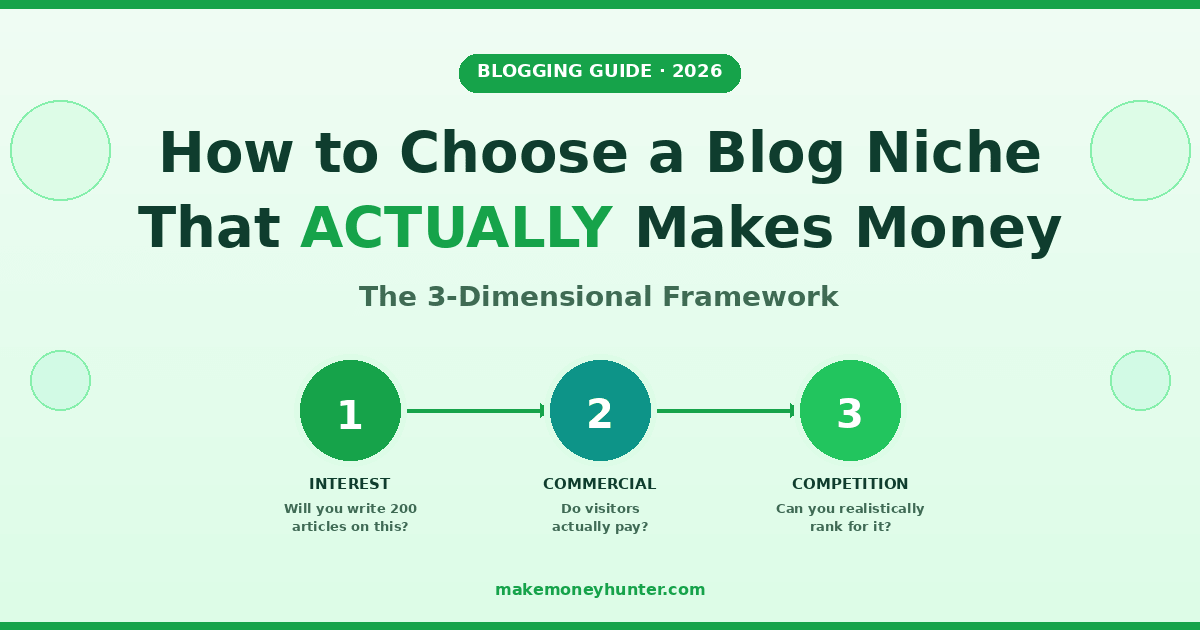
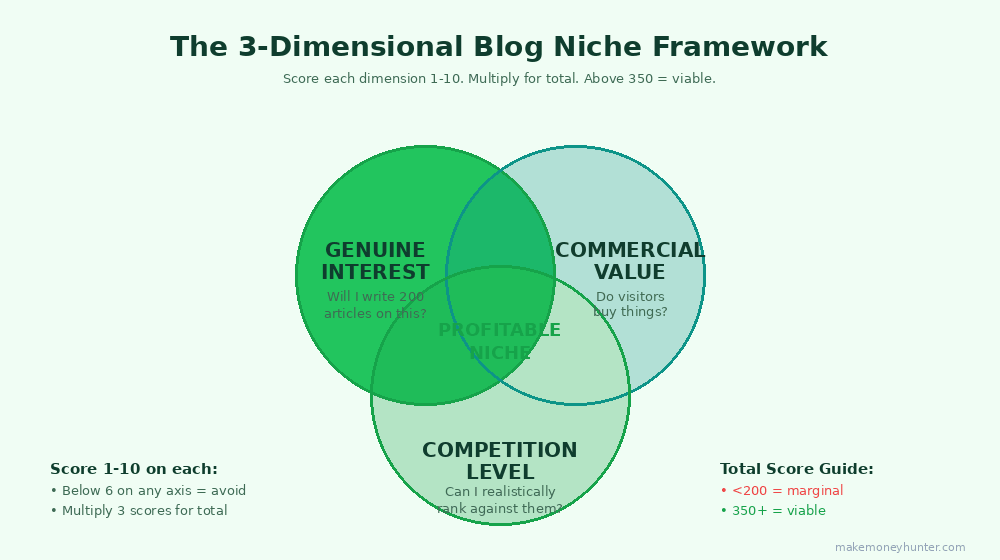
The right blog niche sits at the intersection of three things: your genuine interest, real commercial demand, and a competition level you can realistically beat. Get any one of those wrong, and the math doesn’t work — no matter how much content you publish.
This guide walks you through the exact framework I now use to evaluate every niche before writing a single article. You’ll learn the three-dimensional test, the 10 niches I’ve personally validated as profitable in 2026, the mistakes that cost me thousands, and a step-by-step process you can finish in one afternoon. By the end, you’ll know whether the niche you’re considering can pay you in 12 months — or whether you need to keep looking.
Why Most Bloggers Pick the Wrong Niche
The standard advice you’ll hear is “follow your passion.” It sounds noble. It also explains why so many blogs die in year one. Passion alone doesn’t pay the hosting bill. Neither does picking a high-paying niche you have zero interest in — you’ll burn out before the traffic arrives.
The real problem is that most niche-selection advice treats the decision as one-dimensional. Pick what you love. Pick what pays. Pick what’s trending. None of those single-axis decisions hold up against 18 months of consistent publishing, which is roughly how long it takes for a new blog to generate meaningful organic traffic.
The good news is that a properly chosen niche compounds — your blog becomes one of the better long-term passive income assets you can build from a laptop, but only if the foundation is right.
A profitable niche needs to survive three different stress tests. It needs to interest you enough to keep producing content when results are slow. It needs commercial demand strong enough that traffic actually converts to revenue. And it needs a competition level where a single-person operation can realistically rank against existing players. Miss any of the three, and you’re working hard against a structural problem that effort alone won’t solve.
The Three-Dimensional Niche Framework
I evaluate every niche on three axes. Each gets a score from 1 to 10. A viable niche needs to score at least 6 on every axis — not 9 on one and 3 on another. Balance is the goal, not extremes.
Dimension 1: Genuine Interest (Score: 1-10)
Ask yourself: would I still want to write about this topic 200 articles in, when the novelty has worn off? Would I read about this topic for fun on a random Saturday? Could I have a 30-minute conversation about it without checking my phone?
This isn’t about loving a topic with romantic intensity. It’s about having enough genuine curiosity that the work feels sustainable. The bar I use: would I be willing to spend 5-10 hours a week on this for the next 18 months, even if I made nothing for the first 12?
If the honest answer is “no,” score it under 6 — you’ll quit before the traffic arrives. If you can’t even articulate three subtopics within the niche off the top of your head, you don’t know it well enough yet to commit.
Dimension 2: Commercial Value (Score: 1-10)
This is where most “passion” niches die. Commercial value answers a different question: what does the average visitor to this niche actually spend money on, and how much of that spending can your blog credibly influence?
High commercial value niches share four traits: visitors are actively researching purchases, the products being purchased cost real money (not $5 trinkets), there are affiliate programs paying meaningful commissions, and the buying decisions involve enough complexity that people seek out content to make them.
You can score commercial value quickly using three signals. First, search Google for “best [your niche topic]” and count how many ads appear at the top — more ads means advertisers are paying real money for that traffic. Second, check whether 3-5 affiliate programs exist with commissions above $20 per sale. Third, look at competitor blogs in the niche and check whether they appear to be making money (active content production, professional design, multiple income streams visible).
Vintage typewriters scored about 2 on this dimension. Web hosting scores about 9. The gap explains everything.
Dimension 3: Competition Level (Score: 1-10, inverted)
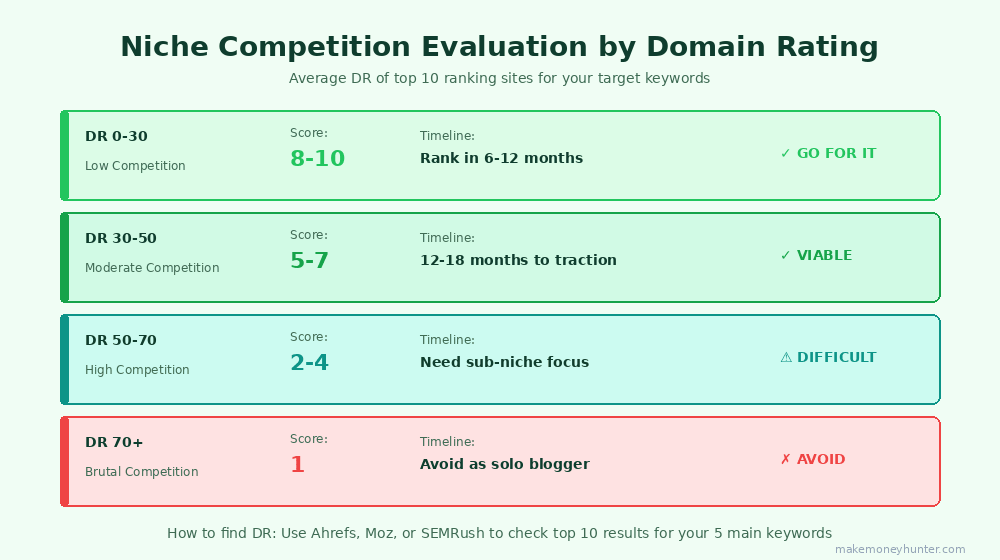
This dimension is reversed: a score of 10 means low competition (good for you), and a score of 1 means brutal competition (run away). The metric I use is the average Domain Rating of the top 10 ranking sites for your top 5 target keywords.
Here’s a rough scoring guide for new blogs in 2026:
- Average DR 0-30 across top 10: Low competition, score 8-10. You can realistically rank within 6-12 months.
- Average DR 30-50: Moderate competition, score 5-7. Possible but expect 12-18 months to traction.
- Average DR 50-70: High competition, score 2-4. Possible only with significant content advantage or sub-niche focus.
- Average DR 70+: Brutal competition, score 1. Don’t pick this niche unless you have a budget for content and links most solo bloggers can’t match.
Big finance, mainstream personal development, and broad fitness niches typically fall into the brutal category. That doesn’t mean you can’t write about money — it means you need a sub-niche where the established giants haven’t focused yet.
How to Combine the Three Scores
Multiply the three scores together. Anything below 200 is a marginal niche. Above 350 is a viable niche. Above 500 is rare and worth pursuing aggressively. The multiplication matters because it punishes weakness — a niche scoring 9-9-2 (162 total) is worse than one scoring 7-7-7 (343 total), even though the first one looks impressive on two dimensions.
The framework stops you from falling in love with a single attribute. A niche you love but nobody pays for is hobby, not business. A niche that pays well but you find boring will lose to anyone who genuinely cares about it. A niche scoring 7+ on all three is what you’re looking for.
10 Profitable Blog Niches I’ve Personally Validated in 2026
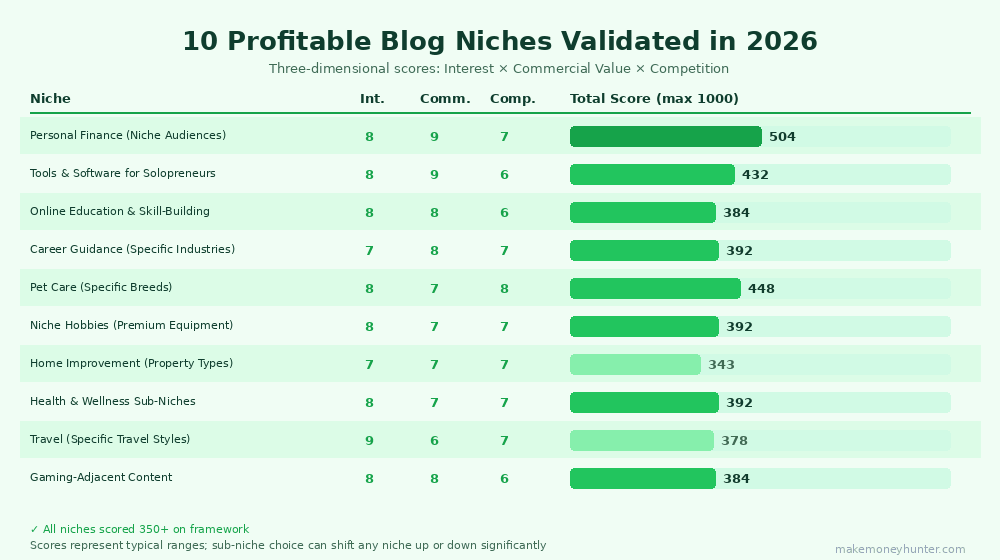
The following niches have all returned positive ROI on at least one of my own sites or sites I’ve audited closely in the past three years. I’m including each one’s typical scores against the three-dimensional framework, plus the specific monetization paths that work.
1. Personal Finance for Specific Demographics
Broad personal finance is a brutal niche. But personal finance for a specific group — military families, recent immigrants, freelancers, single parents — is wide open. Commercial value stays high (financial products pay strong affiliate commissions and CPMs), but competition drops dramatically when you narrow the audience.
Scoring profile: Interest 7-9 (depends on you), Commercial 9, Competition 6-8 (depending on demographic).
Monetization: Credit card affiliate programs, robo-advisor referrals, financial tool affiliate programs, sponsored content from finance brands. Top earners in narrow demographic finance niches report $5,000-$50,000/month within 18-24 months.
2. Tools and Software for Solopreneurs
This is one of my own focus areas. The audience consists of people building businesses who actively buy tools to save time. Affiliate commissions from SaaS products are exceptional — recurring commissions of 20-30% on monthly subscriptions add up quickly. If you’re new to the model, my walkthrough on how affiliate marketing actually works for beginners covers the basics. The audience in this niche already understands the model, which is part of why it converts so well.
Scoring profile: Interest 7+, Commercial 9, Competition 5-7.
3. Niche Hobbies with Premium Equipment
Think specific hobbies where enthusiasts spend serious money on gear: high-end woodworking, premium photography, indoor cycling training, mechanical keyboards, audiophile equipment. These niches reward genuine expertise — the audience can spot a fake immediately, but rewards trusted voices with strong purchase intent.
Scoring profile: Interest 8+ (you must actually do this), Commercial 7, Competition 6-8.
4. Pet Care for Specific Breeds or Situations
“Dog blogs” is brutal. “Care guide for senior French Bulldogs” or “raising puppies in apartments” is wide open. Pet owners spend extraordinary amounts on their animals and search obsessively for guidance. The narrower you go, the better your odds.
Scoring profile: Interest 7+ (love your subject), Commercial 7, Competition 7-9.
5. Career Guidance for Specific Industries
Generic career advice loses to LinkedIn. But specific career guidance — “data engineering interview prep,” “switching from teaching to UX design,” “first 90 days as a product manager” — has high commercial value (course affiliates, coaching, books) and genuine audience need.
Scoring profile: Interest depends on your background, Commercial 8, Competition 6-7.
6. Home Improvement for Specific Property Types
Generic home improvement is competitive. Specific contexts — small condos, vintage homes, RV living, off-grid cabins — have less competition and equally engaged audiences. Home improvement readers convert well on Amazon affiliates and on tool/material brand partnerships.
Scoring profile: Interest 7+, Commercial 7, Competition 7.
7. Online Education and Skill-Building
Teaching specific skills — coding, design, languages, music instruments, cooking techniques — pairs well with course affiliate programs (Skillshare, Coursera, Udemy) plus your own digital products eventually. The audience self-selects as people who buy education.
Scoring profile: Interest 8+ (teach what you know), Commercial 8, Competition varies wildly by sub-niche.
8. Health and Wellness Sub-Niches
Mainstream health is dominated by medical sites and brutal to enter. But specific health contexts — managing autoimmune conditions through diet, recovery from specific injuries, sleep optimization for shift workers — remain accessible. Be careful with YMYL content and cite sources rigorously.
Scoring profile: Interest 8+, Commercial 7, Competition 6-8.
9. Travel for Specific Travel Styles
Generic travel is brutal. But specific travel styles — solo female travel in specific regions, slow travel for digital nomads, travel with toddlers, RV travel routes — have devoted audiences. Booking platform affiliates pay reasonably well, and gear affiliates compound.
Scoring profile: Interest 9 (you actually travel this way), Commercial 6, Competition 6-7.
10. Gaming Adjacent Content
Not gaming itself (brutal). But gaming-adjacent topics: streaming setup guides, sim racing equipment, specific game-genre strategy, indie game recommendations, gaming peripherals. These audiences buy expensive gear and follow trusted voices loyally.
Scoring profile: Interest 8+, Commercial 8, Competition 5-7.
The Niche I Picked Wrong (And What It Taught Me)
Back to vintage typewriters for a moment. The site eventually got to about 8,000 monthly visitors. The audience genuinely loved it. People emailed me beautiful stories about typewriters they inherited from grandparents. By every measure except revenue, it was working.
The lesson wasn’t “don’t follow your passion.” The lesson was that I never asked the second question. I asked “what do I love?” and got an answer. I forgot to ask “what does the audience for this love spend money on?” The answer in that case was: they read about typewriters. Sometimes they bought ribbons or oil — neither of which had meaningful affiliate programs. They didn’t subscribe to typewriter SaaS tools. They didn’t take typewriter courses. The commercial chain of value just wasn’t there.
What I should have done was spend one afternoon on commercial value research before writing 60+ articles. I would have searched “best typewriter [anything]” on Google and noticed there were almost no ads — a nearly infallible signal that advertisers don’t see commercial intent in this audience. I would have searched for affiliate programs and found maybe one or two with token commissions. Twenty minutes of work would have saved me eight months.
The framework above exists specifically because I made that mistake. Don’t make it.
Step-by-Step: How to Validate Your Niche in One Afternoon
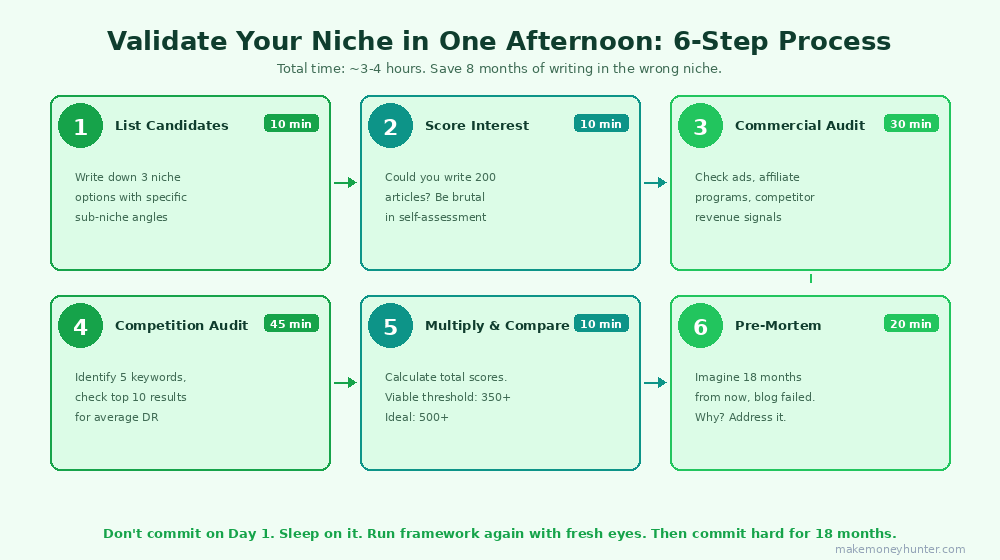
Here’s the exact process I now run before committing to any niche. It takes about 3-4 hours and saves you from the mistake I made.
Step 1: List Your Top 3 Candidate Niches
Write down three niches you’d genuinely consider. For each, note the specific sub-niche or angle, not just the broad category. “Personal finance” isn’t a niche; “personal finance for new immigrants to Canada” is.
Step 2: Score Each on Genuine Interest
For each candidate, answer the gut-check question: would you write about this topic 200 articles in? Score 1-10. Be brutal — if you’re scoring above 8, ask yourself whether you’ve actually written about it before, or whether you’re imagining how it would feel.
Step 3: Run the Commercial Value Audit
For each candidate, do the following 30-minute audit:
- Google “best [niche topic]” and count ads at the top of the results page. 0-1 ads is bad. 2-4 ads is okay. 5+ ads is strong commercial intent.
- Search Google for “[niche topic] affiliate program” and count how many results lead to programs with $20+ commissions per sale or 20%+ recurring commissions.
- Find 3 competitor blogs in the niche. Look at their content frequency and design quality. Active, professional sites mean money flows here.
- Score commercial value 1-10 based on what you find.
Step 4: Run the Competition Audit
For each candidate, identify 5 specific keyword phrases someone in this niche would actually search. Use a free tool like Ahrefs Keyword Generator or SEMrush to find these. Then Google each one and look at the top 10 results.
If most results are from sites with Domain Rating above 60, the competition is high. If you see a mix including some smaller sites under DR 30, the niche is accessible. Score competition 1-10 (10 = low competition).
This is also where solid keyword research basics pay off. Even 30 minutes of focused research will tell you whether you can realistically rank, and which sub-niches give you the cleanest path to ranking with limited starting authority. New sites also need to factor in the early-stage ranking lag — if you’re not familiar with it, my breakdown of what the Google sandbox is and how long it lasts explains why new domains often struggle to rank for the first 4-6 months even on low-competition keywords.
Step 5: Multiply and Compare
Multiply the three scores for each candidate. Compare totals. Pick the highest score above 350 — or, if no candidate scores above 350, go back to Step 1 and brainstorm more options. Don’t commit to a marginal niche just because you’ve already done the research.
Step 6: Pre-Mortem the Top Candidate
For your highest-scoring niche, imagine it’s 18 months from now and the blog has failed. Why? Write down three plausible reasons. If any of them feel uncomfortably likely, address them before committing — or pick the second-place candidate.
Common Mistakes That Sink Blog Niches
Even with the framework, certain mistakes show up repeatedly. Watch for these.
Mistake 1: Picking a niche purely because someone else makes money in it. Their advantage may be timing, expertise, network, or pure luck — none of which transfer to you. Validate independently using the framework.
Mistake 2: Going too broad. “Health and wellness” is not a niche. “Anti-inflammatory eating for autoimmune disease” is. Broad topics force you to compete against established giants on every search. Narrow specifics give you a path.
Mistake 3: Ignoring search intent. If the top 10 results for your target keywords are all e-commerce product pages, your blog post can’t rank — Google has decided users searching that term want to buy, not read. Check the search results before assuming you can compete.
Mistake 4: Underestimating “interest” decay. A topic you find interesting now may bore you in six months. The test isn’t “is this interesting today” — it’s “do I want to be the leading expert on this in 5 years?” Different question, often different answer.
Mistake 5: Picking a trend, not a topic. Trending topics (“metaverse fashion,” “specific coin investing”) have shallow audiences. By the time you build authority, the trend has moved on. Choose evergreen topics with steady search volume over the past 3-5 years.
What to Do Once You’ve Picked Your Niche
Niche selection is step one of about thirty steps to a profitable blog. The next critical step is building your foundation — choosing reliable hosting, setting up WordPress correctly, and planning your content cluster strategy. The infrastructure decisions you make in week one matter more than people realize. Cheap, slow hosting will hurt your rankings before you’ve written your tenth article. My full walkthrough for new bloggers, starting a blog the right way, covers the technical foundation in detail.
From there, the real work begins: keyword research at depth, content production at consistency, and patient internal linking that builds topical authority over months. Once you’ve published your first 10-15 articles, you’ll also need a clear plan for driving traffic to your blog beyond just waiting for Google to find it. None of it works if the niche is wrong. All of it works compounding-style when the niche is right.
If you’re still on the fence between two candidates after running the framework, my recommendation is always: pick the one with higher commercial value, even if your interest score is slightly lower. You can grow into a topic; you cannot manufacture commercial demand that doesn’t exist. Once your blog is live and producing content, the next question becomes how to actually monetize that traffic — which is where my deeper guide on making money blogging in 2026 picks up. I learned the niche-first lesson the hard way at 8,000 monthly typewriter visitors.
Frequently Asked Questions
How do I know if a blog niche is too saturated?
Check the Domain Rating of the top 10 ranking sites for your 5 most important keywords. If the average DR is above 60 across most queries, the niche is brutal for new entrants. You’ll need either a sharp sub-niche angle, an unusual content format advantage, or significant link-building capability to compete. For most solo bloggers, average DR above 50 is the practical ceiling.
Can I succeed in a low-competition niche even if commercial value is moderate?
Sometimes, but you’ll need higher traffic to generate the same revenue. A niche scoring 9 on competition (very low) but only 5 on commercial value can work if you can build to 50,000+ monthly visitors and rely on display ads. The catch is that low-commercial niches often also have lower CPMs, so the math is harder than it appears. Mid-range commercial value (7+) is much safer.
How long should I stick with a niche before deciding it’s not working?
Twelve months minimum, assuming you’re publishing consistently (4+ articles per month) and applying basic SEO fundamentals. Most blogs see no meaningful organic traffic until month 6-9. If you’ve published 50+ quality articles over 12 months and have no movement in Google Search Console impressions, the niche or your execution is wrong — but rarely earlier than that.
Should I pick a niche I’m an expert in or one I’m willing to learn?
Either can work, but the framework changes. Existing expertise lets you produce strong content faster and signals real Experience to Google’s E-E-A-T algorithm. A learning niche means slower early content but potentially fresher perspective for beginners. If you choose to learn, commit to becoming genuinely competent within 6 months — not just researching as you go.
Are there niches I should avoid in 2026 specifically?
YMYL (Your Money Your Life) niches without credentials are increasingly hard. Generic crypto and stock recommendations face regulatory and trust issues. Broad weight loss requires medical credibility most bloggers lack. AI-generated content niches (writing about AI prompts, etc.) are oversaturated and rapidly commoditizing. None are impossible, but each requires more than the framework alone can provide.
Final Thoughts
The right blog niche isn’t found by inspiration; it’s found by structured evaluation. The three-dimensional framework — interest, commercial value, competition — exists precisely because each dimension alone leads bloggers astray. Score honestly on all three, multiply the results, and trust the math more than your enthusiasm.
Here’s what I’d do today if I were starting fresh: spend this afternoon running the framework against your top three candidates. Don’t pick yet. Sleep on it. Run it again tomorrow with fresh eyes. Then commit — and commit hard. The niche that survives 48 hours of honest scrutiny is the one worth giving the next 18 months of your life to.