

My first blog earned $0 for nine straight months. Nine months of writing, tweaking, and wondering if I was wasting my time. Then, in month ten, something clicked — a single article started ranking on Google, and I made $127 from affiliate commissions while I was asleep.
That was back in 2011. Today, blogging for beginners looks completely different than it did back then, but the core truth hasn’t changed: a blog is one of the few online assets you can build from scratch, with almost zero startup cost, that has the potential to generate thousands of dollars per month in passive income.
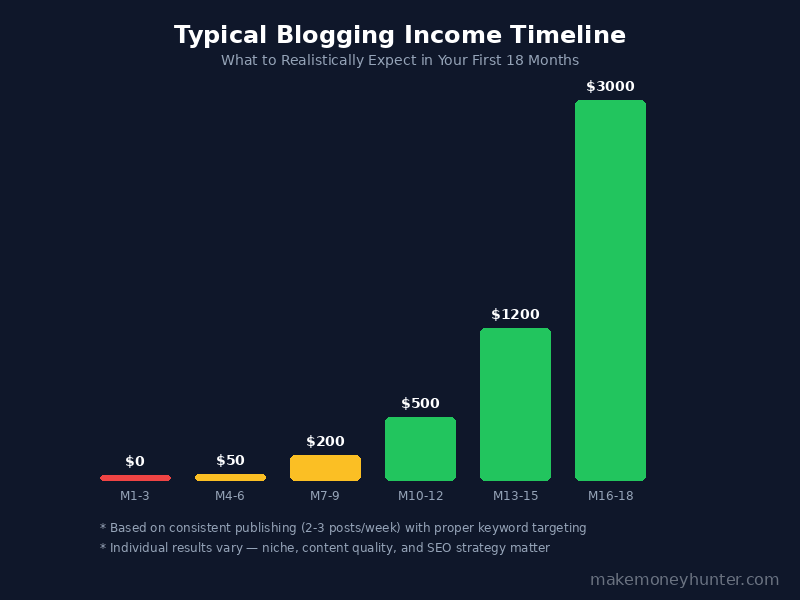
The realistic range? Most bloggers who stick with it for 12-18 months and follow a proven process earn between $500 and $5,000 per month. Some go way beyond that. But here’s the part that nobody warns you about: the first 6 months will feel like shouting into an empty room. If you can survive that phase, the math starts working heavily in your favor.
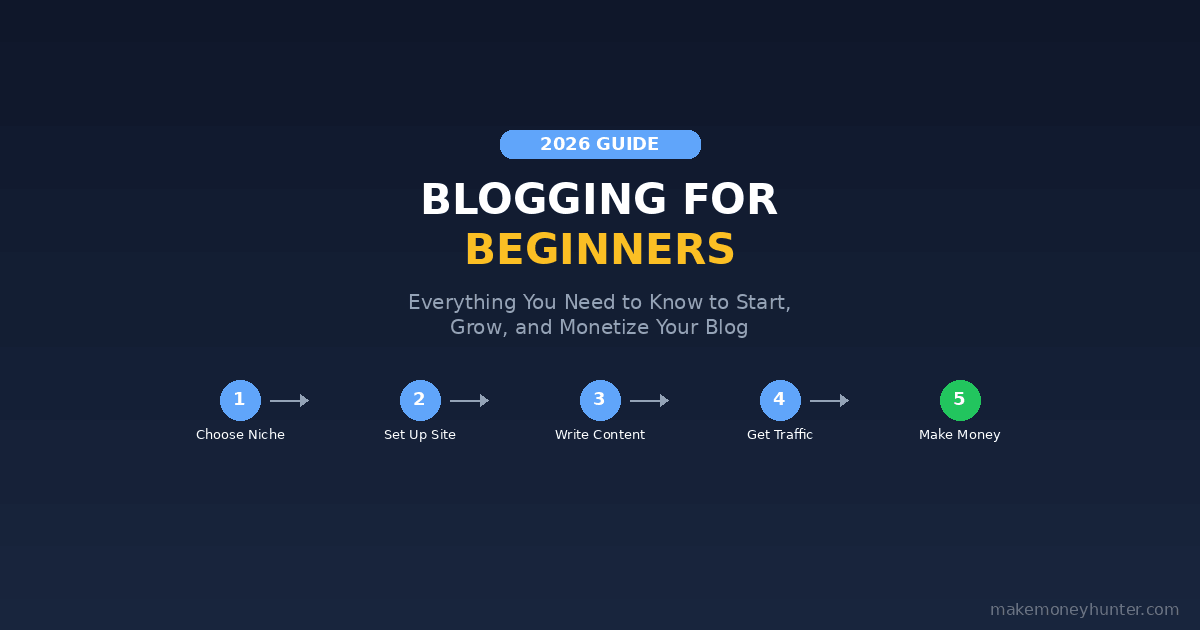
This guide covers everything you need to know about starting a blog in 2026 — from picking a niche and setting up your site, to writing content that ranks, driving traffic, and actually making money. I’ve built and monetized over a dozen blogs in my career, and I’ll share the exact steps I’d follow if I were starting from zero today.
What Is Blogging and Why Does It Still Work in 2026?
A blog is simply a website where you publish articles on a specific topic. Visitors find your content through Google search, Pinterest, social media, or email newsletters — and you earn money through ads, affiliate marketing, digital products, or services.
Some people think blogging is dead. It’s not. What’s dead is the old way of blogging — writing random diary entries and hoping someone reads them. Modern blogging is a search-driven content business.
Here’s why blogging still works in 2026:
- Google processes over 8.5 billion searches per day. People are actively searching for information, and blogs are the primary format Google serves in results.
- AI hasn’t killed blogging — it’s changed it. Google’s AI Overviews pull information from blog articles. If your content is the source, you still get traffic and brand awareness.
- The barrier to entry is incredibly low. You can start a professional blog for under $50/year with WordPress and budget hosting.
- It’s a compounding asset. An article you write today can earn money for 3-5 years with minimal updates. That’s true passive income.
According to a Statista report, global internet users reached 5.56 billion in 2025. The audience keeps growing, and so does the opportunity for bloggers who create genuinely useful content.
How to Choose a Profitable Blog Niche
Your niche is the specific topic your blog covers. This is the single most important decision you’ll make, and most beginners get it wrong.
Here’s the mistake I see over and over: people pick a niche based on passion alone. “I love cooking, so I’ll start a food blog!” That’s fine — unless you’re entering a space with millions of established competitors and no clear path to monetization.
The right niche sits at the intersection of three things:
- Interest — you need to write 100+ articles on this topic without burning out
- Demand — people are actively searching for this topic on Google
- Monetization — there are products, services, or affiliate programs that pay well in this space
Some of the most profitable blog niches in 2026 include personal finance, health and wellness, technology, online business, travel, and home improvement. But within each of these, you need to narrow down further. Don’t start a “technology blog” — start a blog about “productivity tools for remote workers” or “AI tools for small businesses.”
When I started my first profitable blog, I didn’t pick the biggest niche. I picked one where the competition was weak enough that I could realistically rank on Google within 3-6 months. That’s the strategy behind building any online income stream — find the gap where your effort can actually make a difference.
How to Set Up Your Blog (Step by Step)
Setting up a blog in 2026 takes about 30 minutes. Here’s the exact process:
Step 1: Get a Domain Name and Hosting
Your domain name is your blog’s address (like makemoneyhunter.com). Your hosting is the server that stores your website files and makes them accessible to visitors.
For beginners, I recommend starting with a reliable, affordable hosting provider. You’ll spend roughly $3-10/month depending on the plan. Look for hosting that includes a free domain name, one-click WordPress installation, and an SSL certificate.
A few tips for choosing your domain:
- Keep it short and memorable (under 15 characters if possible)
- Avoid hyphens and numbers
- Use a .com extension — it’s still the most trusted
- Your domain doesn’t need to contain keywords — brand names work great
Get Started with InterServer →
Step 2: Install WordPress
WordPress powers over 43% of all websites on the internet. It’s free, flexible, and has thousands of plugins and themes. Most hosting providers offer one-click WordPress installation.
Important: Use WordPress.org (self-hosted), not WordPress.com. The .org version gives you full control over your site, your content, and your monetization.
Step 3: Choose a Theme and Essential Plugins
Your theme controls how your blog looks. Pick something clean, fast-loading, and mobile-friendly. Popular options include Astra, GeneratePress, and Kadence — all have free versions that work great for beginners.
Essential plugins to install right away:
- Yoast SEO or Rank Math — helps optimize every post for search engines
- WP Super Cache or LiteSpeed Cache — speeds up your site
- Wordfence — basic security protection
- UpdraftPlus — automatic backups (don’t skip this)
Step 4: Create Your Essential Pages
Before publishing your first article, set up these pages:
- About Page — who you are and why people should trust you
- Contact Page — a simple form for readers and potential partners to reach you
- Privacy Policy and Disclaimer — legally required if you use ads or affiliate links
How to Write Blog Posts That Actually Rank on Google
This is where most beginners fail. They write articles about whatever comes to mind, publish them, and wait. Nothing happens. No traffic. No income. No motivation to continue.
The truth is, every successful blog post starts with keyword research — not inspiration.
Keyword research means finding what people are actually searching for on Google, and then writing content that answers those searches better than what already exists.
How to Do Keyword Research (The Beginner-Friendly Way)
You don’t need expensive tools to start. Here’s a free method that works:
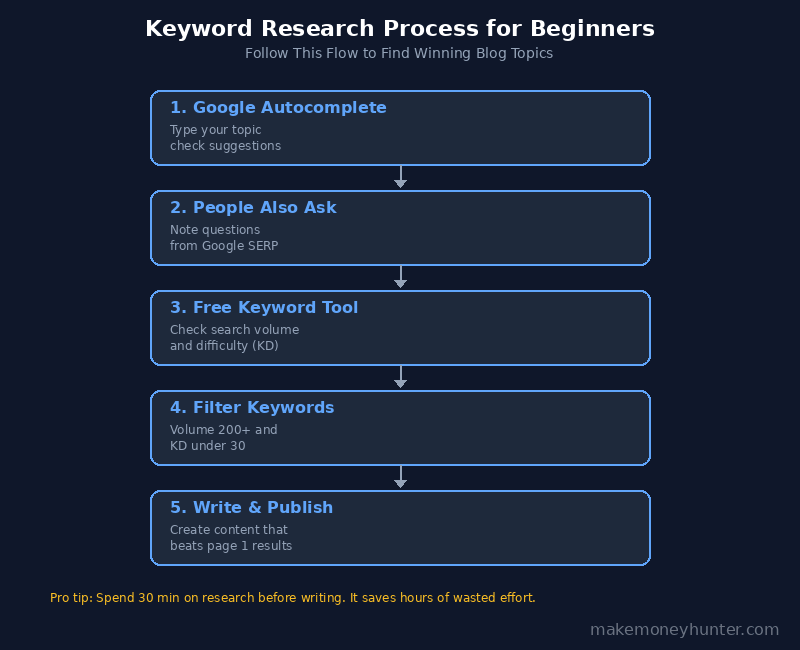
- Type your topic into Google and look at the autocomplete suggestions — these are real searches people make
- Scroll down to “People Also Ask” — each question is a potential blog post topic
- Check the bottom of the page for “Related Searches” — more content ideas
- Use a free tool like Ahrefs Free Keyword Generator or Ubersuggest to check monthly search volume and keyword difficulty
As a beginner, target keywords with:
- Monthly search volume of 200+ (enough traffic to matter)
- Keyword difficulty (KD) under 30 (realistic to rank for as a new site)
- Clear search intent (you can tell what kind of content the searcher wants)
How to Structure a Blog Post for SEO
Google rewards well-structured, comprehensive content. Here’s the framework I use for every article:
- Title (H1) — include your target keyword in the first half, keep it under 65 characters
- Introduction (150-200 words) — hook the reader, state the problem, and preview the solution. Include your keyword naturally in the first 200 words
- Body content organized with H2 and H3 headings — each heading should address a sub-topic or question. Use at least 3 H2s that contain keyword variations
- Conclusion — summarize the key points and include a call to action
Write your H2 headings as questions whenever possible. For example, instead of “Monetization Methods,” write “How Do Bloggers Make Money?” This aligns with how people actually search, and it’s the format AI search engines like ChatGPT and Perplexity prefer to pull from.
10 Blogging Mistakes Beginners Make in 2026 (And How to Avoid Them)
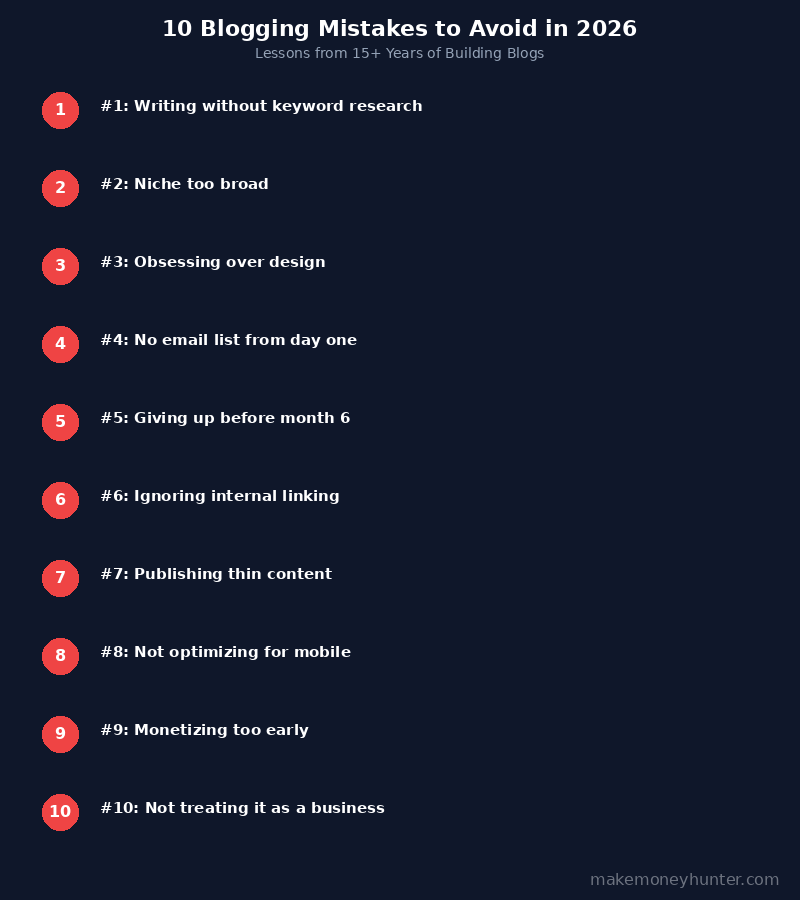
If I could go back and restart my blogging journey knowing what I know now, I’d avoid every single one of these mistakes. Each one cost me months of wasted effort.
Mistake #1: Writing Without Keyword Research
I cannot stress this enough. Writing an article without knowing if anyone is searching for the topic is like opening a store in the middle of a desert. Every article must target a specific keyword with proven search demand.
Mistake #2: Choosing a Niche That’s Too Broad
“Fitness” is not a niche. “Home workouts for busy moms over 40” is a niche. The narrower you go, the easier it is to become the authority in that space — and Google notices.
Mistake #3: Obsessing Over Design Instead of Content
I spent three weeks picking the “perfect” theme for my first blog. During those three weeks, I could have written 15 articles. Nobody cares about your blog’s design in the beginning. They care about whether your content solves their problem.
Mistake #4: Not Building an Email List from Day One
Your email list is the only traffic source you truly own. Google can change its algorithm. Pinterest can suspend your account. But your email list is yours forever. Set up a simple lead magnet (a free checklist, guide, or template) and start collecting emails from day one.
Mistake #5: Giving Up Before Month 6
This one kills more blogs than anything else. Most new blog posts take 3-6 months to start ranking on Google. If you quit at month 3, you never see the results of the work you’ve already done. I’ve watched dozens of bloggers quit right before the inflection point.
Mistake #6: Ignoring Internal Linking
Every article on your blog should link to at least 3-5 other articles on your blog. Internal links help Google understand your site structure and pass authority between pages. This is one of the highest-impact SEO tactics that costs zero dollars.
Mistake #7: Publishing Thin, Low-Value Content
In 2026, Google’s algorithms are extremely good at identifying content that doesn’t add anything new to the conversation. Your articles need to include original insights, personal experience, specific data, or a unique perspective. Rehashing what the top 10 results already say won’t cut it anymore.
Mistake #8: Not Optimizing for Mobile
Over 60% of Google searches happen on mobile devices, and Google uses mobile-first indexing. If your blog looks terrible on a phone, you’re losing the majority of potential readers. Use a responsive theme and test your site on mobile regularly.
Mistake #9: Trying to Monetize Too Early
Slapping ads on a blog with 50 monthly visitors is pointless. Focus on creating quality content and growing traffic for the first 3-6 months. Monetization becomes meaningful when you’re getting at least 1,000+ monthly visitors.
Mistake #10: Not Treating It Like a Business
The bloggers who fail treat blogging as a hobby. The ones who succeed treat it as a business — they track metrics, set content schedules, analyze what’s working, and make data-driven decisions. This took me 8 months and 47 articles before I hit $1,000/month. It wasn’t talent. It was consistency and treating every article like an investment.
How Do Beginner Bloggers Make Money?
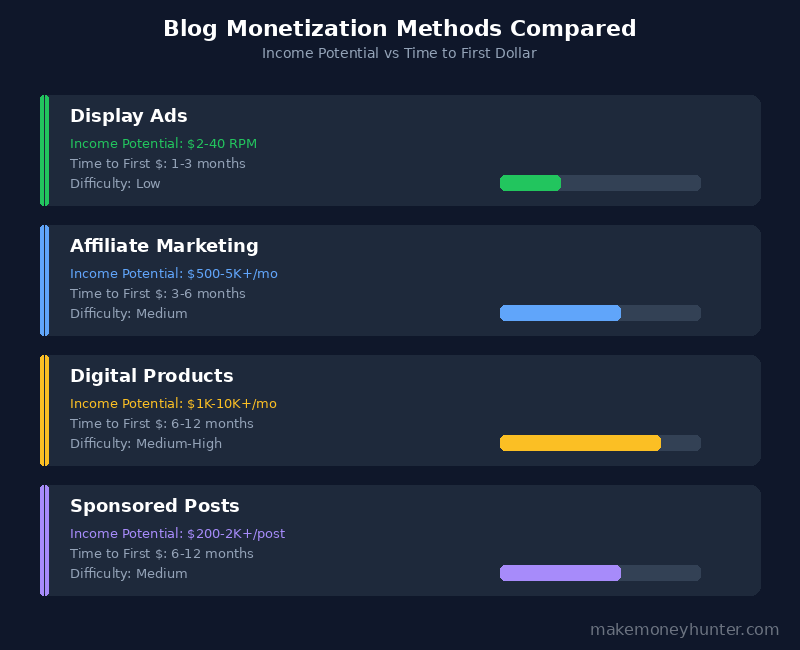
There are four primary ways bloggers monetize their content. Most successful bloggers use a combination of all four. I broke down each method in detail in my guide on how to make money blogging from home, but here’s the quick overview.
1. Display Advertising (Google AdSense and Premium Networks)
Display ads are the simplest monetization method. You place ad code on your site, and you earn money every time someone views or clicks an ad. Google AdSense is the easiest to get started with — approval takes a few days, and there’s no traffic minimum.
However, AdSense pays relatively little. Expect $2-8 per 1,000 page views (RPM). Once you hit 50,000+ monthly sessions, you can apply to premium ad networks like Mediavine or Raptive, where RPMs jump to $15-40+.
2. Affiliate Marketing
AAffiliate marketing is where you recommend products and earn a commission when readers purchase through your link. This is my favorite monetization method because it directly aligns with creating helpful content. If you want a deeper dive into how it works, check out my affiliate marketing guide for beginners.
For blogging-related niches, high-paying affiliate programs include web hosting (Bluehost, SiteGround — $65-200+ per sale), email marketing tools (ConvertKit, Mailchimp), and online course platforms (Teachable, Thinkific).
Claim Your Free $100 Vultr Credit →
3. Digital Products
Once you build an audience, you can sell your own products — ebooks, printables, templates, online courses. The margins are nearly 100% because there’s no physical inventory. A $27 ebook sold to 100 people is $2,700 with almost no ongoing cost.
A $27 ebook sold to 100 people is $2,700 with almost no ongoing cost. You can even use AI tools to speed up your product creation process.
4. Sponsored Content and Services
As your blog grows, brands will pay you to write about their products. You can also offer services like consulting, coaching, or freelance writing. These typically become viable once you have established authority in your niche.
How to Drive Traffic to a New Blog
A blog without traffic is just a personal journal. Here are the proven traffic sources for new bloggers in 2026, ranked by long-term value:
Traffic Source #1: Google SEO (Long-Term King)
SEO (Search Engine Optimization) is the process of getting your blog posts to rank on Google’s first page. It’s slow to start — typically 3-6 months before you see meaningful results — but once a post ranks, it can send free, targeted traffic to your blog for years.
The basics of blog SEO:
- Target one primary keyword per post
- Include the keyword in your title, first paragraph, H2 headings, and meta description
- Write comprehensive content that’s better than what currently ranks
- Build internal links between related posts on your site
- Earn backlinks by creating content so good that other sites want to reference it
Traffic Source #2: Pinterest
Pinterest is a visual search engine, and it’s one of the fastest free traffic sources for new bloggers. Create eye-catching pin images for each blog post, optimize them with keywords, and pin consistently. Pinterest traffic can start within weeks — much faster than Google SEO.
Traffic Source #3: Email Marketing
Building an email list from day one gives you a traffic source you own. Every time you publish a new post, you can send it directly to your subscribers. Over time, this becomes your most reliable and highest-converting traffic channel.
Traffic Source #4: Social Media
Platforms like Twitter/X, LinkedIn, and Facebook groups can drive traffic, but they require consistent effort and the traffic stops when you stop posting. Use social media to supplement SEO, not replace it.
Use social media to supplement SEO, not replace it. And if writing feels overwhelming at first, tools like AI writing assistants can help you produce content faster without sacrificing quality.
If I Were Starting a Blog from Scratch Today, Here’s Exactly What I’d Do
This is the question I get asked more than any other. Here’s my honest, no-BS answer — the exact steps I’d follow if I lost everything and had to rebuild from zero in 2026:
- Week 1: Pick a niche where I can realistically rank (KD under 25, decent affiliate programs). Set up WordPress with a fast, clean theme. Install Yoast SEO and set up Google Search Console and Google Analytics.
- Weeks 2-4: Do deep keyword research. Build a content plan of 30 articles — a mix of informational posts (for traffic) and commercial posts (for monetization). Write and publish my first 8 articles.
- Months 2-3: Publish 2-3 articles per week. Set up Pinterest and start creating pins. Set up an email list with a simple lead magnet. Apply to relevant affiliate programs.
- Months 4-6: Keep publishing consistently. Start seeing early Google rankings and Pinterest traffic. Apply to Google AdSense. Internal link everything. Update and improve early articles based on Search Console data.
- Months 7-12: Traffic starts compounding. Double down on what’s working. Explore additional monetization (digital products, premium ad networks). The hockey stick growth begins.
The biggest lesson from doing this for over 15 years? The people who win aren’t the most talented writers or the most tech-savvy. They’re the ones who show up and publish, week after week, even when nobody’s reading yet.
Frequently Asked Questions About Blogging for Beginners
How Much Does It Cost to Start a Blog?
You can start a blog for as little as $35-100 per year. This covers hosting ($3-10/month) and a domain name (often free with hosting). WordPress itself is free. Many quality themes and plugins have free versions that are perfectly adequate for beginners.
How Long Does It Take to Make Money Blogging?
Most bloggers see their first income between months 6 and 12. Significant income ($1,000+/month) typically takes 12-24 months of consistent effort. The timeline depends heavily on your niche, content quality, keyword targeting, and how many articles you publish.
Can You Start a Blog with No Experience?
Absolutely. I started my first blog knowing nothing about web design, SEO, or content marketing. The skills you need — writing clearly, basic WordPress management, keyword research — can all be learned as you go. You don’t need a tech background. You need persistence.
Is Blogging Still Profitable in 2026?
Yes, but only if you approach it strategically. Random blogging about your day won’t make money. Building a keyword-driven content business around a specific niche, with multiple monetization streams, absolutely still works. The bloggers who treat it seriously are earning more than ever because AI tools help them work faster and smarter. AI tools help them work faster and smarter. If you want to see other income ideas alongside blogging, here are 20 quick ways to make extra money online.
How Many Blog Posts Do I Need Before Making Money?
There’s no magic number, but in my experience, most blogs start gaining traction around 25-30 published posts. Quality matters more than quantity — 30 well-researched, keyword-targeted articles will outperform 100 random ones every time.
Final Thoughts
Starting a blog in 2026 isn’t complicated. The technical setup takes an afternoon. The hard part is what comes next — showing up consistently, writing articles that nobody reads for months, and trusting the process when there’s zero evidence it’s working.
But here’s what I’ve seen after building blogs for over 15 years: the math always rewards consistency. Every article is a lottery ticket that stays in the draw forever. The more tickets you have, the more often you win. And unlike actual lottery tickets, you can dramatically improve your odds by doing keyword research, writing genuinely useful content, and building a site structure that Google trusts.
Pick one niche. Set up WordPress. Write your first article this week. Not next month. Not “when you’re ready.” This week. Because the biggest advantage you have right now isn’t skill or money — it’s time. And the clock is already running.