

Everybody tells you affiliate marketing is simple — “just recommend products and earn commissions.” That advice is technically correct and practically useless. It’s like saying “just buy low and sell high” to someone who’s never traded a stock.
Here’s what actually happened when I started: I spent 6 months writing articles, earned a total of $47, and almost quit twice. Affiliate marketing works — but only if you understand where the money really comes from, which keywords to target, and what separates the people who earn $5,000/month from the ones who earn $5 total.
The affiliate marketing industry crossed $17 billion globally in 2025 and is projected to reach $27.78 billion by 2027. Those numbers aren’t hype — they represent real commissions flowing to content creators who figured out the system. I’m one of them. My affiliate income currently sits around $4,800/month, built primarily through blog content that ranks on Google and converts readers into buyers.
This is the affiliate marketing guide I wish existed in 2009 when I started. Not the 500-word overview that tells you to “pick a niche and write content.” The actual playbook — from choosing keywords that don’t waste your time, to building a site that Google trusts, to scaling from your first $4.50 commission to consistent four-figure months.
Let’s get into it.
What Is Affiliate Marketing and How Does the Money Actually Flow?
Affiliate marketing is a performance-based business model: you recommend a product through content, someone buys it using your unique tracking link, and the company pays you a commission. That’s the one-sentence version.
But let me break down the mechanics, because understanding the money flow prevents the mistakes that kill most beginners.
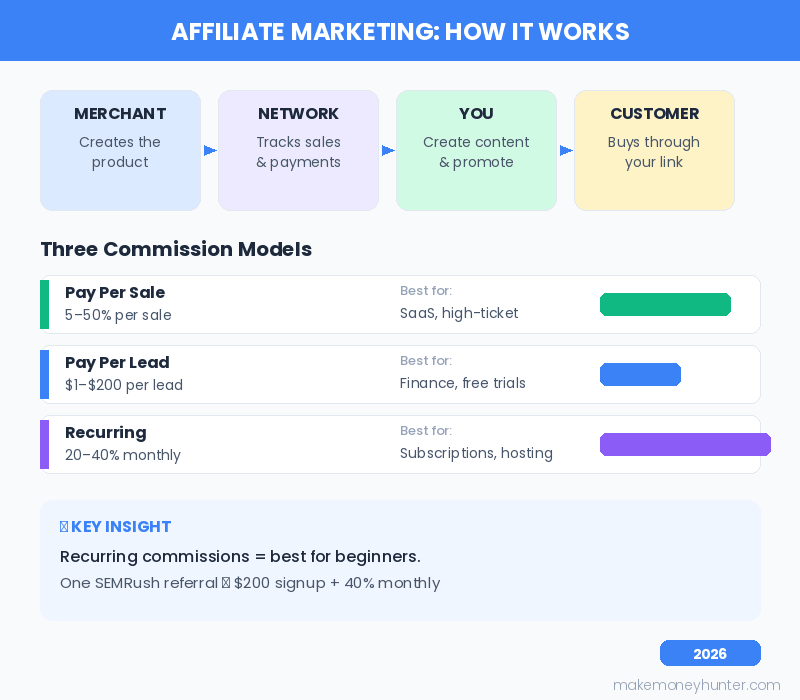
Four players make every affiliate transaction work:
- The Merchant — the company selling the product (Bluehost, SEMRush, Amazon, etc.)
- The Affiliate Network — the platform tracking sales and handling payments (ShareASale, CJ Affiliate, Impact)
- The Affiliate (you) — the content creator who drives purchase decisions
- The Customer — the person who buys through your link
When a reader clicks your affiliate link, a cookie gets stored in their browser — typically lasting 30-90 days depending on the program. If they purchase anything during that window, you get credited with the sale. The beauty of this model: you don’t create products, manage inventory, handle customer service, or process refunds. Your entire job is creating content that helps people make better buying decisions.
Three Commission Models You’ll Encounter
| Commission Model | How It Works | Typical Payout | Best For |
|---|---|---|---|
| Pay Per Sale (PPS) | Percentage of each sale | 5-50% of sale price | High-ticket products, SaaS tools |
| Pay Per Lead (PPL) | Payment for signups, trials, form fills | $1-$200 per lead | Financial products, SaaS free trials |
| Recurring Commissions | Monthly payment as long as customer stays | 20-40% monthly | SaaS tools, hosting, subscriptions |
In my experience, recurring commission programs are where beginners should focus first.
A single referral to a tool like SEMRush ($200/signup + 40% recurring) generates income month after month. After 18 months, my SEMRush referrals alone produced roughly $1,400/month — from articles I hadn’t touched in over a year.
How Much Can You Realistically Earn with Affiliate Marketing?
Most people think you need massive traffic to make real money. But actually, 1,000 targeted visitors per month can outperform 50,000 random ones — if those visitors are searching with buying intent.
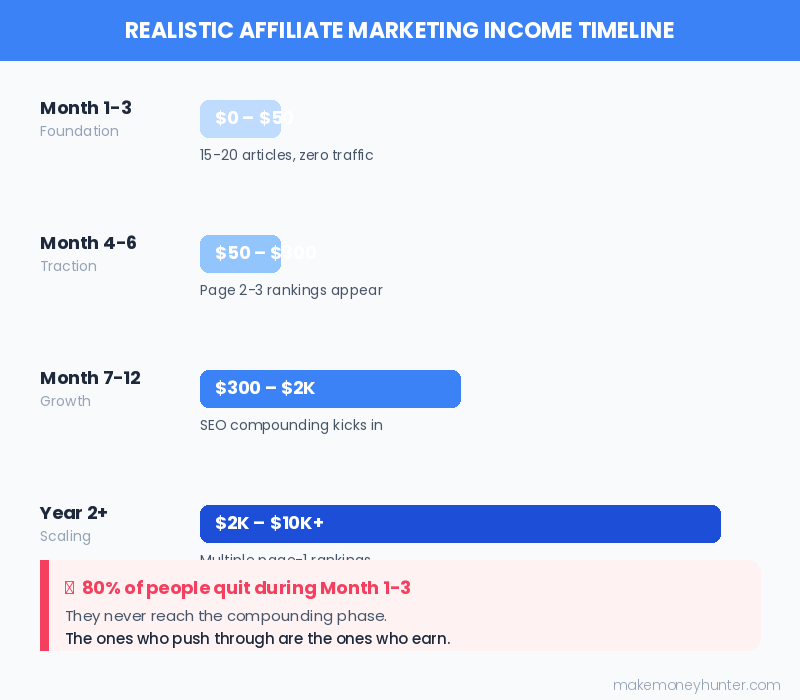
Here’s the honest timeline based on my own progression and people I’ve worked with:
| Stage | Timeline | Monthly Traffic | Monthly Income | What’s Happening |
|---|---|---|---|---|
| Foundation | Month 1-3 | 0-500 | $0-$50 | Site setup, first 15-20 articles, waiting for Google indexing |
| Early traction | Month 4-6 | 500-2,000 | $50-$300 | Some articles ranking page 2-3, first commissions appear |
| Growth | Month 7-12 | 2,000-10,000 | $300-$2,000 | SEO compounding kicks in, conversion optimization begins |
| Scaling | Month 12-24 | 10,000-50,000 | $2,000-$10,000+ | Topical authority established, multiple page-1 rankings |
The uncomfortable reality: month 1-3 is where 80% of people quit. You’re writing articles nobody reads yet, building a site Google hasn’t decided to trust, and earning zero. I made $47 total in my first 6 months. The people who push past this phase are the ones who eventually build real income.
How to Start Affiliate Marketing: A 7-Step Guide
Here’s the exact process I’d follow if I were starting from zero today — specific actions, in the right order.
Step 1: Choose a Profitable Niche (This Determines Your Ceiling)
Your niche choice determines your income ceiling. Pick wrong, and even exceptional content won’t save you.
The niche sweet spot has three characteristics:
- Products that pay well — affiliate programs with $50+ commissions or 20%+ recurring
- Searchable problems — people actively Googling questions you can answer
- Beatable competition — not dominated entirely by mega-authority sites with million-dollar budgets
I chose the “make money online” space for makemoneyhunter.com because it checks all three: high-ticket affiliate products (hosting, SEO tools, course platforms), thousands of searchable long-tail keywords, and plenty of low-KD opportunities that large competitors ignore.
Niches worth exploring in 2026: SaaS and productivity software, online education platforms, AI tools and automation, personal finance apps, home office and remote work gear, pet products (surprisingly lucrative), and sustainable living products.
Niches to avoid as a beginner: health/medical topics (Google’s YMYL standards are brutal), ultra-competitive keywords like “best credit cards” (dominated by NerdWallet and Bankrate), and any niche where you can’t find at least 30 keywords under KD 30.
Step 2: Do Keyword Research Before Writing Anything
Here’s the thing about affiliate marketing — keyword research is where money is made or lost. I’d rather spend 3 days researching keywords and 1 day writing than the reverse.
You need a keyword research tool. I use SEMRush ($200/signup with 40% recurring commissions — and yes, I practice what I preach). Ahrefs and Ubersuggest are solid alternatives.
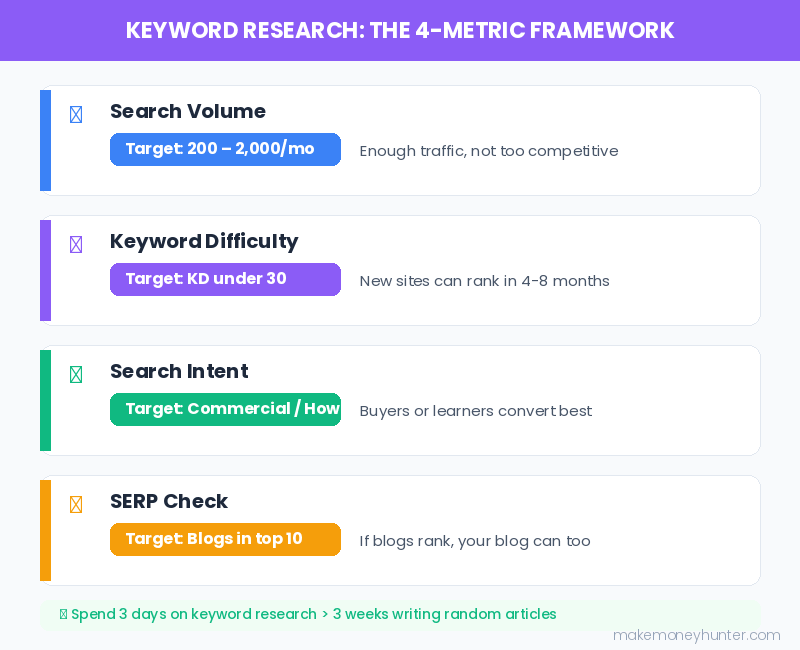
What you’re targeting:
| Metric | Target for Beginners | Why It Matters |
|---|---|---|
| Monthly search volume | 200-2,000 | Enough traffic potential without impossible competition |
| Keyword Difficulty (KD) | Under 30 | New sites can realistically rank within 4-8 months |
| Search intent | Commercial or informational with buying angle | “Best X for Y” and “How to” keywords convert better |
| SERP composition | Blog posts in results (not all product pages) | If Google shows blogs ranking, your blog can rank too |
A lesson from my own mistakes: I wasted 4 months chasing “make money online” (KD 85, 200K+ monthly searches). Not a single article cracked page 1. When I switched to “how to make money with a niche website” (KD 18, volume 720), I ranked within 3 months. That article still drives traffic today. The difference wasn’t writing quality — it was keyword selection.
Step 3: Build Your Website (Keep It Simple)
You need a self-hosted WordPress site. Not Wix, not Squarespace, not free WordPress.com. Self-hosted WordPress gives you complete control over SEO, monetization, and content — and powers 43% of all websites for good reason.
The setup takes about 30 minutes:
- Buy a domain name ($10-15/year through Namecheap or Google Domains)
- Get web hosting (start with a basic plan around $3-5/month)
- Install WordPress (one-click install on most hosts)
- Choose a fast, lightweight theme (GeneratePress or Astra — both have free versions)
- Install essential plugins: Yoast SEO or Rank Math, a caching plugin, and an image compression plugin
Don’t spend weeks perfecting your logo or agonizing over sidebar widgets. I’ve watched people invest a month designing their site and zero hours writing content. That’s backwards. Your readers care about your content, not your color scheme.
Step 4: Join the Right Affiliate Programs
Start with 3-5 programs maximum. Get good at promoting those before expanding.
Where to find programs:
- Affiliate networks — ShareASale, CJ Affiliate, Impact, PartnerStack (thousands of programs in one place)
- Direct programs — search “[product name] affiliate program” on Google. Many SaaS companies run their own
- Amazon Associates — low commissions (1-10%) but high conversion rates because everyone trusts Amazon
My program evaluation framework:
- Commission rate: 20%+ for digital products, $50+ for one-time payouts
- Cookie duration: 30 days minimum (90+ days is ideal — Amazon’s 24-hour cookie is brutal)
- Payment reliability: monthly payments, reasonable thresholds, established network
- Product quality: only promote things you’d recommend to a friend
- Conversion rate: check affiliate forums or ask the affiliate manager for average conversion data
Step 5: Create Content That Ranks and Converts
This is where most guides say “write great content” and leave it at that. Let me be specific about what actually drives affiliate income.
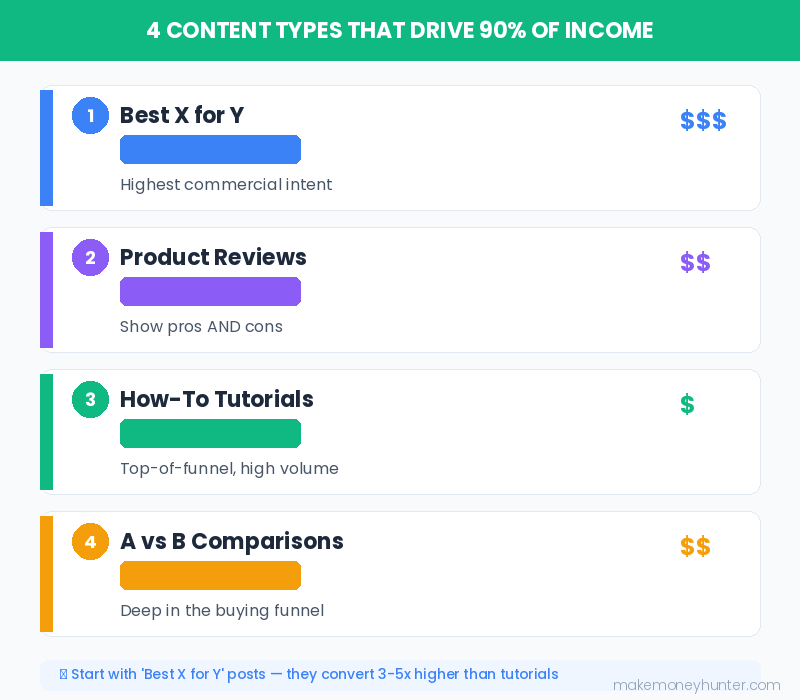
The four content types that generate 90% of affiliate revenue:
1. “Best X for Y” roundup posts — your primary money pages. “Best web hosting for beginners,” “best email marketing tools for small business.” These keywords carry high commercial intent — the reader is ready to buy, they just need help choosing.
2. Product review posts — in-depth reviews of individual products. “SEMRush Review: Is It Worth $139/Month?” These build trust because you show the good AND the bad.
3. “How to” tutorial posts — top-of-funnel traffic drivers that naturally mention affiliate products as part of the solution. “How to start a blog” naturally leads to recommending hosting.
4. Comparison posts — “SEMRush vs Ahrefs” or “WordPress vs Squarespace.” People searching these are deep in the decision-making funnel.
Content rules that consistently work:
- Every article must be better than 80% of what currently ranks on page 1 for that keyword
- Include specific numbers, not vague claims (“starts at $29/month” beats “affordable”)
- Show both pros AND cons — nobody trusts a review that’s 100% positive
- Add personal experience — “I’ve used this daily for 8 months” is 10x more convincing than rewriting the features page
- Target 2,000-4,000 words for pillar content. Thin articles don’t rank in 2026
Step 6: Learn the SEO Basics (80/20 Rule)
SEO intimidates beginners, but 80% of results come from getting a few fundamentals right:
On-page essentials:
- Target keyword in the title (first half), H1, meta description, URL slug, and first 200 words
- Related keywords distributed naturally throughout (Google understands synonyms)
- H2 and H3 headings framed as questions when possible — “How Much Does Affiliate Marketing Cost to Start?” beats “Costs Overview”
- Alt text on every image describing what it shows with a natural keyword inclusion
- 2-5 external links to authoritative sources (Statista, Forbes, industry reports)
- Internal links to your own related content — this is how you build topical authority in affiliate marketing
Off-page (simplified): Backlinks still matter in 2026, but quality beats quantity. One link from a DA 60+ site is worth more than 50 directory submissions. Creating genuinely useful content is the foundation — links follow when you build something worth referencing.
Step 7: Optimize for Conversions
Traffic without conversions is a vanity metric. Here’s how to turn readers into buyers:
- Strategic CTA placement — first affiliate mention after 25% of the article, once you’ve provided value
- Comparison tables — side-by-side feature comparisons dramatically increase click-through rates
- CTA buttons over text links — “Try SEMRush Free for 7 Days →” converts 2-3x better than a hyperlink
- Honest disclaimers — transparency builds trust, not suspicion. Readers already know you earn commissions
- Test and adjust — track which placements generate the most clicks and double down
The 5 Mistakes That Cost Me Thousands
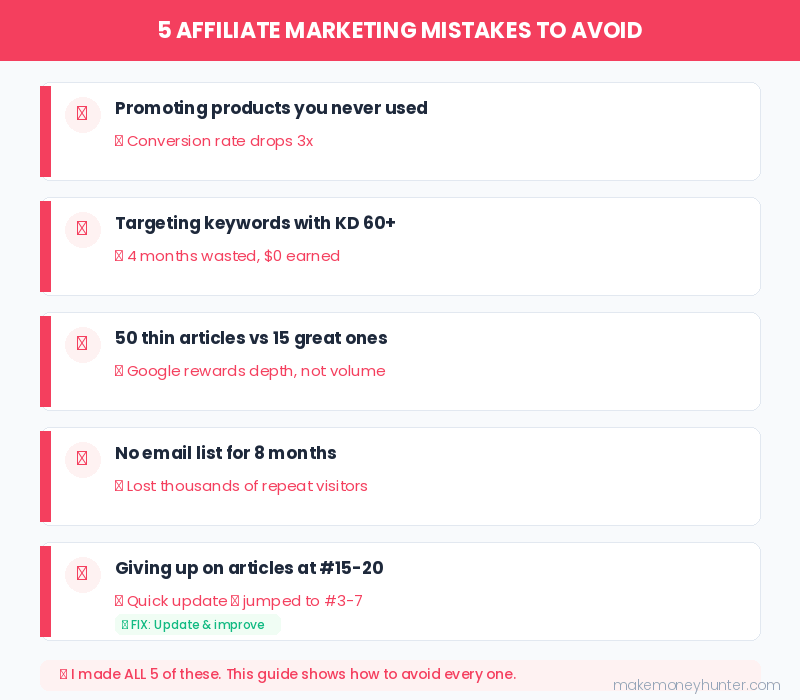
I’ve made every mistake possible. Here are the ones that actually cost me money and time:
Mistake #1: Promoting products I hadn’t used. My early reviews were rewritten product descriptions from company websites. Readers could tell. When I switched to reviewing only tools I actually pay for, my conversion rate tripled. The specificity of real experience (“this feature saves me about 2 hours per week”) can’t be faked.
Mistake #2: Ignoring keyword difficulty. Four months targeting KD 60+ keywords — not a single page-1 ranking. When I shifted to KD under 25, I had 5 articles ranking within 3 months. The content quality didn’t change. The keyword selection did.
Mistake #3: Chasing quantity over quality. I wrote 50 mediocre articles thinking more content = more traffic. Wrong. Google’s 2025-2026 updates reward depth and expertise over volume. Fifteen excellent articles outperform fifty shallow ones.
Mistake #4: Not building an email list from day one. I waited 8 months to add an opt-in form. That’s 8 months of visitors who came, read, and vanished forever. Your email list is the only traffic source you truly own — algorithm changes can’t take it from you.
Mistake #5: Abandoning underperforming articles. I had articles sitting at position 15-20 for months. Instead of improving them, I wrote new ones. When I finally went back — added detail, updated data, improved images — several jumped to positions 3-7 within weeks. Sometimes the best content strategy is updating what you already have.
How to Choose the Right Affiliate Programs (Evaluation Framework)
After testing roughly 40 programs, I’ve developed a 5-point evaluation checklist:
1. Commission math. Calculate effort-to-revenue ratio. A $5/sale program targeting KD-30 keywords is a poor investment compared to a $200/lead program at similar difficulty. The sweet spot: $50+ per conversion OR 20%+ recurring monthly.
2. Cookie duration. Amazon’s 24-hour cookie means buyers must purchase within a day of clicking. Programs with 60+ day cookies generate roughly 40% more revenue from identical traffic because people don’t always buy immediately.
3. Product quality you can stand behind. When you write “I’ve used this daily for 14 months,” your conversion rate skyrockets versus “this product reportedly has good features.” Real experience is an unfakeable competitive advantage.
4. Conversion rate data. A 50% commission rate with 0.5% landing page conversion earns less than 10% commission with 5% conversion. Ask affiliate managers or check forums for real data.
5. Payment reliability. Stick with established networks (ShareASale, CJ, Impact) for payment security. I’ve had two programs delay payments and one go bankrupt owing me $800.
Top Affiliate Program Categories for 2026
| Category | Example Programs | Commission Range | Why It Works |
|---|---|---|---|
| SEO & Marketing Tools | SEMRush, Ahrefs, Surfer SEO | $200 flat + 40% recurring | High-value products, long customer lifetime |
| Web Hosting | Bluehost, SiteGround, Cloudways | $65-$150 per signup | Every new blogger needs hosting — massive audience |
| Email Marketing | ConvertKit, Mailchimp, AWeber | 20-30% recurring | Recurring commissions compound beautifully |
| Course Platforms | Teachable, Thinkific, Kajabi | 20-30% recurring | Growing market as more creators sell digital products |
| WordPress Ecosystem | Elegant Themes, WPForms, GeneratePress | 20-50% per sale | High volume in the blogging niche |
What’s Different About Affiliate Marketing in 2026?
If you’re following advice from 2022-2023 guides, you’re already behind. Three shifts matter most:
AI Overviews are eating clicks. Google now displays AI-generated answers on 40%+ of searches, pulling directly from top-ranking content. Your content needs to be the source AI cites. The fix: put your core answer in the first 200 words, use specific numbers, frame H2s as questions, and include structured data.
E-E-A-T matters more than ever. Google’s March 2026 core update doubled down on “Experience” — content from someone who has actually used a product now dramatically outranks generic overviews. This is good news for affiliates building real expertise.
Information gain is a ranking signal. Google measures whether your content adds something genuinely new. Regurgitating “10 affiliate marketing tips” won’t work anymore. Your unique angle — personal data, failure stories, unconventional methods — is your competitive advantage.
Building Your 12-Month Affiliate Marketing Roadmap
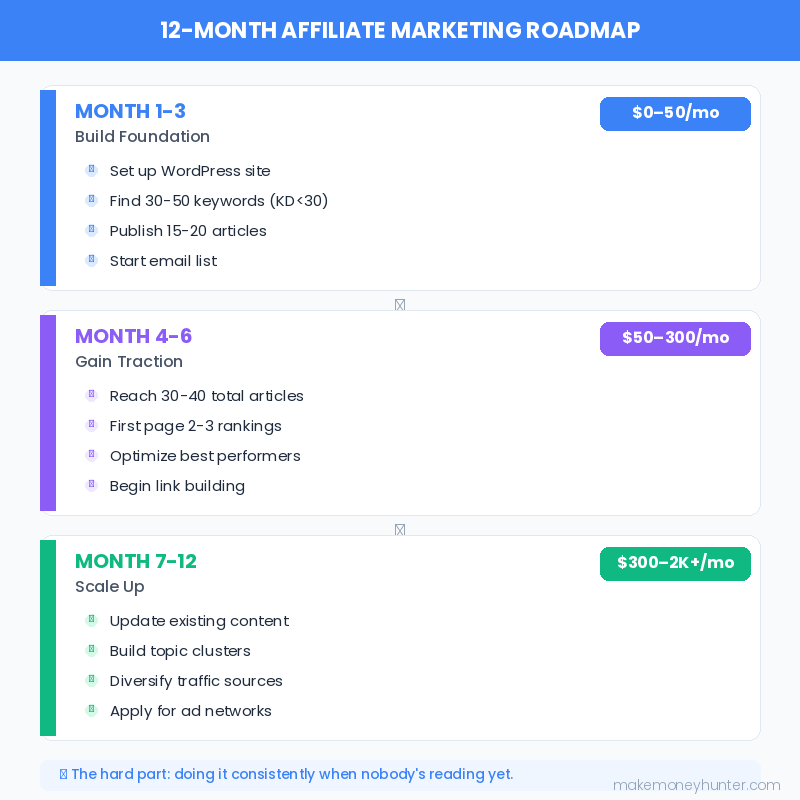
Based on what I’ve seen work across my own sites and mentees, here’s a realistic month-by-month plan:
Month 1-3: Build the Foundation (The “Invisible Work” Phase)
This phase separates people who succeed from people who quit. Visible results: near zero. But the invisible groundwork is everything.
- Set up your website — domain, hosting, WordPress, theme, plugins (Week 1, one afternoon)
- Complete keyword research — find 30-50 target keywords under KD 30 (Week 1-2, this is the most important step)
- Join 3-5 affiliate programs (Week 2)
- Publish 15-20 articles targeting your easiest keywords at 2/week pace (Weeks 2-12)
- Set up Google Search Console and Analytics from day one
- Start email list with a simple lead magnet — checklist, resource guide, or starter kit (Week 3-4)
Expected income: $0-$50. This is normal. The seeds need time.
Month 4-6: Content + SEO Acceleration
- Continue publishing 2-3 articles per week (30-40 total by month 6)
- Articles start appearing on page 2-3 — use Search Console to find positions 8-20 (biggest quick-win opportunities)
- Optimize best-performing articles: expand sections, improve CTAs, strengthen SEO fundamentals
- Begin basic link building through guest posts and resource pages
- First commissions trickle in — celebrate the validation
Expected income: $50-$300/month. The first $100 month proves the model works.
Month 7-12: Optimization + Scaling
- Focus on updating existing content (refresh strategy beats only writing new articles)
- Double down on content types driving commissions
- Build topic clusters — interlink related articles to strengthen topical authority
- Diversify traffic: explore blogging strategies that extend beyond Google, like Pinterest and email
- Apply for premium ad networks (Mediavine/Raptive) when traffic thresholds are met
- Email list should be generating 15-20% of total affiliate income by month 12
Expected income: $300-$2,000+/month. Compounding is now working for you.
Content Strategy: Building a Topic Cluster That Dominates
In 2026, Google evaluates whether your entire website demonstrates expertise on a topic — not just individual articles. This is “topical authority,” and it’s why a focused content strategy beats random publishing.
Here’s how I structure content around making money online as a topic cluster:
Pillar page (this article): “Affiliate Marketing for Beginners: The Complete Guide” — the comprehensive overview targeting the broadest keyword.
Supporting cluster articles (planned):
- “Best Affiliate Programs for Beginners” (commercial intent)
- “Affiliate Marketing vs Dropshipping: Which Is Better?” (comparison)
- “How to Write Affiliate Product Reviews That Convert” (skill-building)
- “How Much Do Affiliate Marketers Make? Real Income Data” (data-driven)
- “How to Build an Affiliate Marketing Website from Scratch” (tutorial)
Every cluster article links back to this pillar page, and this page links to each cluster article. Google sees the interconnected web and thinks: “This site really knows affiliate marketing.” In my experience, sites with 15-20 tightly interlinked articles on one topic outrank sites with 100 scattered articles on different topics. Depth beats breadth every time.
The Email List Strategy Every Affiliate Needs from Day One
Not building an email list from day one was my biggest mistake. Here’s what I’d do differently:
Simple setup:
- Create a free lead magnet — an “Affiliate Marketing Starter Kit” checklist or resource list (2-3 hours to make)
- Set up ConvertKit’s free plan (handles up to 1,000 subscribers)
- Add opt-in forms to highest-traffic articles (sidebar, in-content, exit-intent popup)
- Send one useful email per week — a tip, case study, or resource recommendation
Why email matters specifically for affiliates:
- You can promote affiliate products directly to subscribers who already trust you
- Email traffic doesn’t depend on Google’s algorithm — it’s 100% yours
- A single well-crafted email can generate more affiliate revenue than a week of organic search
- Emailing your list when you publish a new article gives it an immediate traffic boost that signals quality to Google
My list has about 4,200 subscribers, built over 18 months. Those subscribers generate roughly 15-20% of my total affiliate income — and growing.
Pros and Cons of Affiliate Marketing (Honest Assessment)
Too many guides make this sound like easy money. It’s not. But the advantages are compelling if you understand the tradeoffs.
| Pros | Cons |
|---|---|
| Low startup cost ($50-100 to begin) | Takes 6-12 months to see meaningful income |
| No product creation, shipping, or customer service | You don’t control the product or commission rates |
| Income compounds over time (articles keep earning) | Google algorithm changes can crater your traffic overnight |
| Work from anywhere, on your schedule | Requires consistent content creation — it’s not truly “passive” |
| Unlimited income ceiling | Most people quit before seeing results |
| Transferable skills (SEO, writing, marketing) | Programs can slash commissions or shut down without warning |
Frequently Asked Questions About Affiliate Marketing
How much does it cost to start affiliate marketing?
Under $100. Domain name ($10-15/year), hosting ($3-5/month), WordPress (free). The only essential paid tool from day one is keyword research — SEMRush’s free tier or Ubersuggest’s limited plan works to start. Compare this to a physical business requiring $10,000-$50,000 in startup capital.
Can you do affiliate marketing without a website?
Technically yes — social media, YouTube, or email can work. But I strongly recommend a website. It gives you complete control over SEO, monetization, and content. Social platforms change algorithms overnight; I’ve seen affiliates lose entire income streams when Instagram shuffled its algorithm. Your website is yours — nobody can take it away.
How long before I make my first sale?
Most people following a solid strategy see their first commission within 2-4 months. My first sale took 11 weeks. The biggest variable is keyword difficulty — targeting keywords you can actually rank for makes the difference. I’ve seen mentees land their first sale in week 3 by going after ultra-low competition keywords nobody else bothered with.
Is affiliate marketing still worth it in 2026?
Absolutely — but the game has changed. AI Overviews, increased competition, and higher quality standards mean thin content doesn’t cut it. The bar is higher, which is actually good news for anyone willing to do quality work — fewer lazy competitors survive. The market is projected to reach $27.78 billion by 2027 according to Statista.
Do I need to disclose affiliate links?
Yes. The FTC requires disclosure of material relationships with products you promote. WordPress themes and plugins handle this automatically through global settings. Beyond legal compliance, transparency increases trust — I’ve had readers tell me they specifically used my affiliate links because they appreciated the honesty about commission structures.
What’s the difference between affiliate marketing and other online business models?
Compared to dropshipping: no inventory, shipping, or customer service needed. Compared to digital products: no product development time — you leverage existing products. Compared to freelancing: you’re not trading hours for dollars — content works 24/7 once published. The tradeoff: you don’t control products, pricing, or commission terms. That’s why promoting across multiple programs protects against any single program changing terms.
Final Thoughts
When I look at my income dashboard today, 60% of last month’s affiliate commissions came from articles written more than 8 months ago. Some were written in 2023. They rank on Google, they convert visitors, they earn — all without me touching them.
That’s what front-loaded income looks like. You work intensely for months before the payoff appears. Then the compounding kicks in and the math shifts dramatically in your favor. The articles I write today will be earning for me two years from now.
The skills you build along the way — SEO, content writing, keyword research, conversion optimization, data analysis — are transferable to virtually any digital career. Even if affiliate marketing doesn’t become your primary income, you’ll walk away with capabilities that employers pay $60,000-$120,000/year for. You’re not just building a side hustle. You’re building yourself.
If I were starting fresh tomorrow: one niche, 20 keywords under KD 25, one genuinely excellent article per week for 6 months, and an email list from day one. That’s the entire strategy. The hard part isn’t knowing what to do — it’s executing when nobody’s reading yet.
Pick one keyword from this guide that matches your situation. Research it this weekend. Write that first article next week. Not next month. Not when things calm down. The math only starts working once you start.