

You can start affiliate marketing with zero dollars — but only if you treat it like a real business from day one, not a shortcut to easy money. I’ve been doing affiliate marketing since 2011, and my first commission was $14.50 from a web hosting referral. That tiny payout changed everything for me because it proved the model works.
Most people think affiliate marketing requires a big budget for ads, expensive tools, or a massive following. The truth is, I built my first profitable affiliate site with nothing but free WordPress hosting, a borrowed laptop, and about 4 hours a day of writing content nobody read — for 3 months straight.
In this guide, I’ll walk you through exactly how to start affiliate marketing with no money in 2026. You’ll learn how to pick a profitable niche, find programs that actually pay, create content that ranks, and get your first commission — all without spending a dime. These are the same steps I still use today across multiple sites, including this one.
Fair warning: this isn’t a get-rich-quick method. It took me about 90 days to earn my first real commission. But once the momentum builds, it compounds — and that’s what makes it worth it.
What Is Affiliate Marketing and How Does It Work?
Affiliate marketing is a performance-based business model where you earn a commission by promoting other people’s products. You don’t create the product, handle shipping, or deal with customer support. Your only job is to connect the right audience with the right product — and get paid when someone buys through your unique link.
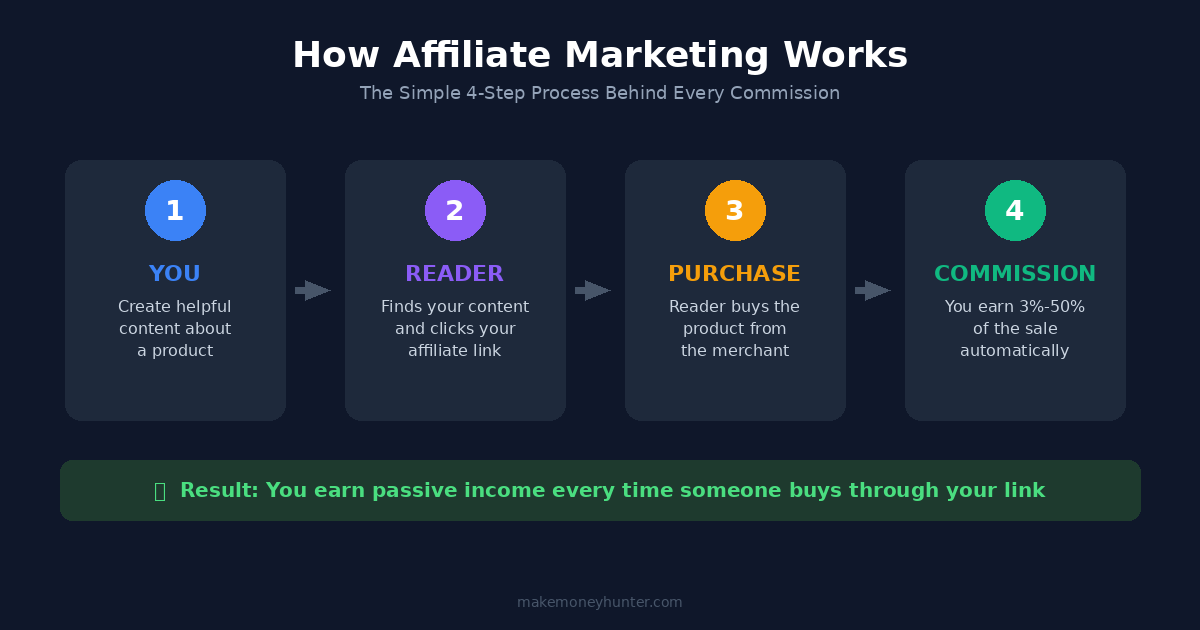
Here’s how the process works in plain English:
- You join an affiliate program (free) and get a unique tracking link.
- You create content — a blog post, YouTube video, or social media post — that naturally recommends a product.
- Someone clicks your link and buys the product.
- You earn a commission — anywhere from 3% to 50% of the sale price, depending on the program.
The reason affiliate marketing is one of the best ways to make money online from home is that the startup cost is essentially zero. You don’t need inventory. You don’t need a warehouse. You just need a way to get your recommendation in front of people who are already looking for it.
In my experience, the affiliates who earn the most aren’t the ones with the biggest audiences — they’re the ones who solve specific problems for specific people. A blog post reviewing one web hosting service can earn more than a generic “50 ways to make money” article with 10 times the traffic.
Can You Really Start Affiliate Marketing with No Money?
Let me be honest: yes, you can start with $0, but there’s a trade-off. What you don’t spend in money, you’ll spend in time. And that’s actually fine — especially when you’re starting out.
Here’s what costs $0 in affiliate marketing:
- Joining affiliate programs — every legitimate program is free to join
- Creating content — writing blog posts, recording videos with your phone, or posting on social media
- SEO traffic — Google doesn’t charge you to rank (unlike ads)
- Free platforms — WordPress.com, Medium, YouTube, Pinterest, TikTok all have free tiers
Here’s the honest reality most guides won’t tell you: starting with $0 is slower than starting with even a small budget. When I started, I used free WordPress.com hosting — and it worked. But once I invested $50 in a proper domain and hosting about 4 months later, my traffic tripled within 6 weeks because Google treats self-hosted sites more seriously.
Bottom line: Start free. Prove the model works. Then reinvest your first earnings into better tools. That’s the path that minimizes risk and maximizes learning.
Step 1: Choose a Profitable Niche (This Decides Everything)
Most people think choosing a niche means picking something you’re “passionate about.” That’s half right. The full truth is: pick a niche where people are already spending money AND where you can add genuine value.
I’ve seen people start blogs about underwater basket weaving because they were passionate about it. Passion is great, but if nobody’s searching for it and there are no products to promote, you’ll earn $0 from passion alone.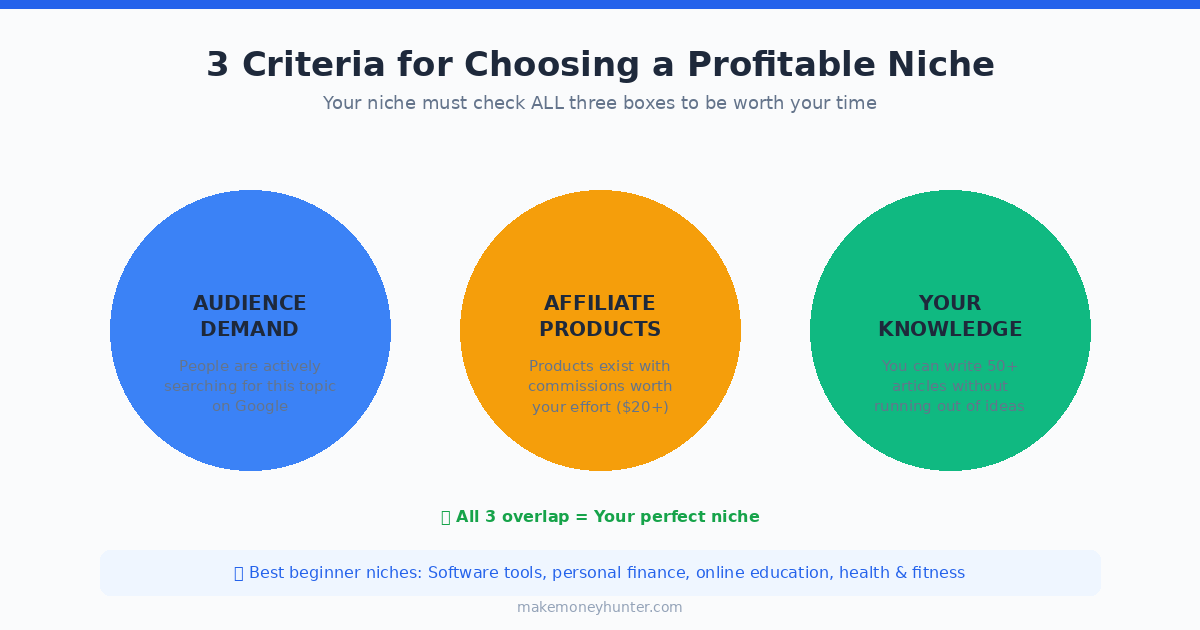
A good affiliate niche checks three boxes:
| Criteria | What to Look For | How to Check (Free) |
|---|---|---|
| People are searching | Monthly search volume for related keywords is 1,000+ | Google Keyword Planner (free), Ubersuggest, Google Trends |
| Products exist to promote | At least 5-10 affiliate products with commissions over $20 | Browse Amazon Associates, ShareASale, Impact, CJ Affiliate |
| You know something about it | You can write 50+ article ideas without running dry | Brainstorm for 15 minutes — if you hit 20+ ideas, you’re good |
Proven beginner-friendly niches with high affiliate potential in 2026:
- Personal finance — budgeting apps, investing platforms, credit cards (high commissions)
- Software/SaaS tools — email marketing, website builders, AI tools (recurring commissions up to 30-40%)
- Health & fitness — supplements, home workout gear, meal plans
- Tech & gadgets — laptops, headphones, smart home devices
- Online education — courses, certifications, learning platforms
In my experience, the sweet spot for beginners is software tools — specifically anything related to blogging, email marketing, or website building. The commissions are high ($50-$200 per sale), many programs offer recurring monthly payouts, and the audience is actively looking for recommendations before buying.
Step 2: Join Free Affiliate Programs (That Actually Accept Beginners)
Here’s a frustration I remember clearly from my early days: you find the perfect product to promote, apply to their affiliate program, and get rejected because you “don’t have enough traffic.” It’s a catch-22 that stops a lot of beginners.
The good news? Plenty of programs approve beginners with no traffic and no website. Here are the ones I recommend starting with:
| Program | Commission | Cookie Duration | Beginner-Friendly? |
|---|---|---|---|
| Amazon Associates | 1-10% per sale | 24 hours | ✅ Yes — but low commissions |
| ShareASale | Varies (5-50%) | 30-90 days | ✅ Yes — huge product selection |
| Impact (formerly Impact Radius) | Varies by brand | Varies | ✅ Yes — top brands like Shopify, Canva |
| CJ Affiliate | Varies | Varies | ✅ Yes — enterprise-level brands |
| Hostinger/Bluehost Affiliate | $60-$150 per sale | 30-90 days | ✅ Yes — high payouts for beginners |
| ConvertKit Affiliate | 30% recurring monthly | 90 days | ✅ Yes — recurring = compounding income |
Pro tip from 15 years of experience: Don’t sign up for 20 programs at once. Pick 3-5 products that genuinely solve a problem in your niche, and focus 100% of your content around those. I’ve made more money promoting 3 products deeply than I ever did promoting 30 products casually.
Step 3: Build Your Platform (For Free)
You need somewhere to publish content and embed your affiliate links. The good news: you have several free options. The less-good news: not all free options are equally effective.
Here’s my honest comparison:
| Platform | Cost | SEO Power | Best For |
|---|---|---|---|
| WordPress.com (free tier) | $0 | ⭐⭐ Medium | Testing the waters before investing |
| Medium | $0 | ⭐⭐⭐ High (borrows Medium’s authority) | Quick content publishing, leveraging existing audience |
| YouTube | $0 | ⭐⭐⭐⭐ Very High | Product reviews, tutorials (video converts well) |
| $0 | ⭐⭐⭐ High (visual search engine) | Driving traffic to blog posts, especially lifestyle niches | |
| Self-hosted WordPress | ~$3-5/month | ⭐⭐⭐⭐⭐ Best | Long-term business (upgrade when ready) |
My recommendation: Start with a free WordPress.com blog or YouTube channel to validate your niche. Once you earn your first $100-200, reinvest in self-hosted WordPress with proper hosting. This is exactly the path I took, and it gives you the best balance of zero-risk start with long-term scalability.
If you want to go the website route (which I strongly recommend for long-term affiliate income), here’s a quick setup you can do in 30 minutes:
- Go to WordPress.com and create a free account
- Pick a clean, simple theme (don’t spend hours on design — content matters more)
- Create 3 essential pages: About (who is James?), Contact, and Privacy Policy/Affiliate Disclosure
- Write your first 5 articles (see Step 4 below)
Step 4: Create Content That Drives Clicks (And Commissions)
Here’s the thing about affiliate marketing: you don’t make money by selling. You make money by helping. The best-converting affiliate content answers a question someone is already asking — and the product recommendation is the natural solution.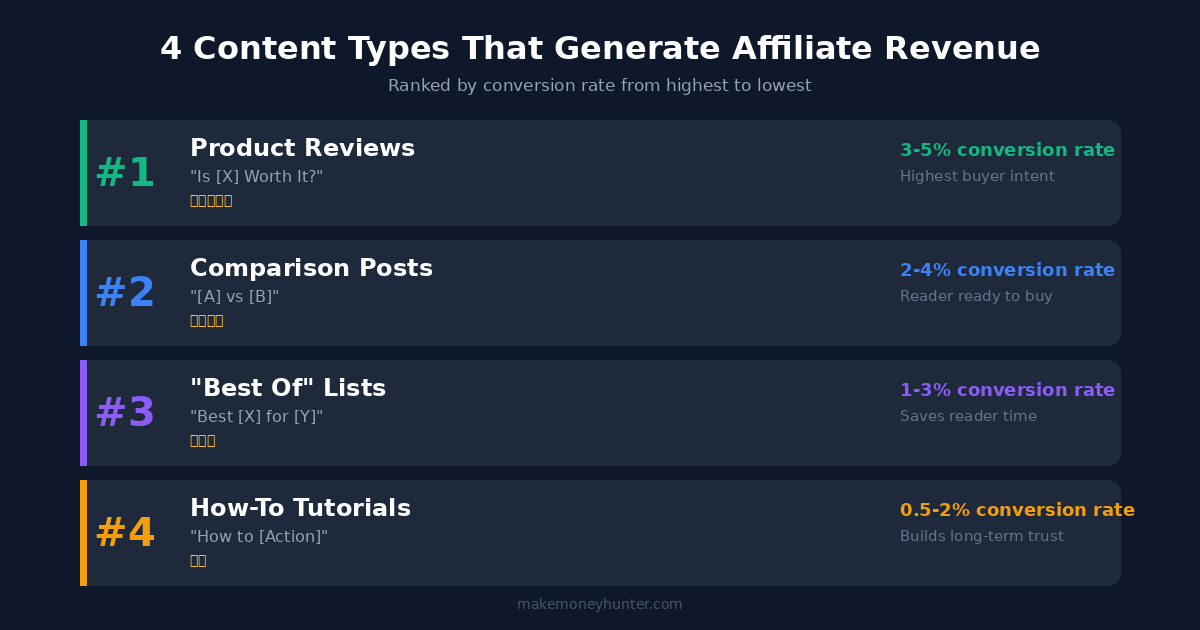
The 4 content types that generate the most affiliate revenue:
1. Product Reviews (“Is [Product] Worth It?”)
People search for reviews when they’re one step away from buying. A thorough, honest review that covers features, pricing, pros, cons, and your personal experience is the highest-converting content type in affiliate marketing. In my experience, honest reviews that mention real drawbacks convert at about 3-5% — while overly positive “everything is amazing!” reviews convert at less than 1%.
2. Comparison Posts (“[Product A] vs [Product B]”)
When someone searches “Bluehost vs SiteGround,” they’re ready to buy — they just need help deciding which one. Comparison posts convert exceptionally well because the reader has already decided to spend money. Your job is simply to help them choose.
3. How-To Tutorials
Tutorials attract people at the beginning of their journey. They won’t buy immediately, but if you help them solve a real problem and naturally mention a tool, a percentage will convert. This took me 8 months and 47 articles before I hit $1,000/month — but the compound effect is powerful.
4. “Best Of” Listicles (“Best [Products] for [Audience]”)
These work because they save the reader hours of research. Instead of comparing 50 options themselves, they get your curated top 5-7 with clear recommendations. The key is to actually have an opinion — don’t just list features. Tell the reader which one YOU would pick and why.
Content structure that works:
For every affiliate article, follow this flow:
- Open with the problem the reader has (they’re searching for a reason)
- Establish your credibility (have you used this product? for how long?)
- Give your honest recommendation upfront — don’t bury it at the end
- Walk through features, pricing, pros, and cons with specific details
- Include your affiliate link as a natural CTA (not a hard sell)
- Close with “who is this best for?” to help the reader self-select
Step 5: Get Free Traffic to Your Content
Content without traffic is like a billboard in the desert. Here are the three best free traffic sources for affiliate marketers in 2026, ranked by long-term ROI:
1. SEO (Search Engine Optimization) — The Long Game
This is, hands down, the most valuable traffic source for affiliate marketing. When someone types “best email marketing tool for small business” into Google, they’re practically begging to be recommended a product. If your article ranks on page one, you get free, targeted traffic every single day — for months or years.
Beginner SEO checklist (all free):
- Target long-tail keywords with 200-1,000 monthly searches (less competition)
- Put your main keyword in the title, first paragraph, one H2, and URL
- Write at least 2,000 words (longer content tends to rank higher for competitive terms)
- Add internal links to your other related posts
- Update your articles every 6 months with fresh information
2. YouTube — The Underrated Goldmine
YouTube is the second largest search engine in the world, and affiliate links in video descriptions get clicked more than most people realize. You don’t need fancy equipment — a smartphone, decent lighting, and a clear explanation of why Product A is better than Product B is enough to start.
3. Pinterest — The Visual Search Engine
Pinterest isn’t a social media platform — it’s a search engine for visual content. If your niche is anything related to lifestyle, finance, food, fitness, or DIY, Pinterest can send serious traffic to your affiliate content. Create pin images for each blog post and link them back to your articles.
Most people think you need Reddit or TikTok to drive traffic. And sure, those can work. But in my experience, SEO + Pinterest is the most sustainable combination for beginners because both platforms reward helpful content over follower count.
Step 6: Track, Learn, and Optimize
Don’t overthink this at the start, but do track the basics. The two numbers that matter most:
- Click-through rate (CTR) — How many people who read your content actually click your affiliate link? If it’s below 2%, your CTA or link placement needs work.
- Conversion rate — Of the people who clicked, how many bought? This is partly the merchant’s job (their sales page), but your recommendation quality matters too.
Free tracking tools:
- Google Analytics 4 — free, tracks all your website traffic and behavior
- Google Search Console — shows which keywords your articles rank for
- Affiliate dashboard — every program shows clicks and conversions
- Bitly — free link shortener that shows click counts (useful when you don’t have a website yet)
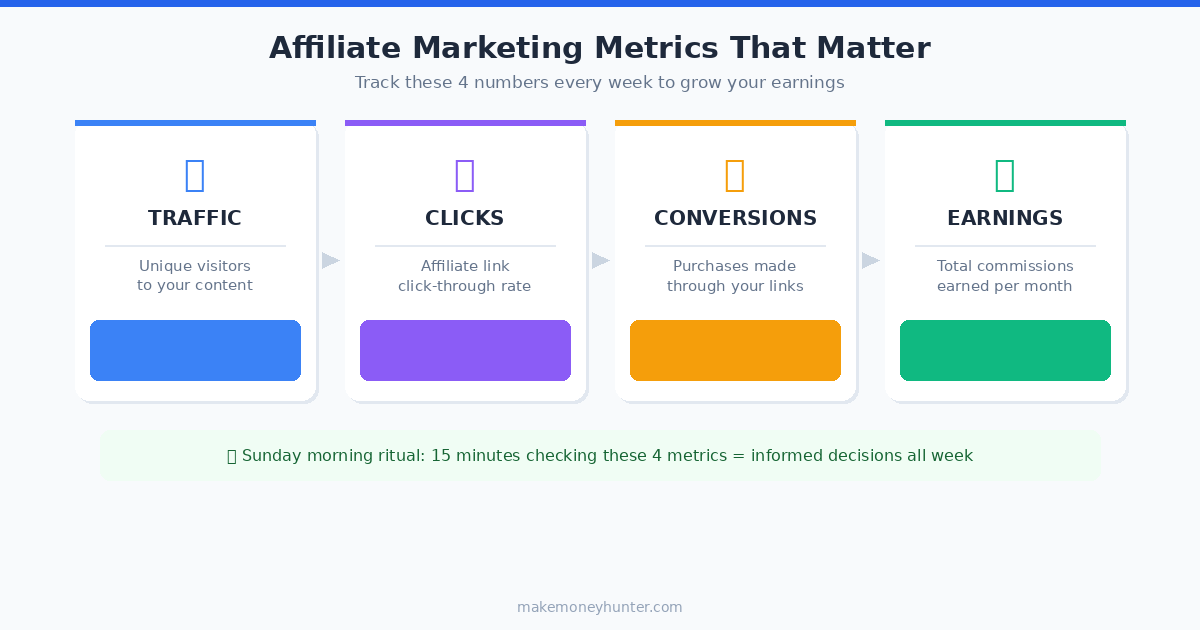
Here’s what I do every Sunday morning (takes 15 minutes): I check which articles got the most traffic, which affiliate links got the most clicks, and whether any articles are ranking on page 2 of Google. If something’s on page 2, I update it with more depth, better images, or a more compelling intro — because the jump from page 2 to page 1 can triple your traffic overnight.
Step 7: Scale from $0 to $1,000/Month
Here’s a realistic timeline based on my experience and what I’ve seen work for dozens of beginners:
| Month | What to Focus On | Realistic Income |
|---|---|---|
| Month 1-2 | Choose niche, join programs, publish 10-15 articles | $0-$10 |
| Month 3-4 | Keep publishing, start seeing Google impressions, get first clicks | $10-$100 |
| Month 5-6 | Some articles start ranking, first consistent commissions | $100-$300 |
| Month 7-9 | Update top articles, add more content, reinvest in proper hosting | $300-$700 |
| Month 10-12 | Compound effect kicks in, multiple articles generating income | $700-$1,000+ |
The key to scaling is compounding. Every article you publish is a potential income-generating asset that works 24/7. Month 1 feels brutal because you have 5 articles earning nothing. By month 8, you have 40 articles — and even if only 10 of them generate traffic, those 10 are working for you while you sleep.
Once you hit consistent income, reinvest in:
- Proper self-hosted WordPress with good hosting (~$3-5/month)
- A keyword research tool like Ubersuggest or KeySearch (~$20/month)
- An email marketing tool like ConvertKit or MailerLite (free up to 1,000 subscribers)
Common Mistakes That Kill Affiliate Earnings
I’ve made every mistake on this list. Here’s what to avoid:
❌ Mistake #1: Promoting too many products
Focus on 3-5 products maximum. One deep review beats 20 shallow mentions.
❌ Mistake #2: Not disclosing affiliate relationships
Always add an affiliate disclosure at the top of your content. It’s legally required by the FTC, and honest disclosure actually builds trust.
❌ Mistake #3: Writing for search engines instead of people
If your content reads like a robot wrote it, nobody will trust your recommendations. Write like you’re explaining to a friend.
❌ Mistake #4: Expecting fast results
Affiliate marketing is a 6-12 month game minimum. If you quit at month 3, you’ll never see the compounding effect that makes it worthwhile.
❌ Mistake #5: Ignoring search intent
Before writing any article, Google your target keyword and look at what type of content ranks. If the top 10 results are all “best of” lists and you write a personal story, you won’t rank — no matter how good it is.
❌ Mistake #6: Only promoting low-commission products
Amazon Associates pays 1-4% on most products. A $20 book earns you $0.80. Meanwhile, a web hosting referral pays $65-$150. Same effort, wildly different returns. Mix in at least some high-commission products.
How Long Does It Take to Make Money with Affiliate Marketing?
Let me give you the most honest answer I can: most people see their first commission within 60-90 days of consistent effort, and reach $500-1,000/month within 8-12 months.
The word “consistent” is doing a lot of heavy lifting in that sentence. Consistent means publishing 2-3 quality articles per week, learning basic SEO, and not giving up when month 2 feels like nothing is happening.
Here’s what was happening behind the scenes during my “nothing months”:
- Google was crawling and indexing my pages
- My domain was slowly building authority
- Long-tail keywords were starting to rank on page 3-4
- A handful of people were reading my content and saving it
Then one day, an article jumped to page 1. Then another. And suddenly, income that felt impossible two months ago became inevitable.
Affiliate marketing isn’t a get-rich-quick scheme — it takes real work and consistency. But if you commit to it, the results compound over time.
Frequently Asked Questions
How much does it cost to start affiliate marketing?
Technically $0. You can join affiliate programs for free, publish content on free platforms like YouTube or WordPress.com, and drive traffic through SEO without spending anything. Most successful affiliates eventually invest $50-100/month in hosting and tools, but it’s not required to start.
Do I need a website to do affiliate marketing?
No, but it helps enormously for long-term success. You can start with YouTube, TikTok, Pinterest, or Medium. However, a website gives you full control over your content, better SEO potential, and more credibility with affiliate programs.
What is the best affiliate program for complete beginners?
Amazon Associates is the easiest to join and has millions of products, but commissions are low (1-4%). For higher earnings, I recommend ShareASale or Impact — both accept beginners and offer access to brands with much higher commission rates.
Can I do affiliate marketing without showing my face?
Absolutely. Most successful affiliate marketers run blogs — not video channels. Your written content, expertise, and recommendations are what matter. If you do YouTube, faceless channels with screen recordings and voiceovers work well for tutorials and reviews.
Is affiliate marketing still worth it in 2026?
Yes. The global affiliate marketing industry is projected to be worth over $27 billion in 2026. While competition has increased, so has online shopping volume. The key is to focus on a specific niche rather than trying to compete on broad topics.
Final Thoughts
Affiliate marketing for beginners with no money isn’t a fantasy — it’s exactly how I started, and it’s how thousands of people build online income every year. The barrier to entry has never been lower. The tools are free. The knowledge is everywhere. The only thing separating you from your first commission is action and patience.
Here’s what I’d do if I were starting from scratch today: pick one niche, join 3 affiliate programs, set up a free WordPress blog, and commit to publishing 3 articles per week for 90 days straight. No excuses, no pivoting, no shiny object chasing. Just consistent, helpful content.
Have questions about getting started? Drop them in the comments — I respond to every one.