

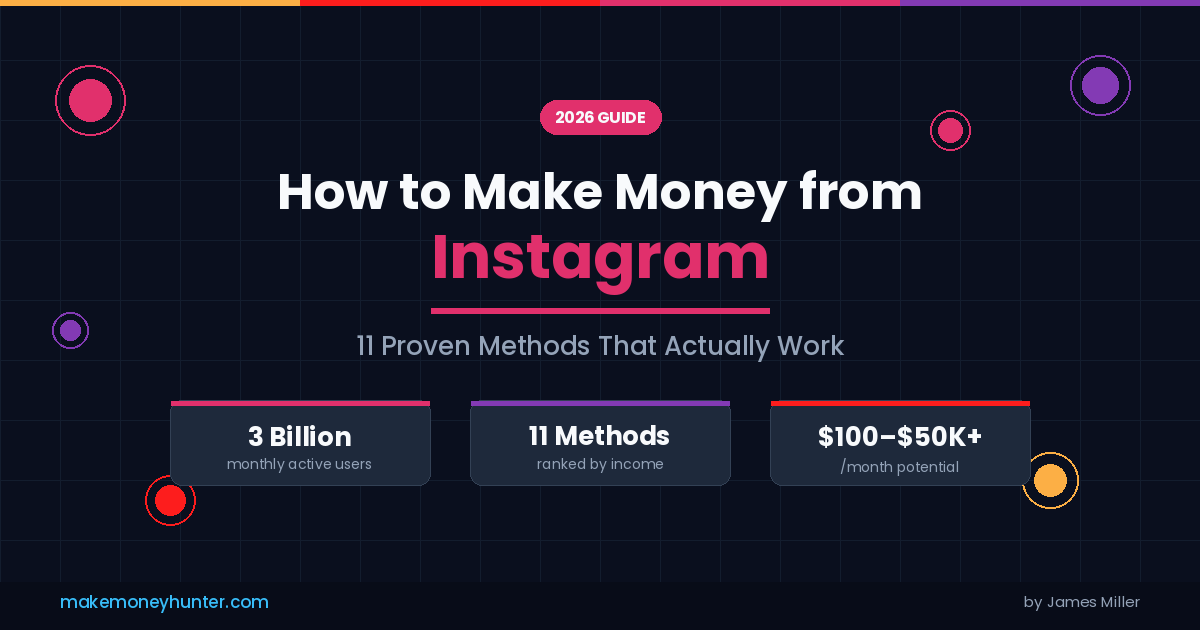
Instagram has 3 billion monthly active users and generated over $83 billion in revenue last year. But here’s what matters to you: regular people — not just celebrities — are earning real money on this platform every single day.
I’ve been building online income streams for over 15 years. I’ve done affiliate marketing, niche sites, blogging, digital products — you name it. And when people ask me which social platform has the most realistic money-making potential for everyday creators in 2026, my answer is always Instagram.
Not because it’s trendy. Because the economics are right. Instagram users actively search for products, 44% engage with shoppable content weekly, and 85% of weekly active users have made a purchase based on something they discovered on the platform. That’s not a social network — that’s a marketplace disguised as one.
But let me be direct: most people who try to make money on Instagram fail because they focus on follower count instead of income strategy. I’ve seen accounts with 2,000 followers earn more than accounts with 200,000 — because they understood the actual mechanics of monetization.
In this guide, I’ll walk you through 11 proven methods to make money from Instagram, the realistic income potential for each one, and the strategy I’d use if I were starting from zero today.
How Does Making Money on Instagram Actually Work?
Before diving into specific methods, you need to understand the fundamental business model behind Instagram monetization.
Instagram makes money from advertising — over $83 billion in 2025 alone. The platform’s entire incentive structure is designed to keep users engaged, because engaged users see more ads, which generates more revenue for Meta.
This creates a cascading opportunity for creators: when you create content that keeps people engaged, Instagram rewards you with more distribution. More distribution means more eyeballs. More eyeballs means more monetization options — whether through brand deals, product sales, affiliate commissions, or Instagram’s own creator programs.
The key insight most people miss is this: Instagram doesn’t pay you for being popular. It creates an ecosystem where your popularity becomes valuable to others — brands, businesses, and your own products.
There are essentially four ways money flows on Instagram:
1. Brands pay you to promote their products (sponsored posts, brand partnerships)
2. You earn commissions by recommending other people’s products (affiliate marketing)
3. You sell your own products or services directly to your audience (digital products, coaching, physical goods)
4. Instagram pays you directly through its creator monetization programs (Bonuses, Gifts, Subscriptions)
The most successful Instagram earners don’t rely on just one of these. They stack multiple streams — which is exactly what I’ll teach you how to do.
How Much Money Can You Realistically Make on Instagram?
Let me give you the actual numbers, because the “Instagram income” conversation is full of hype and misinformation.
Your earnings depend on three things: your niche, your engagement rate, and your monetization strategy. Follower count matters, but far less than most people think.
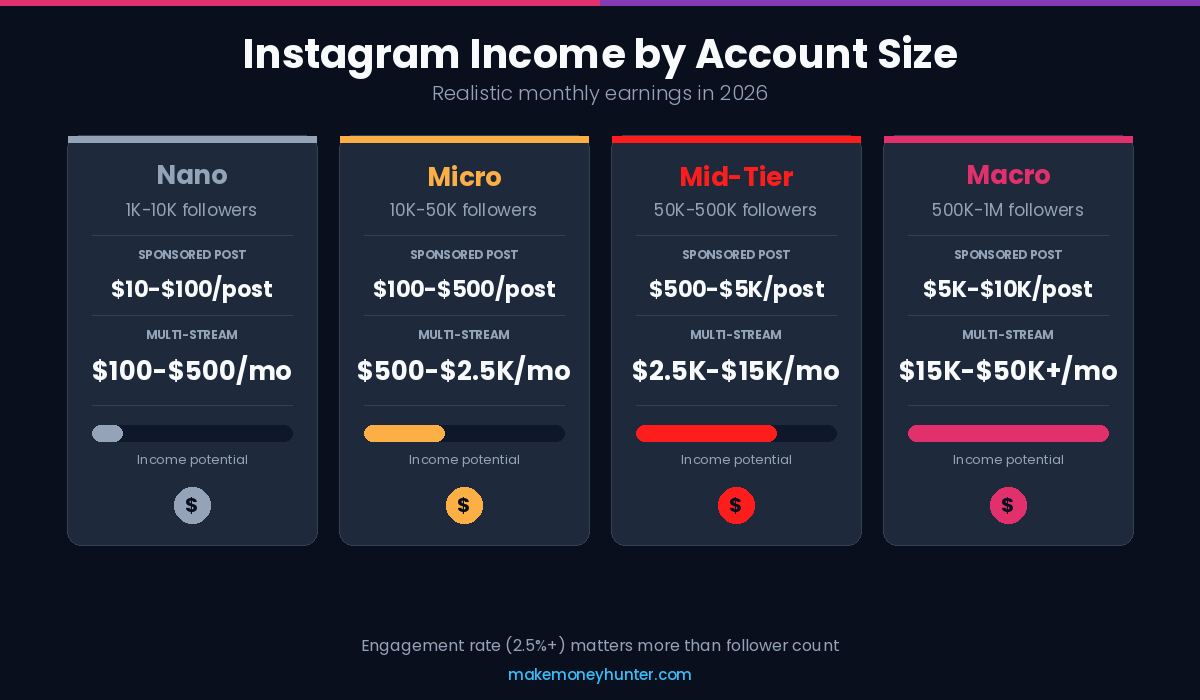
Here’s a realistic breakdown for 2026:
| Account Size | Sponsored Post Rate | Monthly Potential (Multi-Stream) |
|---|---|---|
| Nano (1K–10K followers) | $10–$100/post | $100–$500/mo |
| Micro (10K–50K followers) | $100–$500/post | $500–$2,500/mo |
| Mid-Tier (50K–500K followers) | $500–$5,000/post | $2,500–$15,000/mo |
| Macro (500K–1M followers) | $5,000–$10,000/post | $15,000–$50,000+/mo |
Critical context: these numbers assume a healthy engagement rate (2.5%+) and active monetization across multiple methods. An account with 50K followers but a 0.5% engagement rate will earn far less than an account with 5K followers and an 8% engagement rate. Brands in 2026 prioritize engagement over raw numbers — a trend confirmed by multiple industry reports.
The real takeaway? You don’t need a massive following to start earning. You need the right niche, consistent content, and a smart monetization stack.
11 Proven Ways to Make Money from Instagram in 2026
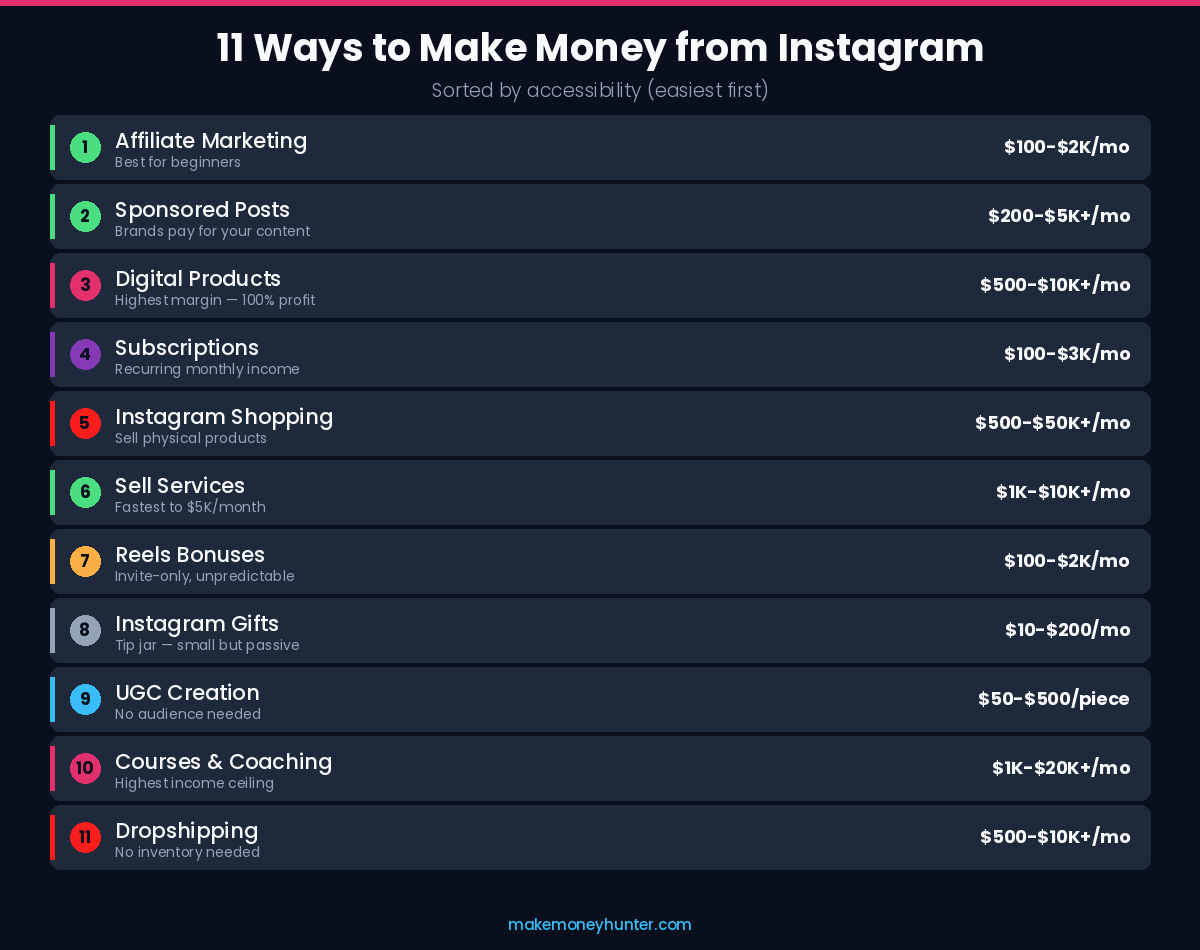
I’ve organized these methods from most accessible (anyone can start today) to most advanced (requires audience or capital). Each one includes realistic income potential and who it’s best suited for.
1. Affiliate Marketing (Best for Beginners)
Affiliate marketing is my recommended starting point for Instagram monetization because it requires zero upfront investment and no product of your own.
The concept is simple: you recommend products through special tracking links, and when someone buys through your link, you earn a commission. Commission rates range from 1% (Amazon) to 50%+ (digital products and SaaS tools).
How to do it on Instagram: Share honest product reviews and recommendations in your content. Place affiliate links in your bio using a link-in-bio tool like Linktree or Stan Store. Use promo codes in post captions (since clickable links aren’t allowed in captions). Mention products naturally in Stories with swipe-up links (available to all accounts now).
Best affiliate programs for Instagram creators: Amazon Associates (broad product range, low commissions), ShareASale and Impact (mid-tier commissions, huge brand selection), digital product platforms like Teachable, ConvertKit, and Canva (high commissions, often 20-40%), and niche-specific programs in your content area.
Realistic income: $100–$2,000/month depending on niche and audience size. Finance, tech, and beauty niches tend to pay the highest commissions.
Pro tip: Focus on products you genuinely use. Authenticity drives conversions on Instagram — forced promotions get ignored. One genuine recommendation beats ten generic product placements.
2. Sponsored Posts and Brand Partnerships
Once you’ve built a following — even a small one — brands will pay you to create content featuring their products. This is the income stream most people associate with “Instagram money.”
In 2026, 40% of all influencer collaborations happen on Instagram, making it the top platform for brand deals. And you don’t need millions of followers to get started. Nano-influencers with 1,000–10,000 followers regularly land paid partnerships because brands value their tight-knit, engaged communities.
How to land brand deals: Switch to a Creator Account and optimize your Professional Dashboard. Join Instagram’s Creator Marketplace — it’s an internal matchmaking service that connects you directly with brands. Sign up for influencer platforms like AspireIQ, Upfluence, and Collabstr. Create a simple media kit showing your niche, audience demographics, and engagement rate. Start by reaching out to smaller brands in your niche — they’re more accessible and often more generous.
Pricing guideline: A common starting formula is $100 per 10,000 followers per post, but engagement rate matters more. If your engagement rate exceeds 3%, you can charge a premium. Also charge more for usage rights — where brands can reuse your content in their ads.
Realistic income: $200–$5,000+/month depending on niche, engagement, and volume of deals. Top earners in profitable niches (beauty, fitness, finance) can earn significantly more.
3. Sell Digital Products
Digital products are the highest-margin income stream on Instagram because once you create them, they cost nothing to deliver. Your profit margin is essentially 100% minus payment processing fees.
Popular digital products on Instagram: ebooks and guides ($7–$47), Lightroom presets and design templates ($10–$97), Notion templates ($5–$29), online courses ($47–$497), workout plans and meal plans ($15–$67), and printable planners and checklists ($3–$19).
You don’t need a full website to sell digital products. Tools like Stan Store, Gumroad, and Payhip let you set up a storefront and link it directly from your Instagram bio. Your audience taps the link, sees your offers, and checks out in seconds.
Realistic income: $500–$10,000+/month. The beauty of digital products is that income scales without additional effort — selling to 100 people takes the same work as selling to 10.
My take: If I were starting an Instagram monetization strategy from scratch in 2026, digital products would be my primary focus after building initial audience trust. They’re the closest thing to genuinely passive income that Instagram offers.
4. Instagram Subscriptions
Instagram’s native Subscription feature lets you charge followers a monthly fee for exclusive content. Think of it as Patreon built directly into Instagram.
You need at least 10,000 followers and an eligible Creator Account to activate Subscriptions. Pricing tiers range from $0.99 to $99.99/month, and you can offer subscriber-only Stories, Reels, Lives, group chats, and badges.
What works for subscriptions: behind-the-scenes content, exclusive tutorials, early access to content, private Q&A sessions, and subscriber-only community access.
Realistic income: Even converting 1-2% of your followers at $4.99/month creates meaningful recurring revenue. An account with 20,000 followers converting 200 subscribers at $4.99 earns roughly $1,000/month in recurring income.
5. Sell Physical Products (Instagram Shopping)
Instagram has evolved from a product discovery platform into an actual commerce engine. 130 million users tap on shopping posts every month, and the platform’s visual-first format is perfect for product showcase.
You can sell physical products through Instagram Shopping — which lets you tag products directly in posts and Stories — or by driving traffic to your own ecommerce store on Shopify, WooCommerce, or similar platforms.
What sells well on Instagram: fashion and accessories, beauty and skincare, home decor, fitness equipment and apparel, handmade and artisan goods, pet products, and food and beverage items.
The most successful Instagram sellers in 2026 focus on niche products rather than broad catalogs. A store built around minimalist home organization or sustainable pet accessories converts far better than a store selling everything.
Realistic income: Highly variable — from $500/month for small niche shops to $50,000+/month for established brands. The key is product-market fit and consistent content that showcases your products naturally.
6. Sell Services
If you have a professional skill — photography, graphic design, social media management, coaching, consulting, writing — Instagram is one of the best platforms to showcase your work and attract clients.
Your Instagram feed becomes your portfolio. Every post demonstrates your expertise. Every Story shows your process. Every Reel proves you know what you’re talking about.
High-demand services on Instagram in 2026: social media management and content creation, photography and videography, coaching and consulting (business, fitness, life, dating), web design and branding, virtual assistance, and copywriting.
How to convert followers to clients: share results and case studies in your content. Use your bio to clearly state what you offer and how to book. Add online scheduling through your website so people can book directly. Use DMs strategically — respond to engagement and build relationships.
Realistic income: $1,000–$10,000+/month depending on your service, pricing, and volume. Service-based income often has the fastest path to $5,000/month because each client represents a significant transaction.
7. Instagram Reels Bonuses
Instagram’s bonus program pays eligible creators based on content performance — primarily views on Reels, carousels, and single image posts. It’s currently the only way Instagram pays creators directly without requiring audience purchases.
The program is invitation-only, and eligibility varies by region and account standing. If you qualify, you’ll see the invitation in your Professional Dashboard. Once activated, up to 150 pieces of content are counted from your activation date to the program’s end.
Reported payouts: estimates range from $0.01 to $0.05 per view. Most creators report monthly earnings between $100 and $2,000 from bonuses alone, though viral Reels can pay significantly more.
My honest take: Don’t build your strategy around bonuses. They’re unpredictable, invitation-only, and subject to constant restructuring. Think of them as a nice cherry on top — not the sundae itself. As Instagram’s head Adam Mosseri has said, if you have a smaller following, focus on growing your audience rather than trying to monetize directly through platform features.
8. Instagram Gifts
Gifts allow your followers to send you virtual “Stars” on your Reels, which convert to real money at the rate of 1 cent per Star. Instagram pays creators monthly for accumulated Gifts.
To enable Gifts, go to your Professional Dashboard, find “Gifts” under Your Tools, and toggle on “Allow gifts on reels.”
This isn’t a primary income stream for most creators, but it adds up. Creating interactive, engaging Reels and actively responding to comments can boost gift earnings. Think of it as the Instagram equivalent of a tip jar.
Realistic income: $10–$200/month for most eligible creators. High-engagement accounts can earn more.
9. User-Generated Content (UGC)
Here’s a method that doesn’t require a large following at all. UGC creators produce content for brands to use in their own marketing — ads, social posts, website imagery — without posting it on their personal accounts.
Brands increasingly prefer authentic-looking content over polished studio productions. If you’re good at creating natural, engaging content with a phone, brands will pay you for it.
How to start: build a UGC portfolio (create sample content for brands you love, even unpaid at first). Pitch directly to brands via DM or email. Join UGC platforms like Billo, Trend, or JoinBrands.
Realistic income: $50–$500 per piece of content, with experienced UGC creators earning $2,000–$5,000/month. The advantage is that you’re paid for content creation skills, not for your audience size.
10. Coaching and Online Courses
If you’ve developed expertise in any area — fitness, business, cooking, photography, personal development — packaging that knowledge into coaching programs or online courses can be extremely lucrative.
Instagram serves as both your marketing platform and your credibility builder. Your free content demonstrates your expertise, and your paid offerings deliver deeper transformation.
The model: share valuable free content on Instagram (build trust and demonstrate expertise). Offer a signature online course or coaching program ($97–$2,000+). Use Instagram DMs, Stories, and Reels to nurture and convert. Deliver courses through platforms like Teachable, Kajabi, or Stan Store.
Realistic income: $1,000–$20,000+/month. Online courses have the potential for the highest income ceiling of any Instagram monetization method because they combine high price points with unlimited scalability.
11. Dropshipping
Dropshipping lets you sell physical products without holding any inventory. When a customer orders from your Instagram Shop, the order goes directly to your supplier, who ships the product to the customer.
The most successful Instagram dropshippers in 2026 focus on niche products — not general stores. A store built around outdoor gear, minimalist home organization, or pet accessories converts far better than a generic catalog.
How it works on Instagram: set up a Shopify store connected to a dropshipping supplier (Aliexpress, CJ Dropshipping, Spocket). Connect your store to Instagram Shopping. Create Reels and posts showcasing your products. Drive traffic from Instagram to your store.
Realistic income: $500–$10,000+/month once you find winning products. Profit margins typically range from 15-40% depending on product and niche.
Read More:How to Make Money with Dropshipping in 2026
The Instagram Monetization Stack I’d Build from Zero
If I were starting from scratch on Instagram today — no followers, no audience, nothing — here’s exactly how I’d approach it:
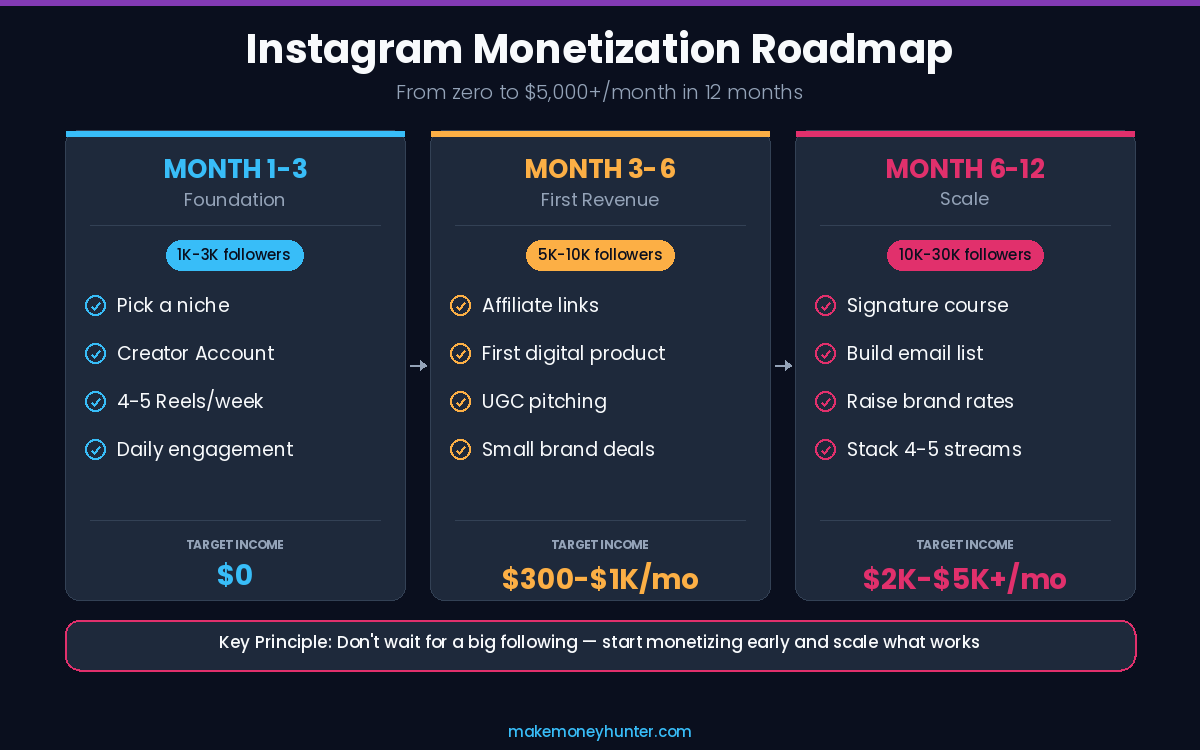
Month 1-3: Foundation Phase
Pick one specific niche where I have genuine knowledge or passion. Create a Creator Account with an optimized bio clearly stating who I help and how. Post 4-5 high-quality Reels and carousels per week (carousels outperform static posts by 3x in reach according to 2026 Metricool data). Engage genuinely with 20-30 accounts in my niche daily. Study what top creators in my niche are doing and adapt their successful formats. Goal: 1,000–3,000 engaged followers.
Month 3-6: First Revenue Phase
Start affiliate marketing with 2-3 programs relevant to my niche. Create my first digital product (a simple guide, template, or resource). Set up a link-in-bio page with Stan Store or Linktree. Start pitching brands for UGC work and small collaborations. Goal: $300–$1,000/month from combined affiliate commissions, digital product sales, and small brand deals.
Month 6-12: Scale Phase
Launch a signature digital product or course. Build an email list from Instagram to own my audience. Increase brand partnership rates as my engagement grows. Explore Instagram Subscriptions if eligible. Stack all income streams simultaneously. Goal: $2,000–$5,000+/month from 4-5 simultaneous income streams.
The key principle: don’t wait until you have a big following to start monetizing. Start small, test methods, and scale what works. The creators who earn the most aren’t the ones with the biggest audiences — they’re the ones who started monetizing earliest and refined their approach over time.
7 Common Mistakes That Kill Your Instagram Income
Mistake #1: Chasing followers instead of engagement. Brands pay based on engagement rate, not follower count. An account with 5K followers and 8% engagement is worth more than 50K followers with 0.5% engagement. Focus on building a community, not collecting vanity numbers.
Mistake #2: Only relying on one income stream. Algorithm changes, brand budget cuts, or program restructuring can wipe out a single income stream overnight. Stack multiple methods to build resilience.
Mistake #3: Ignoring Reels and carousels. In 2026, Reels generate 22% more engagement than standard video posts, and carousels achieve the highest reach of any format — averaging over 30,000 impressions per post according to Metricool’s analysis. Static single-image posts get the least distribution. Adapt your content strategy accordingly.
Mistake #4: Never selling anything. Many creators build large audiences but never actually monetize. They’re afraid of being “salesy.” The reality is that your audience expects you to have offerings. If they trust you, they want to buy from you. Don’t leave money on the table.
Mistake #5: Not owning your audience. Instagram can change its algorithm, restrict your reach, or even suspend your account at any time. Always build an email list from your Instagram audience so you have a direct communication channel you own.
Mistake #6: Inconsistent posting. Instagram’s algorithm rewards consistency. Posting 5 times per week for 6 months beats posting daily for one month and then disappearing. Build a sustainable content routine you can maintain long-term.
Mistake #7: Using a personal account. You cannot access monetization tools, analytics, or the Creator Marketplace with a personal profile. Switch to a Creator Account immediately — it’s free and takes 30 seconds.
Essential Tools for Instagram Monetization
You don’t need expensive tools to make money on Instagram, but the right tools make the process significantly more efficient.
Content creation: Canva (free/Pro) for graphics and carousel design, CapCut for Reels editing, and your smartphone camera (you don’t need professional equipment to start).
Link-in-bio and storefront: Stan Store (all-in-one creator storefront with zero transaction fees), Linktree (simple, free link-in-bio tool), or Beacons (free with advanced features).
Scheduling and analytics: Buffer or Later for post scheduling and analytics, Metricool for in-depth performance tracking, and Instagram’s native Insights for basic metrics.
Affiliate and sales: ShareASale, Impact, and Amazon Associates for affiliate programs. Shopify if selling physical products. Teachable or Kajabi for courses.
My recommendation: start with free tools. Upgrade only when a paid tool will clearly save you time or directly increase revenue. The biggest mistake beginners make is buying $200/month in tools before they’ve earned their first dollar.
Frequently Asked Questions
How Many Followers Do You Need to Make Money on Instagram?
You can start making money with as few as 1,000 followers through affiliate marketing, UGC creation, and small brand collaborations. Instagram’s native monetization features (Subscriptions, Bonuses) typically require 10,000+ followers. But follower count matters less than engagement rate and monetization strategy — plenty of nano-influencers earn $500-$1,000/month.
Can You Make $1,000 a Month from Instagram?
Yes, and you don’t need a huge following to do it. A micro-influencer with 5,000-10,000 engaged followers can realistically earn $1,000/month by stacking affiliate commissions ($200-$400), one monthly brand deal ($300-$500), and digital product sales ($200-$300). It typically takes 3-6 months of consistent effort to reach this level.
What Niche Makes the Most Money on Instagram?
The highest-paying niches on Instagram are finance and investing, business and entrepreneurship, health and fitness, beauty and skincare, and technology. These niches command higher brand deal rates and affiliate commissions because the products involved have higher price points and profit margins. However, the best niche for you is one where you have genuine expertise and can create consistent content.
Do You Need to Show Your Face on Instagram?
No. Many successful Instagram accounts operate without showing the creator’s face — think theme pages, quote accounts, niche education pages, and product-focused brands. That said, face-forward content typically generates higher engagement and trust, which translates to better monetization. If you’re comfortable on camera, it’s an advantage.
Is It Too Late to Start Making Money on Instagram in 2026?
Not even close. Instagram has 3 billion monthly active users, which means there’s always demand for fresh content and new perspectives. The platform added new features like expanded Reels bonuses and improved shopping tools specifically to attract and retain creators. Every year, people say “it’s too late” — and every year, new creators break through. The best time to start was years ago. The second best time is right now.
Final Thoughts
Making money from Instagram isn’t about gaming an algorithm or going viral. It’s about building a focused presence in a specific niche, creating content that genuinely helps people, and stacking income streams that compound over time.
The creators earning real income on Instagram in 2026 aren’t doing anything magical. They picked a niche, showed up consistently, started monetizing early with affiliate links and small brand deals, and gradually built toward their own products and services.
The formula is simple, even if the execution requires patience: Niche clarity + Consistent content + Multiple income streams + Audience you own = Sustainable Instagram income.
Start with affiliate marketing and UGC if you’re new. Build toward digital products and brand partnerships as you grow. And always — always — build an email list so your income isn’t dependent on a single platform.
The opportunity is real. The question isn’t whether you can make money from Instagram. It’s whether you’ll commit to the strategy long enough to see results.
Have questions about Instagram monetization? Drop them in the comments — I read and reply to every one.