

Most bloggers spend their first year obsessing over Google rankings. I did the same thing. And for 11 months, my traffic was stuck under 500 visitors a month — despite publishing 30+ articles that were “SEO optimized.”
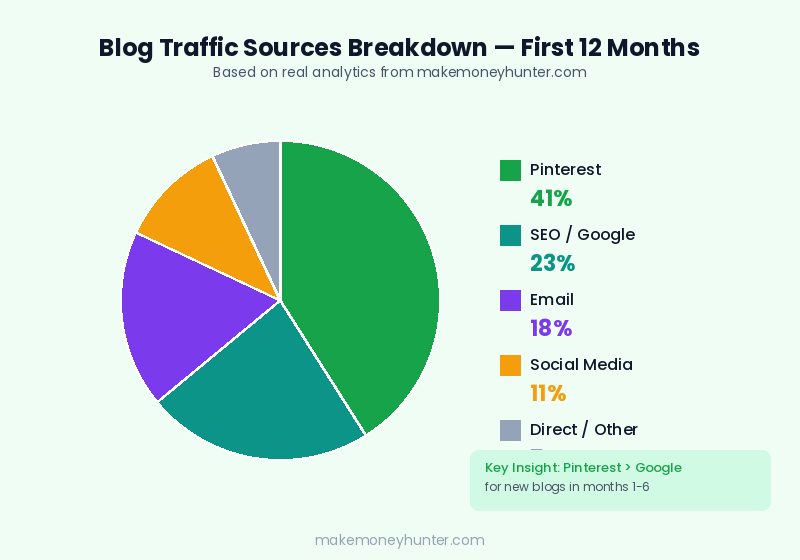
Then I tracked where my traffic was actually coming from. The results surprised me. Only 23% came from Google. Pinterest was driving 41%. And my tiny email list of 340 subscribers was sending more engaged visitors than all my social media accounts combined.
That’s when I realized: if you want to drive traffic to your blog for free, you need to stop thinking about one channel and start building a traffic system. The bloggers who get 10,000+ monthly visitors aren’t doing one thing well — they’re stacking 3-4 free methods that feed each other.
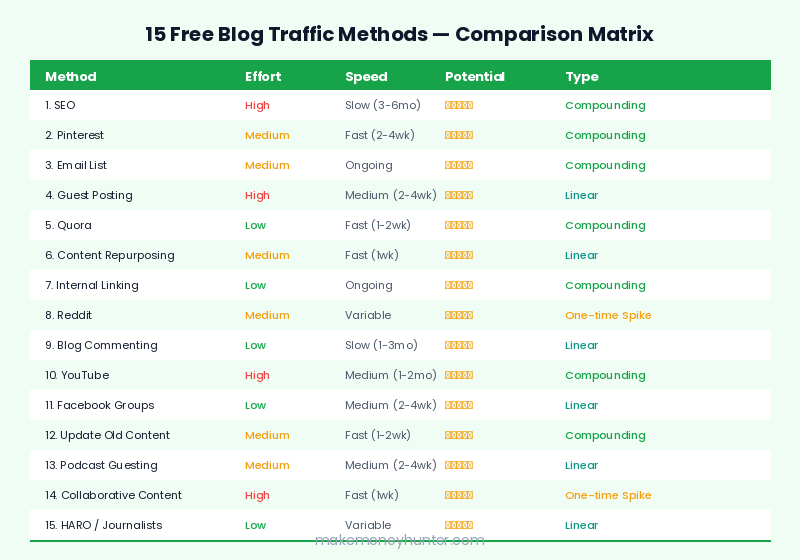
Don’t forget to save this image for later reference!
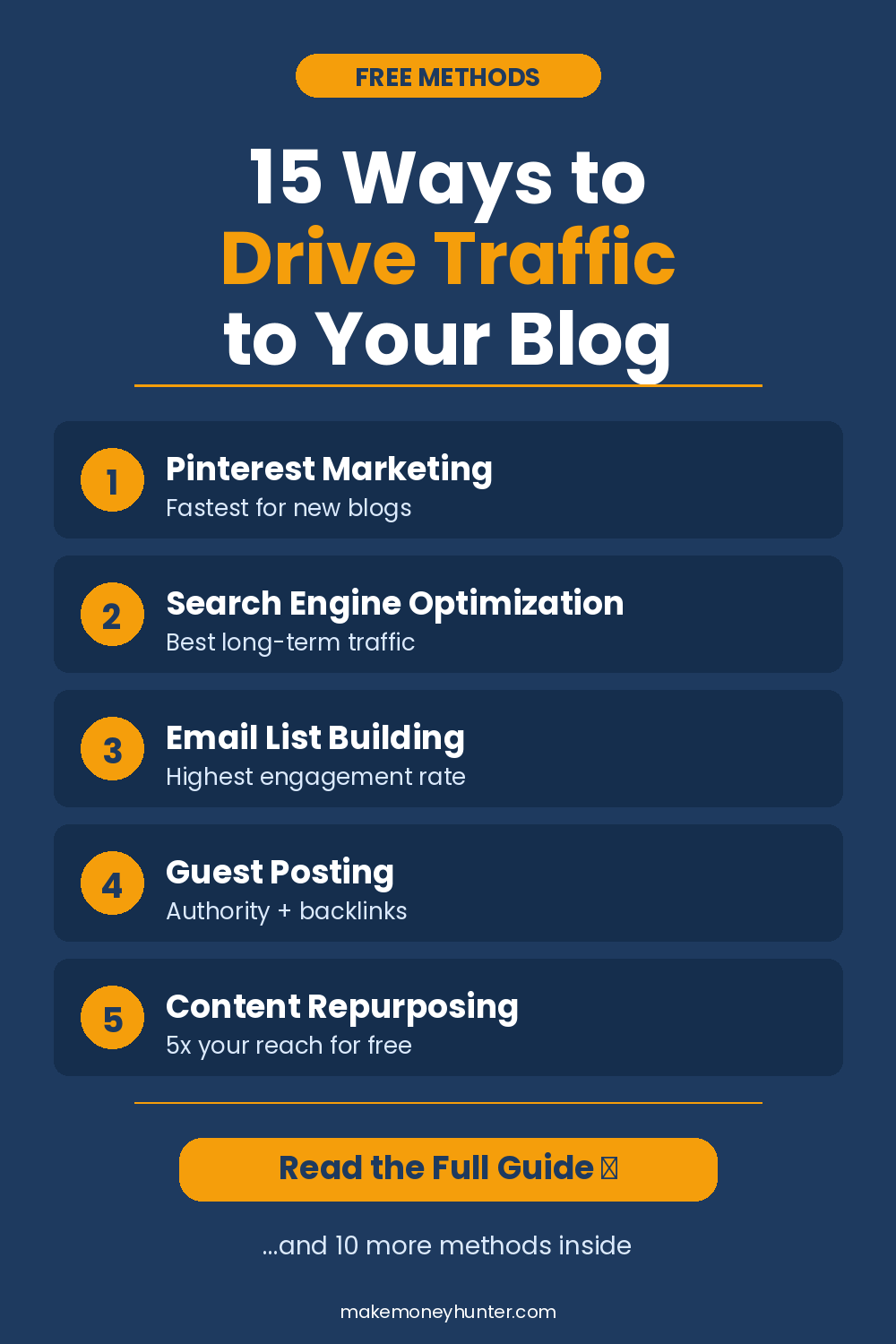
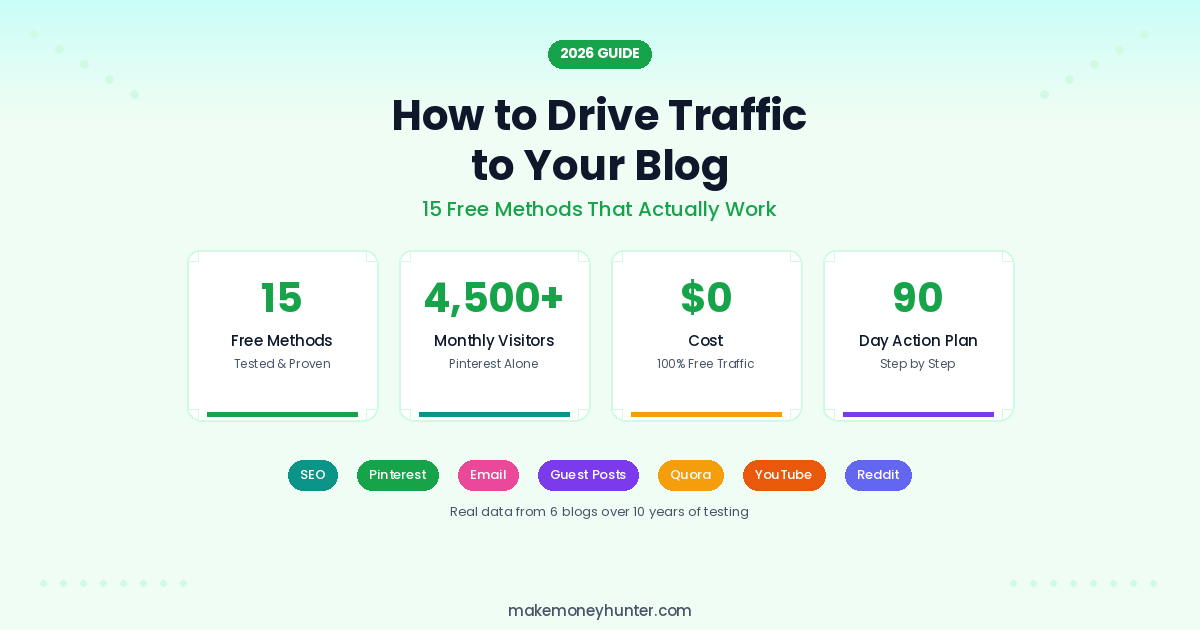
I’ve tested 15 different free traffic methods across 6 blogs over the past decade. Some worked immediately. Some took months. And a few were complete wastes of time. In this guide, I’m sharing the 15 methods that actually moved the needle — with real numbers from my own analytics.
How Does Free Blog Traffic Actually Work?
Before jumping into specific methods, you need to understand something fundamental. Free traffic isn’t really “free.” You’re paying with time instead of money. And some time investments pay back 100x more than others.
Here’s how I think about it. Every traffic method falls into one of three categories:
- Compounding traffic — gets bigger over time without extra work (SEO, Pinterest). This is where you want to invest the most.
- Linear traffic — each effort produces a proportional result (social media posts, guest posting). Good for quick wins.
- One-time spikes — a burst of traffic that fades fast (Reddit posts, viral content). Unreliable as a primary strategy.
The bloggers who build real traffic focus 70% of their effort on compounding methods and use linear methods to bridge the gap while compounding kicks in. That’s the framework behind everything below.
How to Drive Traffic to Your Blog: 15 Free Methods That Work in 2026
1. Search Engine Optimization (SEO)
SEO is still the single most powerful free traffic source for blogs in 2026 — but it’s also the slowest to produce results.
When I launched makemoneyhunter.com, I didn’t see meaningful organic search traffic until month 5. That’s normal. Google needs time to trust a new domain. But once it kicks in, the traffic compounds. Articles I wrote 8 months ago still bring in visitors every single day without any additional work from me.
What actually works right now:
- Target keywords with KD under 30 when you’re starting out. I use SEMRush to find these opportunities — it shows exactly how hard each keyword is to rank for.
- Write content that directly answers the searcher’s question in the first 200 words. Google’s AI Overviews pull from the top of your article.
- Build topic clusters. Don’t write random articles — write 8-12 articles around one core topic and interlink them all. This is how Google understands you’re an authority on a subject.
The mistake most new bloggers make? Targeting keywords that are way too competitive. If the top 10 results are all from sites like Forbes, NerdWallet, and HubSpot — move on. Find keywords where smaller blogs are ranking. That’s your opportunity.
If you’re serious about learning SEO for your blog, start with long-tail keywords. A keyword like “best free email marketing tools for food bloggers” is way easier to rank for than “email marketing tools” — and the traffic is more targeted.
2. Pinterest Marketing
Pinterest is the most underrated traffic source for bloggers. Period.
Most people think of Pinterest as a social media platform. It’s not. It’s a visual search engine. And that distinction matters because search engines deliver compounding traffic — the pins you create today can drive traffic for years.
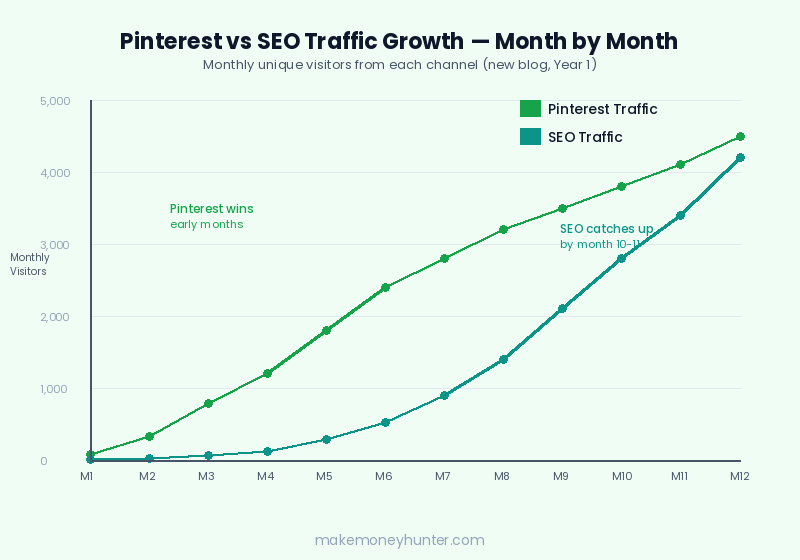
I started taking Pinterest seriously about 8 months ago. Within the first 3 months, it was already sending more traffic than Google. My best-performing pin has been clicked over 4,200 times — from a single image I spent 15 minutes creating in Canva.
My Pinterest strategy in a nutshell:
- Create 3-5 pin designs for every blog post (different titles, different images, same destination URL)
- Use keyword-rich descriptions — Pinterest search works just like Google search
- Pin consistently. I use Tailwind to schedule 15-20 pins per week automatically
- Focus on “idea pins” and standard pins. Video pins get reach but don’t drive clicks as well
The best part about Pinterest? It works for almost every blog niche — especially food, home decor, personal finance, DIY, fashion, travel, and blogging tips. If your content is visual or actionable, Pinterest is probably your fastest path to traffic.
3. Email List Building
Here’s something that took me years to learn: email subscribers are your most valuable traffic source, even though they don’t show up as a separate “channel” in most analytics dashboards.
Why? Because email subscribers come back. They read your new posts. They share your content. They click your affiliate links at 3-5x the rate of organic search visitors. And unlike social media followers, you own your email list — no algorithm can take it away.
I started building my email list from day one using a simple lead magnet — a free PDF checklist related to my most popular topic. Nothing fancy. It converts at about 2.8% of visitors, which is decent for a simple opt-in.
Practical steps to get started:
- Create one simple lead magnet (checklist, template, or cheat sheet) related to your most popular content
- Put opt-in forms in three places: top of sidebar, within blog posts, and exit-intent popup
- Send at least one email per week with your latest post plus one extra tip or insight
- Use a free email tool like MailerLite or the free tier of ConvertKit to start
Even with just 200-300 subscribers, you’ll notice a difference. Every time I publish a new post and send it to my list, I get an immediate traffic spike — which also signals to Google that the content is worth ranking.
4. Guest Posting on Relevant Blogs
Guest posting gets a bad reputation because people do it wrong. They pitch random sites with low-quality filler content just to get a backlink. That doesn’t work anymore.
What works is strategic guest posting on blogs your target audience already reads. The goal isn’t just a backlink — it’s getting in front of the right people.
I’ve written about 25 guest posts since 2015. Most of them brought minimal traffic. But 4-5 of them — the ones published on sites with engaged audiences in my exact niche — each drove 300-800 visitors in the first month, and some of those readers became long-term subscribers.
My guest posting process:
- Find blogs in your niche that accept guest posts and have active comment sections (a sign of engaged readership)
- Read their top 5 articles and pitch a topic that fills a gap in their existing content
- Include a link back to a specific, relevant article on your blog — not just your homepage
- Promote the guest post on your own channels. This helps the host site too, which makes them more likely to accept future pitches
5. Quora Answers
Quora is still an underused traffic source in 2026. The platform has massive domain authority, which means your answers often appear in Google search results.
I spend about 30 minutes per week answering 3-4 questions related to my blog topics. Each answer includes genuine, detailed advice — not just a teaser with a link. When it makes sense, I mention one of my blog posts as a resource.
My best Quora answer has been viewed over 47,000 times and still drives 100-200 monthly visitors to my blog. That’s from one answer I wrote in 20 minutes over a year ago. Compounding traffic at its finest.
6. Content Repurposing
Every blog post you write can become 5-10 pieces of content across different platforms. This isn’t about copy-pasting — it’s about adapting your core ideas for different formats and audiences.
My content repurposing workflow:
- One blog post → 3-5 Pinterest pins
- One blog post → 1 Medium article (shorter, more personal angle)
- One blog post → 3-4 Twitter/X threads pulling key insights
- One blog post → 1 short YouTube video summarizing the main points
The key is that each repurposed piece should link back to the original blog post. You’re essentially building multiple roads that all lead to the same destination.
One thing I’ve noticed: repurposed content on Medium often ranks in Google faster than the original blog post, because Medium has a domain authority of 95. I use canonical tags to make sure Google knows my blog is the original source.
7. Internal Linking Strategy
This isn’t a traffic “source” in the traditional sense, but strong internal linking dramatically increases how much traffic you get from every other method.
When a visitor lands on one of your articles through Google and finds links to 3-4 related posts, their average session duration goes up. They visit more pages. Google sees these engagement signals and rewards you with higher rankings — which brings more traffic.
I aim for 3-7 internal links per article, spread evenly throughout the content. Every article links back to its “pillar page” (the main topic hub), and related articles link to each other.
8. Reddit Participation
Reddit can send massive traffic bursts, but it’s also the most temperamental platform on this list. Self-promotion is punished hard. The only way to make Reddit work for blog traffic is to become a genuine community member first.
My approach: I spend 80% of my Reddit time answering questions and contributing value in subreddits like r/blogging, r/juststart, and r/Entrepreneur. Occasionally, when someone asks a question that one of my articles directly answers, I’ll share the link. Because I’ve built goodwill through genuine participation, the community doesn’t flag it as spam.
One Reddit comment linking to my blog brought 2,800 visitors in 48 hours. But that kind of result only happened because I’d been contributing for months before sharing a link.
9. Blog Commenting on Authority Sites
Old school? Yes. Dead? Absolutely not.
Blog commenting doesn’t drive massive direct traffic, but it does three things that matter. It builds relationships with bloggers in your niche. It creates nofollow backlinks that add diversity to your link profile. And it puts your name and brand in front of the right audience.
I leave 5-10 thoughtful comments per week on popular blogs in the blogging and make money online space. Not “Great post!” — actual, substantive comments that add to the conversation. Over time, some of these bloggers recognize my name and become willing to collaborate on guest posts or link exchanges.
10. YouTube Videos (Even Without Showing Your Face)
You don’t need to be a YouTuber to use YouTube for blog traffic. Screen recordings, slide presentations, and voiceover tutorials can all work.
I create simple videos using screen recordings of me walking through a process. Each video description includes a link to the full blog post. Some of my videos have driven 1,000+ clicks to blog posts — and YouTube videos also rank in Google search results, giving you double exposure.
The barrier to entry is lower than most people think. A decent microphone, free screen recording software (OBS), and 30-minute videos are all you need.
11. Facebook Groups (Niche-Specific)
Posting your blog links in random Facebook groups is a fast way to get banned and build zero traffic. But joining 3-5 groups in your specific niche and becoming a helpful member can drive consistent, targeted visitors.
The strategy is simple. Answer questions. Share advice. When someone asks something that your blog post directly addresses, share the link with context — not just a bare URL. “I actually wrote about this exact problem last week — here’s what I found works best: [link].”
This approach typically drives 50-150 monthly visitors per active group. Not huge numbers, but these visitors tend to be highly engaged because they’re already interested in your exact topic.
12. Optimize Old Content
This is the highest-ROI traffic activity most bloggers completely ignore.
Every quarter, I review my Google Search Console data and look for articles that are ranking on page 2 (positions 11-20). These are articles that Google already thinks are pretty good — they just need a push to reach page 1.
For each of these articles, I update the content with fresh information, add new sections that cover subtopics the competition is missing, and improve the internal linking. In my experience, this process moves 3-4 articles to page 1 every quarter, which translates to an immediate traffic increase of 200-500 monthly visitors per article.
Updating old content is almost always faster and more effective than writing brand new articles from scratch.
13. Podcast Guest Appearances
Being a guest on podcasts in your niche is one of the most overlooked free traffic methods. The direct traffic from podcast listeners is modest — typically 50-200 visitors per appearance. But the indirect benefits are huge.
Podcast episodes create backlinks. Hosts often share episodes on social media. And when someone hears you talk for 30-60 minutes about a topic, they arrive at your blog with a level of trust that no Google search result can match. These visitors are far more likely to subscribe, share, and buy.
To find opportunities, search “[your niche] podcast guest” or use platforms like PodcastGuests.com and PodMatch. Start with smaller podcasts — they’re more likely to accept new guests and often have surprisingly engaged audiences.
14. Collaborative Content
Expert roundups, collaborative blog posts, and co-created content tap into other people’s audiences. The concept is simple: include multiple experts in your content, and each expert shares the finished article with their own audience.
I did an expert roundup with 12 bloggers sharing their best traffic tips. Each contributor shared the post with their email list and social followers. That single post brought in 3,200 visitors in the first week — more than my average monthly traffic at the time.
The catch: this only works if you reach out to people who have engaged audiences and who are genuinely invested in sharing the final product. Targeting mega-influencers rarely works. Mid-tier bloggers with 5,000-20,000 monthly readers are your sweet spot.
15. HARO and Journalist Requests
Help A Reporter Out (now part of Connectively) connects journalists with sources. When you respond to relevant queries and get quoted in articles on major publications, you get high-authority backlinks that boost your SEO and sometimes direct referral traffic.
I’ve landed mentions in 7 articles through this method. Three of them resulted in noticeable referral traffic (200-400 visitors each). More importantly, the backlinks from DA 60+ sites accelerated my overall Google rankings significantly.
Spend 15-20 minutes daily scanning journalist requests related to your expertise. Respond quickly with specific, quotable answers. Include your credentials and blog URL. Most responses get ignored, but the ones that land can be game-changers.
What Are the Fastest Free Traffic Methods for New Blogs?
If you’re starting from zero visitors, here’s the honest timeline based on my experience and data from running multiple blogs:
| Method | Time to First Traffic | Monthly Potential (6 months) | Effort Level |
|---|---|---|---|
| 2-4 weeks | 1,000-5,000 visitors | Medium | |
| Quora | 1-2 weeks | 300-1,500 visitors | Low |
| Guest Posting | 2-4 weeks | 500-2,000 visitors | High |
| SEO | 3-6 months | 500-3,000 visitors | High |
| Email List | Ongoing (compounds) | 200-1,000 visitors | Medium |
| Variable (1 day – 3 months) | 200-3,000 visitors | Medium |
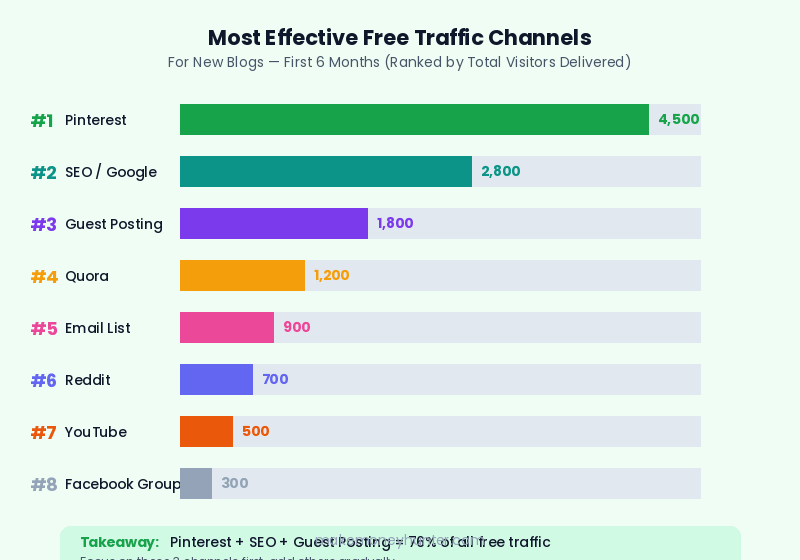
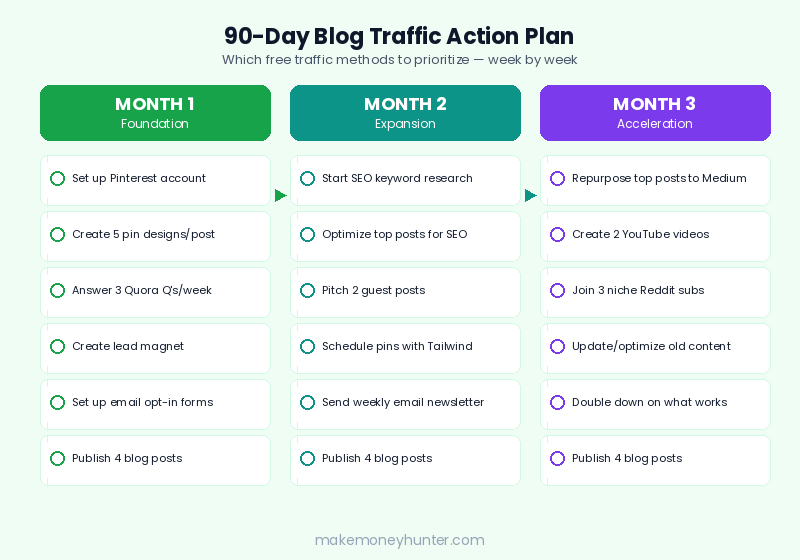
My recommendation for brand new blogs: start with Pinterest + Quora + email list building in month 1. Add SEO and guest posting in month 2. Layer in content repurposing and Reddit in month 3. This gives you quick wins to stay motivated while the compounding methods build momentum.
Which Blog Traffic Strategy Should You Focus on First?
The honest answer depends on your niche and your strengths.
If your content is highly visual (food, travel, fashion, home decor) — Pinterest first. If your content is problem-solving focused (how-to guides, tutorials, reviews) — SEO first. If you’re comfortable on camera or audio — add YouTube or podcasting early.
But here’s the principle that matters more than any specific method: don’t try to do everything at once. I’ve watched dozens of new bloggers burn out because they’re trying to post on 6 platforms simultaneously while also writing new blog content. Master 2-3 traffic channels first, then expand.
The bloggers who reach 10,000 monthly visitors in their first year almost always follow the same pattern: they pick 2-3 methods, execute consistently for 6+ months, and let the compounding effect do the heavy lifting.
Common Mistakes That Kill Your Blog Traffic
After 15 years of building blogs, I’ve seen the same mistakes over and over — including ones I made myself:
- Writing for search engines instead of people. Your content needs to satisfy the searcher first. Google’s gotten incredibly good at detecting content written primarily for algorithms.
- Targeting keywords that are too competitive. A brand new blog going after “how to make money online” is like a lemonade stand competing with Coca-Cola. Start with long-tail keywords where smaller sites are ranking.
- Ignoring analytics. If you’re not checking Google Search Console and your Pinterest analytics weekly, you’re flying blind. Data tells you what’s working so you can double down.
- Expecting overnight results. Blog traffic follows a hockey stick curve — months of slow growth followed by a sudden acceleration. Most people quit right before the curve starts going up.
- Neglecting mobile experience. Over 65% of blog readers are on mobile devices. If your site is slow or hard to read on a phone, you’re losing most of your potential audience.
FAQ
How long does it take to get traffic to a new blog?
With consistent effort on Pinterest and Quora, you can see your first 500-1,000 monthly visitors within 2-3 months. SEO traffic typically takes 4-6 months to become significant. Most bloggers see their real traffic breakthrough between months 8-12, when multiple channels start compounding together.
Can you drive blog traffic without social media?
Yes. SEO + email list + guest posting can build significant traffic without any social media presence. I know bloggers getting 30,000+ monthly visitors purely from Google search and email. Social media helps, but it’s not required.
Is Pinterest really better than Google for new blogs?
For the first 3-6 months, Pinterest often delivers faster results than Google SEO. That’s because Pinterest doesn’t penalize new accounts the way Google’s sandbox treats new domains. Long-term, SEO usually overtakes Pinterest in volume. The smart move is to use both.
How many blog posts do I need before I start promoting?
Start promoting after you have 10-15 quality posts published. This gives visitors enough content to explore when they arrive, and it gives you enough posts to interlink for SEO purposes. Don’t wait until you have 50 or 100 posts — you’ll waste months of potential traffic.
What’s the best free tool for tracking blog traffic?
Google Analytics (free) and Google Search Console (free) are the two essentials. Search Console shows you which keywords you’re ranking for and how people find your site. Analytics shows you what visitors do once they arrive. Together, they tell you everything you need to make smart traffic decisions.
Final Thoughts
Funny thing about blog traffic — the conventional advice says “just write great content and the traffic will come.” If you’ve been blogging for more than a month, you already know that’s not how it works.
But here’s the part that is true: traffic comes from building systems, not chasing hacks. The 15 methods in this guide aren’t secrets. They’re not shortcuts. They’re proven, repeatable processes that compound over time.
My blog went from 0 to 8,400 monthly visitors in 11 months. Not because I found some magical trick — but because I stacked Pinterest + SEO + email consistently, week after week, even when the numbers felt painfully slow.
Pick your first 2-3 methods from this list. Execute them consistently for 90 days. Track your results. Adjust. That’s the entire playbook. The bloggers who do this — the patient, consistent ones — are the ones who actually build real traffic. Everyone else is still searching for shortcuts.