
I spent three months last year testing side hustles that every blog calls “introvert-friendly.” Cold-calling real estate leads. Hosting webinars. Running a tutoring session with six strangers on Zoom. My social battery was dead by Tuesday.
Here’s what I realized: most side hustle guides slap the word “introvert” in the title and then recommend the same extroverted garbage. Driving strangers around in your car? Hosting Airbnb guests? That’s not introvert-friendly. That’s torture with a payment receipt.
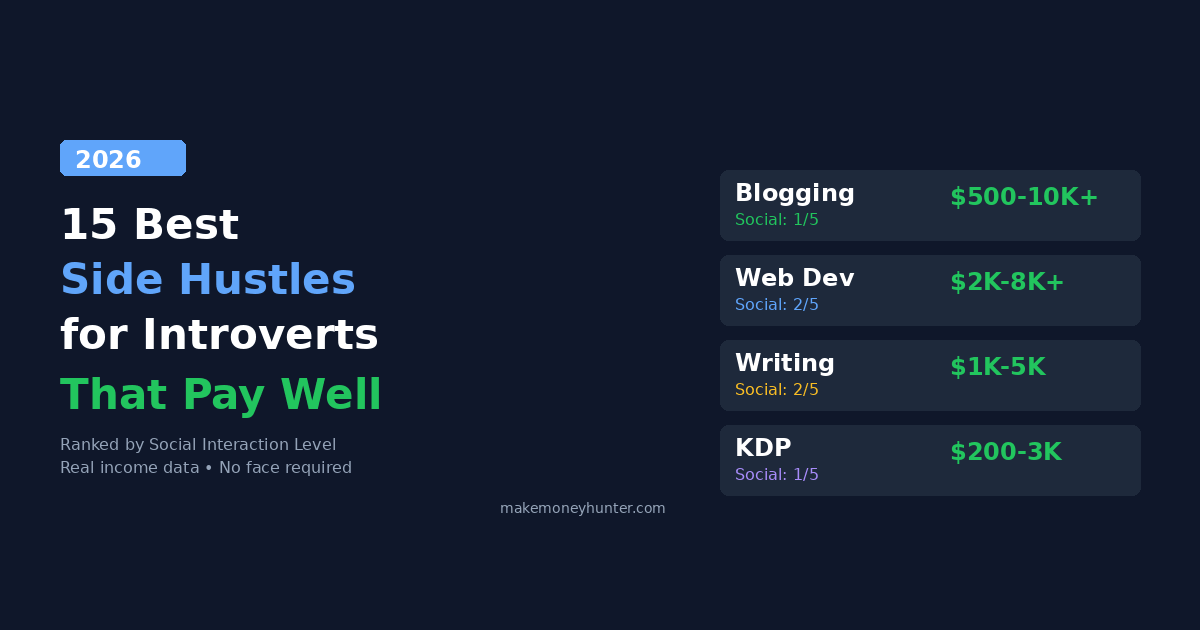
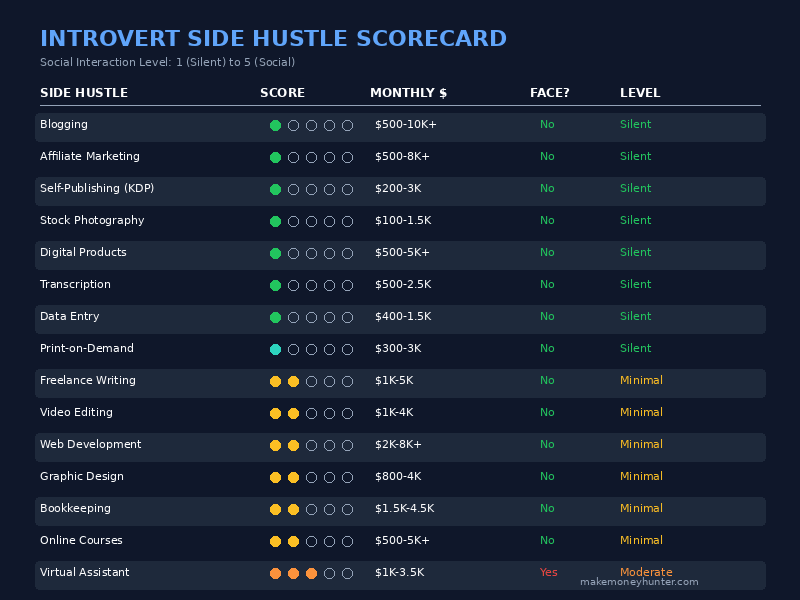
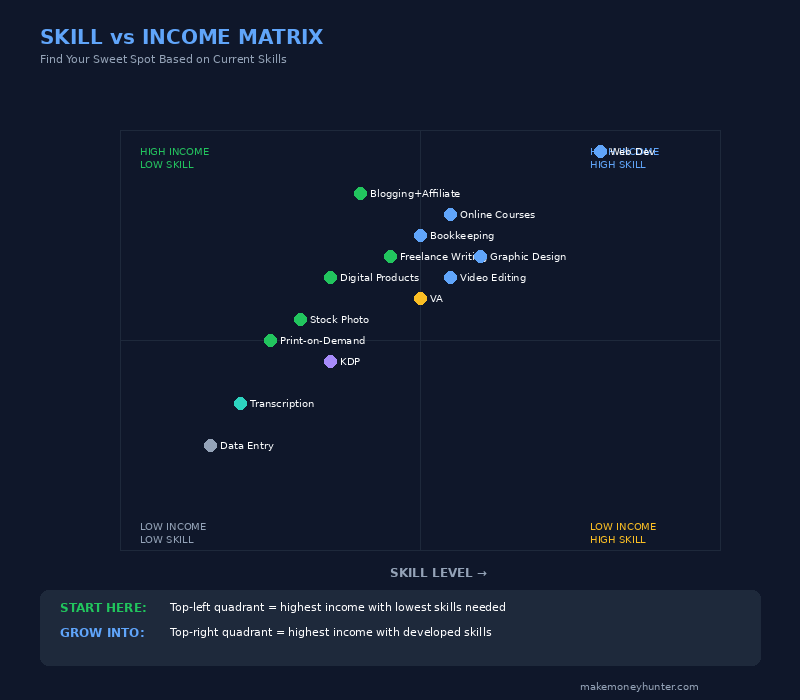
So I built something different. I rated every side hustle on this list using two metrics you won’t find anywhere else: a Social Interaction Score (1-5) — where 1 means “you literally never talk to anyone” and 5 means “you’re basically doing sales” — and a “Do You Need to Show Your Face?” flag. Because as an introvert myself, I know the difference between “remote work” and “actually being left alone.”
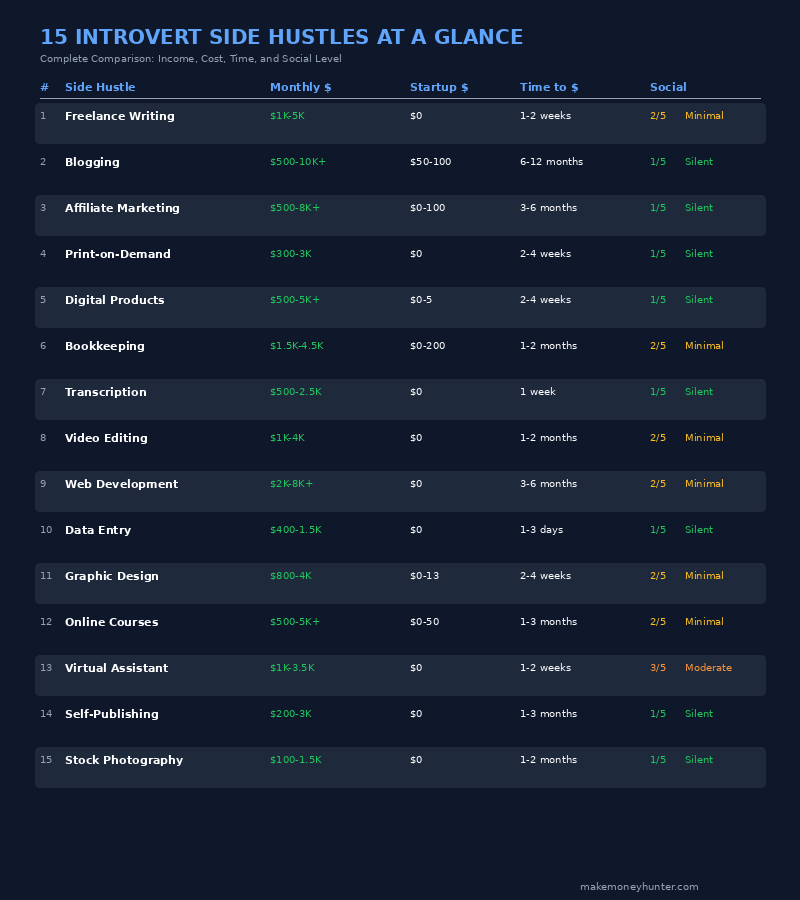
These 15 methods earned me or people in my network real money in 2025-2026. I’ll tell you what each one actually pays, how long it takes to start earning, and — most importantly — exactly how much human interaction is required.
What Makes a Side Hustle Truly Introvert-Friendly?
Before we dive in, let me define what “introvert-friendly” actually means — because the internet has mangled this term beyond recognition.
A side hustle is genuinely introvert-friendly when it meets three criteria:
Asynchronous communication. You communicate through text, email, or project management tools — not real-time phone calls or video meetings. You respond when you’re ready, not when someone demands your attention.
Deliverable-based work. You’re judged by what you produce, not by how charming you are on a call. Your writing, your designs, your code — the work speaks for itself.
Control over your environment. You choose when, where, and how long you work. No open offices. No mandatory team standups. No “quick sync” that turns into a 45-minute energy drain.
Every side hustle below was filtered through these three requirements. If it failed even one, it didn’t make the list.
1. Freelance Writing — The Introvert’s ATM
Social Interaction Score: 2/5 | Show Face: No | Earning Potential: $1,000-$5,000/month
I’ve made more money from writing than any other side hustle, and I’ve been doing it for over a decade. The reason it works so well for introverts is simple: the entire business runs on written communication.
You find clients on platforms like Upwork or ProBlogger. You pitch through text. You deliver through Google Docs. Most of my long-term clients have never heard my voice.
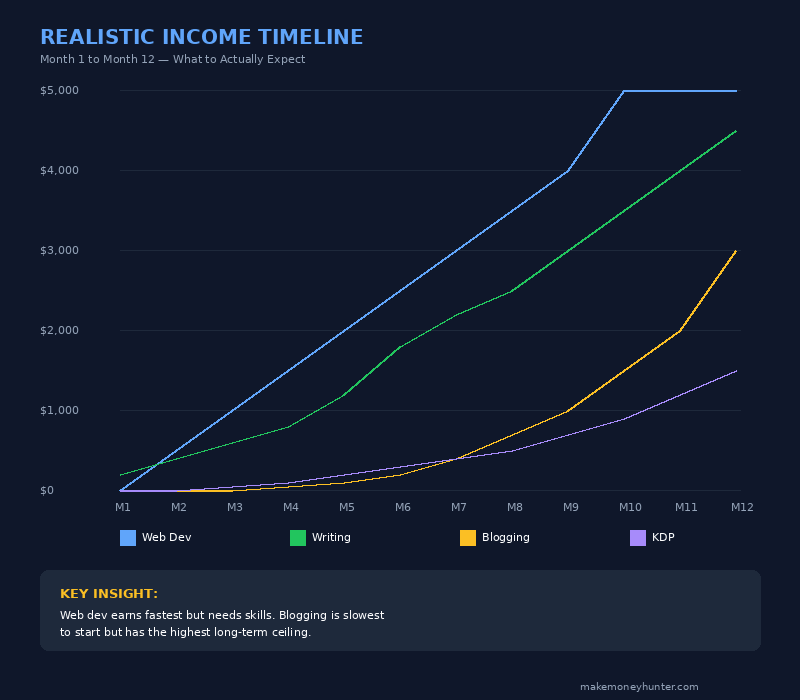
The realistic timeline looks like this: your first month, you’re probably earning $200-$500 writing blog posts at $0.05-$0.10 per word. By month six, if you’ve specialized in a niche like personal finance, SaaS, or health, you’re charging $0.15-$0.30 per word. That’s $750-$1,500 for a single 5,000-word article.
The catch? You need to pitch. And pitching feels like asking someone to like you — which is every introvert’s nightmare. But here’s the trick I use: write three sample articles in your niche before you pitch anyone. Now you’re not asking for a chance. You’re showing proof. That shift changes everything.
My recommendation: start with Upwork for the first 3-5 clients, then transition to direct outreach through email once you have testimonials. The money gets significantly better when you cut out the middleman.
2. Blogging — The Slow Burn That Pays While You Sleep
Social Interaction Score: 1/5 | Show Face: No | Earning Potential: $500-$10,000+/month
Blogging is the ultimate introvert side hustle because your audience finds you — you don’t find them. You write articles, Google ranks them, and people show up. No networking events. No DMs to strangers. No “putting yourself out there.”
I started makemoneyhunter.com as a side project. For the first six months, traffic was embarrassing — maybe 20 visitors a day. But I kept publishing, kept optimizing for search engines, and kept improving. By month 12, organic traffic was growing consistently.
The money comes from three places: display ads (like Google AdSense), affiliate marketing, and digital products. A blog with 50,000 monthly visitors can realistically earn $2,000-$5,000/month from ads alone.
The biggest misconception about blogging is that you need to be on social media. You don’t. Over 90% of my traffic comes from Google search. I rarely post on social media, and when I do, it’s because I feel like it — not because the business depends on it.
Start-up cost: about $50-$100 for hosting and a domain. Time to first income: 6-12 months. Yes, it’s slow. But once it’s working, it’s the closest thing to passive income I’ve ever found.
3. Affiliate Marketing — Get Paid to Recommend What You Actually Use
Social Interaction Score: 1/5 | Show Face: No | Earning Potential: $500-$8,000+/month
Affiliate marketing is the natural companion to blogging, but it also works standalone. You recommend products through special tracking links, and when someone buys, you earn a commission. No inventory. No shipping. No customer service.
What makes this introvert-gold is that the entire sales process is automated. You write a review or comparison article once, and it keeps earning commissions for months — sometimes years.
My first affiliate commission was $4.50 from a web hosting referral back in 2011. I remember staring at my dashboard thinking, “Wait, someone actually bought something because of something I wrote?” That $4.50 changed everything. Not because of the money — but because it proved the model works.
Realistic numbers: a new affiliate marketer focusing on mid-ticket products ($50-$200 commissions) can earn $500-$2,000/month within 6-12 months of consistent content creation. The key is choosing programs with recurring commissions — SaaS tools, online courses, and web services pay you every month the customer stays subscribed.
4. Print-on-Demand — Design Once, Sell Forever
Social Interaction Score: 1/5 | Show Face: No | Earning Potential: $300-$3,000/month
Print-on-demand is what happens when you combine design skills (or AI design tools) with e-commerce, minus all the headaches of inventory and shipping.
You create designs for t-shirts, mugs, phone cases, or tote bags. You upload them to platforms like Printify, Redbubble, or Merch by Amazon. When someone orders, the platform prints and ships it. You never touch the product.
The social interaction here is essentially zero. You’re designing alone, uploading alone, and the platform handles customer service. The closest thing to “interaction” is reading product reviews — and even that’s optional.
I know a designer who makes $2,100/month from Redbubble selling niche quote designs. She spends about 5 hours per week creating new designs using Canva and a Midjourney subscription. Her total startup cost was $0 (Redbubble is free to join) plus $10/month for Canva Pro.
The trick with print-on-demand is niching down hard. “Funny cat shirts” won’t cut it — there are 500,000 of those. But “shirts for introverted cat-loving book readers”? That’s a community that will find you and buy everything you make.
5. Selling Digital Products — Your Best Work, Packaged and Sold on Autopilot
Social Interaction Score: 1/5 | Show Face: No | Earning Potential: $500-$5,000+/month
Digital products are the introvert’s dream business because the product does the selling. Templates, printable planners, spreadsheets, Notion dashboards, stock photos, preset packs — all of these can be created once and sold thousands of times.
Etsy is the easiest starting point. The platform has 90+ million active buyers already searching for digital downloads. You don’t need to build an audience. You don’t need to go viral on TikTok. You just need to make something useful and optimize your listing for Etsy search.
A budget planner template that took me a weekend to create in Google Sheets has generated steady sales for over a year. The total time investment was about 12 hours. The ongoing effort is zero — Etsy handles delivery, payments, and even most customer questions through automated download links.
Start-up cost: $0.20 per Etsy listing. That’s it. If you can use Google Sheets, Canva, or Notion, you already have the skills you need.
6. Online Bookkeeping — Numbers Don’t Need Small Talk
Social Interaction Score: 2/5 | Show Face: Rarely | Earning Potential: $1,500-$4,500/month
If you’re detail-oriented and comfortable with spreadsheets, bookkeeping is one of the highest-paying introvert side hustles that most people overlook.
The work is straightforward: you organize financial records, categorize transactions, reconcile bank statements, and prepare basic reports for small business owners. Most of the communication happens through email or shared dashboards in tools like QuickBooks or Wave.
You don’t need a CPA or accounting degree. A basic bookkeeping certification (which you can get through free or low-cost online courses in 2-4 weeks) is enough to get started. The average remote bookkeeper charges $25-$75 per hour, depending on experience and client complexity.
The reason this works for introverts: your clients are too busy running their business to micromanage you. They want their books done right. They don’t want to chat about it. Most of my bookkeeping contacts tell me they hop on a call maybe once a month per client — if that.
7. Transcription — Get Paid to Listen, Not Talk
Social Interaction Score: 1/5 | Show Face: No | Earning Potential: $500-$2,500/month
Transcription is almost absurdly introvert-friendly. You put on headphones, listen to audio recordings, and type what you hear. That’s the whole job. Nobody talks to you. Nobody sees you. You could do this in your pajamas at 3 AM and nobody would know.
General transcription on platforms like Rev or TranscribeMe starts at $0.30-$0.75 per audio minute. That translates to roughly $15-$25/hour once you get fast. Specialized transcription — legal or medical — pays $25-$45/hour but requires additional certification.
The realistic starting path: sign up on Rev.com, pass their qualification test, and start taking jobs. Your first week will feel slow as you build speed. By month two, most transcriptionists find their groove and can type 60-80 words per minute with accuracy.
The downside? AI transcription tools are getting better, so this market is shrinking for general transcription. My advice: if you go this route, specialize in something AI still struggles with — heavy accents, multi-speaker meetings, or technical jargon in specific industries. That’s where the money stays.
8. Video Editing — Behind the Camera, Behind the Screen
Social Interaction Score: 2/5 | Show Face: No | Earning Potential: $1,000-$4,000/month
Video editing is one of the most in-demand skills of 2026, and nearly the entire job happens in silence. YouTube creators, podcasters, course makers, and small businesses all need editing help — and most of them communicate through shared folders and written notes.
You never appear on camera. You never present your work live. You edit the footage, export the file, and deliver it. The interaction is limited to occasional text messages or emails about revisions.
Tools like DaVinci Resolve (free) and CapCut make the learning curve shorter than ever. A complete beginner can learn basic editing in 2-3 weeks of YouTube tutorials. Your first paid gig might be $50-$100 for a 10-minute video. Within 6 months of building a portfolio, you could be charging $200-$500 per video.
The fastest path to clients: edit 3-5 videos for free for small YouTubers in exchange for a testimonial, then list your services on Fiverr. YouTubers are always looking for reliable editors, and once you find a creator who trusts you, the work becomes consistent and predictable.
9. Web Development — Build Things That Talk So You Don’t Have To
Social Interaction Score: 2/5 | Show Face: Rarely | Earning Potential: $2,000-$8,000+/month
If you’re willing to learn a technical skill, web development is the highest-paying side hustle on this list. And the interaction level is surprisingly low.
Most freelance web developers communicate with clients through project management tools like Trello or Notion. There’s usually a kickoff call to understand requirements, then everything moves to async communication. You build, you deliver, you get paid.
You don’t need a computer science degree. A focused 3-6 month learning path through platforms like freeCodeCamp or The Odin Project can get you to a level where you’re building real websites for real clients.
Realistic pricing: a basic WordPress site for a small business runs $1,500-$5,000. A custom-coded site or web application can be $5,000-$15,000+. Even at the lower end, three projects per month at $2,000 each is $6,000 — more than many full-time salaries.
The introvert advantage here is real: clients care about results, not personality. If your code is clean and your sites work, you’ll never run out of work.
10. Data Entry — Zero Skill, Zero Stress, Zero Socializing
Social Interaction Score: 1/5 | Show Face: No | Earning Potential: $400-$1,500/month
Data entry won’t make you rich, but it will make you money with absolutely no social interaction required. You type information into spreadsheets, databases, or online forms. That’s it.
The pay ranges from $12-$22/hour depending on accuracy requirements and data complexity. It’s not glamorous, but it’s consistent work that requires nothing more than a computer and the ability to type accurately.
Platforms like Clickworker, Amazon Mechanical Turk, and Upwork consistently have data entry jobs available. The key to earning more is speed and accuracy — the faster you work without errors, the more jobs you can take on.
I recommend data entry as a starting point, not a destination. Use it to build confidence in remote work while you develop higher-paying skills like bookkeeping, writing, or development. Think of it as the training wheels of introvert side hustles.
11. Graphic Design — Visual Creativity, Verbal Silence
Social Interaction Score: 2/5 | Show Face: No | Earning Potential: $800-$4,000/month
Graphic designers communicate through visuals, not words. Most client interactions happen through design brief documents and feedback tools like Figma comments — rarely through live calls.
The demand is massive: every business needs logos, social media graphics, presentations, and marketing materials. Canva has lowered the barrier for basic design, but skilled designers who understand brand identity and visual hierarchy still command premium rates.
Starting on Fiverr or 99designs, you can charge $50-$200 for a logo and $25-$100 for social media template packs. As you build a portfolio and direct clients, rates climb to $500-$2,000+ per branding project.
The introvert edge: design is subjective, but a good portfolio eliminates the need for “selling.” When your work looks professional, clients come to you. Build 10-15 portfolio pieces, post them on Dribbble or Behance, and let the work speak.
12. Online Course Creation — Teach Once, Earn Repeatedly
Social Interaction Score: 2/5 | Show Face: Optional | Earning Potential: $500-$5,000+/month
Online courses let you package your expertise into a product that sells on autopilot. And before you say “but I’d have to be on camera” — you don’t. Screen recordings with voiceover, text-based courses, and even entirely written curriculums work perfectly fine.
Platforms like Udemy, Skillshare, and Teachable handle the technology. You create the content, upload it, and the platform manages everything from payments to student access.
The realistic numbers: a well-optimized Udemy course in a popular topic earns $200-$1,000/month passively. A self-hosted course on Teachable with your own marketing can earn $2,000-$10,000+ per launch.
My approach: start with Udemy to test your topic and get initial reviews. If it works, move to a self-hosted platform where you keep 90%+ of the revenue instead of Udemy’s 37%.
13. Virtual Assistance — Behind-the-Scenes Business Support
Social Interaction Score: 3/5 | Show Face: Sometimes | Earning Potential: $1,000-$3,500/month
I’m putting virtual assistance on this list with a caveat: it’s introvert-compatible, not introvert-ideal. Some VA roles require occasional video calls with clients or managing their social media DMs. Others are entirely asynchronous — managing email inboxes, scheduling, data organization.
The key is being selective about what services you offer. Email management, calendar scheduling, and administrative tasks are low-interaction. Social media management and customer service are higher-interaction. Choose accordingly.
Pay ranges from $15-$35/hour for general VA work. Specialized VAs (e.g., real estate VAs, e-commerce VAs, podcast production VAs) charge $25-$50/hour.
Start by defining your services clearly and listing them on Upwork, Fiverr, or specialized VA job boards like Belay or Time Etc. Be upfront about your communication preferences — most clients appreciate a VA who sets clear boundaries around availability.
14. Self-Publishing (Amazon KDP) — Write a Book, Earn for Years
Social Interaction Score: 1/5 | Show Face: No | Earning Potential: $200-$3,000/month
Self-publishing on Amazon’s Kindle Direct Publishing platform is the introvert’s version of launching a product. You write a book (or use AI tools to help draft and you edit heavily), format it, upload it, and Amazon handles everything else — distribution, printing, shipping, customer service.
Non-fiction in practical niches performs best: “How to Budget as a College Student,” “Meal Prep for One,” “Beginner’s Guide to Houseplants.” These aren’t literary masterpieces — they’re useful reference guides that sell 5-20 copies per day at $9.99-$14.99.
At 70% royalty for e-books priced above $2.99, a book selling 10 copies per day earns roughly $200-$300/month. Build a catalog of 5-10 books, and you’re looking at $1,000-$3,000/month in mostly passive income.
The total social interaction required: zero. You don’t even need an author photo. Many successful KDP publishers use pen names and never reveal their identity.
15. Stock Photography and Digital Assets — Shoot Once, License Forever
Social Interaction Score: 1/5 | Show Face: No | Earning Potential: $100-$1,500/month
If you own a decent camera or even a modern smartphone, stock photography can become a genuinely passive income stream. Platforms like Shutterstock, Adobe Stock, and iStock accept photos, vectors, and video clips that businesses license for their marketing materials.
The per-download payout is small — typically $0.25-$3.00 per download. But popular images get downloaded hundreds or thousands of times. A portfolio of 500-1,000 high-quality images in underserved niches can generate $500-$1,500/month consistently.
The interaction level is the lowest on this list. You shoot photos. You upload them. You write keyword descriptions. The platform handles every customer interaction. You could run this business for years without speaking to a single human being.
Focus on niches with high commercial demand but low competition: remote work setups, diverse lifestyle photography, AI and tech concepts, sustainable living, and mental health imagery. Generic “businessman shaking hands” shots are oversaturated.
How to Choose the Right Side Hustle for Your Introvert Type
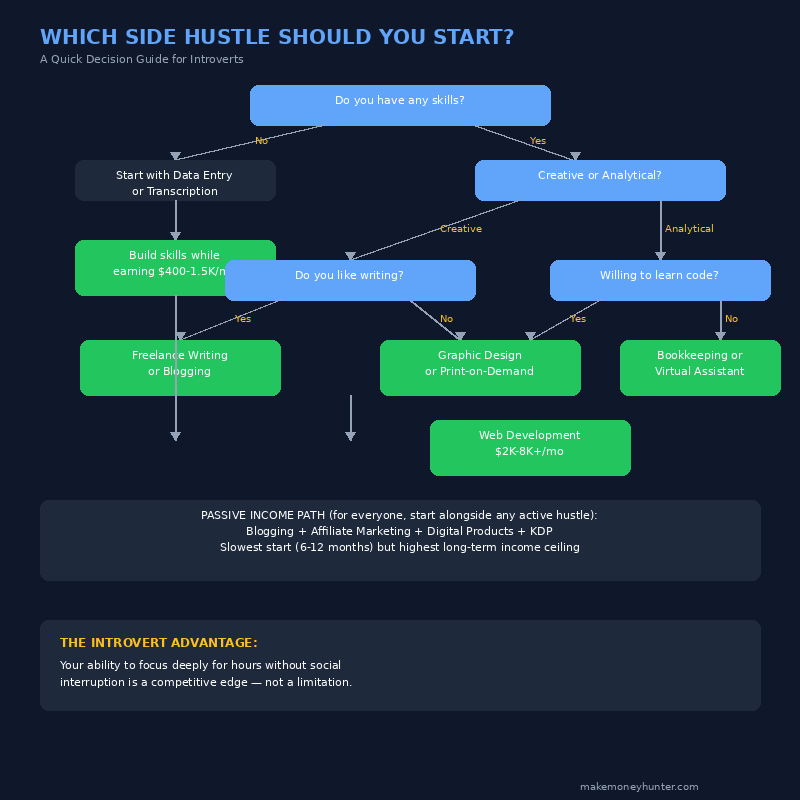
Not all introverts are the same. Some of us are creative. Some are analytical. Some just want to be left alone with a spreadsheet. Here’s my quick framework:
If you’re a creative introvert (you think in visuals, stories, or designs): start with freelance writing, graphic design, print-on-demand, or blogging. These let your creative output do the talking.
If you’re an analytical introvert (you love systems, numbers, and processes): go with bookkeeping, web development, data entry, or virtual assistance. Structure and logic are your strengths — use them.
If you’re a deep-focus introvert (you can sit for hours doing one thing without interruption): transcription, video editing, and stock photography reward sustained concentration. The longer you can focus without distraction, the more you earn.
If you want maximum solitude (you genuinely don’t want to interact with anyone, ever): blogging, affiliate marketing, self-publishing, digital products, and stock photography all score 1/5 on the social interaction scale. You can run these businesses for years without a single phone call.
The Myth of “Passive” Income (And What Actually Works)
Let me be honest about something most side hustle articles won’t tell you: nothing starts passive. Every method on this list requires significant upfront work. Blogging takes 6-12 months before it generates meaningful income. Digital products need creation time. Even “passive” affiliate commissions require active content creation first.
The correct framing is “front-loaded income.” You work hard now so the results keep paying you later. That’s a much better deal than trading hours for dollars forever — but it requires patience that most people don’t have.
In my experience, the introverts who succeed at side hustles share one trait: they pick one method and commit to it for at least 6 months before judging the results. Jumping between methods every 3 weeks is the fastest way to earn nothing.
FAQ
What is the best side hustle for introverts with no experience?
Data entry or transcription. Both require no specialized skills, have zero social interaction, and let you start earning within days. Use them as a bridge while you develop higher-paying skills like writing or web development.
Can introverts really make $3,000+ per month from side hustles?
Yes, but not overnight. Freelance writing, web development, bookkeeping, and blogging can all reach $3,000+/month — typically within 6-12 months of consistent effort. The key is specialization: a “general freelancer” earns less than a “SaaS copywriter” or a “real estate bookkeeper.”
Do I need to show my face for any of these side hustles?
Only virtual assistance occasionally requires being on camera, and even that depends on the client. Every other method on this list can be done completely faceless. Several successful bloggers and KDP publishers I know have never shown their face or used their real name.
What is the most introvert-friendly side hustle that pays well?
Blogging combined with affiliate marketing. Social interaction score of 1/5, no face required, income potential of $2,000-$10,000+/month, and it compounds over time. The downside is it takes the longest to start generating income — typically 6-12 months.
How do introverts find clients without networking?
Three approaches that don’t require small talk: (1) Platform-based work on Upwork, Fiverr, or specialized job boards where clients come to you. (2) Content marketing through a blog or portfolio site that ranks on Google. (3) Cold email outreach with work samples — written communication that showcases your skills without requiring you to “be on” in person.
Final Thoughts
I’ve tested dozens of side hustles over 15 years. The ones that stuck — the ones that actually built into real income — were always the ones that played to my introverted strengths instead of fighting against them.
The internet has made it possible to build a real business without ever attending a networking event, making a cold call, or pretending to enjoy small talk. That’s not a consolation prize — it’s a genuine competitive advantage.
Don’t try to do all 15 methods at once. Pick one — the one that matches your current skills and energy level — and spend the next 30 days going all in. That’s how every successful introvert side hustle starts. Not with a grand plan. With one quiet step.
I wrote a much more detailed breakdown of each method on my site, including the exact tools, platforms, and setup steps I recommend. If you want the complete playbook, head to makemoneyhunter.com.