

You’ve watched the YouTube videos. You’ve bookmarked the Reddit threads. You’ve maybe even bought a course or two. But your “passive income” is still a fantasy — and your bank account is still funded entirely by your day job.
The problem isn’t motivation. It’s that 90% of the “passive income online” advice is some flavor of dressed-up freelancing, dropshipping mania, or crypto noise.
I’m going to do something different here. After 15 years of building niche sites, testing affiliate funnels, publishing ebooks, and watching dozens of “passive income” experiments fail (mine included), I’ve ranked the only 15 methods that actually let you earn while you sleep.
Each one comes with realistic monthly numbers, the upfront work hours you should expect, and the long-term maintenance hours after the income kicks in. No hype. No “I made $30K in my first month” lies. Just the methods that pass a simple test: do they keep paying when you stop working?
What “Passive Income Online” Actually Means (and Doesn’t)
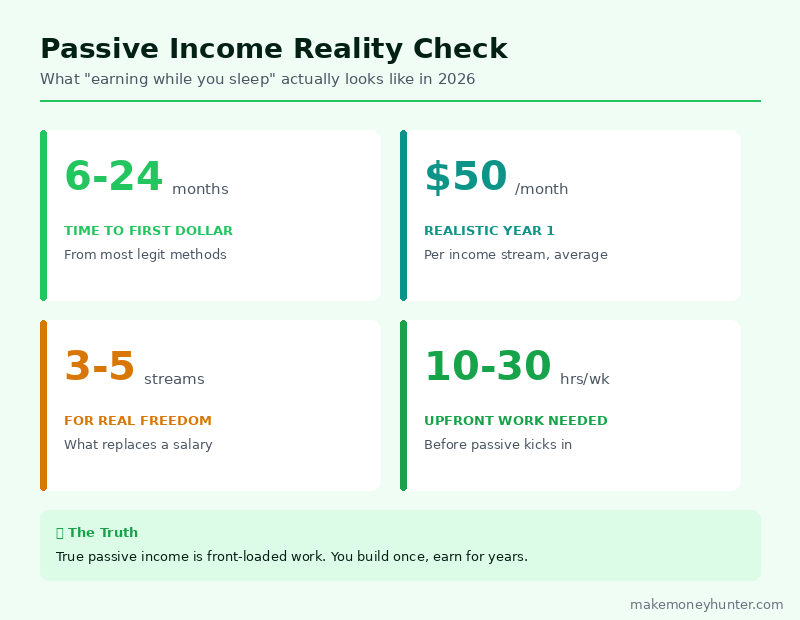
Here’s the thing nobody tells you: truly passive income doesn’t exist on day one. Every method on this list requires upfront work — sometimes months of it — before the dollars start flowing without your daily attention. What separates real passive income from the fake stuff is the shape of the work curve.
Real passive income is front-loaded. You write 50 articles in 9 months, then collect ad revenue and affiliate commissions for years with quarterly maintenance. Fake passive income is a treadmill. You manage Facebook ads daily, restock products weekly, and respond to customer service constantly — pause for two weeks and the income drops to zero.
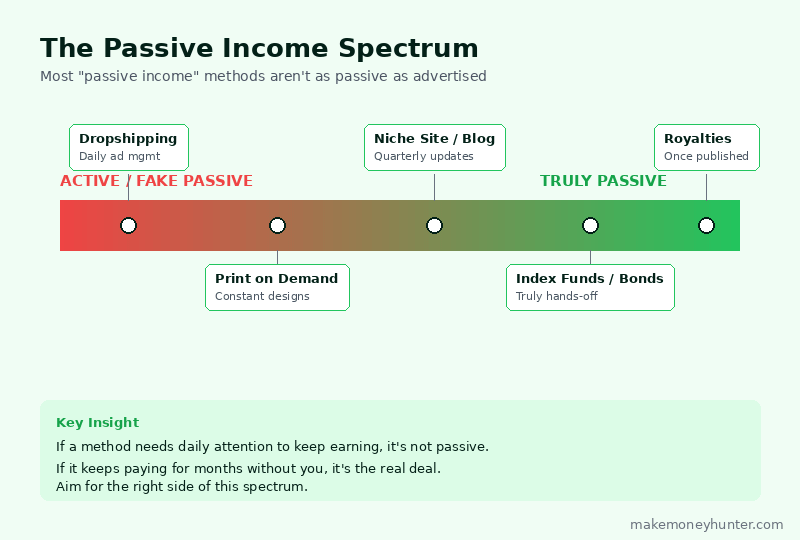
Use this spectrum as your filter. Anything that needs daily attention to keep earning isn’t passive — it’s a job with a different boss. The 15 methods below all sit on the right side of that line, with realistic ramp times and realistic earning expectations. If you want to understand how this fits into the bigger picture, my complete guide to making money online for beginners covers active vs. passive strategies side by side.
1. Niche Affiliate Website (The Long-Term King)
A niche site is a small content website focused on one specific topic — like “best espresso machines under $500” or “RV solar setups.” You write detailed reviews and guides, rank in Google, and earn commissions when readers click your affiliate links and buy products on Amazon, ShareASale, or directly from brands.
- Realistic earnings: $500–$5,000/month after 12–18 months. Top sites hit $10K+/month.
- Upfront work: 200–400 hours over 9 months (50+ articles).
- Maintenance: 5–10 hours/month for content updates and link checks.
- Best for: Patient writers who can pick a niche and stick with it.
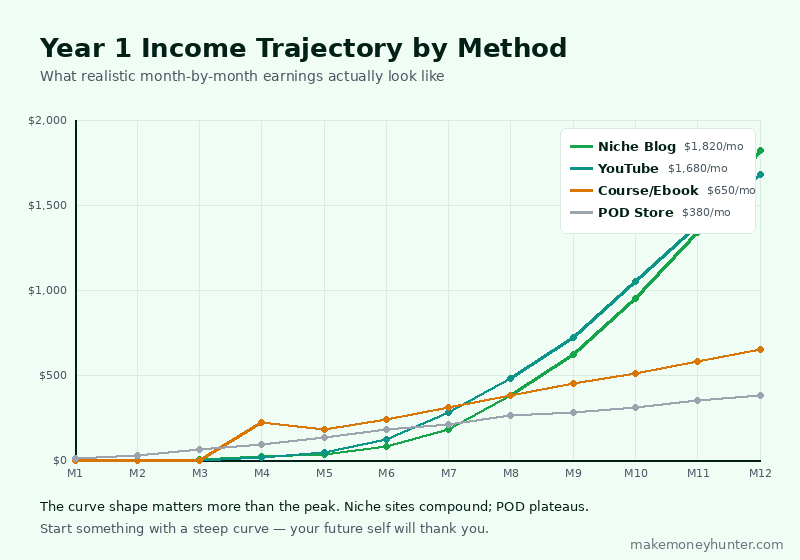
This is what I’d start with if I were 25 again. The income compounds quietly, then explodes around month 12 when Google’s sandbox lifts. The only catch: most people quit at month 4 when they’re still earning $30/month and haven’t seen the curve bend yet.
My current niche site went from $47 in month 4 to $1,847 in month 13 — same amount of effort each month, but the back catalog had finally hit critical mass. If I’d quit at month 6 like 90% of bloggers do, I would have walked away from what’s now my biggest income stream.
2. YouTube Channel with Ad Revenue + Affiliate Stack
YouTube pays roughly $3–$15 per 1,000 views (RPM) depending on your niche, plus affiliate commissions and sponsorships once you grow. Old videos keep earning for years — I have videos from 2020 still pulling $200/month with zero updates.
- Realistic earnings: $500–$8,000/month after 18 months and 100+ videos.
- Upfront work: 400+ hours to reach the 1,000 subs / 4,000 watch-hours monetization threshold.
- Maintenance: 5–15 hours/month if you stop posting; the back catalog keeps earning.
- Best for: People comfortable on camera or making screen-recorded tutorials.
The trick most people miss: your channel becomes truly passive only when you stop chasing the algorithm and let the back catalog work. Most quit too early to find out.
3. Self-Published Ebook on Amazon KDP
Amazon Kindle Direct Publishing lets you upload an ebook and earn 35–70% royalties on every sale, forever. Write once, edit once, and Amazon’s traffic does the rest. I have a $9.99 ebook from 2022 that still brings in around $180/month with zero promotion.
- Realistic earnings: $50–$500/month per book. Multiple books compound.
- Upfront work: 60–120 hours per book (writing, editing, cover design, keywords).
- Maintenance: Near zero. Maybe 1 hour every 6 months for category updates.
- Best for: Writers, niche experts, anyone with knowledge worth $9.99.
4. Online Course on Teachable, Thinkific, or Your Own Site
Record once, sell forever. Courses on focused, valuable skills (specific software, niche professional skills) sell for $97–$497. The economics work even at low volume — 30 sales/month at $197 = $5,910/month with zero ongoing work after the launch.
- Realistic earnings: $200–$10,000/month depending on course price and audience size.
- Upfront work: 100–300 hours to record, edit, and build sales pages.
- Maintenance: Quarterly updates if your topic changes (software tutorials especially).
- Best for: People with a specific skill and a small existing audience to launch into.
Honest warning: courses fail when launched without an audience. Build the email list first (even 500 subscribers), then create the course based on what they actually want.
5. Stock Photography on Adobe Stock + Shutterstock
Upload high-quality photos once, earn $0.25–$2.50 per download forever. The catch: you need a portfolio of 500–2,000 images before earnings get meaningful. Top contributors with 5,000+ images earn $1,500–$5,000/month.
- Realistic earnings: $100–$1,500/month after a 1,000+ image portfolio.
- Upfront work: Hundreds of hours of shooting, editing, keywording.
- Maintenance: Almost none. Old images keep earning indefinitely.
- Best for: Photographers who already shoot regularly and have a backlog.
6. Stock Footage on Pond5 + Artgrid
Same model as stock photos but for video clips — 4K nature shots, drone footage, lifestyle scenes. Pays $20–$80 per license, much higher than photos. A 200-clip portfolio of decent B-roll can earn $400–$1,200/month.
- Realistic earnings: $200–$2,000/month after building a 100+ clip portfolio.
- Upfront work: 200–500 hours for shooting, editing, color grading.
- Maintenance: Near zero.
- Best for: Anyone with a decent camera and willingness to learn editing.
7. Print-on-Demand (POD) Designs on Redbubble + Merch by Amazon
Upload designs once. POD platforms handle printing, shipping, and customer service. You earn a royalty (usually $2–$8 per item) every time someone buys. Building a 200–500 design portfolio is the path to consistent income.
- Realistic earnings: $50–$1,500/month after 200+ designs.
- Upfront work: 100–300 hours of design work and keyword research.
- Maintenance: Light — adding seasonal designs helps but isn’t required.
- Best for: Designers, illustrators, or anyone good at niche text-based designs.
8. Display Ads on a Content Site (AdSense → Mediavine → Raptive)
Run display ads on your blog, niche site, or content portal. AdSense is the entry-level option ($3–$10 per 1,000 visitors). Once you hit 50,000 monthly sessions, you can apply to Mediavine ($25–$45 RPM) or Raptive ($25–$50 RPM). Premium networks 5x your earnings overnight on the same traffic.
Bottom line: the same site that makes $200/month on AdSense usually makes $1,000+/month the day it switches to Mediavine. If you’re already running AdSense and you’re close to 50K sessions, applying to Mediavine is the highest-leverage move you’ll make all year.
- Realistic earnings: $300–$10,000+/month depending on traffic and niche.
- Upfront work: Whatever it takes to build the traffic in the first place (see #1).
- Maintenance: 0 hours/month for ads themselves; just keep the site healthy.
- Best for: Anyone with a content site already getting traffic.
9. Index Funds in a Taxable Brokerage
This is the most truly passive income on the list. Buy a low-fee S&P 500 index fund (VOO, VTI, SPY) through Vanguard, Fidelity, or Schwab. Set up automatic dividend reinvestment. According to the historical data on the SEC’s investor education portal, the S&P 500 has averaged roughly 7–10% annual returns after inflation over multi-decade periods, with quarterly dividend payouts.
- Realistic earnings: 1.5–2% dividend yield + 5–8% capital appreciation.
- Upfront work: 30 minutes to open an account and set up auto-investing.
- Maintenance: 0 hours/month. Truly hands-off.
- Best for: People with cash to invest who want zero work involvement.
The honest tradeoff: you need capital, not time. $10,000 invested earns roughly $200/year in dividends — meaningful only when you stack it for decades.
10. High-Yield Savings Account (HYSA) Interest
The boring tier. HYSAs at Marcus, Ally, or Wealthfront pay around 4% APY in 2026 (rates fluctuate). Risk: virtually zero. Liquidity: total. Earnings: modest but real.
- Realistic earnings: ~4% APY on cash balance. $25,000 → ~$1,000/year.
- Upfront work: 15 minutes to open an account.
- Maintenance: 0 hours/month.
- Best for: Emergency funds and cash you don’t want exposed to market risk.
11. REITs (Real Estate Investment Trusts)
Buy shares in publicly traded real estate trusts (VNQ, O, STAG) and collect dividends from commercial property income. You get real estate exposure without the hassle of being a landlord. Most REITs pay 3–6% dividend yields.
- Realistic earnings: 3–6% dividend yield + appreciation.
- Upfront work: 30 minutes through any brokerage.
- Maintenance: 0 hours/month.
- Best for: People who want real estate income without buying physical property.
12. Treasury Bond Ladder
Buy U.S. Treasuries directly through TreasuryDirect.gov in staggered maturities (3-month, 6-month, 1-year, 2-year). As each one matures, reinvest at the new rate. Government-backed, predictable income.
- Realistic earnings: 4–5% on T-bills in current rate environment.
- Upfront work: 1 hour to set up TreasuryDirect and place orders.
- Maintenance: 1 hour every few months to roll maturing bonds.
- Best for: People who want safer-than-stocks income with full government backing.
13. Niche Mobile App with Subscription Revenue
If you can code (or hire someone), a single-purpose paid app can earn for years with minimal updates. Think habit trackers, niche calculators, or specialized tools. The App Store does the distribution; you collect 70% of every sale or subscription.
- Realistic earnings: $500–$10,000/month if you nail a real need.
- Upfront work: 200–600 hours to build, polish, and launch.
- Maintenance: 5–10 hours/month for OS updates and bug fixes.
- Best for: Developers, or non-developers willing to invest $5–15K with a freelance dev.
14. Podcast with Sponsorships + Affiliate Stack
Once you have an audience, podcast sponsorships pay $15–$50 per 1,000 downloads. Episodes keep earning evergreen affiliate revenue from links in show notes. The catch: you need to publish consistently for 12–18 months before sponsors come knocking.
- Realistic earnings: $300–$5,000/month at 5,000+ downloads per episode.
- Upfront work: 200+ hours to build an audience.
- Maintenance: Light if you’ve stopped publishing — back catalog still earns.
- Best for: People who can talk for 30 minutes about their niche without scripting it.
15. Templates, Notion Pages, and Digital Products on Gumroad or Etsy
Sell finite, useful files: budget spreadsheets, Notion templates, Lightroom presets, resume designs. The friction is near zero — buyers download instantly. Pricing sweet spot is $5–$49. Building a small portfolio of digital products is one of the fastest paths to your first $500/month online.
- Realistic earnings: $50–$3,000/month depending on product quality and traffic.
- Upfront work: 20–80 hours per product.
- Maintenance: Near zero — refresh annually if your tools update.
- Best for: Designers, organized professionals, niche tool experts.
How to Pick Your First Method (Don’t Try All 15)
Here’s the mistake I made for years: trying three methods at once and doing none of them well. Pick one. Commit for 12 months. Resist the urge to chase the next shiny thing.
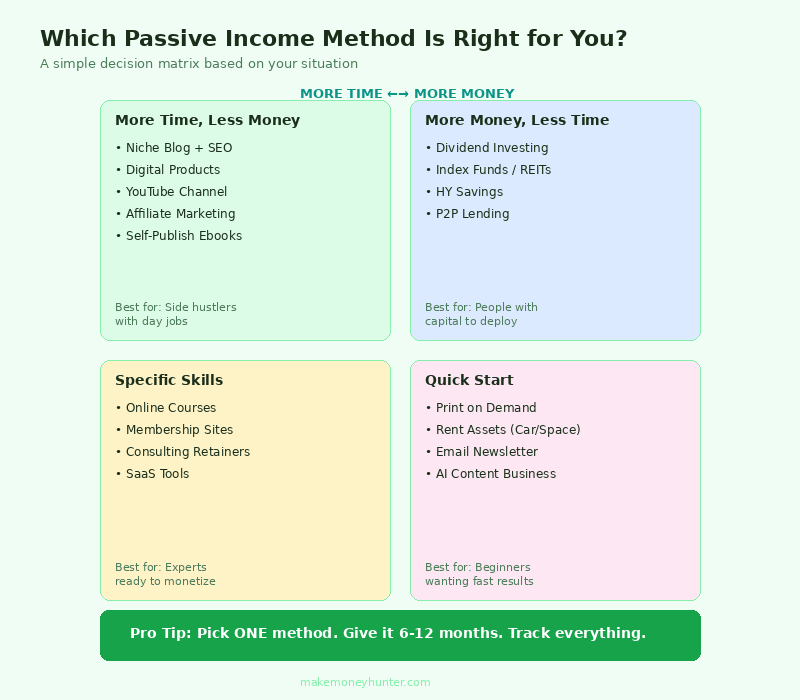
The decision comes down to two questions: do you have capital or do you have time? If you have $1,000+ to invest and want zero ongoing work, start with index funds and an HYSA. If you have time but no capital, content-based methods (niche site, YouTube, ebook) compound far better than anything else over 5–10 years. If you’re not sure where to start with content, my blogging-for-beginners guide walks through the exact setup I’d use today.
The 15 Methods at a Glance: Quick Comparison Table
If you skim better than you read, here’s the entire list compressed into the four numbers that actually matter. Bookmark this — most “passive income” articles never give you the upfront work hours, which is exactly why people quit before the math kicks in.
| Method | Realistic Monthly Earnings | Upfront Work (hours) | Maintenance (hrs/month) |
|---|---|---|---|
| 1. Niche Affiliate Site | $500–$5,000 | 200–400 | 5–10 |
| 2. YouTube Channel | $500–$8,000 | 400+ | 5–15 |
| 3. Amazon KDP Ebook | $50–$500/book | 60–120 | ~0 |
| 4. Online Course | $200–$10,000 | 100–300 | 2–5 |
| 5. Stock Photography | $100–$1,500 | 200+ | ~0 |
| 6. Stock Footage | $200–$2,000 | 200–500 | ~0 |
| 7. Print-on-Demand | $50–$1,500 | 100–300 | 2–5 |
| 8. Display Ads on Site | $300–$10,000+ | (see #1) | 0 |
| 9. Index Funds | 1.5–2% dividends + growth | 0.5 | 0 |
| 10. High-Yield Savings | ~4% APY on cash | 0.25 | 0 |
| 11. REITs | 3–6% dividend yield | 0.5 | 0 |
| 12. Treasury Bond Ladder | 4–5% yield | 1 | 1 every few months |
| 13. Mobile App | $500–$10,000 | 200–600 | 5–10 |
| 14. Podcast | $300–$5,000 | 200+ | 5+ if active |
| 15. Digital Templates | $50–$3,000 | 20–80/product | ~0 |
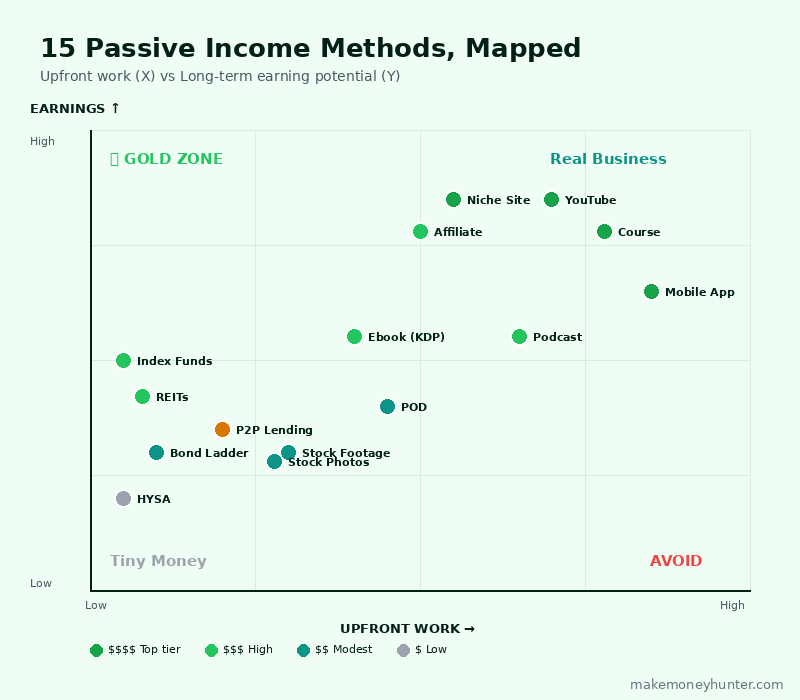
Notice the pattern: the methods with the highest earning ceilings (niche sites, YouTube, courses, mobile apps) all demand 100+ upfront hours. The truly hands-off methods (index funds, HYSA, bonds) require capital instead. There’s no method that requires neither time nor money. If anyone tells you otherwise, close that tab.
Stacking Methods: How Real Passive Income Earners Actually Build Wealth
Here’s something most articles miss: nobody who earns serious passive income online relies on just one method. The people I know making $10K+/month online stack 3–5 methods that feed each other.
A typical stack looks something like this: a niche site (#1) generates traffic, which gets monetized with display ads (#8) and affiliate links. The site’s email list sells an online course (#4) and a few digital templates (#15). The most popular content gets repurposed into YouTube videos (#2) and an ebook (#3). The cash flow from all of this gets dumped into index funds (#9) for long-term wealth building.
The key word is sequenced, not simultaneous. Build method one until it’s generating real money. Then add method two as a layer on top. Then method three. Trying to launch a niche site, a YouTube channel, and an Amazon FBA business in the same month is the fastest way to end up with three half-finished projects and no income. If you want to scan a wider menu before committing, I keep a separate list of 25 passive income ideas worth considering — useful for picking your second or third stream once your first one is profitable.
Common Mistakes That Kill Passive Income Dreams
I’ve watched smart people sabotage themselves the same ways for 15 years. Here are the four mistakes that kill 90% of attempts:
- Mistake #1: Chasing trends. AI dropshipping, NFT royalties, the latest TikTok hustle — most “trends” peak right when bloggers tell you to jump in. Boring methods (content sites, index funds, ebooks) outlast every fad.
- Mistake #2: Quitting at the dip. Months 3–6 are brutal. You’ve done the work and earned $40 total. Most people quit here. The math only starts working around month 9.
- Mistake #3: Spreading too thin. Five half-built streams will always lose to one well-built stream. Pick one, then add another only after the first is profitable.
- Mistake #4: Confusing “automated” with “passive.” Dropshipping is automated. It’s not passive — it requires daily ad management and supplier coordination. Know the difference before you commit.
Frequently Asked Questions
How much can I realistically make with passive income online in the first year?
For most content-based methods (niche sites, YouTube, ebooks), expect $0–$50/month in months 1–6, then a slow ramp to $200–$1,500/month by month 12 if you’ve been consistent. Investment-based methods (index funds, HYSA) earn predictably from day one but require capital. Anyone promising you $5,000/month in 90 days is selling something.
What’s the most truly passive income method on this list?
Index funds and HYSAs are the only methods that require essentially zero ongoing work after setup. Stock photography, ebooks, and old YouTube videos come close — months can pass without you touching them, and they keep earning. The “most passive” choice depends on whether you have capital to invest or time to build content.
Do I need a lot of money to start passive income online?
No — but you need either money or time. Investment methods (index funds, REITs, bonds) need capital but require almost zero work. Content methods (niche sites, YouTube, ebooks) need time and patience but cost under $100 to start. Pick based on what you have more of.
Why do most “passive income” courses recommend dropshipping or POD as the best method?
Affiliate commissions. Most “make money online” courses earn affiliate revenue from Shopify, course platforms, or ad management tools — so they push the methods that pay them, not necessarily the methods that work for you. Dropshipping is automated, but it’s an active business, not passive income.
How long until passive income online can replace my salary?
Realistic answer: 3–5 years of consistent work to reach $5,000+/month, depending on the method and your starting point. Niche sites and YouTube channels at scale can replace a $60K salary in 3 years if you commit and don’t switch methods every 6 months. Most people who succeed do it by stacking 3–5 income streams over time, not by hitting one home run.
Final Thoughts: The Honest Truth About Passive Income
One last thing — ignore anyone who tells you passive income is about working less. The successful passive income earners I know work just as hard as anyone else. The difference is they work hard once on something that keeps paying, instead of trading hours for dollars forever.
That’s a much better deal than passive. It’s asymmetric. You can write 50 articles in a year, then collect ad revenue from those same articles for the next 5 years. You can’t do that with a job.
Pick one method from the list above. The one that matches what you actually have — capital or time — and what you can stick with for 12 months without quitting. Stop reading roundup posts (yes, even this one), and write your first article, record your first video, or open your first brokerage account today. Future you will be very glad you did.
And if you remember nothing else from this article, remember this: the people earning real passive income online aren’t smarter than you. They just picked one boring method and stayed boringly consistent while everyone else was chasing the next shiny thing. That’s the entire game.