

My first YouTube channel earned $3.17 in its first six months. I had 47 videos, 312 subscribers, and roughly $400 sunk into a microphone, lighting kit, and editing software I barely knew how to use. The channel is still up — I leave it there as a reminder of how badly you can mess this up if you skip the parts that actually matter.
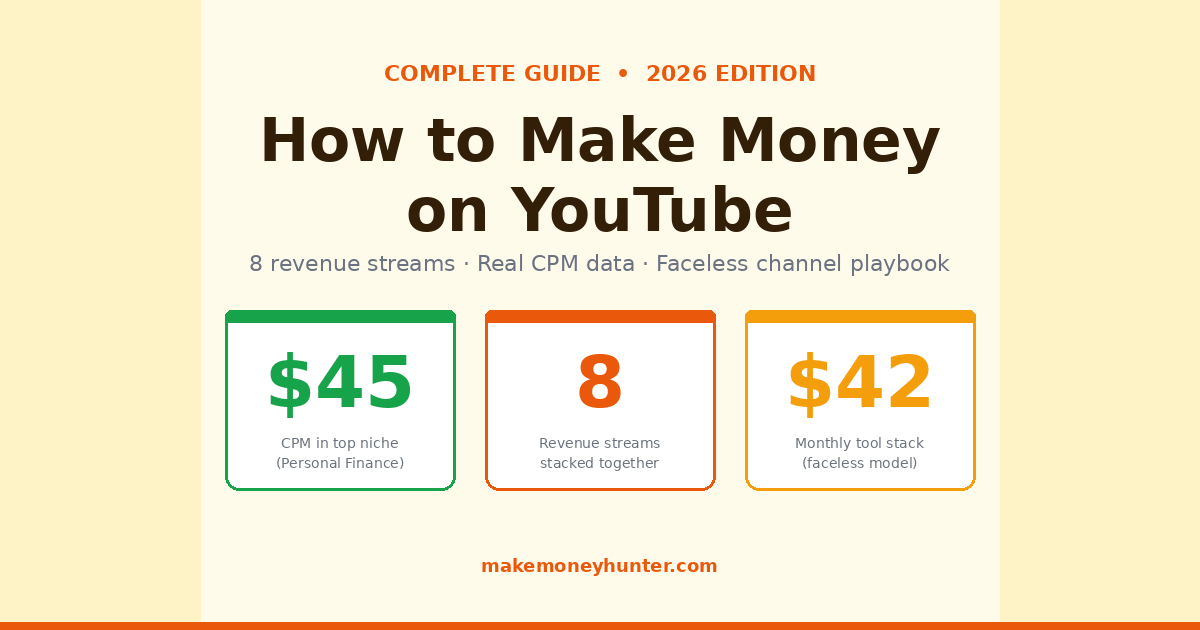
If you want to know how to make money on YouTube in 2026, here’s the short answer: the platform pays you through eight different revenue streams, the largest of which (AdSense) requires either 1,000 subscribers + 4,000 watch hours in the last 12 months, or 10 million Shorts views in the last 90 days. Earnings vary wildly by niche — a personal finance channel can earn 15-20x more per view than a gaming channel with identical traffic.
I’ve been running content sites since 2009 and built a small faceless YouTube channel to about $1,800/month in 2025 using AI tools, so the rest of this guide is what I’d tell a friend who asked me how this actually works in 2026 — including the parts most “make money on YouTube” articles skip.
How Does Making Money on YouTube Actually Work?
YouTube doesn’t pay you “for views.” It pays you through a stack of monetization features that get unlocked once you’re accepted into the YouTube Partner Program (YPP). Understanding the structure is the difference between someone who earns $50/month with a million views and someone who earns $5,000/month with 100,000 views.
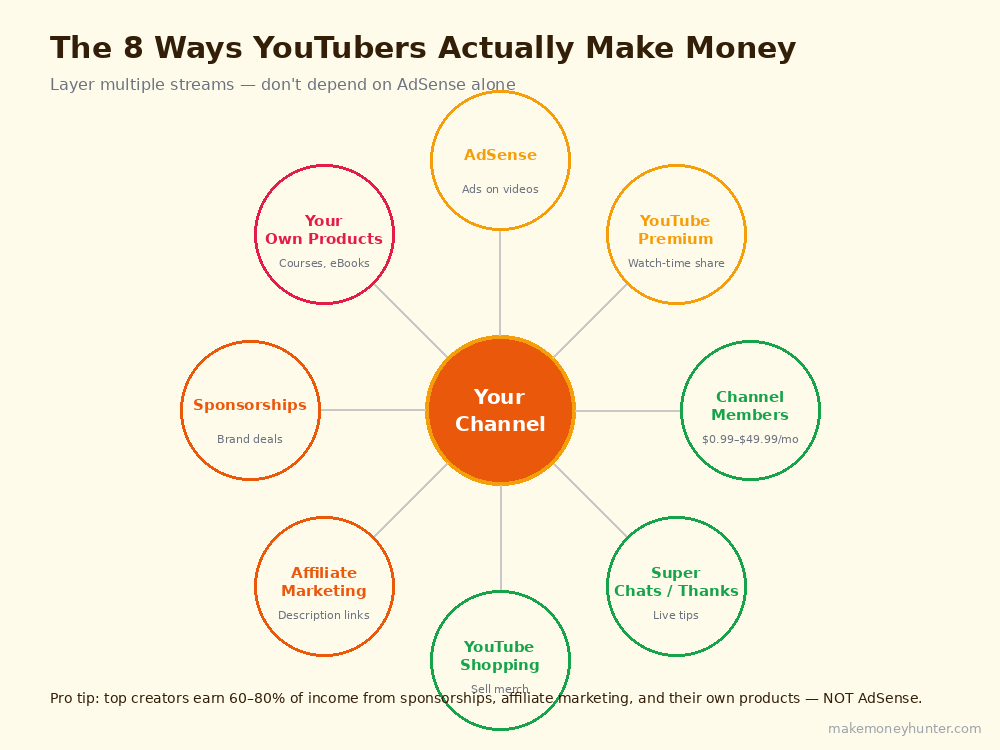
Here’s what actually flows into your bank account:
- AdSense (ad revenue): The biggest income stream for most creators. YouTube keeps 45% and pays you 55% of ad revenue. Your CPM (cost per 1,000 impressions) is set by advertisers, not you.
- YouTube Premium revenue: When Premium subscribers watch your content, you get a slice based on watch time.
- Channel memberships: Recurring monthly payments from your most loyal viewers ($0.99 – $49.99 tiers).
- Super Chats, Super Stickers, and Super Thanks: Tips from viewers during live streams or under videos.
- YouTube Shopping: Sell your own merch or partnered brand products directly under videos.
- Affiliate marketing: Recommend products in your descriptions and earn commission. This is often bigger than AdSense for smaller channels.
- Sponsorships and brand deals: Direct payments from companies to feature their product. Available even before you’re in YPP.
- Selling your own products: Courses, ebooks, services, coaching — the highest-margin stream.
Here’s the part nobody tells beginners: AdSense alone is rarely how successful YouTubers get rich. It’s the foundation, but most full-time creators earn 60-80% of their income from sponsorships, affiliate marketing, and their own products. If your strategy is “go viral and collect ad checks,” you’re playing the hardest version of this game.
This is what a typical pre-roll AdSense ad actually looks like on a creator’s video — the “Sponsored” label in the lower-left is YouTube’s standard ad placement, and the creator earns a cut of whatever NordVPN (in this case) is paying YouTube to put that ad in front of viewers:
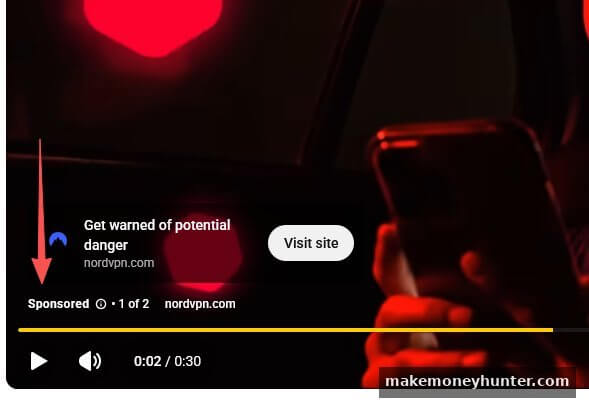
Notice the ad takes the bottom-left corner of the video player. That impression — and every other ad shown across that video’s lifetime views — is what generates the creator’s AdSense payout. If your CPM is $20 and you get 100,000 monetized impressions in a month, your share is roughly $1,000 (after YouTube’s 45% cut).
What Are the Requirements to Make Money on YouTube in 2026?
YouTube currently runs a two-tier monetization system, which is a meaningful change from the old “1,000 subs or nothing” days. According to YouTube’s official Partner Program page, the requirements break down like this:
Tier 1: Fan Funding Access (Lower Bar)
- 500 subscribers
- 3 public uploads in the last 90 days
- EITHER 3,000 valid public watch hours in the last 12 months OR 3 million valid Shorts views in the last 90 days
- Live in a country where YPP is available
- Linked AdSense account
- Two-step verification enabled
At this level you unlock channel memberships, Super Chats, Super Thanks, and YouTube Shopping — but not ad revenue.
Tier 2: Full Ad Revenue Access
- 1,000 subscribers
- EITHER 4,000 valid public watch hours in the last 12 months OR 10 million valid Shorts views in the last 90 days
- All Tier 1 requirements
Once you cross this threshold, you start earning a cut of ad revenue from your long-form videos and Shorts feed ads.
One thing I wish someone had told me earlier: Shorts views from the Shorts shelf don’t count toward the 4,000 watch hours requirement. If you’re publishing only Shorts, you’re locked into the 10 million Shorts views path. If you mix Shorts and long-form, the long-form watch time counts toward 4,000 hours and the Shorts views count toward 10 million separately — but they don’t combine. Plan your content mix accordingly.
Why Your Niche Matters More Than Your View Count
This is the single most important section of this guide, so read it twice. The niche you pick determines roughly 80% of your earning ceiling. Pick wrong and you’ll grind to a million views for the same paycheck a finance channel gets from 50,000.
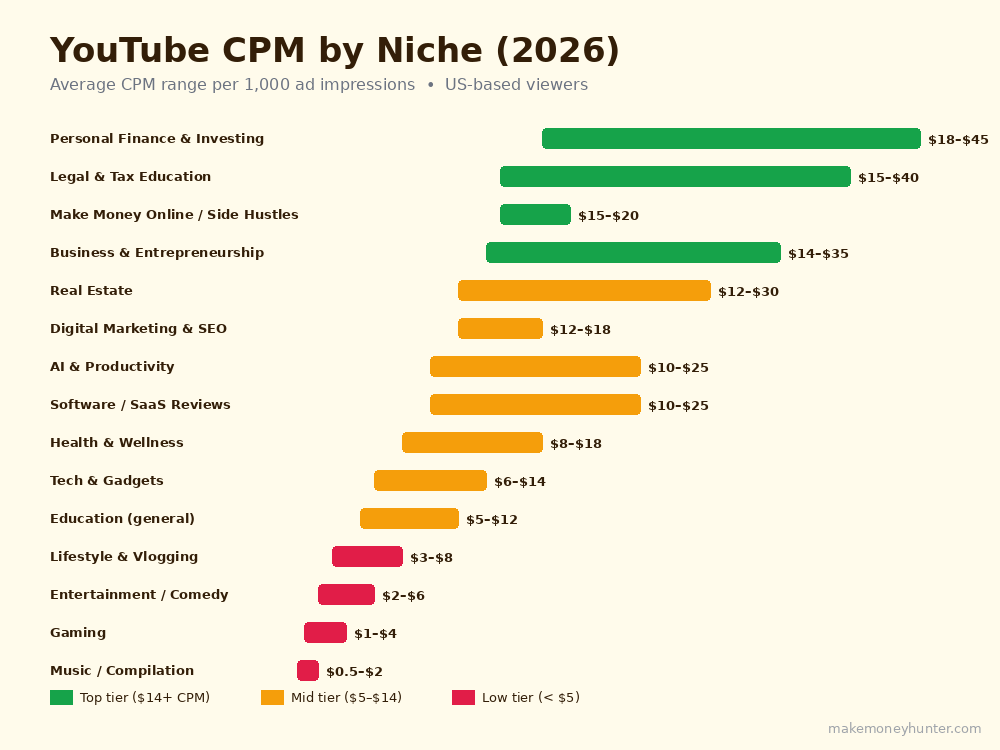
Here are the verified CPM ranges by niche based on aggregated 2026 data from OutlierKit’s creator dashboard analysis, vidIQ’s niche profitability report, and channel-level data from US-based viewers:
| Niche | CPM Range (USD) | Difficulty | Best For |
|---|---|---|---|
| Personal Finance & Investing | $18 – $45 | High | Experts, planners, ex-finance professionals |
| Legal & Tax Education | $15 – $40 | Very High | Lawyers, CPAs, paralegals |
| Make Money Online / Side Hustles | $15 – $20 | High | Operators with real income proof |
| Business & Entrepreneurship | $14 – $35 | High | Founders, operators, B2B specialists |
| Real Estate | $12 – $30 | Medium-High | Agents, investors, market analysts |
| Digital Marketing & SEO | $12 – $18 | High | Marketers, agency owners |
| AI & Productivity | $10 – $25 | Medium | Tool reviewers, automation experts |
| Software / SaaS Reviews | $10 – $25 | Medium | Tech reviewers, product hunters |
| Health & Wellness | $8 – $18 | High | Certified practitioners only (YMYL rules) |
| Tech & Gadgets | $6 – $14 | High | Hands-on reviewers with budget |
| Education (general) | $5 – $12 | Medium | Teachers, tutors, subject experts |
| Lifestyle & Vlogging | $3 – $8 | Very High | Personality-driven creators |
| Entertainment / Comedy | $2 – $6 | Very High | Strong on-camera presence required |
| Gaming | $1 – $4 | Very High | Streamers building community |
| Music / Compilation | $0.50 – $2 | Low | Not recommended in 2026 |
Look at the gap: a finance channel earning $30 CPM makes roughly 26x more per ad impression than a prank channel at $1.13 CPM. That’s not a small edge — that’s the difference between “this could be a real income” and “I love making videos as a hobby.”
But CPM isn’t the whole story. Three more things matter:
- Audience geography. A US viewer is worth 5-10x more than a viewer from India or the Philippines. Same niche, same content — the audience location alone changes everything.
- Seasonality. Q4 (October-December) CPMs are 30-50% higher than Q1. If you have a hit video, hold the release for fall when possible.
- Video length. Videos over 8 minutes can run mid-roll ads, which roughly doubles your effective revenue per view compared to shorter videos.
How to Make Money on YouTube: 8-Step Process for Beginners
This is the order I’d follow if I were starting today. Skip a step and you’ll feel it later.
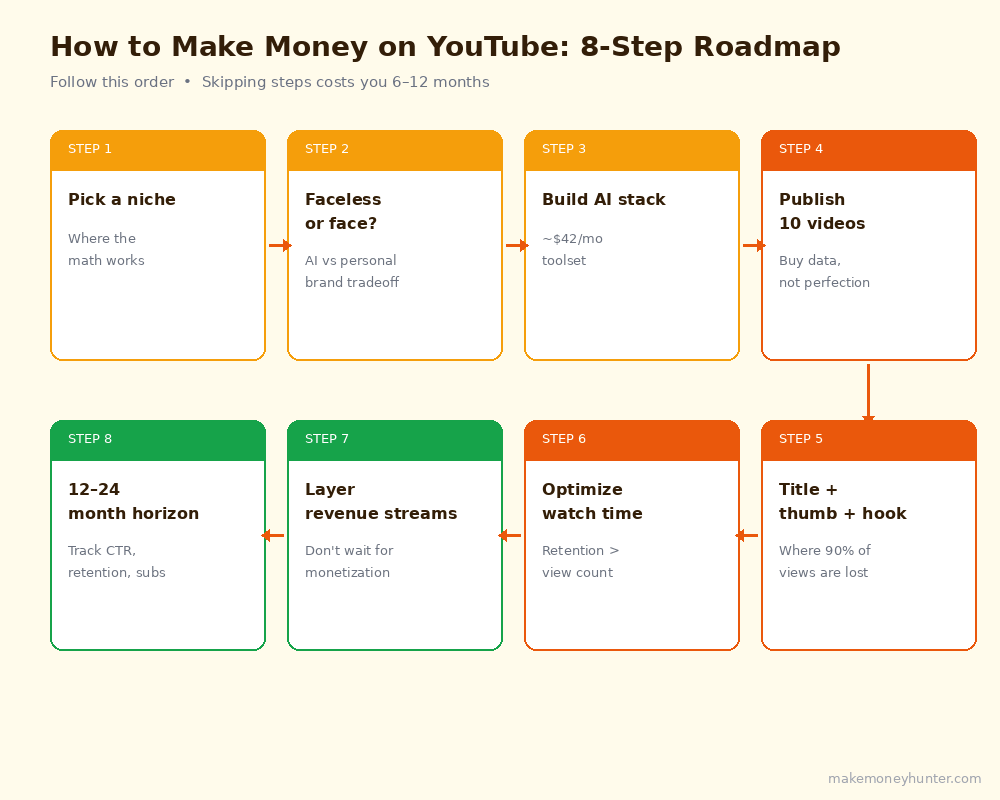
Step 1: Pick a Niche Where the Math Actually Works
Don’t start with “what am I passionate about?” Start with two filters: (a) what can you talk about for 100+ videos without running out of angles, and (b) does the CPM table above support real income at the view counts you can realistically hit?
If you love gaming but want to make $5,000/month, you need to do the math: at a $3 CPM, you need ~3 million monthly views from US audiences just for ad revenue at that level. At $25 CPM in a finance niche, the same income requires only ~360,000 monthly views. Same effort, ten times the revenue.
My recommendation for beginners in 2026: pick a sub-niche inside Personal Finance, AI Productivity, Side Hustles, or Real Estate. Specifically a sub-niche where you have either credentials, proof, or genuine curiosity to learn out loud. If you want a deeper breakdown of how to validate a niche before committing, I covered the full framework in how to choose a blog niche — the same logic applies to YouTube.
Step 2: Decide Faceless vs On-Camera (And Why It Matters)
This is one of the biggest 2026 shifts. AI tools have made faceless YouTube channels — where you never show your face or use your real voice — genuinely viable, not just a meme.
Here’s the honest tradeoff:
| Factor | Faceless | On-Camera |
|---|---|---|
| Time per video | 30-90 minutes | 3-8 hours |
| Cost per video | $1-5 (tool costs) | $20-200+ (equipment amortized) |
| Scaling potential | Multiple channels possible | Capped by your time |
| Sponsorship rates | Lower (no personality) | Higher (built-in trust) |
| Selling your own products | Harder (low parasocial bond) | Easier (audience knows you) |
| YouTube policy risk | Higher (Jul 2025 “inauthentic content” crackdown) | Lower |
The faceless approach won me back to YouTube after I quit on-camera content in 2018. My current faceless channel produces 8 videos a month in about 6 hours of total work, using a tool stack that costs me $42/month. The same channel would have required a $3,000+/month editing team three years ago.
But here’s the warning: YouTube’s July 2025 policy update specifically targets “mass-produced, template-based videos with no creative input.” Lazy automation is dead. If your plan is to feed ChatGPT a prompt, dump the output into a video generator, and upload — you’ll either fail to monetize or get demonetized within months. Faceless still requires editorial judgment, original angles, and consistent quality. If you’re leaning faceless, my guide on making money without showing your face covers the broader category of “anonymous creator” income models that work well alongside YouTube.
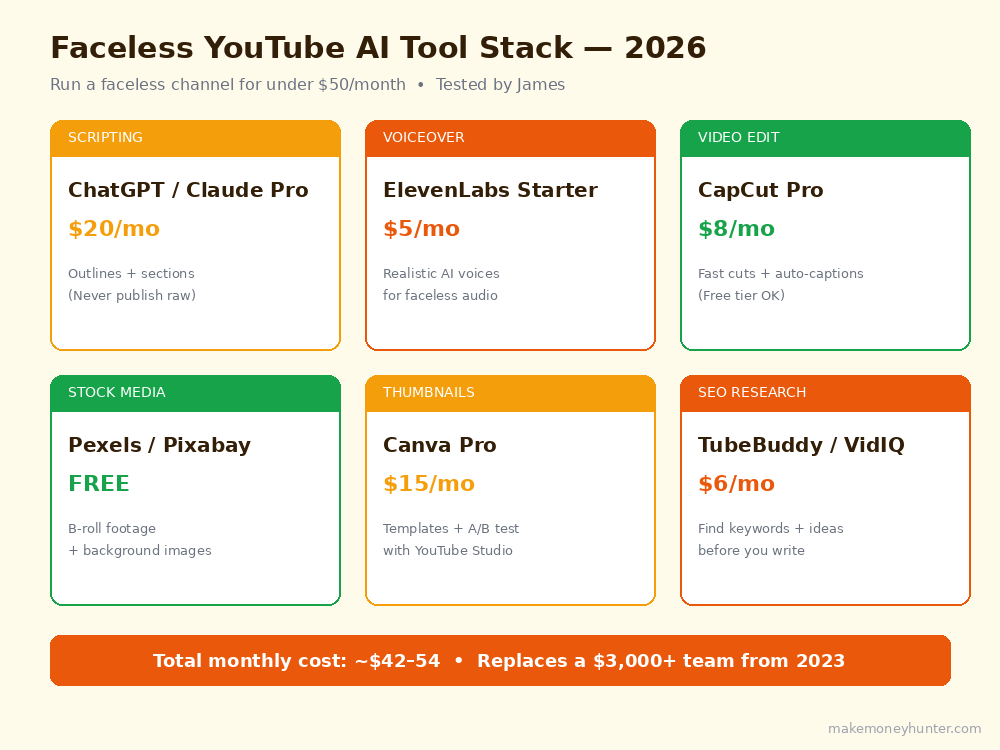
Step 3: Build Your AI Tool Stack (2026 Edition)
Whether you go faceless or on-camera, AI tools can multiply your output by 5x. Here’s a practical stack I’ve tested or seen working in real channels:
- Scriptwriting: ChatGPT Plus or Claude Pro ($20/month). Use them to draft outlines and rough sections — never publish raw AI output. Edit aggressively.
- Voiceover (faceless only): ElevenLabs Starter ($5/month) for AI voices, or Descript ($16/month) if you want studio-quality with your own voice.
- Video editing: CapCut Pro ($7.99/month) for fast cuts, or DaVinci Resolve (free) for serious editing. Skip Premiere unless you already know it.
- Stock footage and assets: Storyblocks ($30/month) or free options like Pexels and Pixabay.
- Thumbnails: Canva Pro ($14.99/month) plus a thumbnail testing tool like ThumbsUp or YouTube’s built-in A/B test.
- SEO and idea research: VidIQ Pro ($19/month) or TubeBuddy Pro ($5.99/month). These pay for themselves on your first ranking video.
You can start for about $30-50/month total. That’s the entire cost of running a faceless YouTube channel in 2026. Compare that to the $50-200 per video traditional production used to cost, and you understand why the barrier to entry has collapsed. For a broader view of how AI tools are reshaping online income across multiple platforms, see my breakdown in how to make money with AI.
Step 4: Create Your First 10 Videos Before You Worry About Anything Else
The most common mistake I see new creators make is obsessing over channel art, intro music, and equipment before they’ve published 10 videos. Nobody watches a channel because the banner is pretty. They watch because the content is good enough to retain attention.
Your first 10 videos serve three purposes:
- Test whether you actually enjoy doing this (about 60% of new creators quit before video 10)
- Build a baseline of which formats your specific audience responds to
- Give the YouTube algorithm enough data to start recommending your channel
Set yourself a target: publish 10 videos in 60 days. They will not be your best work. That’s the point. You’re buying data, not making art.
Step 5: Master the Title-Thumbnail-Hook Triangle
This is where 90% of new creators leak views. A great video with a weak title-thumbnail combo gets 200 views. A mediocre video with a great title-thumbnail combo gets 20,000. The math is brutal but it’s reality.
- Titles: Lead with the benefit or hook. Numbers work (“7 ways”). Curiosity gaps work (“Why I quit X”). Contrarian takes work (“X is wrong about Y”). Keyword stuffing doesn’t.
- Thumbnails: One subject (face or object), bold contrasting text (under 5 words), emotion-driving expressions, and the title-thumbnail must show different information that combines into a compelling promise.
- Hook (first 15 seconds): State what the video delivers and why the viewer should stay. Skip the long intro. Don’t say “in this video we’re going to talk about.” Just deliver the first piece of value.
Step 6: Optimize for Watch Time, Not View Count
YouTube’s algorithm rewards videos that hold attention. A 10-minute video where viewers stay for 7 minutes will outperform a 10-minute video where viewers stay for 3 minutes — even if the second video has 5x the initial clicks.
Concrete tactics that actually move the needle:
- Restate the hook with new information every 2 minutes (“but here’s what most people miss…”)
- Use pattern interrupts: B-roll cuts, graphic overlays, location changes, voice tone shifts
- Promise specific delivery points: “I’ll show you the exact numbers at 6:30”
- Cut ruthlessly. If a sentence doesn’t earn its place, delete it. I delete about 30-40% of my first draft
- End with a question, cliffhanger, or call-to-action that links to your next video
Step 7: Layer Revenue Streams Before You Need Them
Don’t wait until you’re monetized to think about other income streams. AdSense will likely be 30-50% of your income at the start. The faster you stack the others, the faster your effective RPM grows.
The first stream to add (immediately, no YPP required) is affiliate marketing in your video descriptions. Here’s exactly what that looks like in practice — a VPN comparison channel with 197K subscribers including their affiliate links at the very top of every video description:
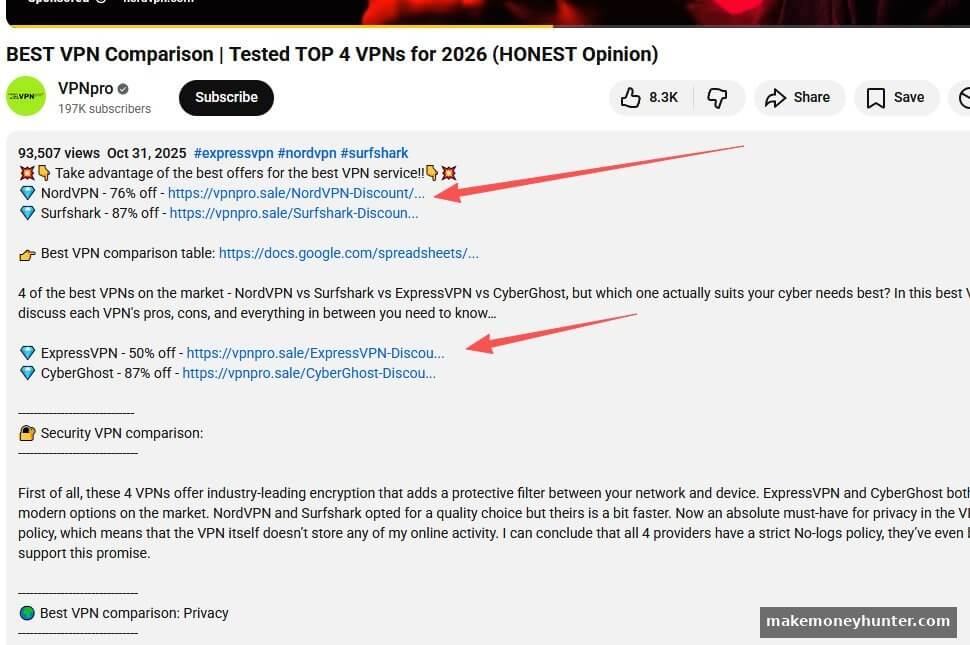
Notice the format: discount percentage (76% off, 87% off) + branded short link (vpnpro.sale/…). Every time a viewer clicks one of those links and signs up, the channel earns a commission. A channel like this likely earns more from those four VPN affiliate links than from AdSense — VPN affiliate payouts run $25-100 per signup, and a 100,000-view video can drive 200-500 conversions if the audience matches the product. If you’re new to affiliate marketing, I cover the full setup process in affiliate marketing for beginners.
Once you cross the YPP Tier 1 threshold (500 subscribers), channel memberships become available. Here’s what a typical creator membership looks like — NationSquid, a 514K-subscriber channel about technology and internet mysteries, charges $2.99/month for the basic tier with custom emojis, member badges, and members-only posts:
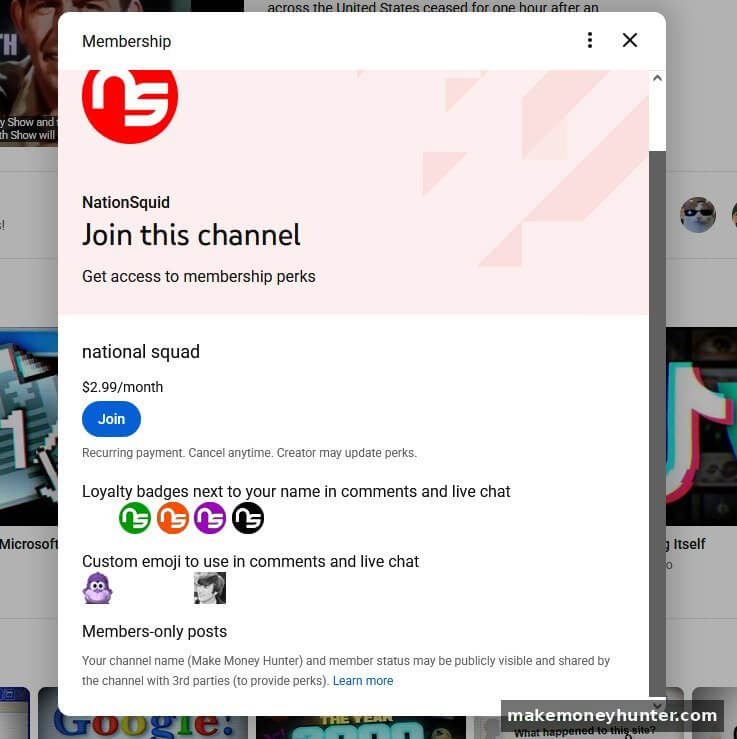
Memberships work because 1-2% of your subscriber base will pay for something they’re already getting for free, just to support a creator they like. At 514K subscribers, even a 0.5% conversion rate means 2,570 paying members × $2.99 = ~$7,700/month before YouTube’s cut. That’s a meaningful income floor that doesn’t depend on ad rates fluctuating.
But the highest-leverage move is layering external monetization platforms outside YouTube. Most successful channels send their most loyal viewers to Patreon, Buy Me a Coffee, or their own website where the margins are much better. Here’s the same NationSquid creator showing their full external link stack in their channel description:
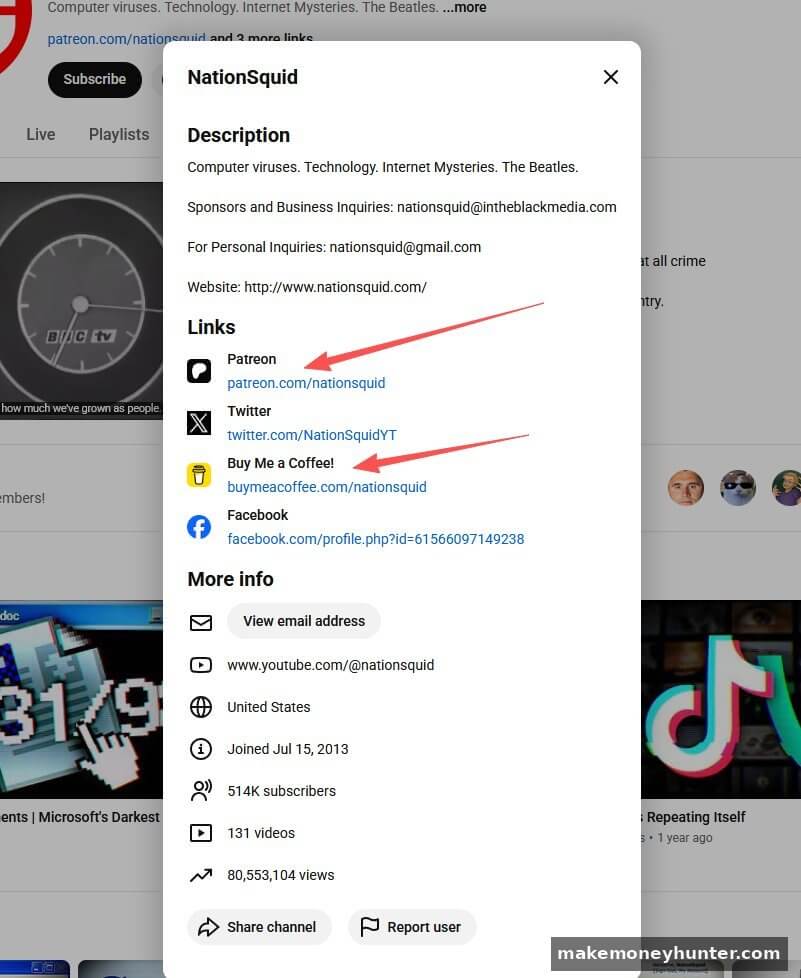
Look at the priority order: Patreon listed first, Buy Me a Coffee second. That’s deliberate. Both platforms let creators capture recurring income that YouTube can’t touch and that doesn’t depend on the algorithm. If YouTube demonetizes a video tomorrow, the Patreon revenue keeps flowing.
And the Patreon side of the same creator’s funnel looks like this — 41 paying members at multiple tiers, fully separate from YouTube’s monetization:
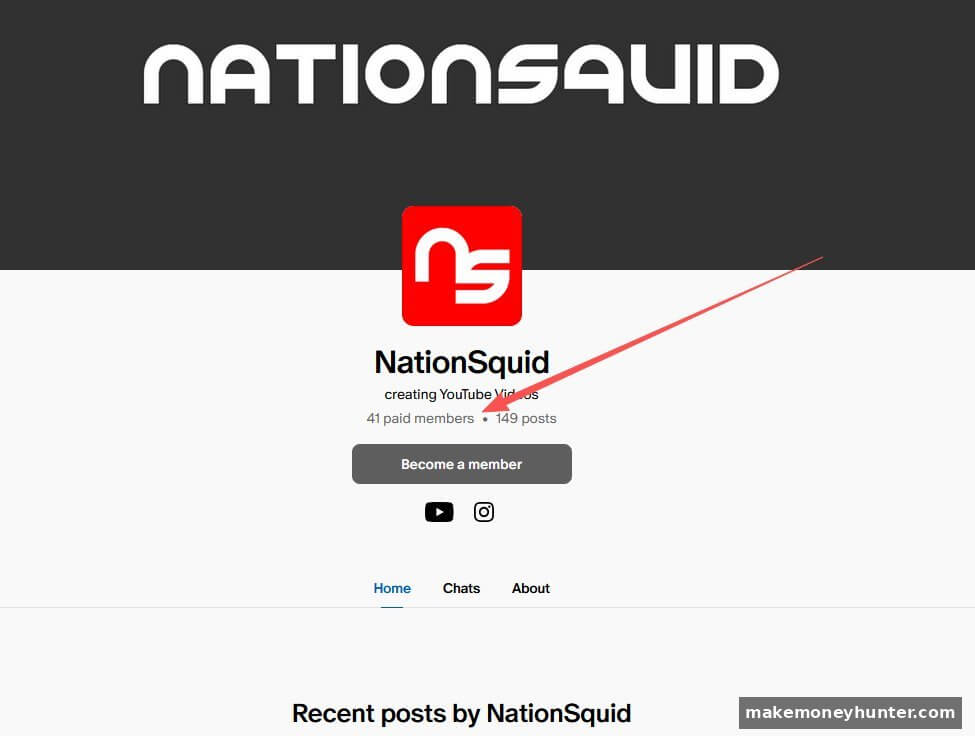
41 members across three tiers ($2 / $5 / $10) averaging maybe $5/member = around $200/month. Not huge, but here’s the math that matters: Patreon takes ~5-12% in platform fees vs. YouTube’s 45% cut on AdSense. The same $200 of viewer support delivers nearly twice as much to the creator’s bank account when it flows through Patreon instead of YouTube ads.
Here’s what those three tiers look like in practice — note how each one builds escalating value (basic feed access → vote on content + Q&A → behind-the-scenes + early access). This is the standard Patreon structure most YouTube creators use:
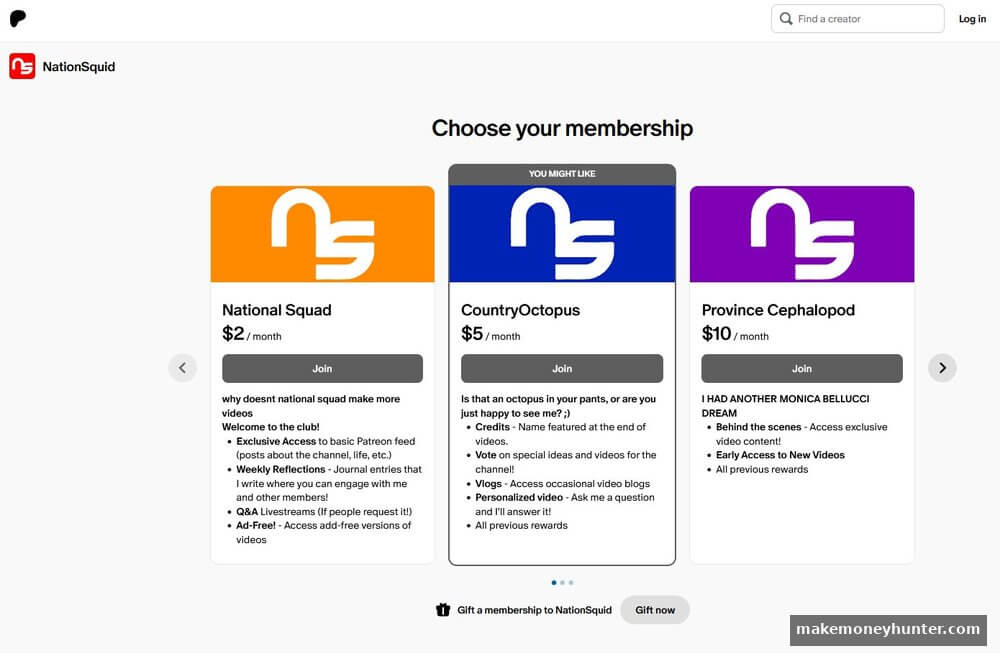
The key insight: the $5 tier (CountryOctopus) is positioned as “you might like” — that’s the price point that maximizes total revenue. Most creators discover that the middle tier is where 60-70% of supporters land. Price your basic tier too high and conversion drops; price your top tier too low and you leave money from superfans on the table.
Order I’d add streams in:
- Affiliate links (start immediately — no YPP required). Amazon Associates, Impact, ShareASale all let you start day one.
- Sponsorships (around 10K-25K subscribers). Brands will start reaching out, or you can pitch via platforms like FameBit or PassionFroot.
- Patreon / Buy Me a Coffee (around 3K-5K engaged subscribers). Capture recurring income outside YouTube’s algorithm risk.
- Your own digital product (around 5K subscribers, if you have audience trust). A simple $27 ebook or template pack can outearn your AdSense in month one.
- Channel memberships and Super Thanks (after YPP acceptance). Smaller income but very loyal.
- Courses and coaching (after you have a clear, repeatable transformation to sell).
For a complete picture of how affiliate income compounds alongside YouTube traffic, see how to make money with affiliate marketing — many of the strategies translate directly to monetizing a YouTube audience.
Step 8: Pick a Realistic Time Horizon and Track Leading Indicators
Most channels that succeed take 12-24 months to reach meaningful income ($1,000+/month). The data from HubSpot’s creator economy research is consistent here: the median monetized channel takes 16 months from first video to first $1,000 month.
Track these leading indicators monthly:
- Click-through rate (CTR) — aim for 4-6% on long-form, 8%+ on Shorts
- Average view duration as a percentage — aim for 40-50%+ retention
- Subscriber conversion rate — aim for 1-2% of viewers subscribing per video
- Watch hours per video (rolling 30 days)
If these are trending up, your channel is healthy even if revenue hasn’t caught up yet. Revenue is a lagging indicator — by the time AdSense shows up, the work that generated it happened 3-6 months earlier.
How Much Money Can You Realistically Make on YouTube?
This is the question everyone asks and nobody answers honestly. Here are realistic income brackets based on observed earnings from channels I’ve tracked, the Statista creator economy reports, and creator-submitted income proofs aggregated by industry watchers:
| Channel Stage | Monthly Views | Realistic Monthly Income | Income Mix |
|---|---|---|---|
| Pre-monetization (0-1K subs) | 500-5,000 | $0 – $50 | Affiliate links only |
| Just-monetized (1K-10K subs) | 10K-50K | $50 – $500 | AdSense + affiliate (50/50) |
| Growing channel (10K-50K subs) | 50K-300K | $500 – $3,500 | AdSense + affiliate + small sponsorships |
| Established channel (50K-250K subs) | 300K-1.5M | $3,500 – $20,000 | AdSense + sponsorships + own products |
| Large channel (250K+ subs) | 1.5M+ | $20,000+ | Diversified across all streams |
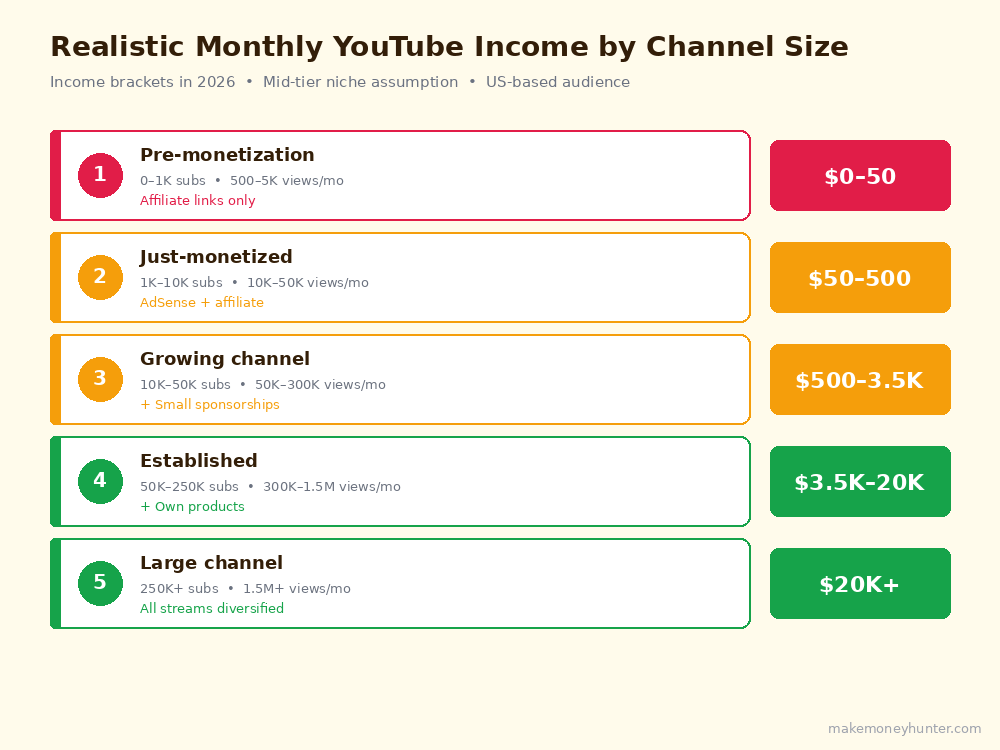
Important caveats: these are realistic brackets, not guarantees. A finance channel at 50K subscribers can earn $15,000/month. A gaming channel at the same size might earn $1,500. And anyone telling you they made $10K in their first 90 days is either an outlier, lying, or in a niche you probably shouldn’t follow.
Pros and Cons of Making Money on YouTube
Pros
- Low barrier to entry. You can start with a phone and free editing tools.
- Massive audience reach. Over 2.5 billion monthly active users.
- Multiple income streams. Eight different ways to earn from one channel.
- Compounding equity. Old videos keep earning years after publication. I have a video from 2014 that still pays me roughly $40/month in 2026.
- Skill stack is portable. The skills you build (video, copywriting, marketing) transfer to consulting, freelancing, and your own business.
Cons
- Income is slow to start. First 12-18 months are usually mostly unpaid.
- Algorithm dependency. A single policy change can cut your income overnight.
- Burnout is real. The pressure to publish consistently kills many channels.
- Demonetization risk. Controversial topics, copyrighted music, or “inauthentic content” can wipe out your ability to earn ad revenue.
- It’s a public-facing job. Comments, critics, and trolls come with the territory, especially on-camera.
Common Mistakes to Avoid
I’ve watched dozens of new creators make the same handful of mistakes. Skip these to save yourself 6-12 months of unnecessary pain:
- Optimizing for views over depth. A channel with 50 surface-level videos earns less than one with 15 in-depth videos.
- Ignoring titles and thumbnails. The best content in the world earns nothing if nobody clicks. Spend 30% of your production time here.
- Switching niches every 3 months. YouTube’s algorithm needs ~10 videos in a niche to understand who to recommend you to. Restart and you lose all that signal.
- Relying on AdSense only. One income stream means one bad month destroys you. Stack from day one.
- Comparing yourself to channels 3 years ahead. Their current output is the result of compounding work. Look at where they were at month 6.
- Using copyrighted music. Free strikes will get you demonetized faster than any other mistake. Use YouTube Audio Library or paid royalty-free services.
- Mass-producing low-effort AI content. YouTube’s 2025 policy update killed this entire strategy. Don’t waste your time on it.
FAQ: How to Make Money on YouTube
How long does it take to make money on YouTube?
Most creators reach the YouTube Partner Program threshold (1,000 subscribers + 4,000 watch hours) in 6-12 months of consistent uploads. Reaching $1,000/month typically takes 12-24 months. The fastest path is to publish 2-3 long-form videos per week in a high-CPM niche while running Shorts to drive subscriber growth.
Can you make money on YouTube without showing your face?
Yes. Faceless YouTube channels are fully viable in 2026 and represent some of the fastest-growing channels on the platform. Use AI tools for voiceover (ElevenLabs), stock footage, and graphics. The key constraint is that lazy mass-produced content was banned in YouTube’s July 2025 policy update — your faceless content still needs original angles, editorial judgment, and consistent quality.
How many views do I need to make $1,000 per month?
It depends entirely on niche. In personal finance at a $25 CPM, roughly 80,000 US-based monthly views (with mid-roll ads on 8+ minute videos) gets you to $1,000. In gaming at a $3 CPM, you’d need closer to 700,000 monthly views for the same income. Add affiliate and sponsorship income and the view requirements drop significantly.
Is YouTube saturated in 2026?
The mainstream niches (general vlogging, basic gaming commentary, surface-level tutorials) are saturated. But specific sub-niches are wide open. There’s no shortage of room for a channel about “tax strategies for freelancers” or “AI tools for small business accounting.” Saturation is a niche problem, not a platform problem.
Do I need to pay tax on YouTube income?
Yes, in every country I’m aware of. YouTube reports your earnings to relevant tax authorities and provides 1099 forms (US) or equivalents. Track every dollar from day one. I am not a tax professional, so consult one in your country once your income becomes meaningful.
Should I start with YouTube Shorts or long-form videos?
Mix both, but make long-form the foundation. Shorts are great for subscriber growth and discoverability, but they pay roughly $0.01-0.07 per 1,000 views compared to $5-30+ RPM on long-form. Use Shorts to attract subscribers, then convert them to long-form watchers where the money actually is.
Final Thoughts
Here’s the thing most “how to make money on YouTube” guides get wrong — they treat YouTube like a get-paid-for-views machine. It’s not. It’s a media business with eight revenue levers, where the people who win understand the math behind their niche before they ever turn on a camera (or open ElevenLabs). The people earning $10,000+/month aren’t doing it because they got lucky. They’re doing it because they picked a niche where the unit economics work, layered multiple revenue streams, and showed up consistently for 18+ months.
One last thing — don’t fall for the “YouTube is passive income” framing. It’s not passive. It’s front-loaded income. You work hard now so the videos keep paying you later. A two-year-old video of mine still earns more in a month than I spent making it. That’s a much better deal than passive — but only if you’re willing to do the front-loaded part.
Pick your niche this week. Publish your first video before the end of the month. Track the leading indicators monthly. Most people won’t do this — which is exactly why the people who do still find room to win.