

Last year I tested 12 different side hustles trying to answer one specific question: which ones actually clear $500 a week for a normal person with a normal job? Not influencer money. Not “I quit my 9-to-5 and now I’m rich” stories. Just real, repeatable income on top of a day job.
The honest answer is that $500 a week — about $2,000–$2,167 a month — is one of the few side hustle income targets that’s actually realistic without being insulting. It’s high enough to matter (covers a car payment, a rent increase, or a serious savings goal) and low enough to hit without quitting your job. But the path you take depends entirely on one thing almost nobody talks about: how many hours per week you actually have.
So I built this guide around that. Instead of dumping 30 random side hustle ideas on you, I sorted the methods I tested into three brackets — 5 hours/week, 10 hours/week, and 20 hours/week — and showed you what’s realistic in each. If you only have 5 hours, some methods on this list will waste your time. If you have 20 hours, you can aim much higher than the obvious freelance route.
Let’s get into it.
The Math: What Does $500 a Week Actually Require?
Before we go method by method, let’s set realistic expectations.
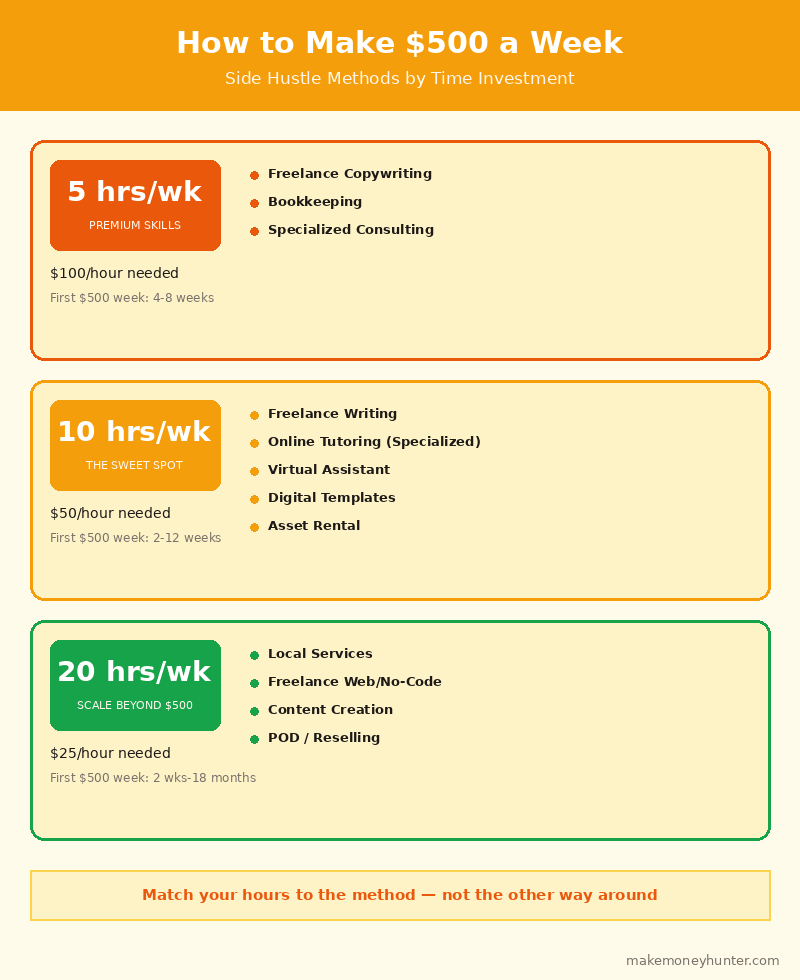
$500 a week works out to roughly $25 per hour at 20 hours of work, $50 per hour at 10 hours, or $100 per hour at 5 hours. Those are very different worlds. $25/hour is achievable on entry-level freelance platforms within a few weeks. $100/hour usually requires either a specialized skill, an audience you’ve already built, or assets (like a spare room) you can monetize without trading time.
Here’s the thing: most “make $500 a week” articles ignore this math entirely. They tell you to “drive for Uber” without mentioning that Uber drivers averaged around $19–$25 per hour gross before expenses in 2024, which means you’d need 20–26 hours weekly just to gross $500. After gas and car wear, more like 30 hours.
If your goal is closer to making $1,000 a month with a side hustle, the math is far gentler — about $250/week, which most methods on this list reach in their first few weeks. $500/week roughly doubles that bar, and the doubling is where most people get stuck.
So the right way to read this list is: match the method to your available hours, not the other way around.
If You Have 5 Hours a Week: Premium Skills Only
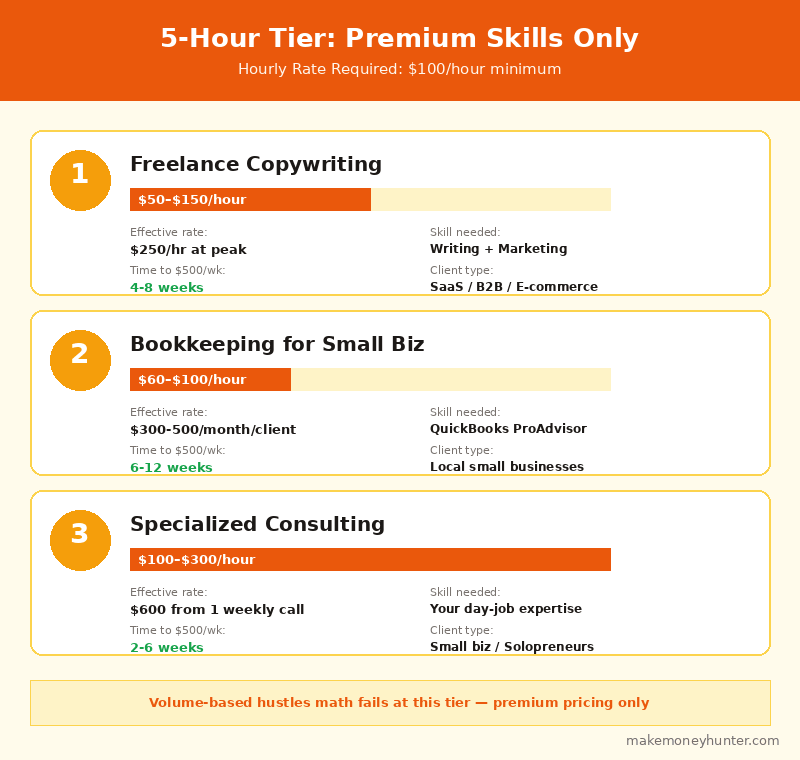
At 5 hours weekly, you have one option to hit $500: you need to charge premium rates. That means $100/hour minimum. Anything less and you won’t make the math work. Volume-based hustles (driving, delivery, surveys, simple gig work) are mathematically out at this tier.
1. Freelance Copywriting for Businesses ($50–$150/hour)
Copywriting — writing sales pages, email sequences, ad copy — is one of the few skills where small business clients will pay $100–$200 an hour without flinching. I started writing email sequences for SaaS companies in late 2022. By month 4, I was charging $1,500 for a 5-email welcome sequence that took me about 6 hours. That’s $250/hour effective.
The catch: you need writing samples and at least 2–3 testimonials before clients pay these rates. Plan for 4–8 weeks of lower-paid work first ($30–$50/hour on Upwork or Contra) to build a portfolio. Once you cross that threshold, $500/week from 5 hours is very doable.
Best for: Anyone with writing experience or a marketing background. Worst for: people who hate writing on demand.
2. Bookkeeping for Small Businesses ($60–$100/hour)
Bookkeeping is quietly one of the highest-paying skill-based side hustles in 2026 because every small business needs it and most owners hate doing it. You don’t need an accounting degree. A QuickBooks ProAdvisor certification (free from Intuit) and a few months of practice with a free trial account is enough to land your first clients.
Typical retainer: $300–$500 per month per client for a small business with 50–100 transactions. Pick up 2–3 clients and you’re at $500+ weekly working 4–6 hours total. I broke down the full path (certification, finding first clients, pricing your packages) in my dedicated guide on how to make money with bookkeeping.
3. Specialized Consulting in Your Day Job Field ($100–$300/hour)
The most underused $500/week strategy: just charge for what you already know. If you work in HR, sales ops, B2B marketing, IT compliance, or any specialized corporate function, small businesses will pay you $100+/hour for the same advice you give in meetings for free. Sites like Clarity.fm and GLG let you list yourself; LinkedIn outreach works even better.
One Friday-afternoon call per week at $150/hour = $600/week. The hard part isn’t doing the work. It’s giving yourself permission to charge what corporate consultants charge.
If You Have 10 Hours a Week: The Sweet Spot
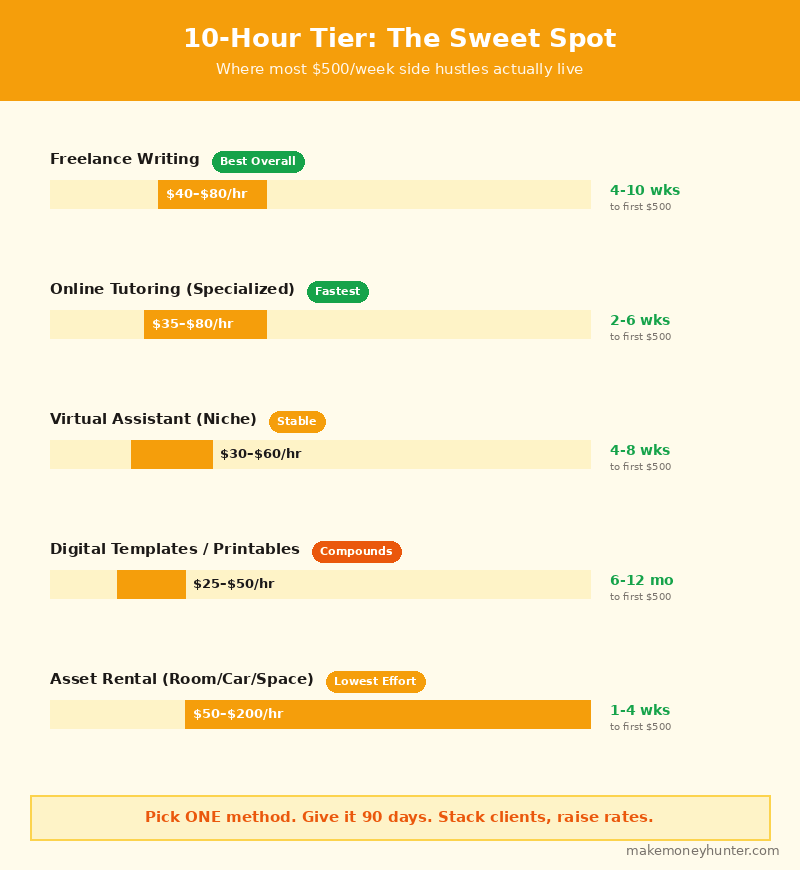
Ten hours weekly is where most $500/week side hustles actually live. You need roughly $50/hour, which is achievable on dozens of platforms once you have a few months of experience. This tier is where I’d point most readers.
4. Freelance Writing on Industry Topics ($40–$80/hour)
Different from copywriting — this is content writing for B2B blogs, industry trade publications, and Substack-style newsletters. Pay rates have gone up in 2026, not down, despite the AI panic. The reason is simple: AI flooded the market with mediocre content, and any human who can write with original perspective and real research is now more valuable.
Going rate as of 2026: $0.20–$0.50 per word for B2B SaaS content, $0.30–$0.80 for finance and healthcare verticals. A 1,500-word article at $0.30/word = $450, and a decent writer can finish that in 3–4 hours of focused work.
Find clients on Contra, Superpath’s job board, and ProBlogger. If you’re brand new and need help getting your first paid pieces, my walkthrough on making money writing from home covers how to position yourself when you have zero portfolio.
5. Online Tutoring (Specialized Subjects) ($35–$80/hour)
Generic English tutoring pays $15–$25/hour and isn’t getting you to $500 weekly in 10 hours. But specialized tutoring — SAT/ACT prep, AP Calculus, MCAT, finance certifications, programming interview prep — pays $50–$100/hour, and clients book recurring sessions.
Platforms: Wyzant for general tutoring, Varsity Tutors for test prep, Preply for languages, and direct outreach for niche subjects. The trick is to pick a subject where the clients are motivated (test prep, professional certifications) rather than reluctant teenagers being forced to study.
6. Virtual Assistant for Solopreneurs and Creators ($30–$60/hour)
VA work has split into two tiers in 2026. The bottom tier ($15–$25/hour) is data entry and inbox management for general clients. The top tier ($40–$60/hour) is “specialized VA” — you support a specific type of business (real estate agents, course creators, podcasters, e-commerce sellers) and you handle work that requires actual judgment.
At 10 hours per week with one or two clients paying $50/hour, that’s $500. Find these clients on LinkedIn, Twitter, and in Facebook groups for the niche you want to support — not on Upwork, where rates trend lower.
7. Selling Digital Templates and Printables ($25–$50/hour effective)
This is the “build once, sell many” model. Create Notion templates, Canva templates, ebook layouts, planner printables, or business documents (employee handbooks, marketing plans) and sell them on Etsy, Gumroad, or your own site.
Realistic Year 1 income: $300–$1,500/month after you’ve built up 20–40 listings. To get to $500/week specifically, you usually need 50+ listings and at least 6 months of refinement. The first 10 hours of effort produce almost nothing. Hours 100–300 are where it compounds. Plan accordingly.
8. Renting Out an Unused Asset ($300–$1,500/month, near-zero hours)
The cleanest way to earn $500 weekly with minimal time: rent out something you already own.
- Spare room on Airbnb: $800–$2,500/month depending on city. Real management time: 3–5 hours/week.
- Car on Turo: $400–$1,500/month for a paid-off compact car near an airport.
- Driveway/parking space on Neighbor or SpotHero: $50–$300/month, near-zero effort.
- Storage space on Neighbor.com: $50–$400/month for an empty garage or basement.
Bottom line: if you own an underused asset, monetize it before you trade time. The hourly ROI is unbeatable. For more ways to layer asset-based income on top of your active work, check out my breakdown of passive income ideas that actually generate money.
If You Have 20 Hours a Week: Scaling Beyond $500
At 20 hours, $500 weekly is the floor, not the ceiling. You can hit it at $25/hour, which opens up volume-based methods that don’t work in the lower tiers. More importantly, you can start building assets that earn while you sleep instead of trading time forever.
9. Local Service Business (Cleaning, Lawn Care, Pet Care) ($25–$60/hour)
Service businesses are unfashionable on the internet and dominant in the real world. House cleaning, pressure washing, mobile car detailing, lawn care, dog walking, and pet sitting all clear $25–$60/hour and have basically zero barrier to entry.
20 hours per week at $30/hour = $600. The Reddit subreddit r/sidehustle is full of people quietly making $2,000–$4,000 monthly from one of these. The reason they work: most customers in your local area don’t want to deal with a faceless app — they want to text one reliable person. Be that person.
Marketing: Nextdoor, Facebook neighborhood groups, and door hangers in upper-middle-class neighborhoods. Avoid TaskRabbit and similar platforms; they take 15–20% and price-anchor you low.
10. Freelance Web Development or No-Code Builds ($40–$120/hour)
If you can build websites — even with no-code tools like Webflow, Framer, Bubble, or WordPress — small businesses will pay $1,500–$5,000 for a complete site. That’s a 15–25 hour project. Do one a month and you’re at $1,500–$5,000 monthly.
Where to find clients: cold outreach to local businesses with bad websites (gyms, dentists, contractors, restaurants). Direct outreach beats Upwork for this niche by a wide margin.
11. Content Creator Side Income (YouTube, TikTok, Newsletter) ($0–$10,000+/month)
I’m including this with a caveat: it’s high variance and slow. Most people who try this earn $0 for 6–12 months. But once it works, it compounds harder than anything else on this list.
The realistic path: pick a niche where you have real expertise (not “make money online” — too saturated), publish consistently for 12 months, and monetize through a combination of affiliate links, sponsorships, and your own digital products. By month 12–18, a focused creator can clear $500–$2,000 weekly. Before then? Plan to break even.
If a blog is your preferred long-term play, my full guide on how to make money blogging walks through the realistic timeline, monetization stack, and the mistakes most new bloggers make in their first year.
12. E-commerce: Print-on-Demand or Hand-Picked Reselling ($300–$5,000/month)
Print-on-demand (POD) lets you sell custom-designed shirts, mugs, posters, and home goods without holding inventory. Printify and Printful handle production and shipping; you upload designs and market them on Etsy, Shopify, or Amazon Merch.
Honest numbers: most beginners earn $0–$200/month for the first 3–6 months because they don’t have the design-trend research dialed in. The successful ones treat it like a real business — they research what’s trending, they run small paid ad tests, and they iterate on listings weekly. At that level of effort, $500/week is reachable in 6–12 months.
An alternative path: reselling. Buy underpriced items from thrift stores, estate sales, or clearance racks; resell on eBay, Poshmark, Mercari, or Whatnot. Top resellers clear $5,000–$15,000 monthly. The 20-hour version of this comfortably hits $500/week once you know what categories to hunt (vintage clothing, kids’ toys, tools, branded electronics).
The Comparison: All 12 Methods Side by Side
| Method | Hours/Week to Hit $500 | Time to First $500 Week | Skill Required | Scalable? |
|---|---|---|---|---|
| Copywriting | 5 | 4–8 weeks | High | Yes |
| Bookkeeping | 5 | 6–12 weeks | Medium | Yes |
| Specialized Consulting | 5 | 2–6 weeks | High | Yes |
| Freelance Writing | 10 | 4–10 weeks | Medium | Yes |
| Online Tutoring | 10 | 2–6 weeks | Medium | No |
| Specialized VA | 10 | 4–8 weeks | Low–Medium | Limited |
| Digital Templates | 10 | 6–12 months | Low–Medium | Yes |
| Rental Income | ~3 | 1–4 weeks | None | Asset-limited |
| Local Services | 20 | 2–6 weeks | Low | Yes |
| Web Dev / No-Code | 20 | 4–12 weeks | High | Yes |
| Content Creator | 20 | 6–18 months | Medium | Yes (huge) |
| POD / Reselling | 20 | 3–12 months | Low–Medium | Yes |
The Three Mistakes That Kill Most People’s $500-a-Week Goal
I’ve watched a lot of people start a side hustle and quit before they hit $500 a week. The pattern is always one of these three:
Mistake 1: Picking a method that doesn’t match your hours. If you have 5 hours weekly and you pick reselling or content creation, you’ll fail and conclude side hustles “don’t work.” They work — you just picked the wrong one. Honest hour estimates are everything.
Mistake 2: Switching methods every 4 weeks. Most side hustles look profitless in week 3 and profitable in week 12. People who jump from idea to idea every month never hit the compounding point. Pick one and give it 90 days, minimum, before deciding it’s not working.
Mistake 3: Trying to make $500/week feel “passive” from day one. Most of these methods are front-loaded. You work hard for 2–6 months, and then the income becomes much easier to maintain. Anyone selling you truly passive $500/week from week one is selling a course, not a strategy.
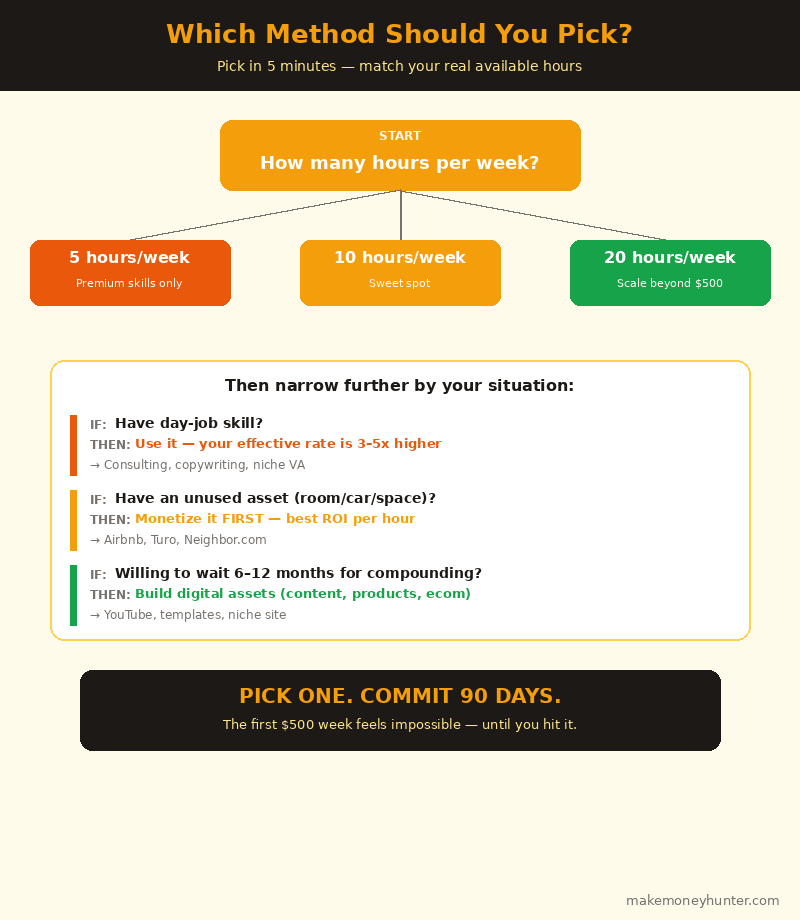
How to Pick Your Method in 5 Minutes
Use this quick decision framework:
- How many hours can you actually commit weekly? Not how many you wish you had. The number you’d commit even on a bad week.
- Do you have a marketable skill from your day job? If yes, use it — your effective hourly rate will be 3–5x higher than any volume hustle.
- Do you have an underused asset (room, car, parking, garage)? Monetize it first. The hourly ROI beats almost anything else.
- Are you willing to wait 6–12 months for compound income? If yes, content creation, digital products, or e-commerce. If no, services or freelancing.
Most readers should pick from the 10-hour tier. It’s where the realistic math, reasonable timeline, and decent hourly rate all overlap.
What I’d Do If I Was Starting Over Today
If I had to hit $500 a week with no audience, no portfolio, and a regular 9-to-5, here’s the exact path I’d take:
Weeks 1–2: Pick one specialized service based on my day-job skills. Build a basic portfolio (3 sample pieces). Set rates 20% below market to land first clients fast.
Weeks 3–6: Land 2–3 clients via LinkedIn outreach and one job board. Deliver above expectations to get testimonials. Charge market rate for client #4 onward.
Weeks 7–12: Raise rates 20% every 3 clients until I hit $500/week from 8–10 hours. Now I have margin and reputation.
Months 4–6: Use the $500/week as fuel — invest 5 hours weekly into a longer-term asset (digital products, content, niche site). Keep services as my income floor.
That’s it. No course required, no big plan, no quitting the day job. The compound effect is in the consistency, not the strategy.
FAQ
Is making $500 a week with a side hustle actually realistic?
Yes, for most people willing to commit 10+ hours weekly to a method that matches their skills. The methods that hit $500/week are well-established — freelance writing, tutoring, bookkeeping, local services, virtual assistance — and thousands of people earn at this level consistently. What’s not realistic is hitting $500/week passively, instantly, or with 1–2 hours of weekly effort.
How long does it take to make $500 a week from scratch?
For skill-based services (writing, tutoring, bookkeeping, consulting), most people hit $500/week within 4–12 weeks if they commit consistent time. For asset-based methods (content, e-commerce, digital products), expect 6–18 months. The timeline depends more on consistency than talent.
What’s the easiest side hustle to make $500 a week?
“Easiest” depends on what’s hard for you. If you have a corporate skill, specialized consulting is easiest (highest hourly rate, lowest hours required). If you have an underused asset, renting it is easiest (lowest hours, no skill required). If you have neither, online tutoring tends to be the fastest path because demand is high and barrier to entry is low.
Can I make $500 a week without any startup money?
Yes. Service-based side hustles (writing, tutoring, VA work, consulting, bookkeeping, local services) require near-zero startup capital — you need a laptop, internet, and a free profile on a platform like LinkedIn, Upwork, or Wyzant. You’ll only need to invest money once you’re scaling beyond services into product-based income.
Is it possible to make $500 in just one hour?
One hour total, no. But $500 from one hour of actual client-facing work per week is possible with premium consulting once you’ve built reputation — many fractional consultants earn $300–$500 per single-hour call. You’d still need to put 3–5 hours weekly into business development behind the scenes. If you’re trying to earn quickly with minimal time, my guide on making money in one hour online covers faster but smaller-dollar options.
What’s the best side hustle for someone with a full-time job?
The methods that fit a 9-to-5 schedule best are the ones that can be done in evenings or weekends without client coordination headaches — freelance writing on retainer, digital templates, weekend tutoring blocks, weekend local services, and asset rental. Methods that require client calls during business hours (most consulting, some VA work) are harder unless you can take occasional calls during your lunch break.
Final Thoughts
The honest truth about hitting $500 a week is that almost nobody fails because the methods don’t work. They fail because they mismatch their hours to the method, or they switch methods every month, or they expect passive income from week one.
Pick one method from the tier that matches your real available hours. Commit to 90 days. Stack one client, then two, then three. The first $500 week feels impossible until you hit it; the second one feels routine.
Don’t try to do all 12 methods. Pick one — the one that matches your current skills and hours — and spend the next 7 days going all in. That’s how every successful side hustle starts.