

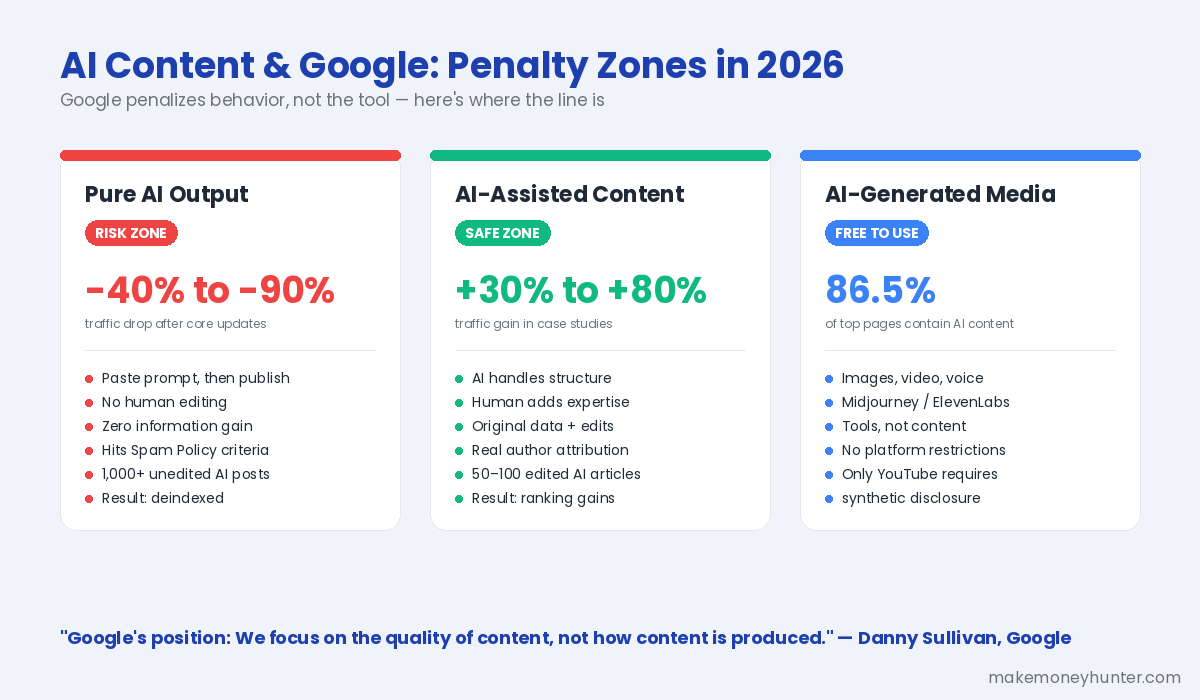
Most people think Google penalizes AI content. The data says otherwise. An Ahrefs study of 600,000 top-ranking pages found that 86.5% contain some AI-generated content, and the correlation between AI content percentage and ranking position was statistically negligible. Yet sites pushing out 1,000 unedited AI articles still see traffic drops of 40-90%. So which is it?
Here’s the thing — both are true. Google doesn’t penalize AI content. Google penalizes low-quality content at scale. The fact that most AI content happens to be low-quality is what creates the confusion. And that’s actually good news for anyone willing to do the work, because the bar to win is lower than it looks.
I’ve spent the last year testing AI content workflows on my own sites and watching what works for the affiliate marketers I follow. This guide breaks down exactly how to make money with AI-generated content in 2026 without getting penalized — what works, what gets sites deindexed, and the workflow I now use every week.
What “Make Money with AI-Generated Content” Actually Means in 2026
Let me clear up some terminology first, because the confusion here is where most people lose money before they even start.
“AI-generated content” is a broad term. Right now it covers four distinct things:
- Pure AI output — paste a prompt into ChatGPT, hit publish. This is the version that fails.
- AI-assisted content — AI handles the first draft and structure, but a human adds expertise, edits, and original data.
- AI-generated media — images, videos, voiceovers, music made with tools like Midjourney, ElevenLabs, or Synthesia.
- AI-powered products — templates, prompt packs, custom GPTs sold as digital products.
The money comes from category 2, 3, and 4. Category 1 — the one most beginners chase — is exactly what Google’s Spam Policies and YouTube’s reused content rules target. If you’ve already explored the broader topic of how to make money with AI or specifically how to make money with ChatGPT, this guide focuses on the content angle of those broader plays.
Here’s the core principle: AI is the production tool, not the product. The product is value to a specific audience. Once you internalize that, the methods below stop feeling like loopholes and start feeling like legitimate businesses.
How Does Google Actually Treat AI Content? (The Policy Behind the Rules)
Google’s official position has been consistent since 2023. From their Search Central guidance on AI-generated content: “Using automation — including AI — to generate content with the primary purpose of manipulating ranking in search results violates our spam policies. But not all use of automation, including AI generation, is spam.”
Translation: Google doesn’t care who or what writes the content. They care if it helps people. The March 2026 core update reinforced this with three specific penalty categories:
- Scaled content abuse — mass-producing low-value pages, AI or human, to game rankings.
- Site reputation abuse — third-party AI content slipped onto authoritative domains.
- Expired domain abuse — buying old domains and stuffing them with AI content to inherit authority.
Notice the pattern. The penalty targets the behavior, not the tool. A solo creator using ChatGPT to draft 10 carefully edited articles a month is doing something completely different from a site pumping out 500 unedited posts a week. Google’s algorithms — especially SpamBrain — are good at telling the difference.
The other thing worth knowing: Google’s March 2026 update re-weighted “information gain” as a ranking signal. Information gain measures how much new knowledge your content adds compared to existing ranking content. Pure AI output, by definition, has near-zero information gain — it recombines what already exists.
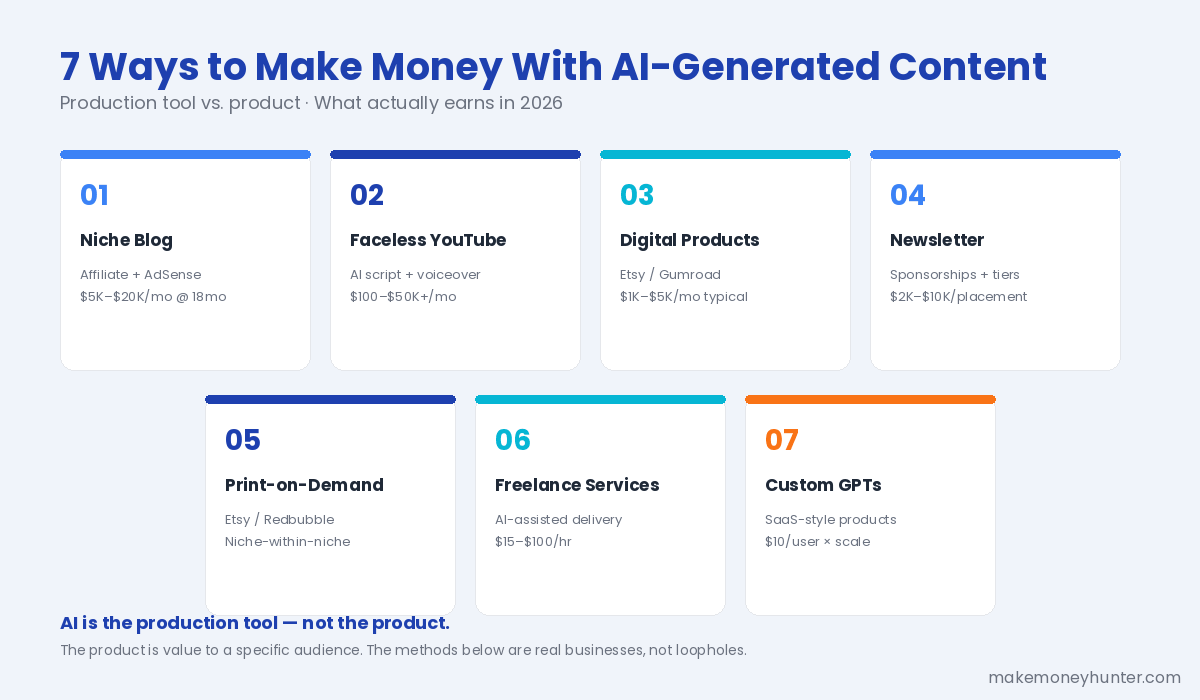
7 Proven Ways to Make Money with AI-Generated Content
Below are the seven methods I’ve either tested personally or watched generate consistent income for people I trust. I’ve ranked them roughly by how fast you can start earning versus how much they scale long-term.
1. AI-Assisted Niche Blog with Affiliate + AdSense Revenue
This is the model I’m most familiar with because it’s what running an affiliate blog from scratch taught me. The workflow is straightforward: pick a niche you actually know something about, research keywords with real search volume (200+ monthly), let AI draft the structure and first version, then you add the expertise, screenshots, original analysis, and edits.
Take a look at what a successful niche affiliate blog looks like in practice. WPBeginner’s podcast hosting comparison article is a textbook example — clear buyer-intent keyword targeting, structured comparison tables, real affiliate links to multiple products:
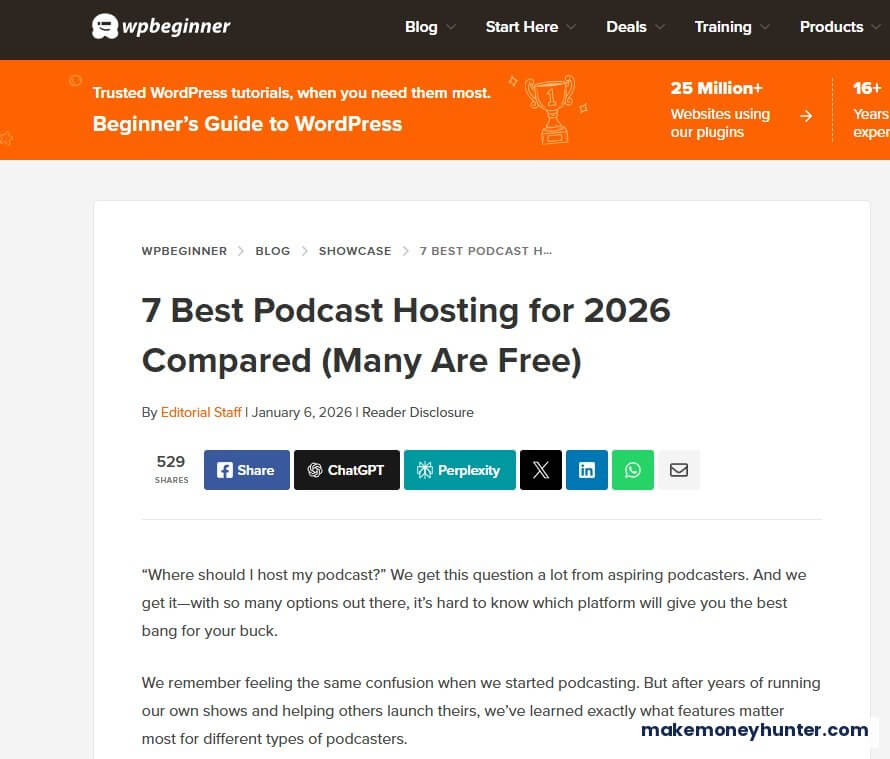
Notice the structure: question-style title with the year, breadcrumb navigation showing topical authority, byline with author attribution, and a hook that addresses the reader directly. That’s the template that works. AI can draft a structure like this in minutes — your job is filling it with original analysis, real testing data, and the editorial polish AI can’t fake.
The other crucial element is the “quick picks” table near the top, which gives readers a fast comparison before they dig into the long form:
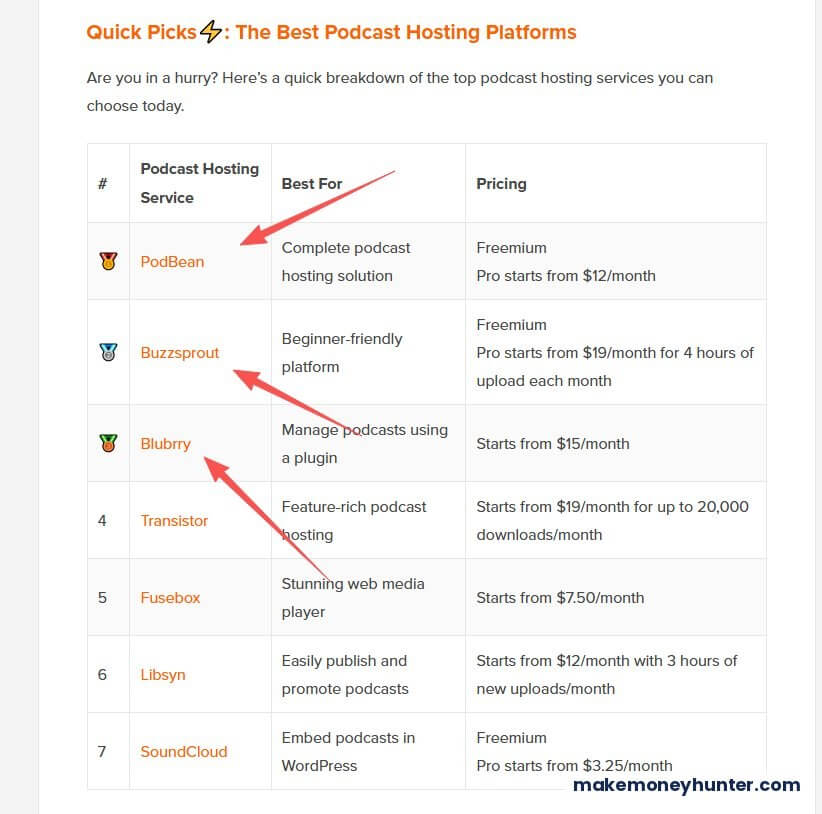
This format converts. Why? Because most readers don’t read 4,000-word articles top to bottom — they scan. The table gives them what they need in 30 seconds, with affiliate links right there. AI can structure a table like this, but the editorial judgment about which products to rank in which order — that’s yours.
The math: a single article ranking on page one of Google for a buyer-intent keyword (think “best web hosting for podcasts”) can pull in $200-$800 per month indefinitely. Stack 30-50 of these and you’re at $5,000-$20,000/month within 18-24 months.
The trap most beginners fall into is publishing 200 pure AI articles in month one and waiting for the traffic. It doesn’t come. Sites publishing 50-100 AI-assisted articles with proper human editing saw traffic gains of 30-80%. Sites publishing 1,000+ unedited AI articles dropped 40-90%. The difference isn’t volume — it’s editorial discipline.
2. Faceless YouTube Channels (AI Video + Voiceover)
YouTube’s July 2025 monetization policy update tightened the rules on AI content, but it didn’t ban it. What got banned: “repetitious” or “reused” content with no transformation. What still works: original scripts, AI voiceover, AI-generated visuals or stock footage, all assembled into something with a clear point of view. If you want the deeper breakdown of channel-level monetization, the full guide on how to make money on YouTube covers the AdSense, sponsorship, and affiliate stack that combines on top of the content production layer I’m about to walk through here.
The clearest proof this still works in 2026 is a channel like The Analyst. Look at the thumbnails — hand-drawn, cartoonish, instantly recognizable visual style:
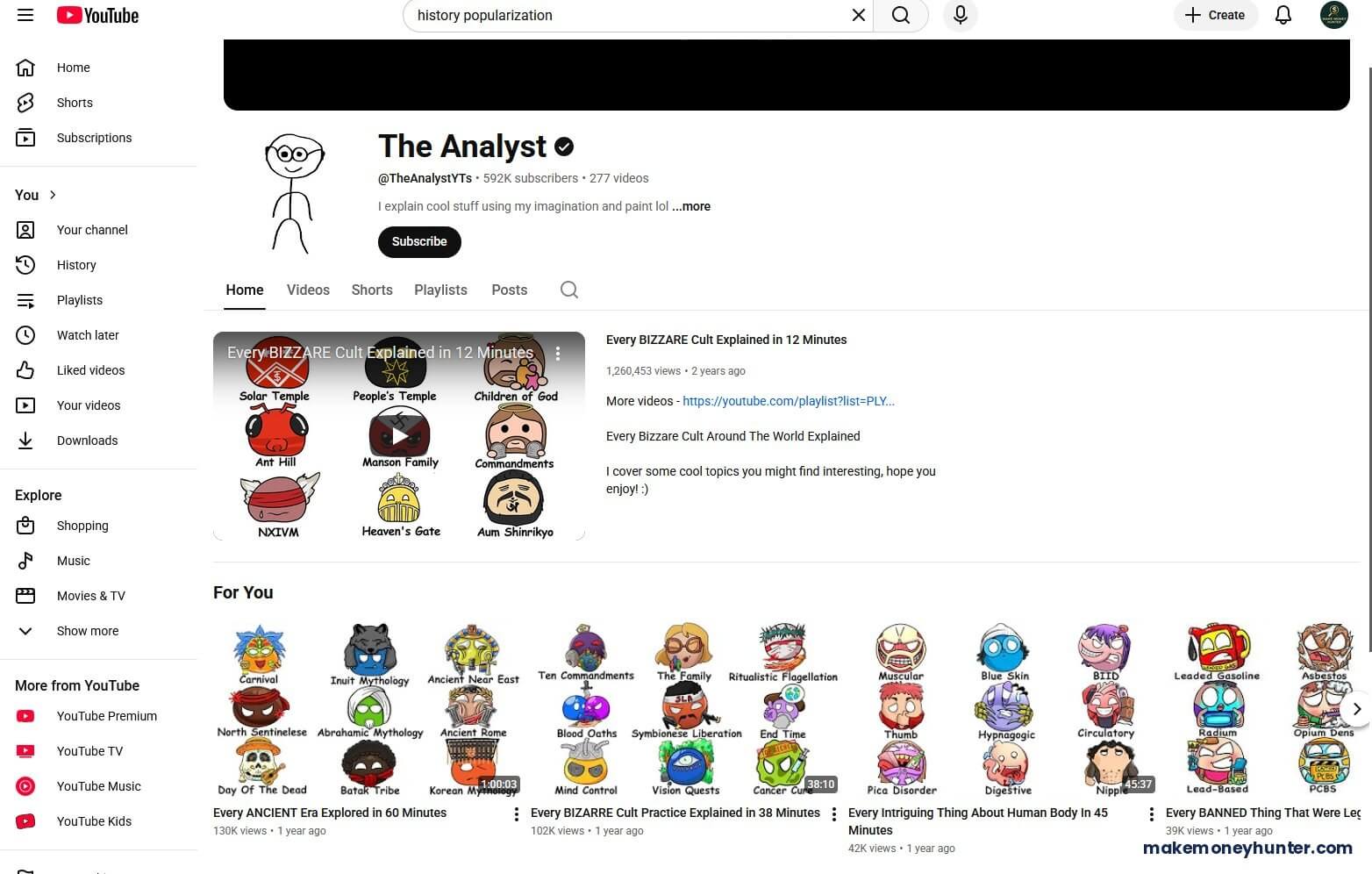
No talking head. No camera. Just illustrations, AI-assisted scripts on dark/weird/cult history topics, and a consistent visual identity that signals “this is The Analyst” within half a second of any thumbnail appearing in your feed. That’s the model: pick a niche, build a distinctive visual brand, produce consistently.
Now look at the actual channel stats:
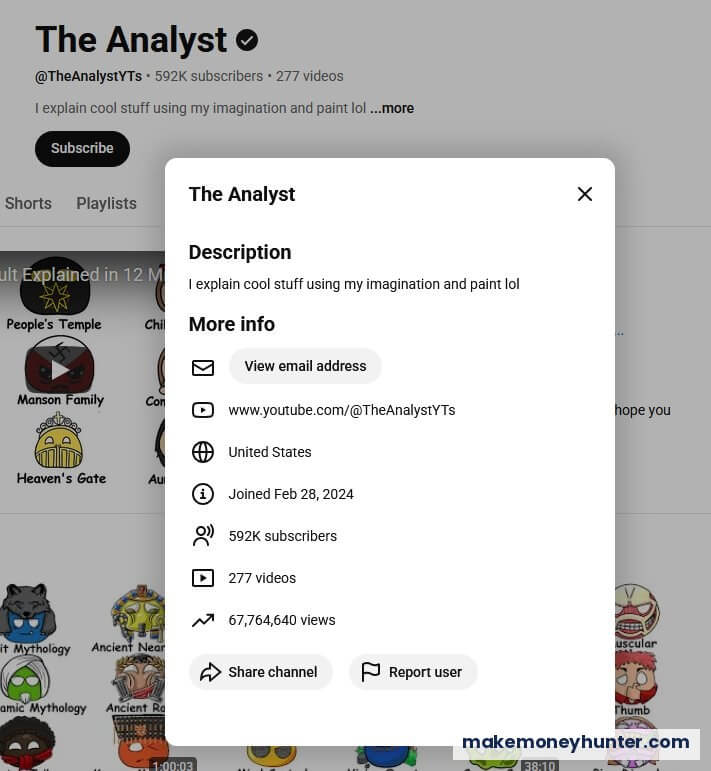
592,000 subscribers. 277 videos. 67,764,640 lifetime views. Channel joined February 28, 2024 — meaning the entire run happened in about two years. At a conservative $2-$5 RPM for this kind of educational content, that’s roughly $135,000 to $340,000 in lifetime AdSense alone, before any sponsorships or affiliate income. The niches that work in 2026: history explainers, finance education, motivation, weird-science deep dives. The earnings range is huge — anywhere from $100/month to $50,000+/month depending on niche and CPM.
The honest version: the bar has risen. Three years ago you could screen-record a Reddit thread, slap on AI narration, and earn. Now you need genuine scripting effort and a visual identity people recognize. The good news? Most people don’t, which leaves the field open for anyone who does.
3. AI-Generated Digital Products (Templates, Planners, Prompt Packs)
If you’ve spent any time on Etsy in the last year, you’ve seen this category explode. Creators are selling AI-designed printables, planners, journals, wall art, prompt packs, and Notion templates — often for $5-$30 a pop. One creator I follow earns roughly $2,900 per month selling AI-generated wall art on Etsy. Nothing flashy, just consistent listings and good SEO.
Search “notion template” on Etsy right now and you’ll see what an active marketplace this is:
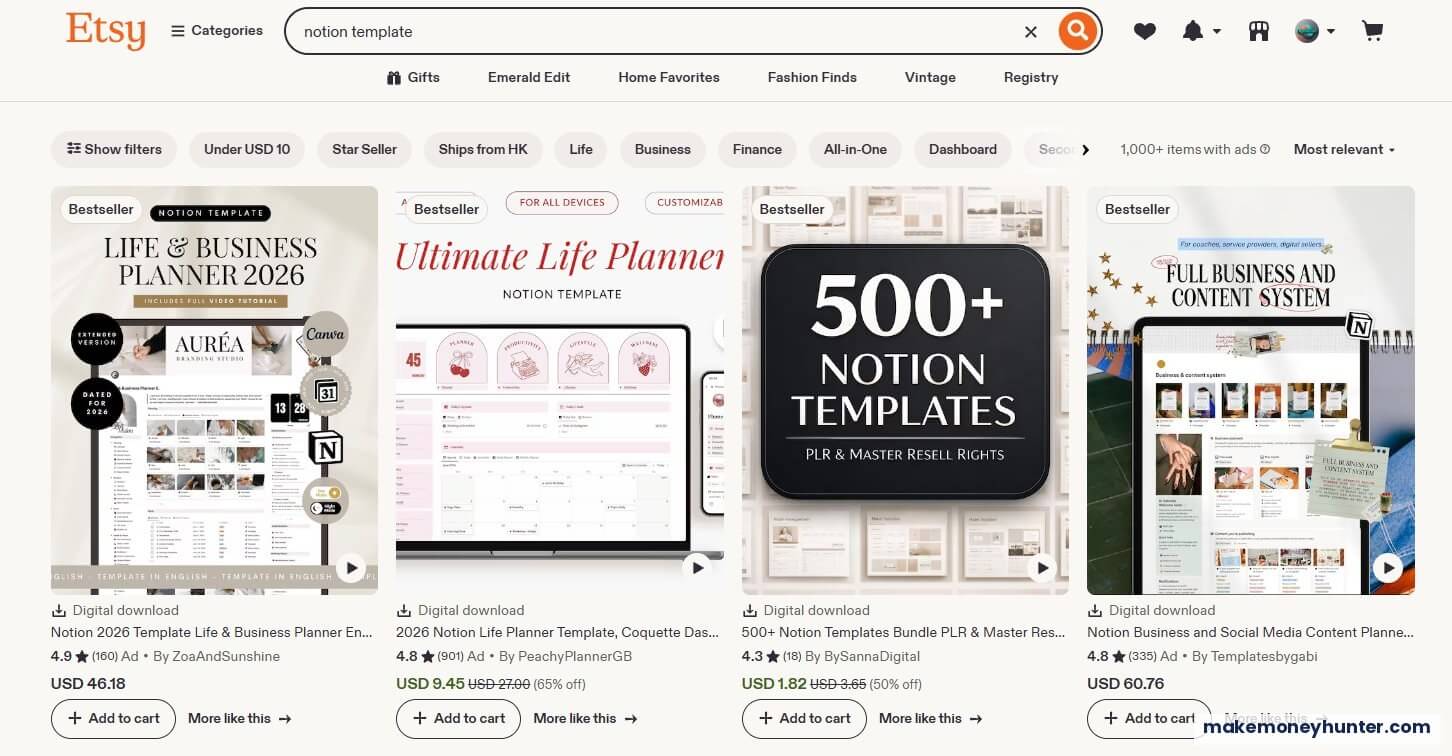
Four bestsellers on the first row alone, prices ranging from $1.82 to $60.76, all digital downloads (zero fulfillment cost), and the ratings — 4.3 to 4.9 stars — tell you these are real, satisfied customers. The “500+ Notion Templates Bundle PLR” listing on the right at $1.82 is a volume play. The “Notion Business and Social Media Content Planner” at $60.76 is a premium niche play. Both work. Pick a strategy and execute.
The workflow: use Midjourney or DALL-E 3 for visuals, Canva for layout, Etsy or Gumroad for distribution. The investment is mostly time. The leverage comes from the fact that you make each product once and sell it forever.
What kills most attempts in this category isn’t AI quality — it’s the assumption that “more listings = more sales.” Etsy’s algorithm punishes thin variations and duplicates. Twenty well-positioned listings beat 500 lazy ones, every time.
4. AI-Powered Newsletters (Substack, Beehiiv, Kit)
Newsletters became the most underrated AI play in 2024-2025. Ben’s Bites famously went from zero to 100,000+ subscribers in under six months by curating AI news with a personality-driven voice — then attracted sponsors paying $2,000-$10,000 per placement.
How AI fits: it’s the research and first-draft engine. You feed it news, source articles, and links. It produces a structured summary. Then you add commentary, hot takes, and the “why this matters to you” angle that no AI can replicate.
The variables you control: niche choice (AI tools, finance, health, parenting all work), sending frequency, and whether you monetize via sponsorships, paid tiers, or affiliate links. Most newsletters that hit $5K+/month do all three.
5. Print-on-Demand with AI-Generated Designs
This one’s saturated, but the saturation is at the bottom of the market. Print-on-demand stores with random AI-generated quotes on t-shirts compete with millions of others — and lose. Stores that target a specific fandom, hobby, or sub-culture and pair AI design with deep audience knowledge still do well.
Here’s what the active POD marketplace looks like on Redbubble for an oddly specific niche query — “vintage kittens wearing bows stickers”:
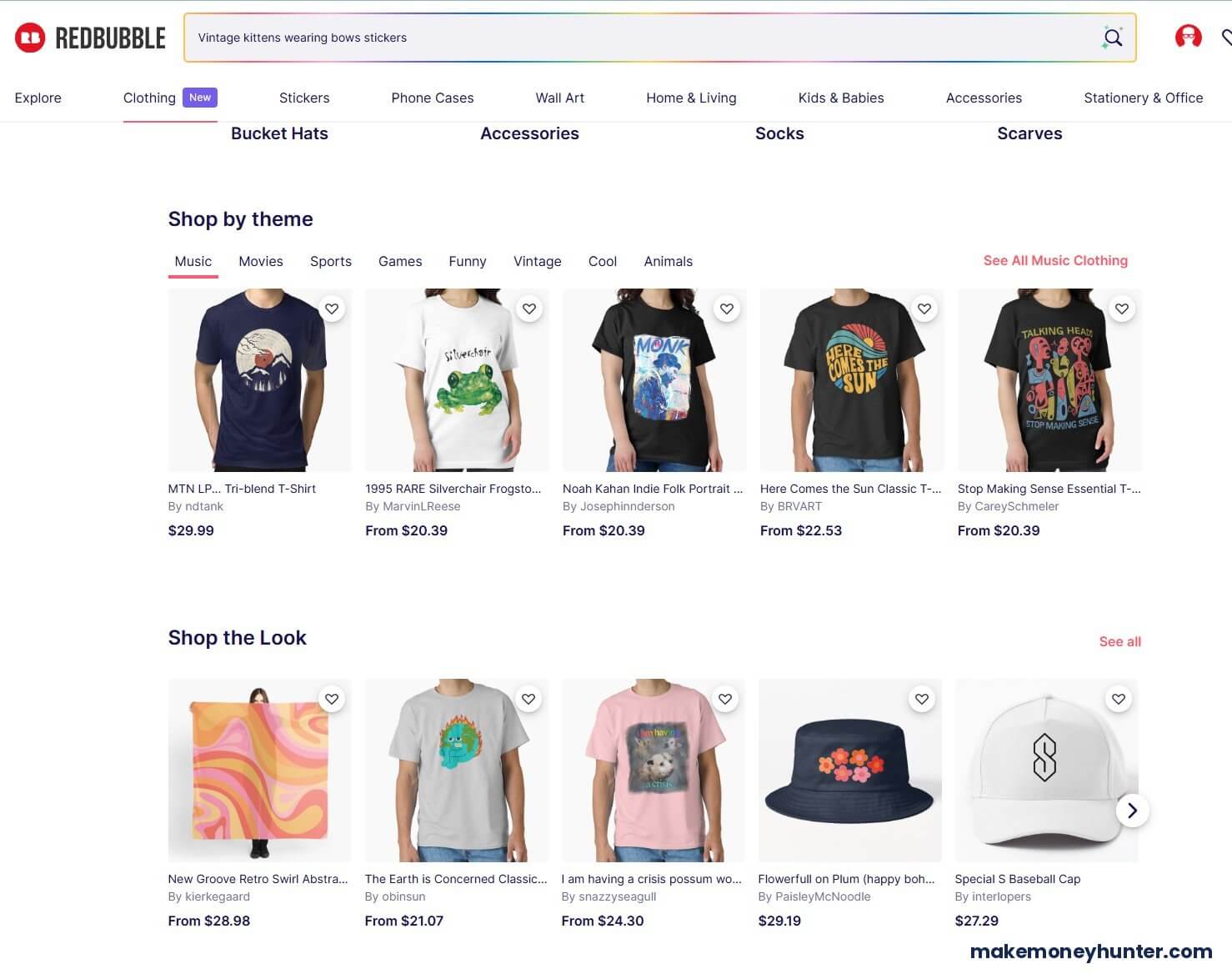
Look at the product diversity: music-themed t-shirts at $20.39-$29.99, bucket hats with floral designs at $29.19, abstract retro swirl scarves at $28.98. Each is a niche within a niche — Noah Kahan indie folk portrait, “I am having a crisis possum” meme tee, vintage Silverchair frog graphics. These aren’t trying to be everything to everyone. They’re hyper-specific designs for hyper-specific audiences. That’s the model that works.
The real money in POD is on platforms like Etsy, Redbubble, and Printful where you can leverage SEO and audience targeting. I know a creator selling cat-themed coffee mugs designed in Midjourney who pulls about $3,500/month — not because the designs are revolutionary, but because she actually understands what cat people want on a mug.
6. Freelance AI-Assisted Services (Copywriting, Design, SEO)
Upwork reported AI-related freelance demand climbing 109% in 2025, with AI video generation jobs jumping 329%. Businesses don’t want to learn AI tools themselves. They want results. That’s where you come in.
The pitch isn’t “I use AI” — that’s a turnoff. The pitch is “I deliver X result faster than the alternative.” Rates I’ve seen consistently: $15-$45 per hour for AI-assisted copywriting, $25-$75 per hour for AI design work, and $40-$100+ per hour for SEO content production. Specialized niches (legal, medical adjacent, B2B SaaS) pay even more.
The skill that actually matters is editing — knowing where AI gets things wrong, what’s worth keeping, and what needs to be rewritten by hand. That’s the human moat.
7. Custom GPTs and AI Tools as Products
The most advanced and most scalable play. You build a custom GPT, fine-tuned for a specific use case (résumé writing, legal contract review, SEO audits, recipe planning), and either charge for access, sell it as a subscription, or use it as a lead magnet for a higher-ticket service.
This requires more technical comfort than the others, but the ceiling is higher. Jasper.ai projected $250 million in revenue for 2023 doing essentially this — packaging GPT capabilities into a domain-specific product. You don’t need to be Jasper; a custom GPT serving a niche of 5,000 paying users at $10/month is $50K/month. For more on the broader space of AI side hustles that actually pay, this category sits at the high end of effort/reward.
James’s AI Content Workflow (The One I Actually Use)
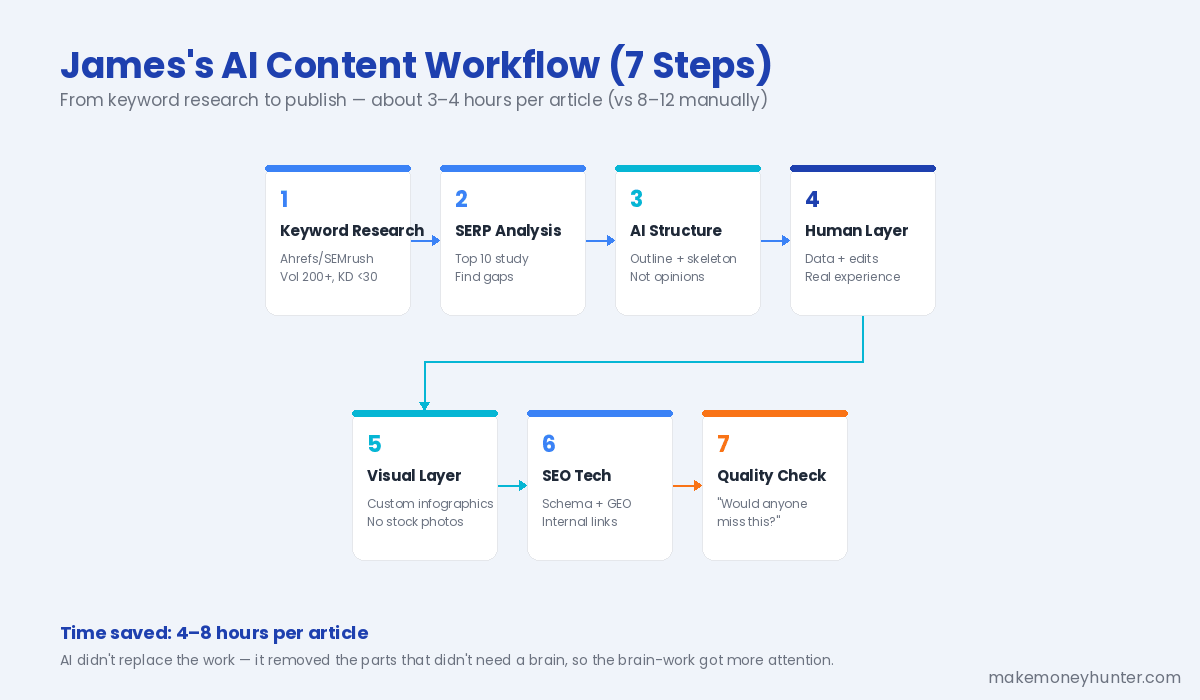
Here’s how I personally produce AI-assisted content that ranks. I’m not pretending this is the only way — it’s just what works for me after about a year of trial-and-error.
Step 1: Keyword research first, always. I use SEMrush or Ahrefs to find keywords with 200-1,000 monthly searches and KD under 30. The Keyword Magic Tool filter view looks something like this when I’m hunting:
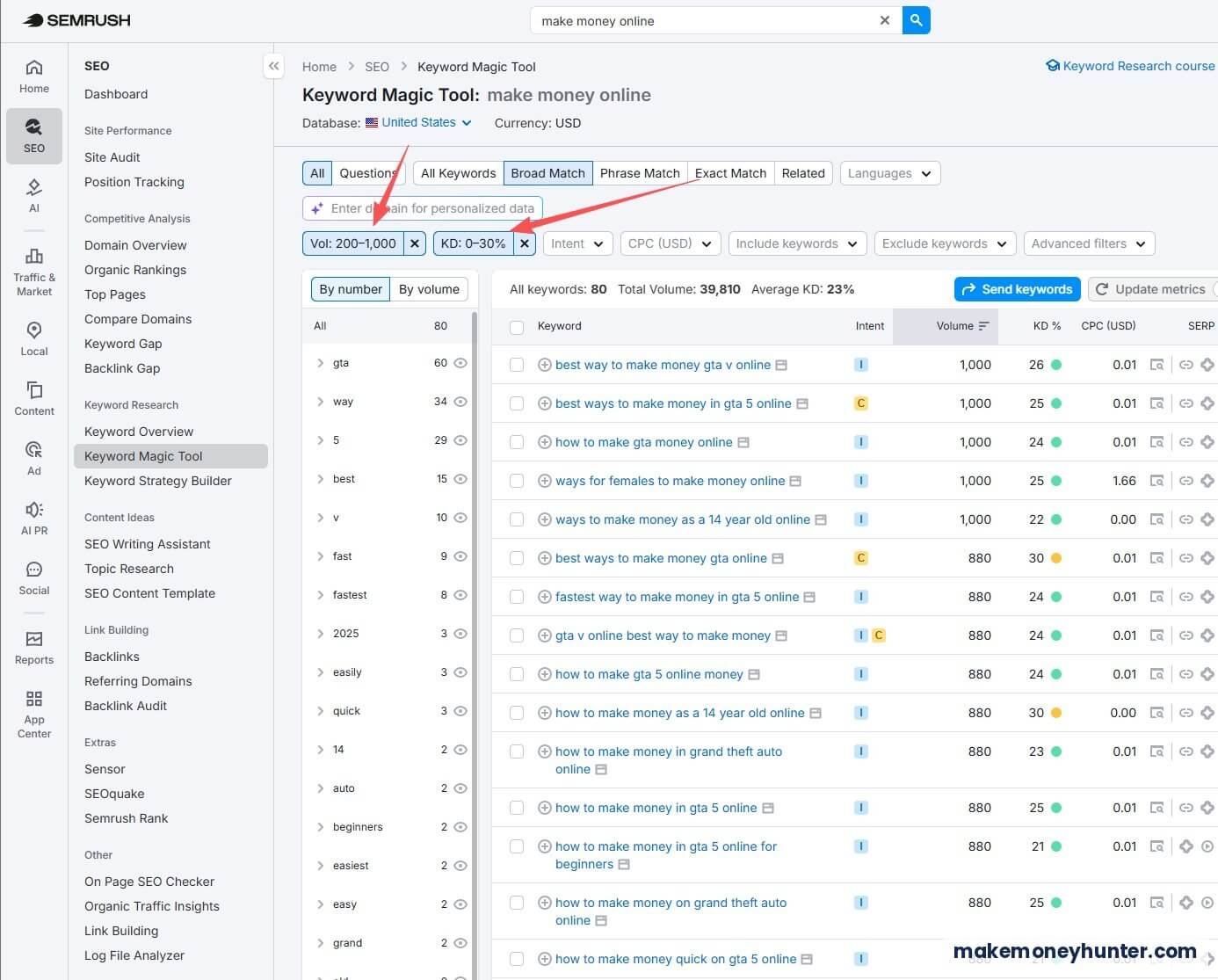
Notice the filter setup: Volume 200-1,000, KD 0-30%. That’s the sweet spot for newer sites — enough traffic to be worth writing, low enough difficulty that you can actually rank. The tool returned 80 keywords with a total monthly volume of 39,810 and an average KD of just 23%. AI doesn’t research keywords for me — that’s a human judgment call. But the data here is what tells me whether a topic is worth a week of work or not. The same logic applies to choosing a blog niche — the keyword data tells you whether the niche has real search demand or just feels good.
Step 2: SERP analysis before drafting. I read the top 10 results for the keyword, note the average word count, and identify the information gap — what nobody is talking about that I can. This step takes 30 minutes and saves entire articles from being written.
Step 3: AI generates structure, not opinions. I prompt Claude or ChatGPT with the keyword, the SERP analysis, and a request for an H2/H3 outline plus a first-draft skeleton. The AI is doing the structural heavy-lifting. It is not deciding what’s true.
Step 4: Human layer (the actual work). I add original data, personal experience, specific dollar amounts from real projects, fact-check every claim, and rewrite the AI’s generic transitions (“dives into,” “in this article,” “comprehensive guide”) because they kill dwell time.
Step 5: Visual layer. I create infographics, comparison charts, and process diagrams — not stock photos. Stock photos add zero value. Custom visuals are an information gain signal Google’s algorithms now reward.
Step 6: Schema, internal linking, GEO optimization. Article Schema, BreadcrumbList, Author markup. Internal links to 3-5 related articles. The full on-page SEO checklist for bloggers covers each technical element in detail. The first 200 words directly answer the search query because 44.2% of AI Overview citations come from the first 30% of a page.
Step 7: Quality check. If I removed this article from the internet tomorrow, would anyone miss it? If the answer’s no, I rewrite. That’s the information gain test, and it’s the most important check I do.
The whole process takes me roughly 3-4 hours per article instead of the 8-12 it used to. AI didn’t replace my work — it removed the parts that didn’t need a brain so I could spend more time on the parts that do.
Common Mistakes That Get AI Content Penalized
If you only remember one section, make it this one. These are the patterns I see kill sites and channels over and over.
- Publishing volume over editing. 1,000 unedited AI posts is a deindex risk. 50 well-edited posts is a real business. The math isn’t subtle.
- Generic AI tells. Phrases like “dives into,” “in today’s fast-paced world,” “let’s explore,” and “comprehensive guide” scream low-effort. Readers bounce. Bounce rate is a quality signal. Edit them out.
- YMYL niches without expertise. Health, finance, legal — AI-only content in these areas is the fastest way to a quality update penalty. Either bring real credentials or pick a different niche.
- Hallucinated stats and fake quotes. AI invents numbers and sources confidently. If you don’t fact-check, your readers will, and they’ll never come back.
- Faceless content with no author. Google’s March 2026 update specifically flagged content without verifiable author attribution. An “About Me” page with a real name and credentials isn’t optional anymore.
- Copying the SERP. If your article says exactly what positions 1-10 already say, the algorithm has no reason to add you to that list.
FAQ
Can you really make money with AI-generated content in 2026?
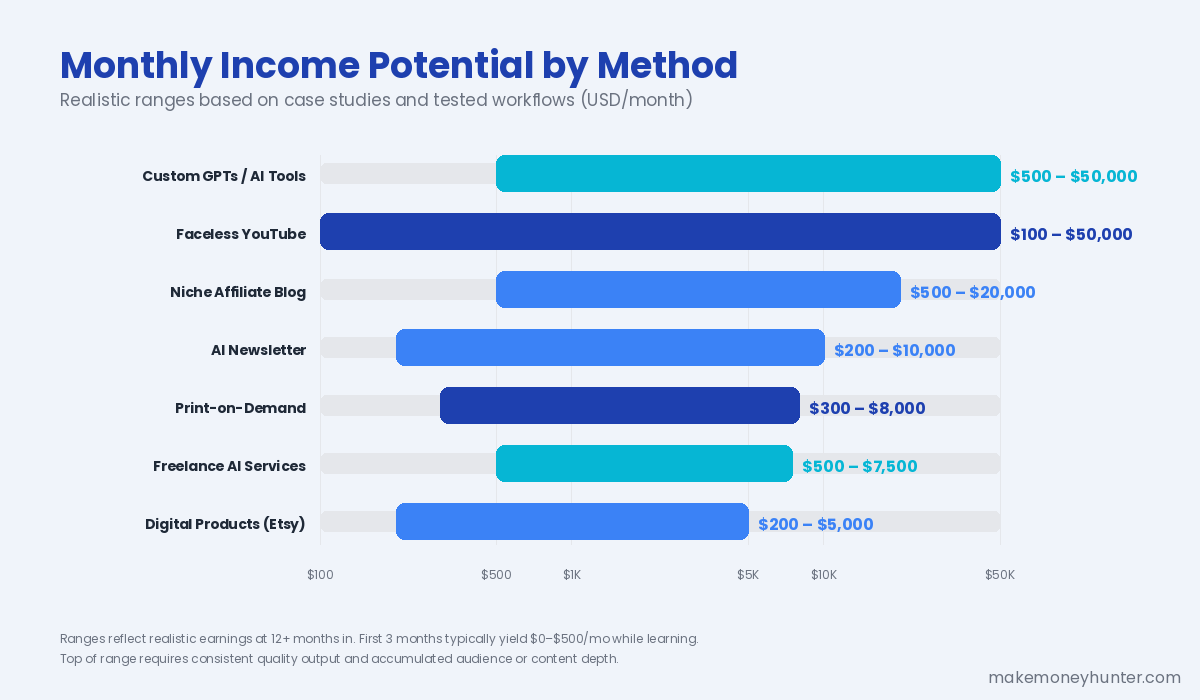
Yes — but the path has narrowed. Pure AI output gets filtered out fast. AI-assisted content with genuine editing, original data, and real expertise can absolutely earn $1,000 to $50,000+/month depending on the method and niche. The methods that work are blogging, faceless YouTube, digital products, newsletters, print-on-demand, freelance services, and custom GPT products.
Does Google ban AI content?
No. Google has stated repeatedly — most recently in their March 2026 spam policy update — that they evaluate content quality, not production method. What gets banned is scaled content abuse, site reputation abuse, and expired domain abuse, regardless of whether AI or humans created the content.
How much money can a beginner realistically make with AI content?
Honest answer: $0-$500/month in the first three months while you learn the craft. $500-$3,000/month by month 6-12 if you stay consistent and focus on quality. The people earning $10K+/month with AI content have been at it 18-36 months and treat it like a real business, not a side experiment.
Do I need to disclose that I used AI to write content?
Google doesn’t require disclosure. YouTube requires disclosure only for “realistic” synthetic content (deepfakes, AI-generated people, AI voice clones of real humans). Some platforms like Medium have their own AI disclosure rules. When in doubt, check the platform’s terms.
What’s the single biggest mistake to avoid?
Publishing AI content without adding information gain. If your article doesn’t tell readers something they couldn’t already find in the top 10 search results, it doesn’t matter how well-written it is — it won’t rank, and it won’t earn.
Final Thoughts
One last thing — ignore anyone who tells you AI content is “passive income.” It’s not. It’s front-loaded income. You do real work upfront — keyword research, editing, original analysis, audience building — and the AI gives you leverage so that work pays off bigger and longer than it would alone. That’s a much better deal than passive income anyway, because passive income is mostly a myth, and front-loaded income is just how every real business actually works.
Pick one method from the list above — the one that matches your current skills and audience — and spend the next 30 days going all in. Don’t try to do all seven. Don’t switch methods every week. The AI content space rewards depth, not breadth, and the people who earn are the ones who pick a lane and stay in it.