

Over the past four years, I’ve launched 23 different digital products. Some hit $4,000 in their first month. Others sold three copies in a year before I quietly took them down. The gap between the winners and the dead listings had almost nothing to do with the quality of the product — and almost everything to do with picking the right type of digital products to sell online in the first place.
This guide is a ranked list of the 20 most profitable digital products you can realistically build and sell in 2026. For each one, I’ve included four numbers that almost no other guide bothers with: how long it takes to create, what people actually charge for it, the realistic monthly income range, and the best platform to sell it on. Numbers come from my own products, real seller dashboards I have access to, and current pricing data across Gumroad, Etsy, and the major course platforms.
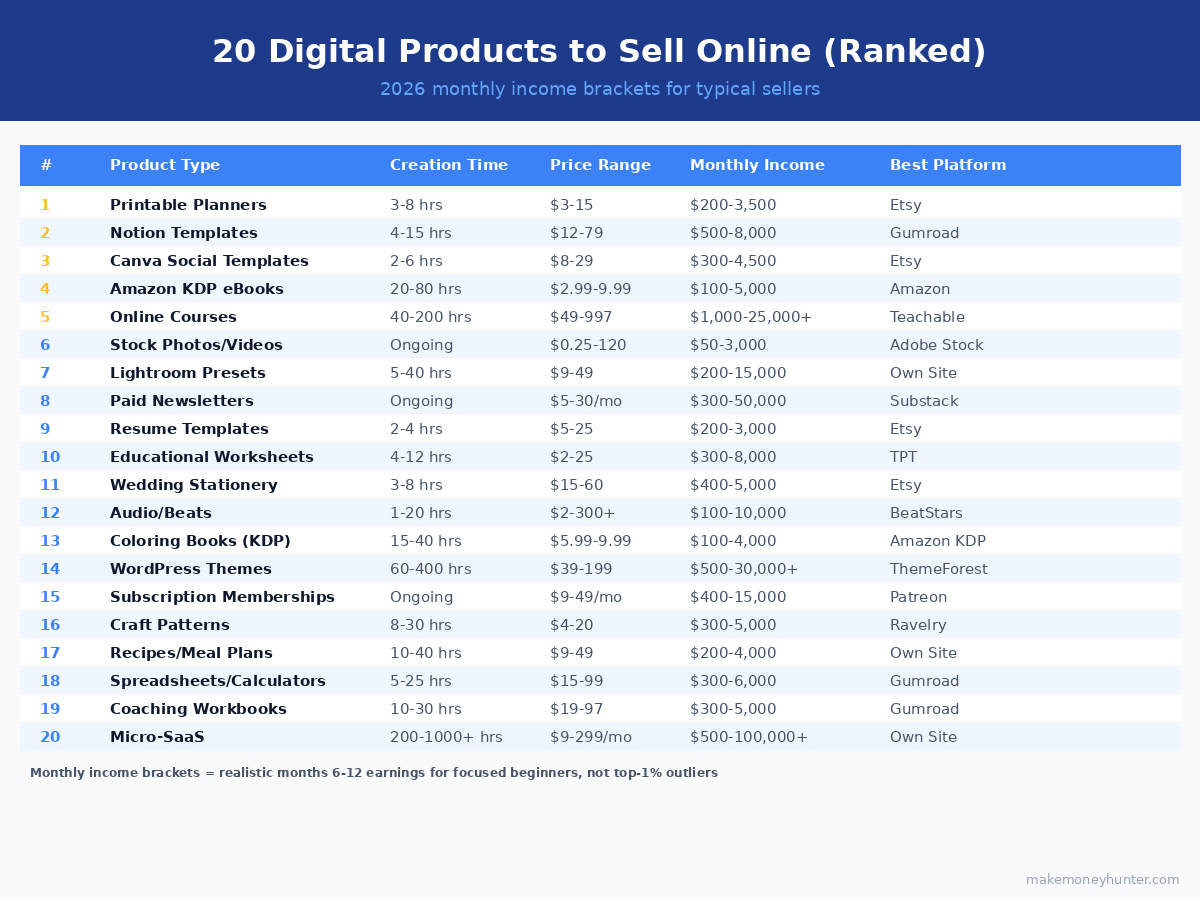
If you want the short version: templates, printables, and Notion-style systems are where most beginners should start in 2026 — low effort to create, fast feedback loop, and the buying audience is huge. The bigger paydays sit further down the list (online courses, software, paid newsletters), but they’re slower to build and the failure rate is higher. I’ll walk you through all 20 so you can pick the one that matches where you are right now.
Why Digital Products Are Still One of the Best Online Businesses in 2026
Before the list, the math. A digital product is anything you create once and sell forever — no inventory, no shipping, no returns to process. Cost of goods sold rounds to zero. Margins after platform fees run somewhere between 70% and 95%, depending on where you sell.
Three things shifted in 2024–2025 that make this even better now:
- Creation time collapsed. AI tools cut design and copywriting time by roughly 60–80% for the products on this list. A Notion template that used to take me three weekends now takes one afternoon. I covered the broader angle in my guide on AI side hustles that actually pay.
- The buying audience grew. Etsy’s digital downloads category passed 80 million active buyers. Gumroad’s creator payouts crossed $1 billion cumulative in 2024.
- Discovery is more diversified. Pinterest, TikTok, and Medium now drive real digital product sales — you’re no longer dependent on Google SEO alone to be found.
The catch most people miss: digital products are not passive income, especially in the first 12 months. They’re leveraged income. You’re trading upfront effort for the ability to sell the same thing 1,000 times. If you want a broader look at how this fits into other income models, check out my breakdown of realistic passive income online methods.
How I Ranked These 20 Digital Products
Every product on this list was scored on four dimensions:
- Creation time: Hours required for a beginner with no prior experience to ship a sellable version.
- Price range: What real sellers charge today, based on current Etsy, Gumroad, and Teachable listings I checked in April 2026.
- Monthly income potential: Realistic earnings in months 6–12, assuming consistent marketing. Not the top 1% outlier numbers.
- Best platform: Where this specific product type actually sells, not where the platform tells you it sells.
I’ve put the easiest, fastest-to-launch products at the top, then worked toward higher-revenue products that take more time and skill. Pick based on where you are, not based on which one sounds the most exciting.
1. Printable Planners and Worksheets
Creation time: 3–8 hours per product
Price range: $3–$15
Monthly income potential: $200–$3,500
Best platform: Etsy
Printables are the entry drug of digital products. A weekly planner page, a meal-prep worksheet, a budget tracker — anything customers can download, print at home, and use immediately. Etsy alone has thousands of sellers doing $1,000–$5,000/month on printables under $10.
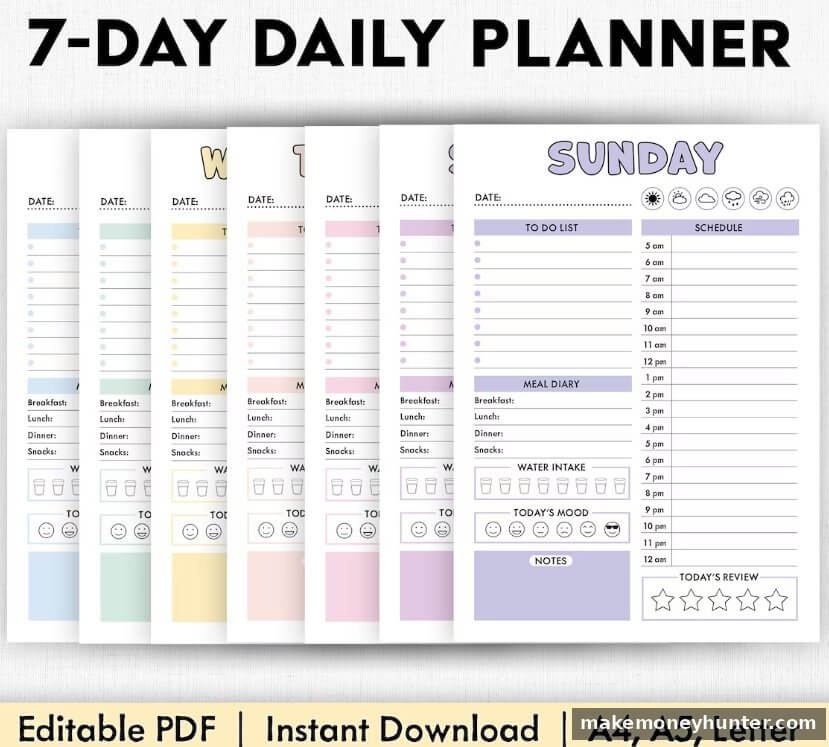
Look at the listing above. A 7-day daily planner bundle, sold as an editable PDF, multiple sizes (A4/A5/Letter). It looks simple — and that’s exactly the point. Sellers move thousands of units of these by getting two details right: aesthetic that matches a specific buyer mood (this one is soft pastel, aimed at the calm-productivity crowd), and clear utility (to-do list, schedule, meal diary, water intake, mood, notes — everything in one spread).
The trick isn’t the design. It’s the niche. “Daily planner” has 200,000 competing listings. “ADHD adult daily planner with hyperfocus tracker” has maybe 80, and it converts at 4–6%. Pick a specific person with a specific problem.
Tools: Canva covers 95% of what you need. Save your files as PDFs at 300 DPI. If you want a deeper walkthrough of building these specifically, see how to make money with Canva — I broke down 9 different monetization paths there with specific income data for each.
2. Notion Templates
Creation time: 4–15 hours
Price range: $12–$79
Monthly income potential: $500–$8,000
Best platform: Gumroad + your own site
Notion templates have been the breakout digital product category of the last two years. The audience is technical, willing to pay, and actively looking. A few solo Notion sellers I track are pulling $10K+/month with under 10 templates in their catalog.
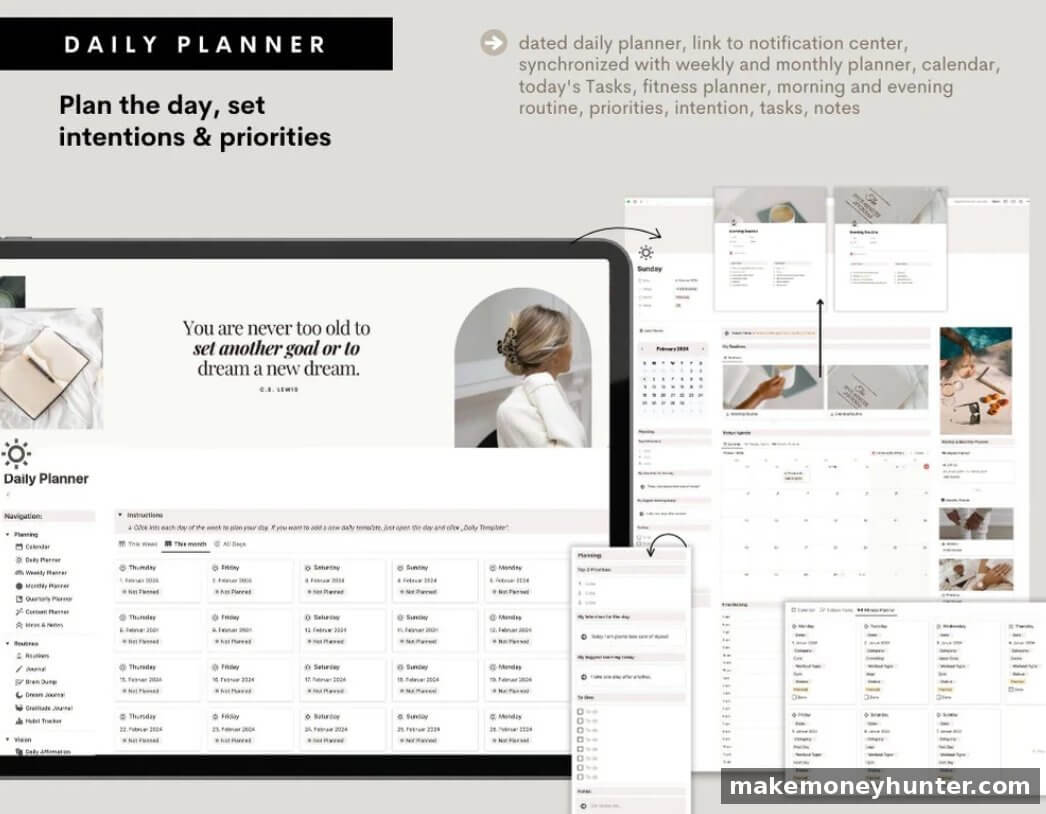
The Daily Planner template above is a textbook example of what sells on Notion: not a single page, but a complete linked system. Calendar synced with weekly and monthly planner. Today’s tasks pulling from a routines database. Morning and evening routines as their own modules. Brain dump, gratitude journal, habit tracker, dream journal — each one is a discrete database the buyer can use independently or together.
What works: complete systems, not single pages. A “Freelancer Operating System” with project tracking, invoicing, client CRM, and content calendar all linked together sells for $49–$79. A standalone task list sells for $9 and converts worse.
Gumroad is the dominant platform here because the audience already lives there. Listing on the Notion Marketplace as a secondary channel will add 10–20% to your sales for free. If you’re using AI to speed up the build, the workflow I described in how to make money with ChatGPT applies directly — ChatGPT is excellent at structuring database schemas and writing template instructions.
3. Canva Templates for Social Media
Creation time: 2–6 hours per pack
Price range: $8–$29
Monthly income potential: $300–$4,500
Best platform: Etsy + Creative Market
Instagram carousel templates, TikTok hook graphics, Pinterest pin packs. Small business owners, coaches, and content creators buy these in volume because making the graphics themselves takes too long.
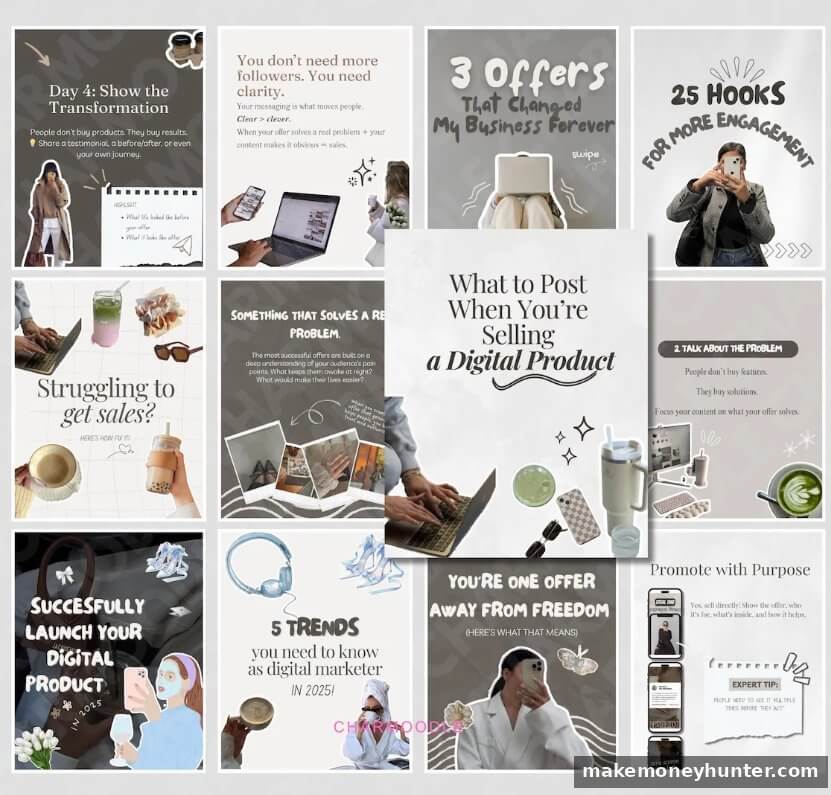
Notice the consistency in the pack above. Every slide uses the same earth-tone palette, the same font stack, the same hand-drawn accents. That visual consistency is what buyers pay for. They’re not buying individual graphics — they’re buying a complete on-brand content kit they can plug their own copy into and post for a week without re-thinking design.
The math is interesting: a 20-template Instagram pack at $19 needs to sell 16 copies a month to clear $300 after Etsy fees. Most “decent quality” packs in popular niches do that in their first month if the SEO listing is set up correctly.
The non-obvious win: bundle by industry, not by style. “30 Instagram Templates for Wedding Photographers” beats “30 Modern Instagram Templates” every time, because the buyer can see themselves in the title.
4. eBooks on Amazon KDP
Creation time: 20–80 hours
Price range: $2.99–$9.99
Monthly income potential: $100–$5,000 per title
Best platform: Amazon KDP (with Gumroad as a secondary)
Amazon Kindle Direct Publishing is still the largest single buyer audience for ebooks in the world. The royalty structure is 70% on books priced $2.99–$9.99, 35% outside that range. Most successful KDP authors price at $4.99 or $6.99.
Here’s the part most KDP guides won’t tell you: one book rarely makes real money. The sellers earning $3,000–$10,000/month from KDP almost always have 5–20+ titles in the same narrow niche. The catalog effect compounds. Your second book sells the first; your fifth book sells all four prior ones.
If you want one product instead of a catalog, sell the same ebook on Gumroad at $19 instead of $4.99. You’ll do fewer units but make 3–4x more per sale. KDP has additional revenue paths beyond direct sales too — I covered these in how to make money on Amazon without selling, which goes through KDP royalties, affiliate income, and Mechanical Turk as separate streams.
5. Online Courses
Creation time: 40–200 hours
Price range: $49–$997
Monthly income potential: $1,000–$25,000+
Best platform: Teachable, Thinkific, or your own site
Online courses are the highest-ceiling product on this list. They’re also where most people fail — because building the course is 20% of the work and the other 80% is marketing it to people who don’t know you exist yet.

Look at the Udemy listings above. A 6.5-hour Indian cooking course at $94.99 with 1,284 ratings. An “Essential Cooking Skills” course at $69.99 with 4,424 ratings. These look impressive — but here’s the reality: Udemy’s average actual selling price after their constant 70-80% discounting is closer to $10–$15. Those $94.99 prices are anchor prices the platform almost never lets you sell at.
The realistic path: don’t start with a $497 flagship course. Start with a $29 mini-course, sell 30 of them to learn what your audience actually needs, then build a bigger course around the gaps you saw. Every course platform makes this easy — Teachable and Thinkific both have free tiers you can launch on without paying until you make sales.
Use Udemy only if you specifically want their built-in audience and you accept the deeply-discounted average sale prices. For real margin and the ability to build a business, host on Teachable or your own site.
6. Stock Photos and Videos
Creation time: Variable (10–500+ shots)
Price range: $0.25–$120 per download (commission-based)
Monthly income potential: $50–$3,000
Best platform: Adobe Stock + Shutterstock
I want to be honest about this one: stock photography is a long, slow grind. The top contributors on Shutterstock have 5,000–50,000+ images in their portfolio. New contributors typically earn $5–$50 in their first three months.
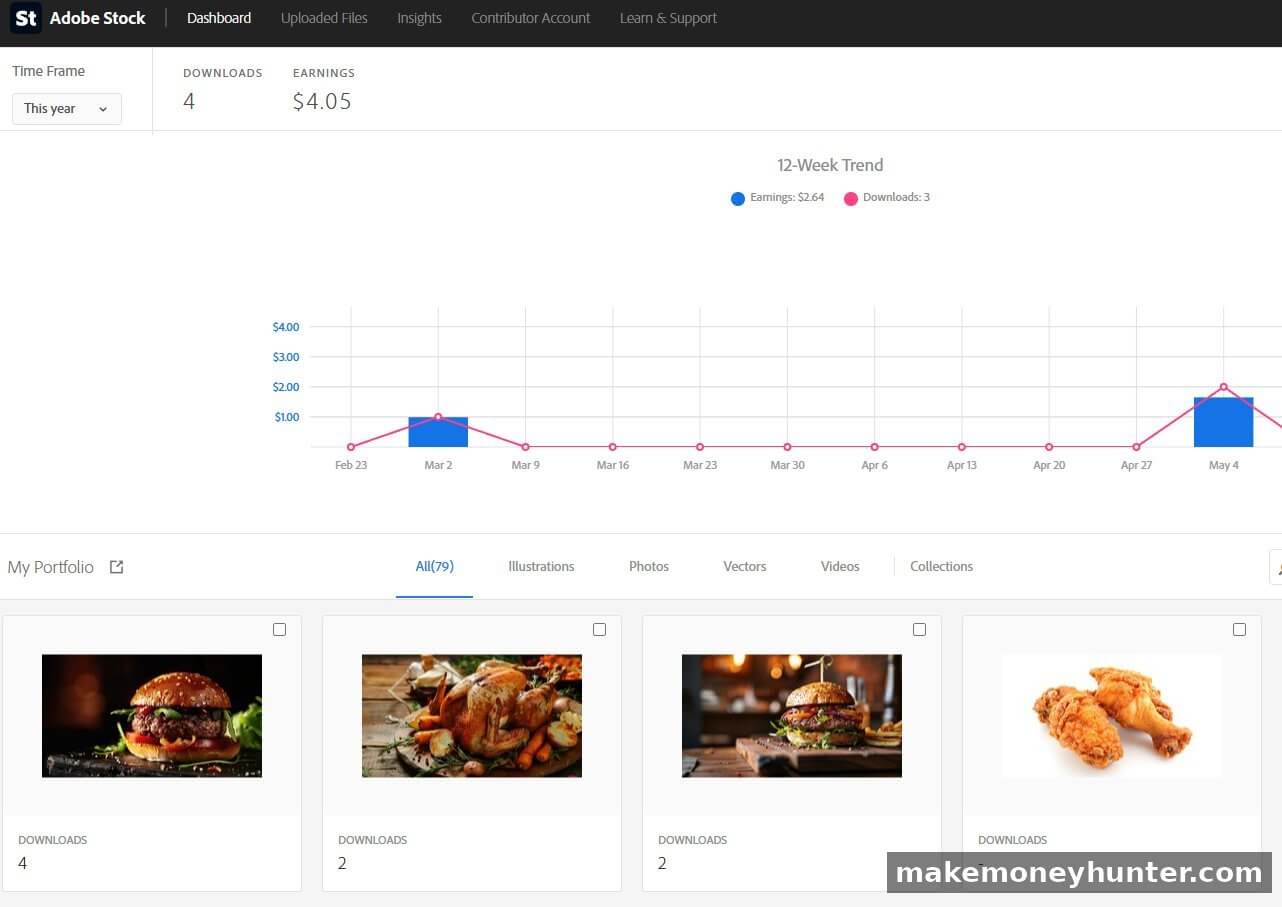
The dashboard above is real and brutal: $4.05 in earnings for the year, 4 downloads, 79 portfolio images. This is what month 1–3 looks like for almost every new stock contributor. The portfolio is too small, the keywords aren’t optimized yet, the trend timing is wrong. Most people quit at this stage. The contributors who don’t quit and keep uploading 50–200 images per week start seeing the inflection point around image #500 in their portfolio.
It works when you do two things: shoot what’s missing (boring corporate scenes with non-white-collar professionals, niche hobby setups, modern remote-work scenarios) and upload in batches (50–200 images per week minimum).
Stock video pays significantly better than stock photo per unit — a single $79 clip license can match a month of photo royalties — but the bar is higher.
7. Lightroom Presets and Mobile Apps
Creation time: 5–40 hours for presets / 80–500 hours for apps
Price range: $9–$49 for presets / $2.99–$9.99 for apps
Monthly income potential: $200–$15,000
Best platform: Your own site (presets) / App Store (apps)
Lightroom presets — the photo filter packs photographers and Instagram creators buy to maintain a consistent visual style — are one of the most under-discussed digital product winners. Top sellers do $20K–$80K/month with preset packs sold through their own websites and Instagram.
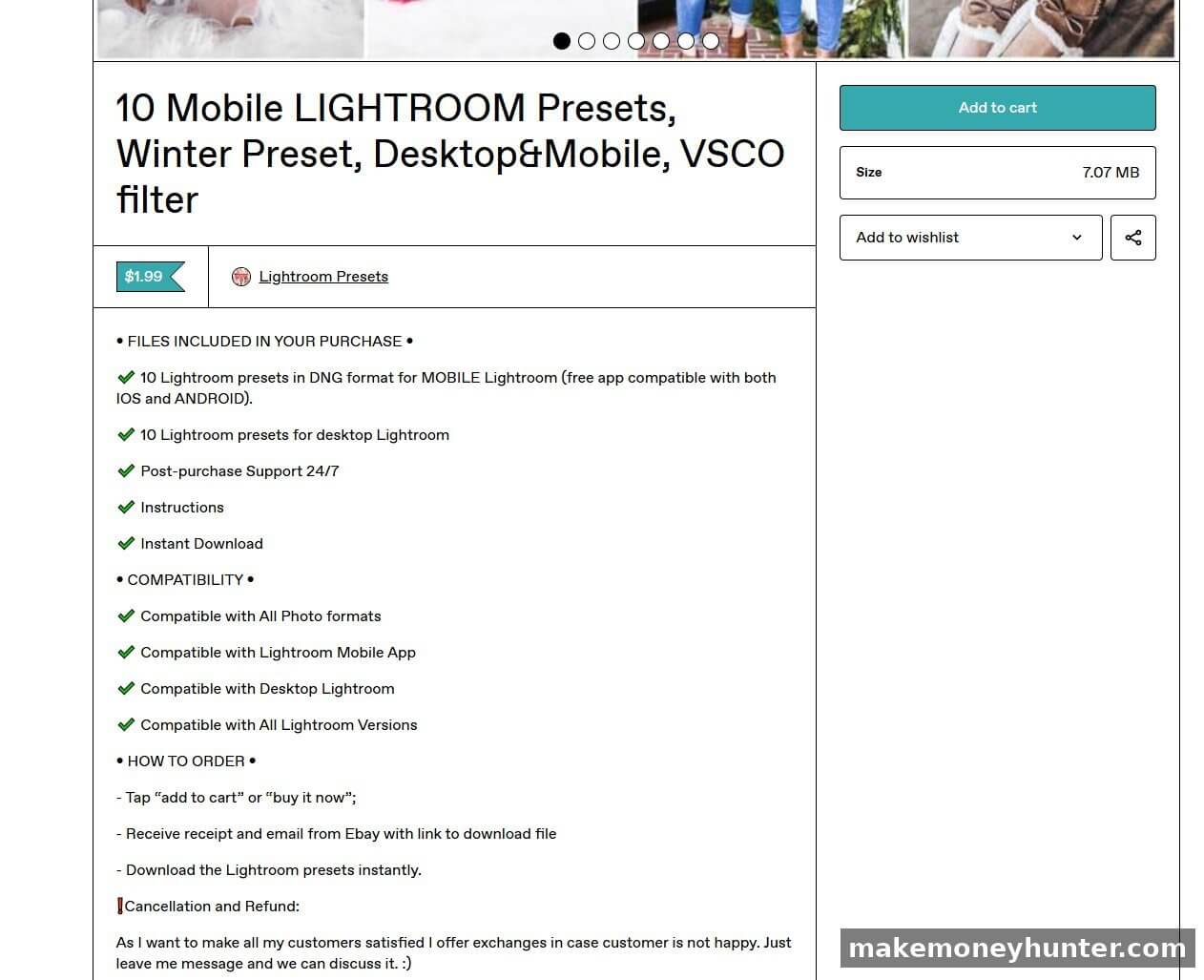
Notice the price on the listing above: $1.99 for 10 presets. That’s the marketplace race-to-the-bottom problem. The same seller, on their own Instagram with a real following, could charge $39 for the exact same pack — and they’d make 20× more per sale with the same effort. Marketplaces will train you to underprice. Your own audience will train you to charge properly.
Mobile apps are higher-ceiling but also higher-risk. The successful indie app developers I know averaged 6–18 months of development before their first profitable product, and most had at least one failed app before the winner. Not a beginner play.
8. Paid Newsletters
Creation time: 4–10 hours per issue, ongoing
Price range: $5–$30/month
Monthly income potential: $300–$50,000
Best platform: Substack, Beehiiv, or Ghost
Paid newsletters became a real category in 2023–2024 and the audience is now mature enough to sustain a long list of $5K–$30K/month operators. The trade is honest: you commit to writing valuable content every week, forever. In exchange, you get recurring revenue that doesn’t depend on platform algorithms.
What works: narrow niche, real expertise, specific outcomes. “Newsletter about marketing” doesn’t work. “Newsletter for B2B SaaS founders growing past $1M ARR” works.
The realistic launch curve is 200–500 free subscribers in months 1–3, with 3–7% converting to paid. That’s $300–$1,500 MRR by month 6 if you stick with it. Most people quit at month 2. If you’re newsletter-curious but undecided between that and starting a blog, my how to make money blogging guide has a side-by-side comparison of the income paths.
9. Resume and CV Templates
Creation time: 2–4 hours per template
Price range: $5–$25
Monthly income potential: $200–$3,000
Best platform: Etsy
Resume templates are an evergreen Etsy category. The buyer intent is razor sharp — someone needs a job, needs it now, and a $12 template feels like a no-brainer.
The winners differentiate by industry: nursing resume templates, tech resume templates, executive resume templates. Generic “professional resume template” is overcrowded. Industry-specific versions still have room. If you want to dive deeper into the Etsy side, my make money on Etsy guide breaks down the entire shop setup process.
10. Educational Worksheets and Lesson Plans
Creation time: 4–12 hours per resource
Price range: $2–$25
Monthly income potential: $300–$8,000
Best platform: Teachers Pay Teachers + Etsy
Teachers Pay Teachers (TPT) is the dominant platform here, and it pays well — teachers buy aggressively for their classrooms, and the platform takes a 45% cut on free-tier accounts, 20% on Premium ($59.95/year).
The top TPT sellers do $10K–$200K/year. They’re almost all actual teachers who built their resources for their own classrooms first, then realized they could sell them. If you’re a teacher (or have taught), this is one of the best digital product categories for your skillset.
11. Wedding Invitations and Stationery
Creation time: 3–8 hours per design
Price range: $15–$60 per template
Monthly income potential: $400–$5,000
Best platform: Etsy
Wedding stationery is a high-emotion, high-willingness-to-pay category. Brides will pay $35 for a customizable invitation template they could theoretically design themselves, because the saved time and design quality is worth it during planning chaos.
Use Canva to build editable templates (so the buyer can customize names, dates, venue) and provide a Canva share link as the deliverable. This is now the standard format on Etsy and it dramatically reduces customer service questions.
12. Audio Files (Music, Sound Effects, Beats)
Creation time: 1–20 hours per track
Price range: $2–$300+ per license
Monthly income potential: $100–$10,000
Best platform: AudioJungle + BeatStars
If you make beats, sound effects, or production music, the digital marketplaces are reasonable: AudioJungle (Envato) for production music, BeatStars for hip-hop and pop beats, Pond5 for sound effects.
Beat producers can lease the same beat 30–80 times at $20–$50 a lease, then sell exclusive rights for $200–$2,000. The math gets compelling fast if you can produce 3–5 quality beats a week.
13. Coloring Books for KDP
Creation time: 15–40 hours per book
Price range: $5.99–$9.99 (print)
Monthly income potential: $100–$4,000 per book
Best platform: Amazon KDP Print
This is a specific KDP sub-category that deserves its own line because the economics are different. Coloring books, puzzle books, journals, and other “low-content” books are a real business — but the market got saturated in 2022 and only the niche-specific titles still work.

The example above is exactly the right model: a specific theme (cute houses), a specific page count (72), a clear audience (kids and adults who want relaxing detail). Not “adult coloring book” — that keyword has 300,000+ competing listings. “Cute house coloring book” is searchable, specific, and the kind of gift-friendly title that buyers find and complete the purchase on within minutes.
The AI-illustration angle works particularly well here. Tools like Midjourney can generate hundreds of consistent line-art house illustrations in a few hours. The skill that still matters is curating, cleaning up, and packaging — not drawing from scratch.
14. WordPress Themes and Plugins
Creation time: 60–400 hours
Price range: $39–$199 (themes), $29–$299 (plugins)
Monthly income potential: $500–$30,000+
Best platform: ThemeForest + your own site
WordPress themes are a real business if you can actually code. ThemeForest’s top sellers each earn $30K–$100K+/month per popular theme, after Envato’s commission. The bar is high: clean code, solid documentation, ongoing support.
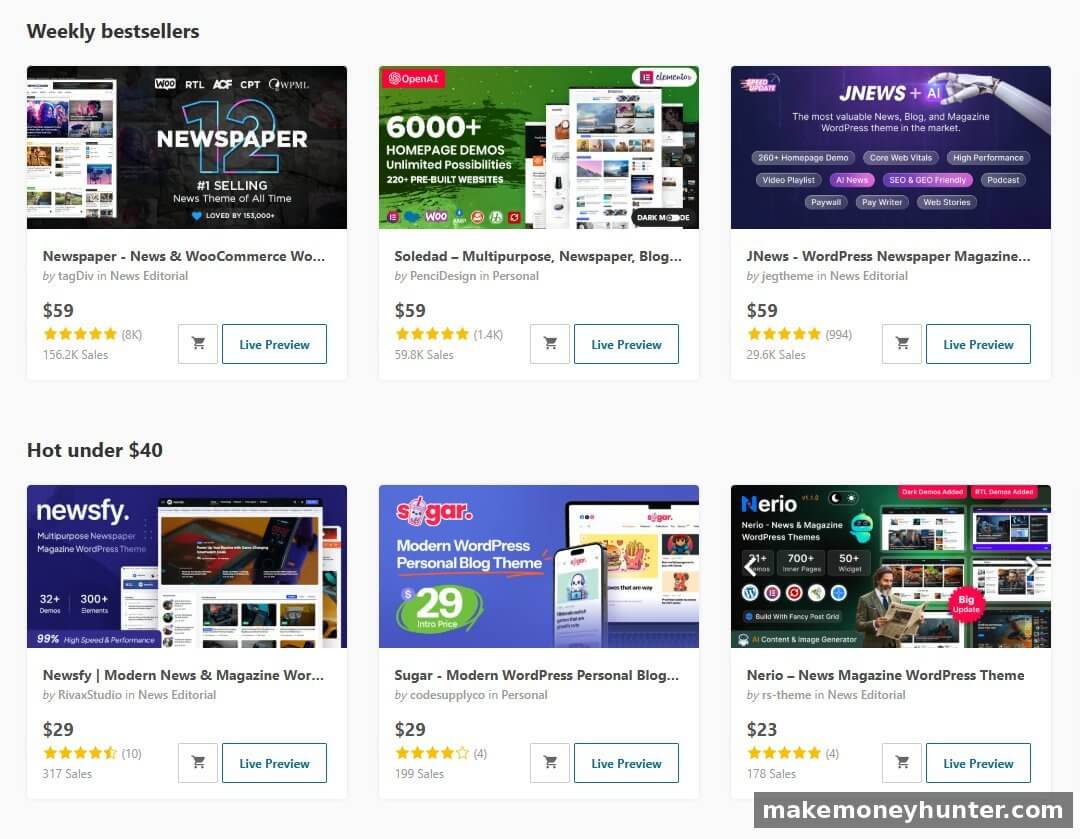
Look at the sales numbers: Newspaper theme has 156,200 sales at $59. JNews has 29,600 sales at $59. That’s $9M+ and $1.7M+ in lifetime gross revenue, respectively, on a single product. The “Hot under $40” section shows newer themes priced at $29 doing 178–317 sales — modest, but real income for a recent launch. ThemeForest is one of the few marketplaces where a single well-executed product can build a real long-term business.
Plugins have lower production cost than themes but higher support burden. If you’re a developer with a specific industry insight, a niche plugin (membership site for course creators, booking system for hair salons) can outperform a general-purpose theme by 5x.
15. Subscription Memberships for Digital Content
Creation time: 5–15 hours per month, ongoing
Price range: $9–$49/month
Monthly income potential: $400–$15,000
Best platform: Patreon + your own site
Monthly access to fresh digital content — new printables, new templates, new beats, new courses — turns a one-time sale into recurring revenue. Patreon is the easiest entry point, but moving subscribers to your own site (using Memberstack, Memberpress, or Substack) gives you a much bigger cut per member.
Realistic membership math: 100 paying members at $19/month is $1,900 MRR. That sounds small until you realize it took the same effort to build as a single $19 ebook. Recurring revenue compounds.
16. Knitting, Crochet, and Craft Patterns
Creation time: 8–30 hours per pattern
Price range: $4–$20
Monthly income potential: $300–$5,000
Best platform: Ravelry + Etsy
Craft pattern sellers are one of the most underrated digital product communities. Ravelry alone has over 9 million users, almost all of whom buy patterns regularly. A single popular pattern can sell 5,000–20,000 copies over its lifetime.
What separates winners from beginners: clear photography, line-by-line written instructions (not just charts), and a defined skill level on each pattern. Patterns that need 30 customer service messages per sale don’t scale.
17. Recipes and Meal Plans
Creation time: 10–40 hours per pack
Price range: $9–$49
Monthly income potential: $200–$4,000
Best platform: Your own site / Gumroad
“30-Day Mediterranean Meal Plan” or “Keto Recipes for Busy Parents” type products are a steady seller in the health and fitness niche. They work best when paired with content marketing — a recipe blog or Instagram account that gives free value and converts followers to the paid pack.
Direct selling on Etsy underperforms here because the buyer is searching for free recipes, not paid ones. Your own audience pre-built is essential.
18. Spreadsheets and Financial Calculators
Creation time: 5–25 hours
Price range: $15–$99
Monthly income potential: $300–$6,000
Best platform: Gumroad + your own site
Highly-customized Excel and Google Sheets templates — budgeting spreadsheets, real estate deal analyzers, content calendar trackers, freelancer pricing calculators — are a quiet six-figure category. Specific, professional, and the audience values their time enough to pay.
The hidden lever: include a 2-minute Loom walkthrough video with each download. Customer service questions drop 70%, refund rates drop, and you can charge 30–50% more.
19. Coaching Worksheets and Workbooks
Creation time: 10–30 hours
Price range: $19–$97
Monthly income potential: $300–$5,000
Best platform: Gumroad / your own site
If you’re in the coaching, therapy-adjacent, or self-development space, structured workbooks (“90-Day Confidence Workbook,” “Career Pivot Planning Guide”) sit in a sweet spot between low-cost printables and high-cost courses. They feel premium without requiring you to deliver live calls.
Bundle them with a small course or membership to push the average order value up. A workbook alone sells; a workbook plus 2 hours of video content sells for triple.
20. Software-as-a-Service (Micro-SaaS)
Creation time: 200–1,000+ hours
Price range: $9–$299/month
Monthly income potential: $500–$100,000+
Best platform: Your own infrastructure
I’m including micro-SaaS at #20 not because it’s the worst product, but because it’s the highest-skill option on this list. A small focused SaaS — a single-purpose tool that solves one specific problem for one specific audience — can become a real business doing $10K–$50K MRR with one founder.
The successful indie founders I know all started with a specific frustration they had at their day job, then built the tool they wished existed. They didn’t start by asking “what SaaS should I build?” — they started by being annoyed enough to code a fix.
Not a beginner play. But if you can code, this is the longest-runway option on the list.
How to Choose the Right Digital Product for You
Twenty options is too many. Here’s how to narrow it down.
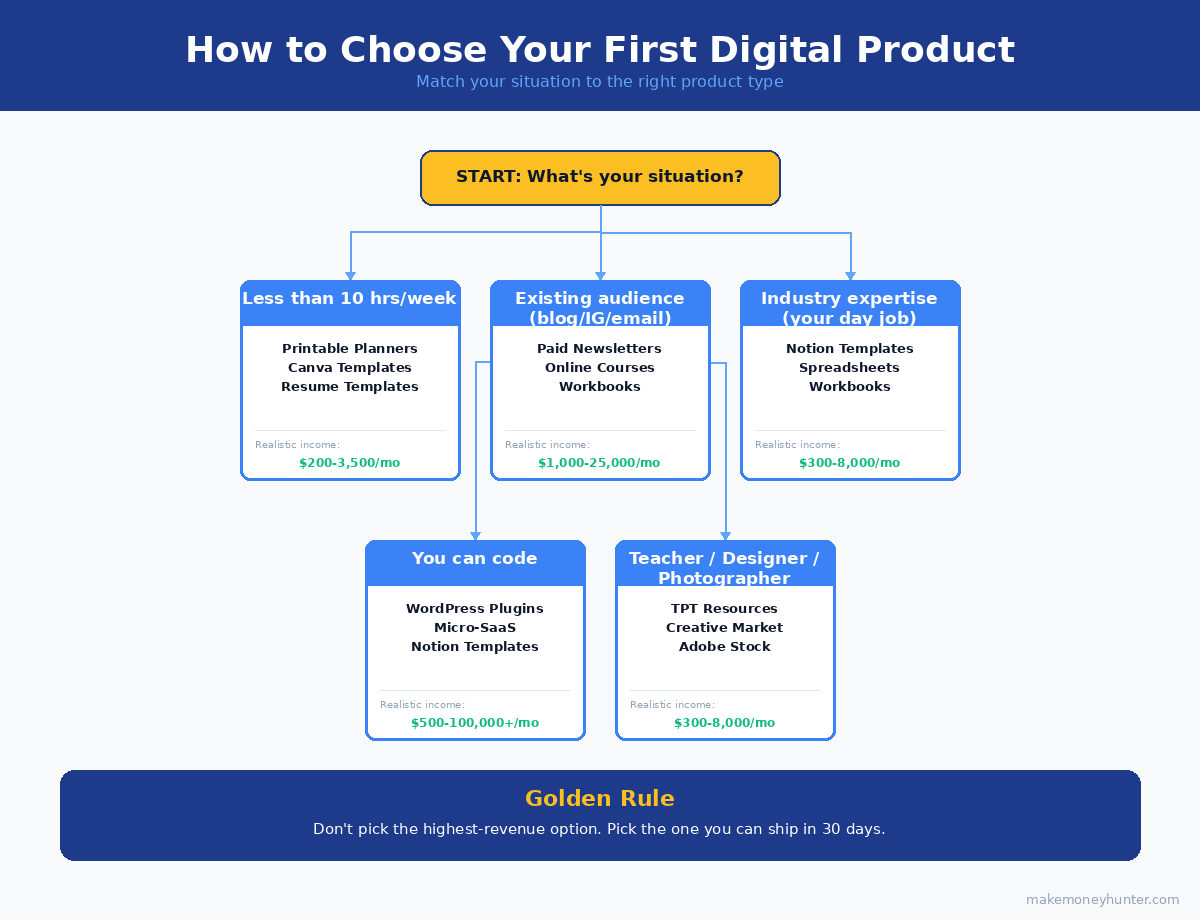
If you have less than 10 hours per week to commit: printables, Canva templates, or resume templates. Fastest creation cycle, fastest feedback loop.
If you already have an existing audience (newsletter, Instagram, blog): the products that monetize attention best are paid newsletters, online courses, or coaching workbooks. You’re not starting from zero on traffic.
If you have professional skills in a specific industry: sell the templates, calculators, or workbooks you wish had existed when you were learning. Industry-specific products outperform generic ones every time.
If you can code: WordPress plugins, Notion templates, or micro-SaaS will likely outperform other categories per hour invested.
If you’re a teacher, designer, or photographer: use the platforms built for you (TPT, Creative Market, Adobe Stock). The audience is there. Don’t build your own audience from zero when a marketplace already aggregates buyers.
One more honest filter: don’t pick the highest-revenue option on this list. Pick the one you can ship in 30 days. A printable selling 5 copies a month is infinitely better than a course that’s been “in development” for 8 months.
Realistic Income Timeline: Months 1 to 12
The number-one reason new sellers quit isn’t lack of ability — it’s misaligned expectations. Here’s what an honest income curve actually looks like for a focused beginner who launches 3–5 related products in their first year:
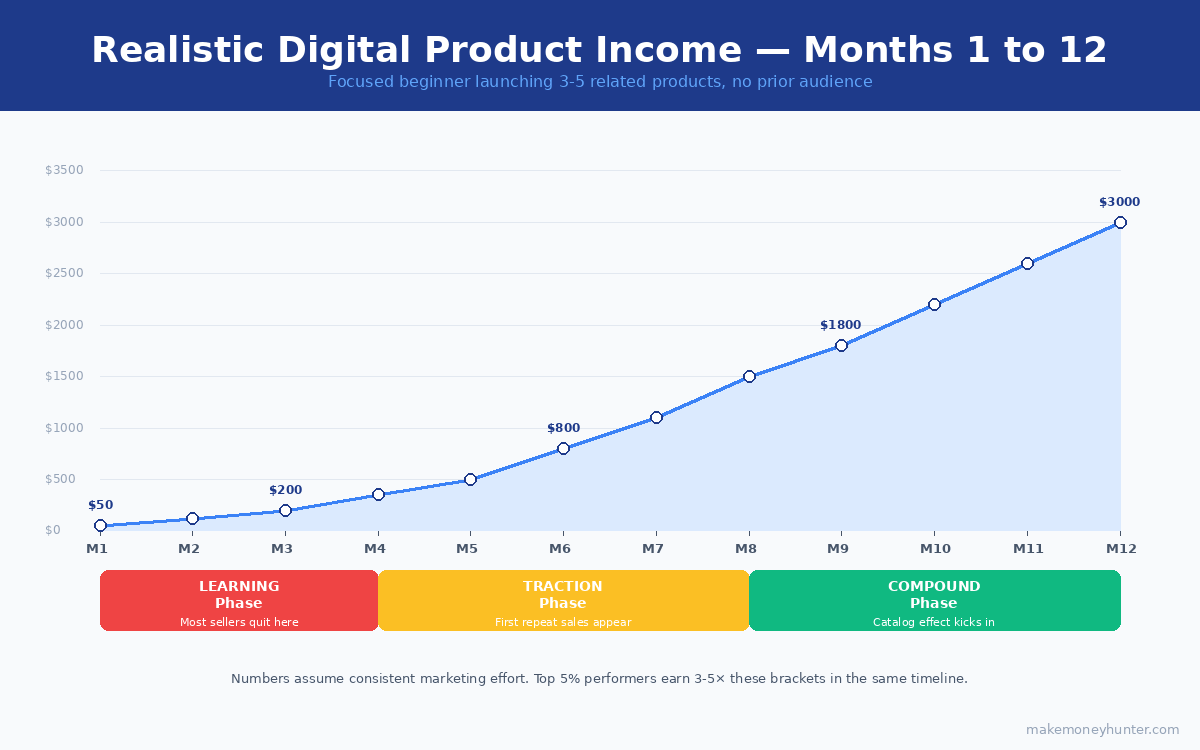
The first 3 months are the Learning Phase: you’re earning $50–$200/month, learning marketplace SEO, fixing your first product based on feedback, launching your second. Most sellers quit in this zone. The math feels broken.
Months 4–7 are the Traction Phase: first repeat customers appear, you’ve got 2–3 products live, and one of them starts pulling ahead. You’re hitting $350–$1,100/month.
Months 8–12 are the Compound Phase: the catalog effect kicks in. Buyers of your winning product start buying your other products. Your top-performing listing has accumulated enough reviews to rank organically. You’re hitting $1,500–$3,000/month and the curve steepens.
The top 5% performers earn 3–5× these brackets in the same timeline. But the model above is what’s realistic — and being realistic is what keeps you in the game long enough to hit those better numbers.
The 3 Mistakes That Kill Most Digital Product Businesses
Across 23 of my own product launches and the dozens of seller dashboards I’ve helped people audit, three patterns kill more digital product businesses than anything else:
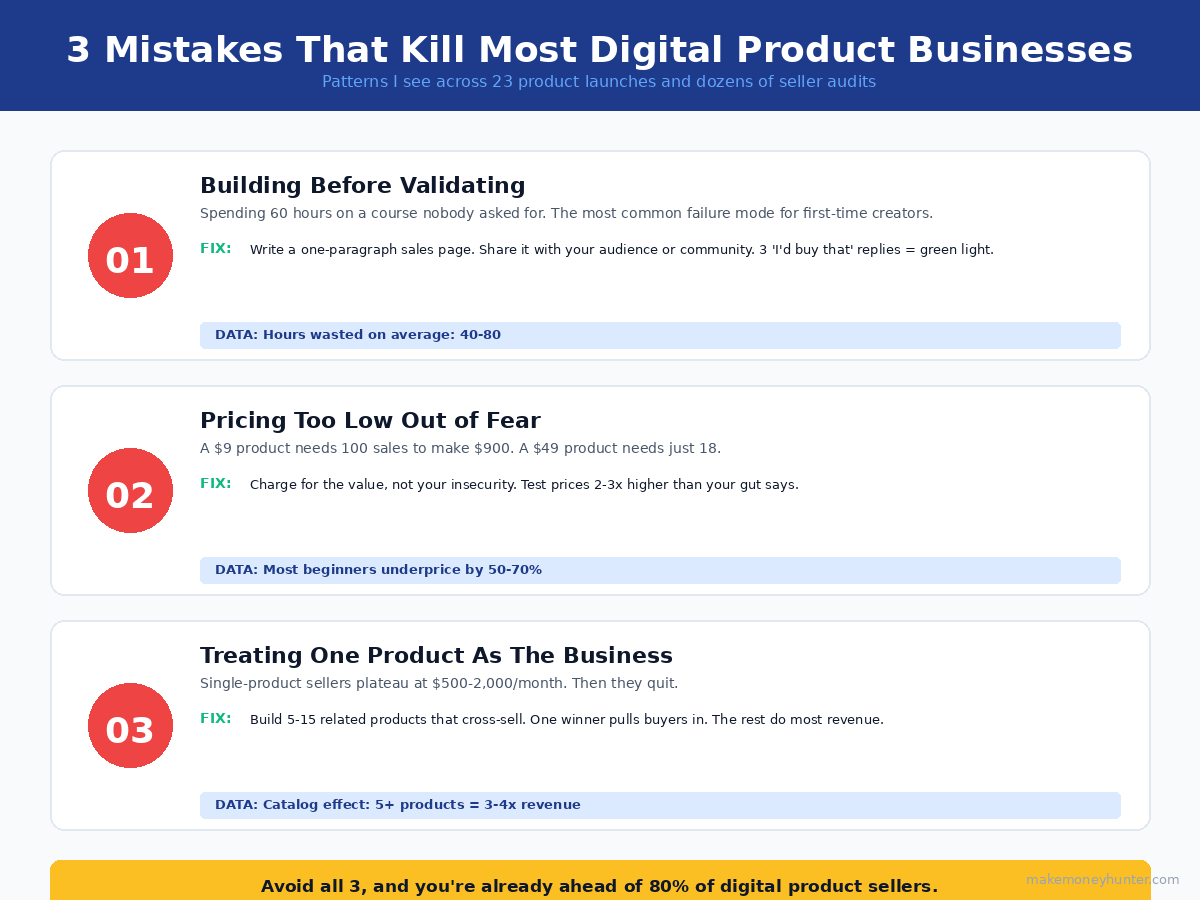
Mistake 1: Building before validating. Spending 60 hours on a course nobody wants is the most common failure mode. The fix is dumb-simple: write a one-paragraph sales page, share it with your audience or in a relevant community, and see if anyone says they’d pay. Three “I’d buy that” responses is your green light. Zero responses means you build something else.
Mistake 2: Pricing too low out of fear. A $9 product needs 100 sales to make $900. A $49 product needs 18 sales. The buyer effort to find your product is the same either way. Most beginners underprice by 50–70%, and it costs them their business.
Mistake 3: Treating one product as the business. Single-product creators tend to plateau at $500–$2,000/month. The serious money — and the resilience — comes from having 5–15 related products that cross-sell. One winner pulls buyers into your ecosystem. Then your second, third, and fourth products do most of the revenue.
Best Platforms to Sell Digital Products in 2026
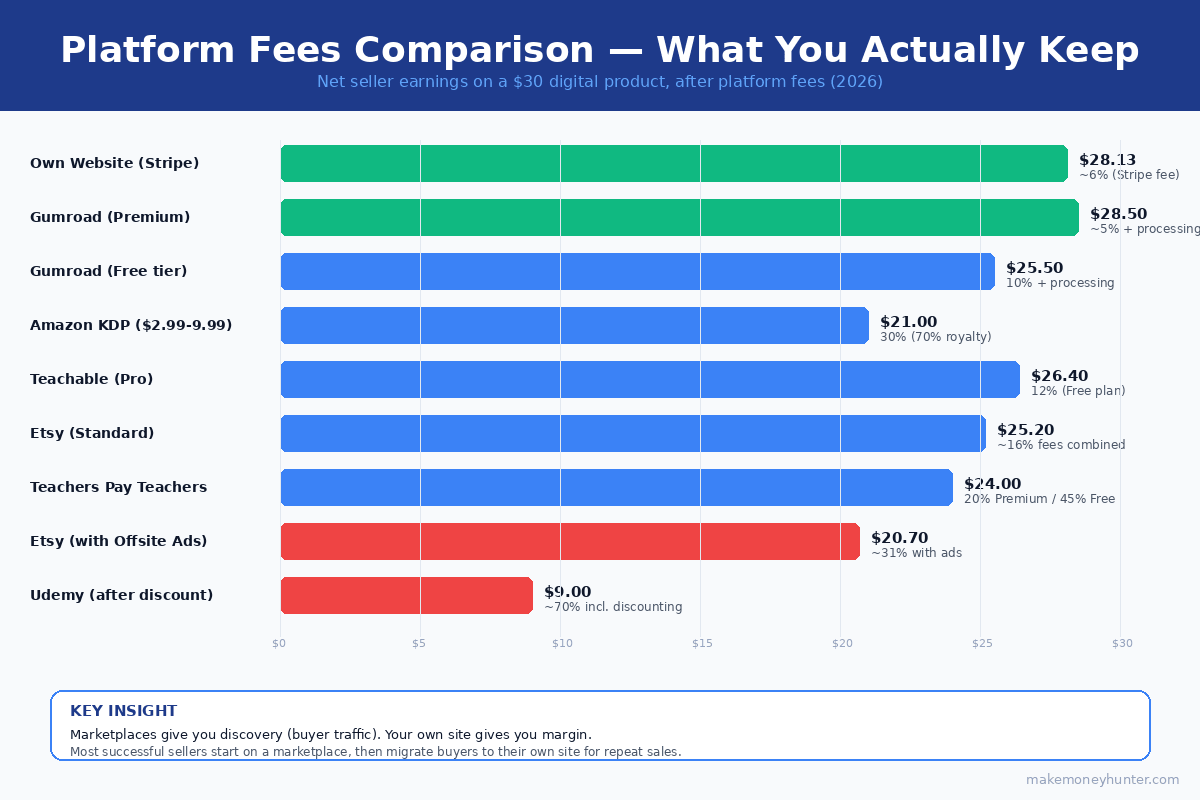
Where you sell affects your take-home as much as what you sell. Here’s the net-earnings reality on a typical $30 digital product across the major platforms:
A quick reference, since people always ask:
- Etsy — best for printables, templates, wedding stationery, resume templates. Massive buyer audience, but transaction fees + offsite ads can take 25–35% on small-ticket items.
- Gumroad — best for Notion templates, ebooks, spreadsheets, workbooks. Cleaner experience, 10% flat fee (Premium tier drops it), better creator brand.
- Teachable / Thinkific — best for online courses with structured lessons, quizzes, and student progress tracking.
- Amazon KDP — best for ebooks and low-content books with an existing book-buying audience.
- Teachers Pay Teachers — best for educational resources and lesson plans. Single largest education buyer base.
- Your own website — best long-term home for everything once you have repeat customers. Lower fees, full email list ownership, full pricing control. The trade-off is you handle traffic generation yourself.
Most successful sellers don’t pick one — they use a marketplace for discovery and migrate buyers to their own site over time. If you want to think through where this fits in a bigger online income strategy, my make money online for beginners guide is the broader starting point.
FAQ: Digital Products to Sell Online
What is the most profitable digital product to sell in 2026?
On a per-unit basis, online courses ($49–$997) and micro-SaaS subscriptions are the highest-revenue categories. But profitability isn’t only about price — it’s price multiplied by the volume you can realistically sell. For most beginners, printable planners and Notion templates produce the highest return per hour invested in the first 12 months, because they sell at smaller prices but require almost no marketing infrastructure to launch.
Do you need an audience before selling digital products?
Not for marketplace-based products (Etsy, Teachers Pay Teachers, Amazon KDP, Creative Market, AudioJungle). The marketplace provides the audience and the buyer-intent traffic. You’ll need to learn marketplace SEO to be found, but you don’t need a personal following. For products sold off-marketplace (Gumroad, your own site, paid newsletters), you’ll need some form of audience or distribution channel — typically 500–2,000 engaged followers minimum before the math starts working.
How much money can you realistically make selling digital products?
Honest brackets: $0–$200/month is normal for the first 90 days while you learn the marketplace, even with a good product. $500–$3,000/month is realistic within 6–12 months for a focused beginner who launches 3–5 related products and learns the marketing. $5,000–$30,000+/month is achievable in years 2–3 for sellers who treat it like a real business — multiple products, email list building, paid traffic, and continuous iteration based on what sells. The top 5% earn six and seven figures, but that’s the top 5% across every business category.
What digital products sell best on Etsy specifically?
Printables and templates dominate Etsy. The categories with the strongest year-round demand: wedding invitations, resume templates, planner pages, social media templates, art prints (printable wall art), educational worksheets, and small business templates (logos, business card templates, invoice templates). The shared trait is that the buyer needs the product immediately, prints it or uses it at home, and doesn’t need to wait for shipping.
Is it too late to start selling digital products in 2026?
It’s later than 2020, but not late. The number of buyers grew faster than the number of new sellers in 2024–2025. The truly saturated categories (generic adult coloring books, generic Instagram templates, generic budget planners) are saturated. Niche-specific versions of every category on this list are still wide open. The opportunity didn’t close — it moved one layer deeper into specificity.
Final Thoughts
Of the 23 products I’ve launched, the four winners — a Notion freelancer system, a niche wedding invitation pack, a budgeting spreadsheet, and a paid newsletter — generated more revenue than the other 19 combined. The pattern wasn’t talent. It was that I picked product categories where the buying audience was already shopping, then made the specific version of that product nobody else was making.
Pick one from this list. Ship it in 30 days. Let the market tell you whether you’ve picked correctly. Then iterate. That’s how every successful digital product business actually starts — not from a perfect plan, but from one shipped product and the willingness to keep learning.
If you want to keep going on this topic, the next decision is which platform to commit to first — that choice matters more than the product idea itself for the first 90 days. Pick the marketplace where your specific product type already sells, list one product this week, and start treating it like a real business.