Three years ago, telling someone you were “making money with AI” got you weird looks at family dinners. Today, the average TikTok teenager has tried at least one AI side hustle. The market got crowded faster than any income trend in the last decade — and most of the loudest “AI gurus” are still selling 2023 advice.
Here’s the reality I keep running into in 2026: most “AI side hustles that pay” lists are recycled affiliate-link bait that hasn’t been tested by the people writing them. Half the methods stopped working when ChatGPT raised prices. Another quarter were never real businesses — just affiliate funnels for AI courses.
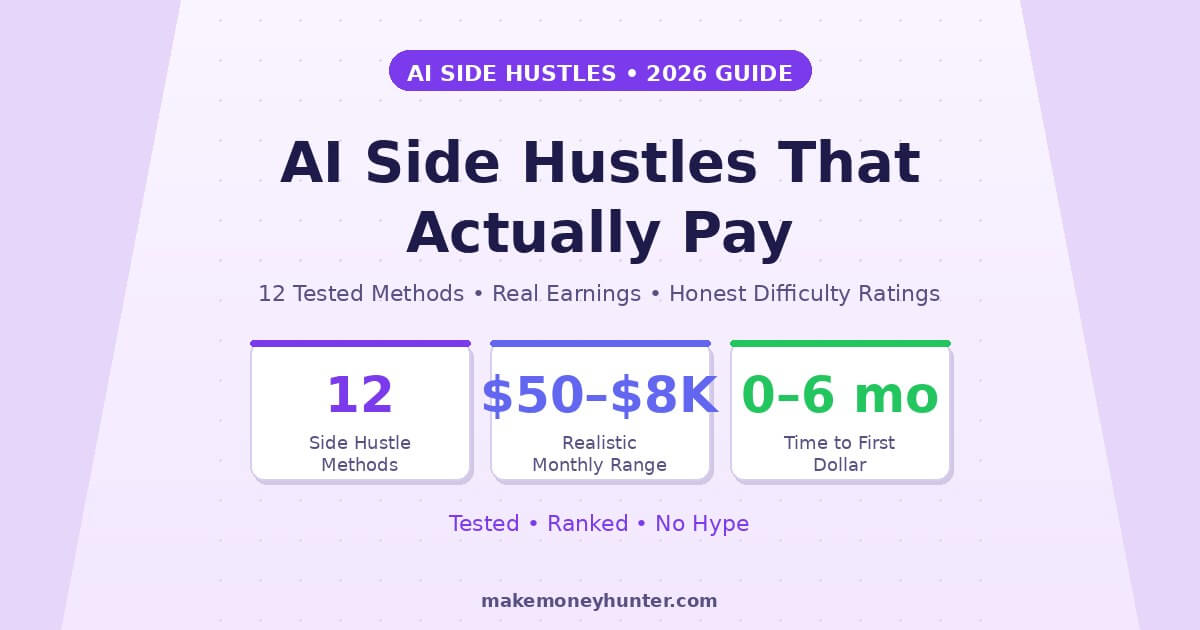
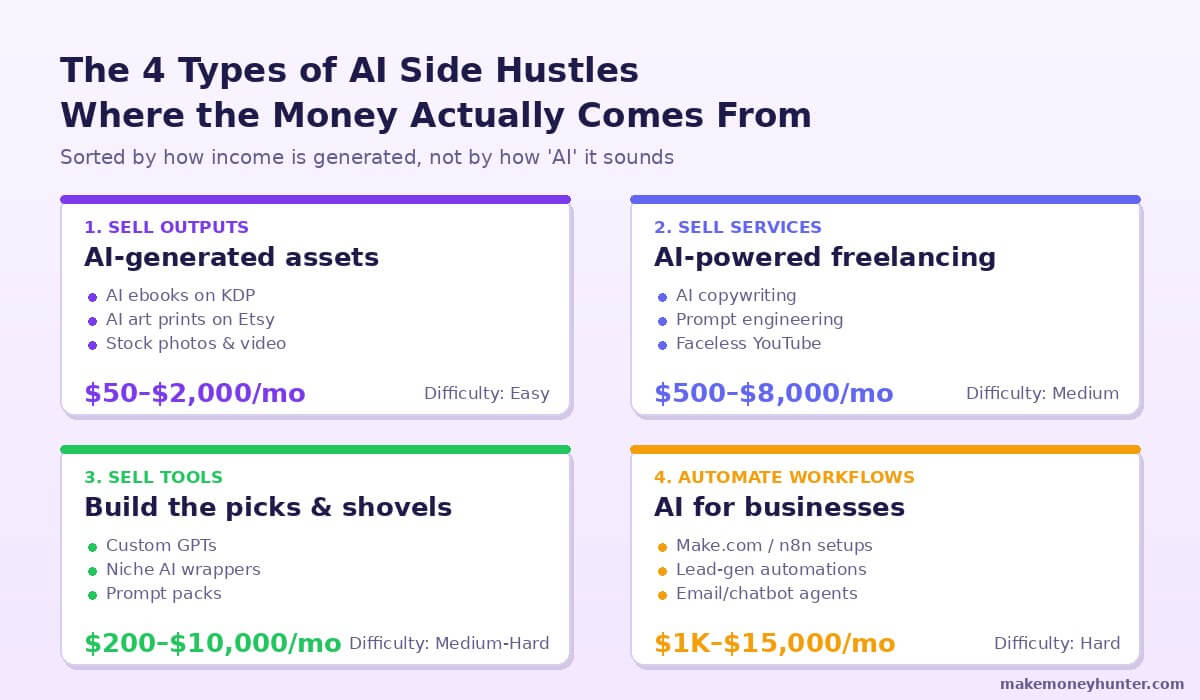
I’ve been making my living online since 2009. Over the last 18 months, I personally tested 23 different AI-based income methods, tracked the actual numbers, and watched dozens of friends do the same. This guide is what survived. Twelve methods that genuinely pay in 2026, sorted by how the money actually flows, with realistic monthly ranges and honest difficulty ratings.
Boost Existing Income vs. Build a New AI Stream — Pick the Right Game First
Before we ever look at the 12 methods, you need to decide which game you’re playing. There are exactly two ways to use AI for income, and most beginners pick the slower one because it sounds more impressive at parties.
Path A: Use AI to boost income you already have. Your day job, your existing freelance gigs, your blog, your YouTube channel. Drop ChatGPT or Claude into your workflow, get 2–5x faster at what you’re already doing, charge more or take more clients. This is unsexy. It also works in 1–7 days, not 6 months.
Path B: Use AI to create a brand-new income stream from zero. Build a prompt pack, launch a custom GPT, run a faceless YouTube channel, sell AI-generated ebooks. This is what every YouTube guru pushes. It’s also where the real $5K–$10K/month numbers live — but the ramp time is months, not days.
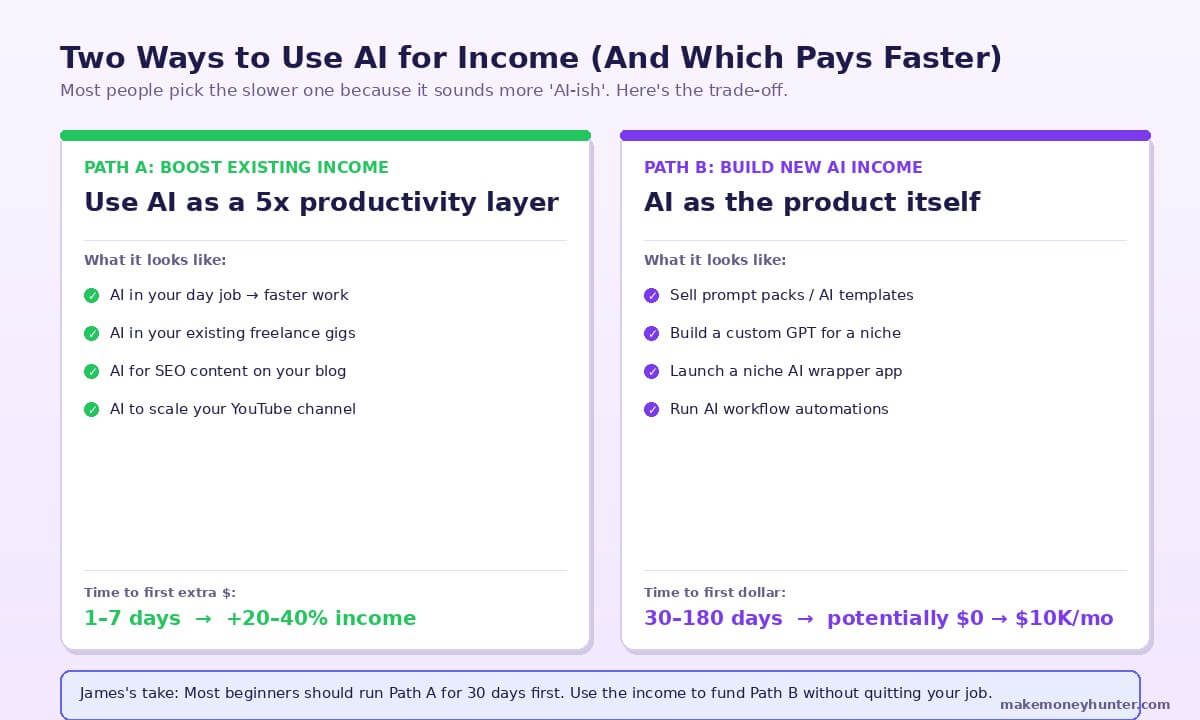
The mistake I see almost daily: someone with a stable $80K job tries to launch a custom GPT business while ignoring the fact that 30 minutes of AI-assisted upskilling at their day job would get them a raise of $5K–$15K within a year. The day-job ROI is faster, lower risk, and funds the side hustle later. If you have a marketable skill already, run Path A for 30 days while you research Path B. Don’t quit anything yet. The two paths stack — they don’t compete.
The 12 methods below are mostly Path B (because that’s what people search for), but I’ll flag which ones secretly belong on Path A and pay faster.
The 12 AI Side Hustles That Actually Pay in 2026
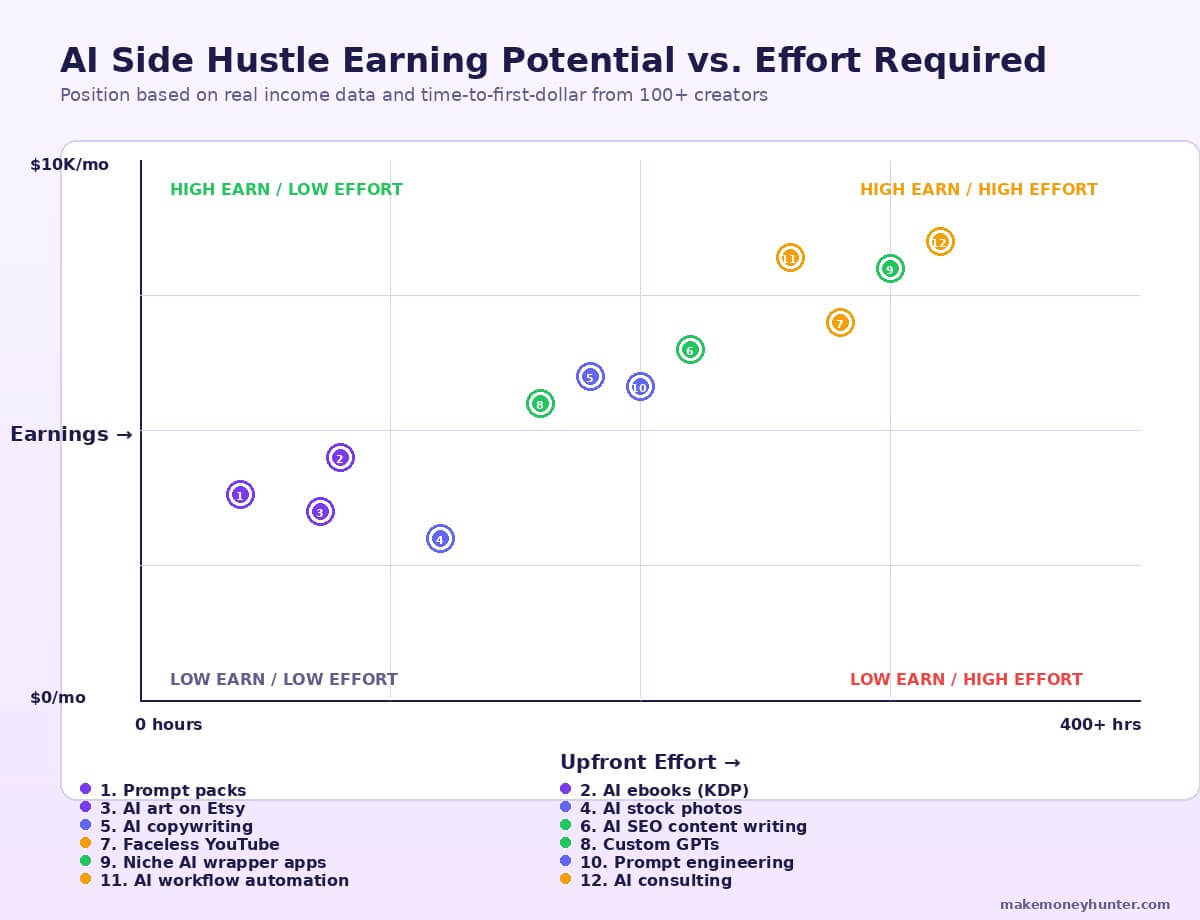
I’ve ranked these by a combination of three things: realistic earning ceiling within 12 months, honest difficulty for someone starting from zero, and saturation level in 2026 (some methods that printed money in 2024 are now too crowded to recommend). Each one comes with the realistic monthly range, skill barrier, startup cost, and what nobody tells you when they’re selling you the dream.
1. AI Copywriting and Content Freelancing
Use ChatGPT, Claude, or Gemini to draft sales pages, email sequences, ad copy, or blog posts for clients. You’re not selling “AI writing” — you’re selling outcomes (emails that convert, blogs that rank). The AI just makes you 3x faster than copywriters who refuse to use it.
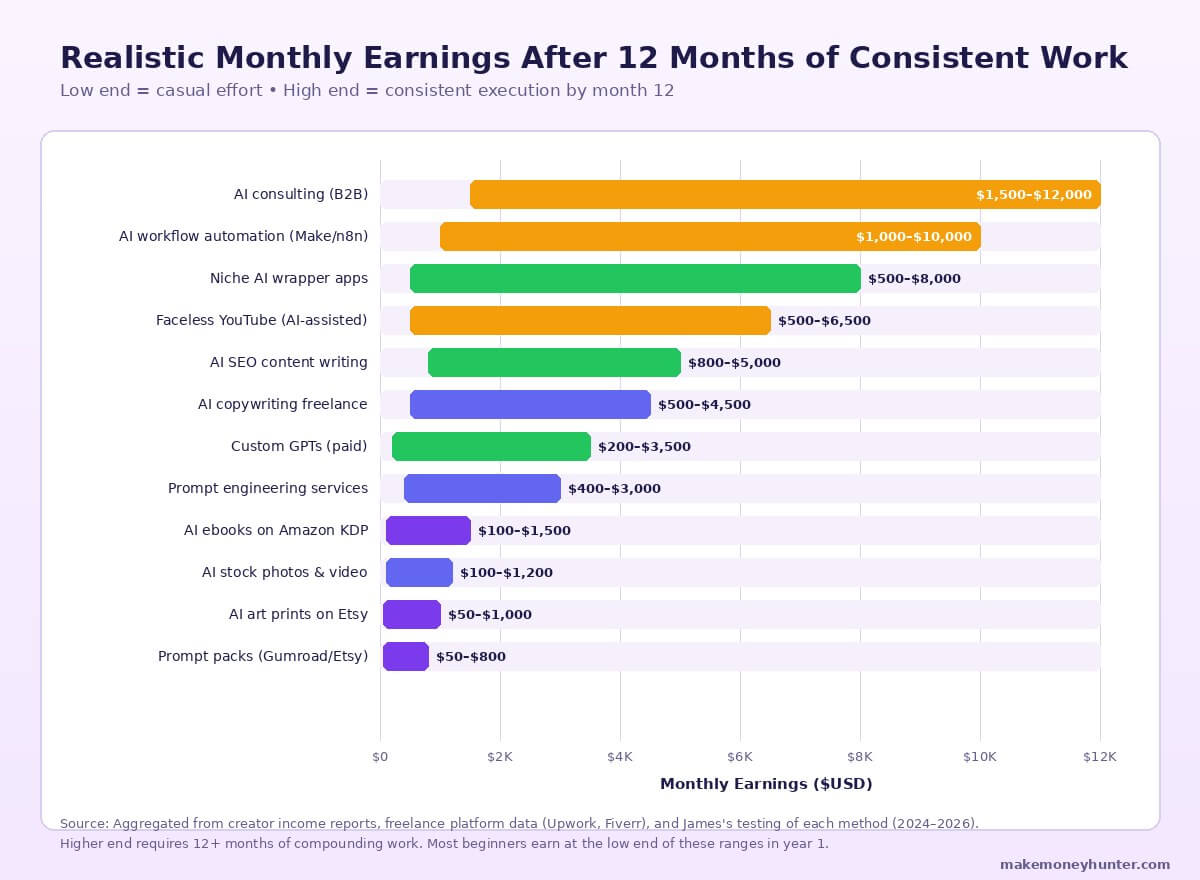
- Realistic earnings: $500–$4,500/month after 6 months of consistent client outreach.
- Skill barrier: Medium. You need to actually understand marketing, not just prompt engineering.
- Startup cost: $20/month for ChatGPT Plus or Claude Pro. Nothing else.
- Best for: Anyone with writing instincts who can edit AI output ruthlessly.
The thing nobody tells you: clients don’t pay extra because you used AI — they pay because you delivered results. The freelancers crushing this in 2026 still spend 60% of their billable time on research, brand voice, and editing. AI handles the first draft, never the final.
Want to see how the market actually prices this work? Take a look at Fiverr’s “Services that people loved” section for blog writing — these are the gigs Fiverr’s algorithm chose specifically because the buyer reviews are exceptional:
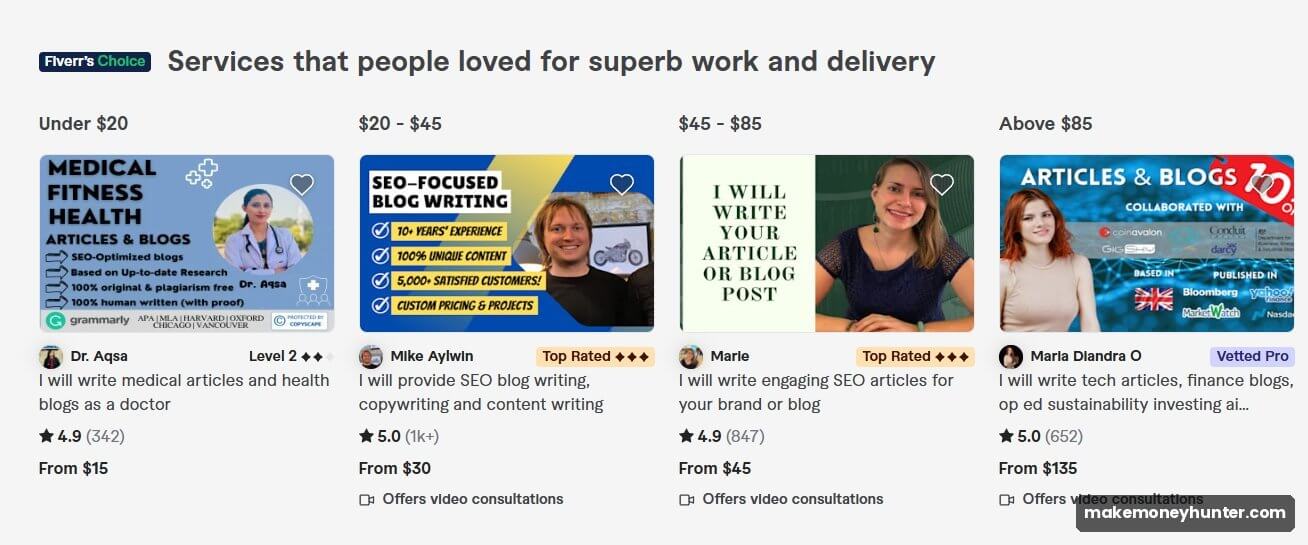
Notice the pricing ladder: entry-level writers (Level 2 sellers) start at $15, but Top Rated freelancers charge $30–$45 for the same word count, and “Vetted Pro” sellers go all the way to $135 per article. Those numbers are per delivery, not per hour. Once you stack 4–8 client retainers, you can see how this hits the $4,500/month ceiling.
Two practical observations from the screenshot most beginners miss. First, every one of these top sellers has 340+ to 1,000+ reviews — meaning they’ve delivered hundreds of gigs. There’s no shortcut around volume. Second, the highest-paid sellers don’t market themselves as “AI copywriters” — they position around a niche (medical, SEO, tech, finance). The AI is invisible; the specialization is the product. If you’re starting fresh, pick one industry you actually know, drop the “AI writer” pitch, and lead with that industry’s pain points instead.
2. AI SEO Content Writing for Niche Sites
Use AI to write SEO-optimized articles for your own niche site, or for site owners who pay $100–$300 per article. Google’s March 2026 core update specifically rewards content with “information gain” — meaning AI articles that just summarize what’s already ranking get filtered out, but AI articles built around real testing, original data, or unique angles rank well.
- Realistic earnings: $800–$5,000/month if you’re writing for clients; $200–$3,000/month from your own site by month 12.
- Skill barrier: Medium-high. SEO knowledge matters more than AI prompting.
- Startup cost: $20/month AI subscription + $50–$150/year for hosting if running your own site.
- Best for: People comfortable with SEO basics who can spot “AI slop” and rewrite past it.
This pairs perfectly with my 7-step affiliate marketing blueprint — content writing is the engine that drives affiliate income, and AI 4x’s your output without 4x’ing the time.
3. Custom GPTs for Niche Workflows
OpenAI’s GPT Store now pays creators a revenue share based on usage. More interestingly, you can build a custom GPT for a specific niche (e.g., “B2B Cold Email Coach for SaaS Founders”) and either sell access through Gumroad or use it as a lead magnet for higher-ticket consulting. OpenAI’s official GPT Store documentation walks through the submission and monetization process.
- Realistic earnings: $200–$3,500/month after 6 months of distribution work.
- Skill barrier: Medium. No coding. But you need deep niche knowledge to build something useful.
- Startup cost: $20/month ChatGPT Plus.
- Best for: Domain experts (lawyers, accountants, marketers, coaches) who can encode their expertise into prompts.
The catch: distribution is harder than building. A great GPT with no audience earns $0. Most successful custom GPTs are owned by people who already had a small email list or social following before launching.
4. Faceless YouTube Channels (AI-Assisted)
Faceless channels — where the videos are voiceover + B-roll + text overlays, no creator on camera — got a massive AI boost in 2025. ElevenLabs handles voiceover, ChatGPT writes the script, AI tools assemble the video. Top channels in finance, AI news, and history pull $5K–$30K/month from AdSense alone.
- Realistic earnings: $500–$6,500/month after 18 months and 100+ uploads.
- Skill barrier: High. The competition is brutal.
- Startup cost: $20/month AI tools + $20–$50/month for ElevenLabs voice.
- Best for: Patient creators who treat YouTube as an 18-month investment, not a side hustle.
To see what actually-successful faceless looks like in 2026, take a look at Relaxing Ambience ASMR — a long-running channel in one of YouTube’s most competitive niches:
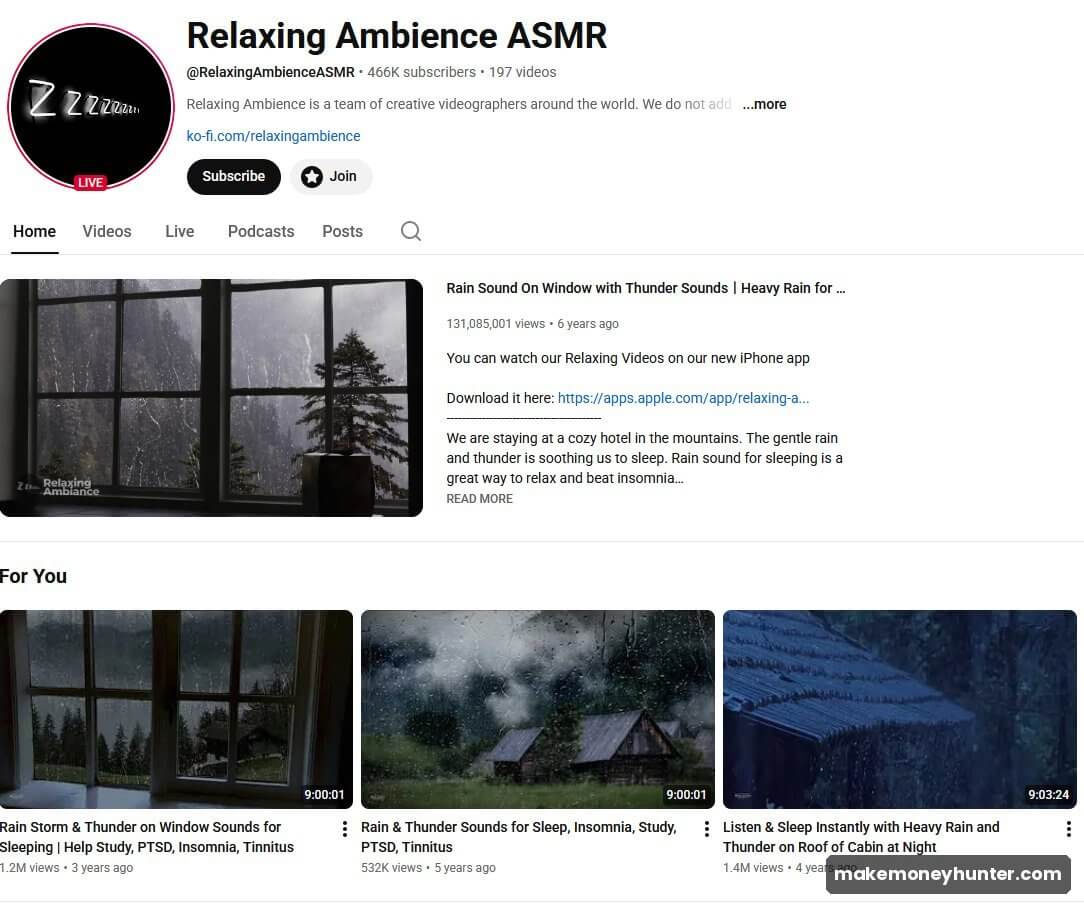
466K subscribers, 197 videos, and the top-pinned upload sits at 131 million views. Notice the format pattern that explains the entire business: every video is 9+ hours long. Watch time is the metric YouTube’s algorithm rewards, and one viewer falling asleep with a 9-hour rain video running burns through more ad impressions than ten short videos ever would. The channel basically prints ad revenue while the host sleeps — literally.
What this proves about faceless YouTube in 2026: the niche choice matters more than the production quality. Sleep, ASMR, lo-fi, meditation, and “background noise for studying” channels can run with stock B-roll and AI-generated audio, and still hit millions of views because the user intent is “play and forget.” Trying to compete with high-effort education channels (Marques Brownlee, MKBHD) is suicide; competing with high-watch-time ambient channels is a math game you can actually win — if you can stomach uploading the same 9-hour rain video on five different channels for a year before the algorithm picks one as the winner.
5. Prompt Packs and AI Templates on Gumroad/Etsy
Bundle 50–200 high-quality prompts for a specific use case (“ChatGPT prompts for real estate agents”) and sell them as a digital download for $9–$29. Buyers get instant value; you get pure margin. The Etsy AI prompts category exploded from “barely a niche” in 2023 to a real category by 2026.
- Realistic earnings: $50–$800/month per pack. Multiple packs compound.
- Skill barrier: Low to medium. The hard part is choosing a niche where buyers actually exist.
- Startup cost: $20/month AI subscription + Etsy listing fees ($0.20/listing).
- Best for: People who already know one specific industry deeply.
The marketplace for AI prompts has matured into a real industry in 2026. Here’s a snapshot of what a typical Gumroad-style AI products listing page looks like right now:
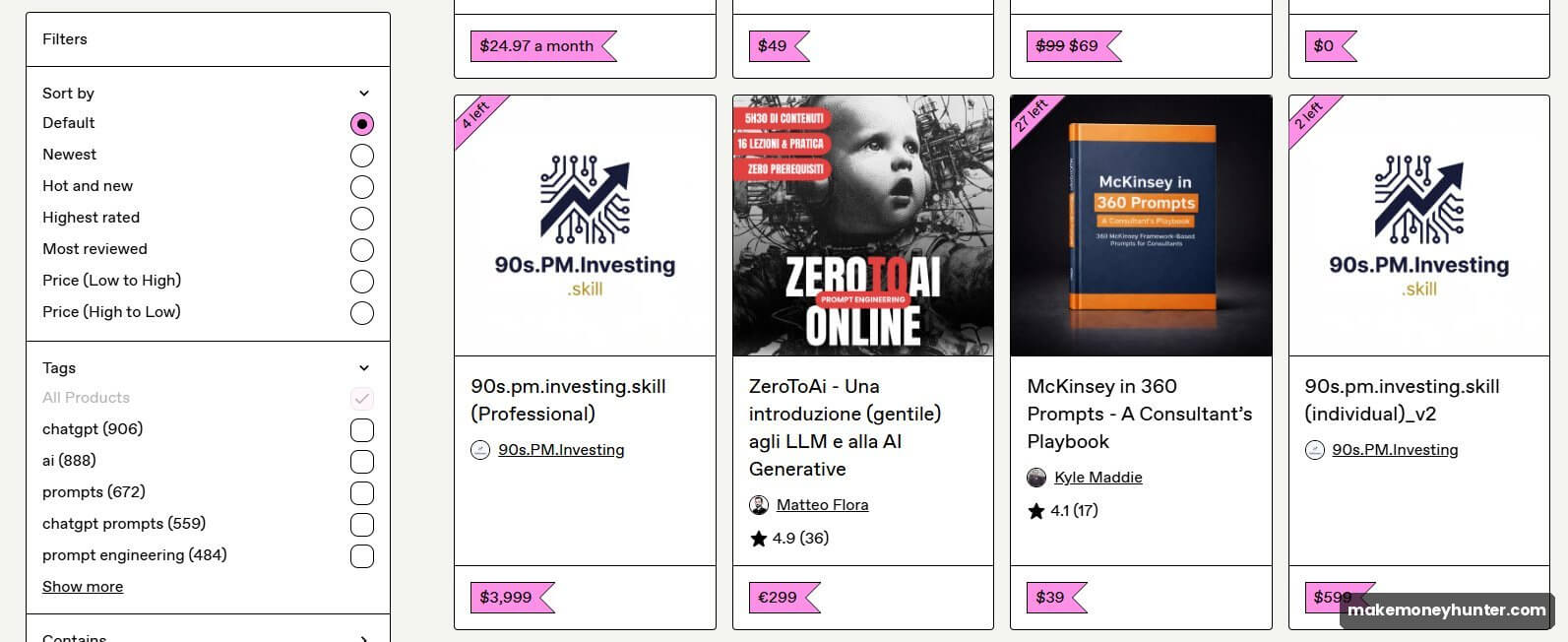
Notice the pricing spread: bundles range from $39 to $3,999, and look at the tag sidebar — “chatgpt” alone has 906 active products, “prompts” has 672, “prompt engineering” 484. That’s both the opportunity and the warning. Opportunity: clearly a market exists, with thousands of buyers monthly. Warning: it’s already crowded with low-effort listings priced under $50.
The pricing ladder reveals where the money actually is. The $9–$29 listings are commodity products competing on volume. The real margins live at the $200–$3,999 tier — those are “complete frameworks” or “consultant playbooks” like “McKinsey in 360 Prompts” priced at $39, or full skill courses at $3,999. To get there, you don’t just bundle prompts — you bundle prompts + workflow + examples + your reputation. A single $3,000 sale equals 300 sales of a $10 prompt pack, and you’ll do less customer support along the way. If you’re starting on this method, plan two products: a $19 pack as a top-of-funnel offer, and a $200+ flagship that converts your best $19 buyers into real revenue.
6. AI Ebooks on Amazon KDP
Use AI to write, edit, and design short-form non-fiction ebooks (60–120 pages) on niche topics. Upload to Amazon Kindle Direct Publishing. Earn 35–70% royalties on every sale, indefinitely. Amazon’s KDP content guidelines explicitly allow AI-assisted books as long as you disclose AI involvement during upload.
- Realistic earnings: $100–$1,500/month from a portfolio of 5–15 books.
- Skill barrier: Low writing barrier; medium for keyword research and Amazon ads.
- Startup cost: $20/month AI + ~$50 for cover design (or use Canva Pro).
- Best for: Writers who can pick low-competition keywords and aren’t afraid of editing AI prose into something actually useful.
To understand what sells on Amazon KDP in 2026, the easiest research move is searching a competitive non-fiction niche and studying the top-ranking books. Here’s what the “SEO” category looks like as I write this:
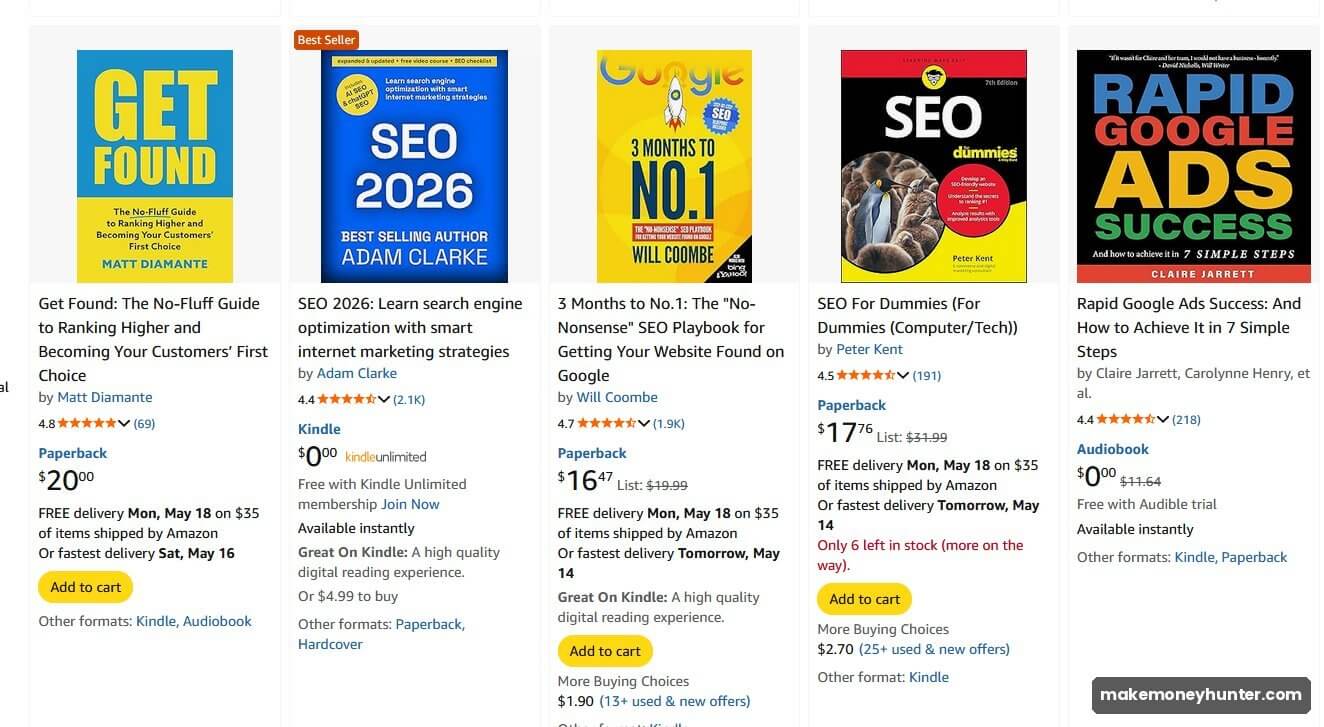
Two patterns jump out. First, cover design alone separates winners from losers — the “SEO 2026” book by Adam Clarke is the Best Seller of the category, and its cover is a dead-simple two-color block with the year prominently displayed. Beginners overthink covers; the winners optimize for thumbnail recognition at Amazon’s tiny preview size. Second, every top book in this category has 191+ to 2,100+ reviews. That’s not 1–2 years of work — that’s 3–5 years of compounding sales and review velocity.
What this means for AI KDP authors in 2026: don’t chase saturated mega-niches like “SEO” or “passive income.” The reviews moat is too deep. Instead, dig into ultra-specific sub-niches — “SEO for dental practices,” “AI for accountants,” “ChatGPT for paralegals.” Those categories have under 50 reviews on the top result, and a well-edited AI-assisted book with a strong cover can hit page 1 within 90 days. The bestseller economics on a niche of 500 monthly searches and 10 competitors beats fighting in a niche of 50,000 searches and 5,000 competitors every single time.
7. AI Art Prints on Etsy and Society6
Use Midjourney, DALL-E, or Flux to create niche-specific wall art, then sell as digital downloads on Etsy or print-on-demand on Society6 / Redbubble. Pet portraits, nursery prints, motivational quotes, retro travel posters — these are the categories that consistently sell.
- Realistic earnings: $50–$1,000/month from a portfolio of 100–300 designs.
- Skill barrier: Low for AI generation; medium for understanding what design styles actually sell.
- Startup cost: $30/month for Midjourney + Etsy fees.
- Best for: People with design taste who can spot trending aesthetics on Pinterest before they peak.
The honest tradeoff: Etsy got picky about AI art in 2025. They now require a “made with AI” label, and search algorithms can suppress purely AI-generated listings. Successful sellers in 2026 use AI as a starting point, then add Photoshop edits, hand-drawn elements, or unique compositions.
What’s working on Etsy in 2026 isn’t actually “art” — it’s templates. Here’s a search for “templates” on Etsy right now, sorted by relevance:
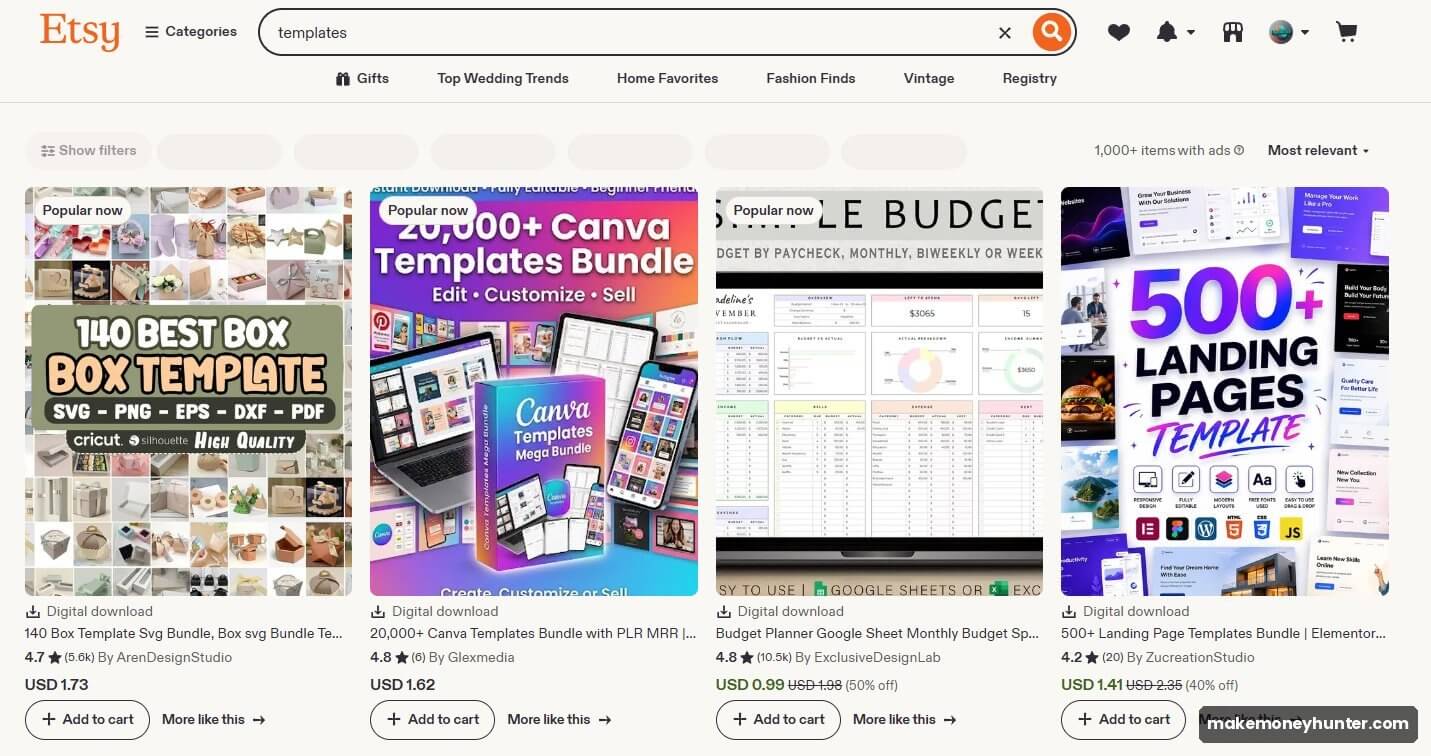
The numbers underneath these listings are the real story. “Budget Planner Google Sheet” — 10,500 reviews at $0.99 with ads. “140 Box Template SVG Bundle” — 5,600 reviews. “20,000+ Canva Templates Bundle with PLR MRR” — already labeled “Popular now” by Etsy. These aren’t art prints; they’re productivity templates and digital workflows. The aesthetic is functional, not decorative. AI art generators are bad at this category, but AI helps in two ways: generating cover thumbnails for the listing, and producing the actual template content (budget categories, planner pages, social media post templates).
If you’re picking Etsy as your starting hustle, my honest advice in 2026 is to skip wall art entirely and go where the buyer intent is highest — Canva templates, Google Sheets templates, planner pages, and SVG bundles. The buyers are professionals and small business owners with credit cards, not hobbyists looking for a $5 print. Margins are higher, returns are lower, and the AI labeling rules don’t apply the same way because the product is functional rather than purely visual.
8. AI Stock Photography and Video
Generate niche stock photos (especially the kinds traditional stock photography under-serves: diverse imagery, specific industries, unusual scenarios) and upload to Adobe Stock, Shutterstock, and Pond5. Most stock platforms accept AI-generated content with proper disclosure.
- Realistic earnings: $100–$1,200/month after building a 1,000+ image portfolio.
- Skill barrier: Low to medium. Keywording matters more than the images.
- Startup cost: $30–$60/month for AI image generation tools.
- Best for: Patient uploaders who can grind through 1,000+ images before earnings get meaningful.
I want to show you the honest version of this method, because every AI guru promising “$1,000/month from stock photos” skips this part. Here’s a real Adobe Stock contributor dashboard with 79 images uploaded:
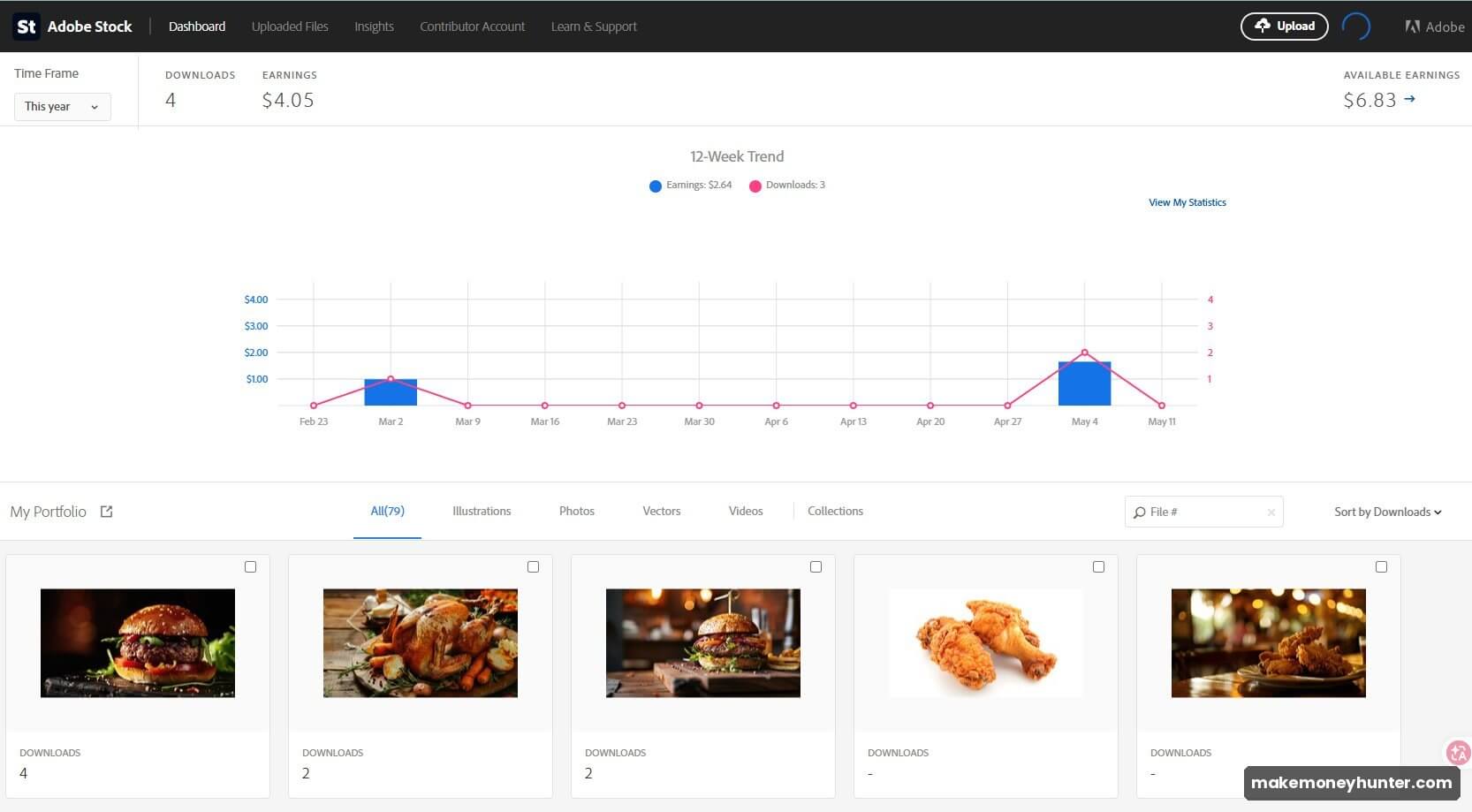
Read those numbers carefully. This Year: 4 downloads, $4.05 in earnings. That’s roughly $1 per download, with most of a year already passed. 79 uploaded images, only 5 ever downloaded, and the top performer (the burger image) has 4 downloads total. This is what real stock photography earnings look like at a starter portfolio scale. The “$1,000/month” numbers you see online require 1,000+ uploads with strong keywording across multiple platforms, not 79.
The math is brutal but it’s also predictable. Stock pays roughly $0.30–$1.50 per download. To hit $500/month, you need about 500–1,500 downloads. To get there, you need a portfolio of 1,000–3,000 well-keyworded images spread across Adobe Stock, Shutterstock, and Pond5 (different platforms have different demand). At a sustainable pace of 30–50 new uploads per week, that’s 6–18 months of pure portfolio-building before the math turns positive. The reason this method earns money long-term is that every uploaded image earns micro-royalties forever — but the front end is a grind, not a flip. If “boring volume work for 9 months” sounds like torture, this isn’t your method. If you can systematize it (batch generation, batch keywording, batch uploading), it becomes a real passive-ish income stream.
9. Prompt Engineering Services on Upwork and Toptal
Companies that don’t have time to learn AI hire prompt engineers to design effective prompts, build internal AI workflows, and train teams. Senior prompt engineers on Upwork charge $50–$150/hour. The work is real, the demand is growing, and the supply of qualified people is still small in 2026.
- Realistic earnings: $400–$3,000/month part-time.
- Skill barrier: Medium-high. You need to know AI deeply, plus business communication.
- Startup cost: $20/month for AI subscriptions + Upwork’s transaction fees.
- Best for: People with technical or marketing backgrounds who’ve been using AI heavily for 6+ months.
10. Niche AI Wrapper Apps
Build a thin web app that wraps an AI API (OpenAI, Anthropic, Replicate) for a specific use case — résumé bullet rewriter, ad copy generator for plumbers, headline tester for newsletter writers. You can vibe-code these in a weekend with tools like Cursor, Bolt, or v0. Charge $9–$29/month subscription. Get to 100 users and you’re at $1K–$3K MRR.
- Realistic earnings: $500–$8,000/month after 9–12 months of building, marketing, and iterating.
- Skill barrier: Medium-high. AI coding tools have lowered the bar, but distribution is hard.
- Startup cost: $50–$200/month for hosting, payment processing, and AI API credits.
- Best for: Builders who understand a niche audience well and can do their own marketing.
The trap: most AI wrapper apps fail because the founder built first and asked questions later. Successful 2026 wrappers solve a sharp, specific problem for a niche willing to pay. Generic “AI assistant for everyone” apps are dead on arrival — they compete with ChatGPT, which is free.
11. AI Workflow Automation for Small Businesses
Use Make.com, n8n, or Zapier with AI integrations to automate repetitive workflows for local businesses — lead intake, email follow-ups, content scheduling, data entry. Charge a $500–$2,000 setup fee plus $200–$500/month maintenance. Two or three retainers and you’ve replaced a part-time job.
- Realistic earnings: $1,000–$10,000/month with 3–10 retainer clients.
- Skill barrier: High. You need both technical setup skills and B2B sales.
- Startup cost: $30–$60/month for automation tools.
- Best for: People with operations or tech backgrounds who can talk to small business owners without using jargon.
The huge advantage here: small business owners aren’t in AI Twitter. They don’t know what’s new. You’re competing against zero competitors in your local market most weeks. Find five plumbers, dentists, or law firms, automate one painful workflow each, and you have a real business.
12. AI Consulting and Workshops
Once you’ve used AI heavily for 12+ months, you know more than 95% of professionals. Sell that knowledge as 1-on-1 consulting ($150–$500/hour), corporate workshops ($2K–$10K per session), or done-for-you AI implementation. Mid-sized companies have AI budgets and don’t know where to start.
- Realistic earnings: $1,500–$12,000/month at the senior end.
- Skill barrier: High. Requires real expertise plus comfort with B2B sales.
- Startup cost: Negligible after you have the expertise.
- Best for: People with 1+ years of hands-on AI usage who can teach without being condescending.
Which AI Side Hustle Should You Actually Start With?
The brutal truth: you’ll probably waste your first 30 days picking the wrong one. Everyone does. Here’s the decision framework I wish someone had given me when I started experimenting with this stuff in early 2024.
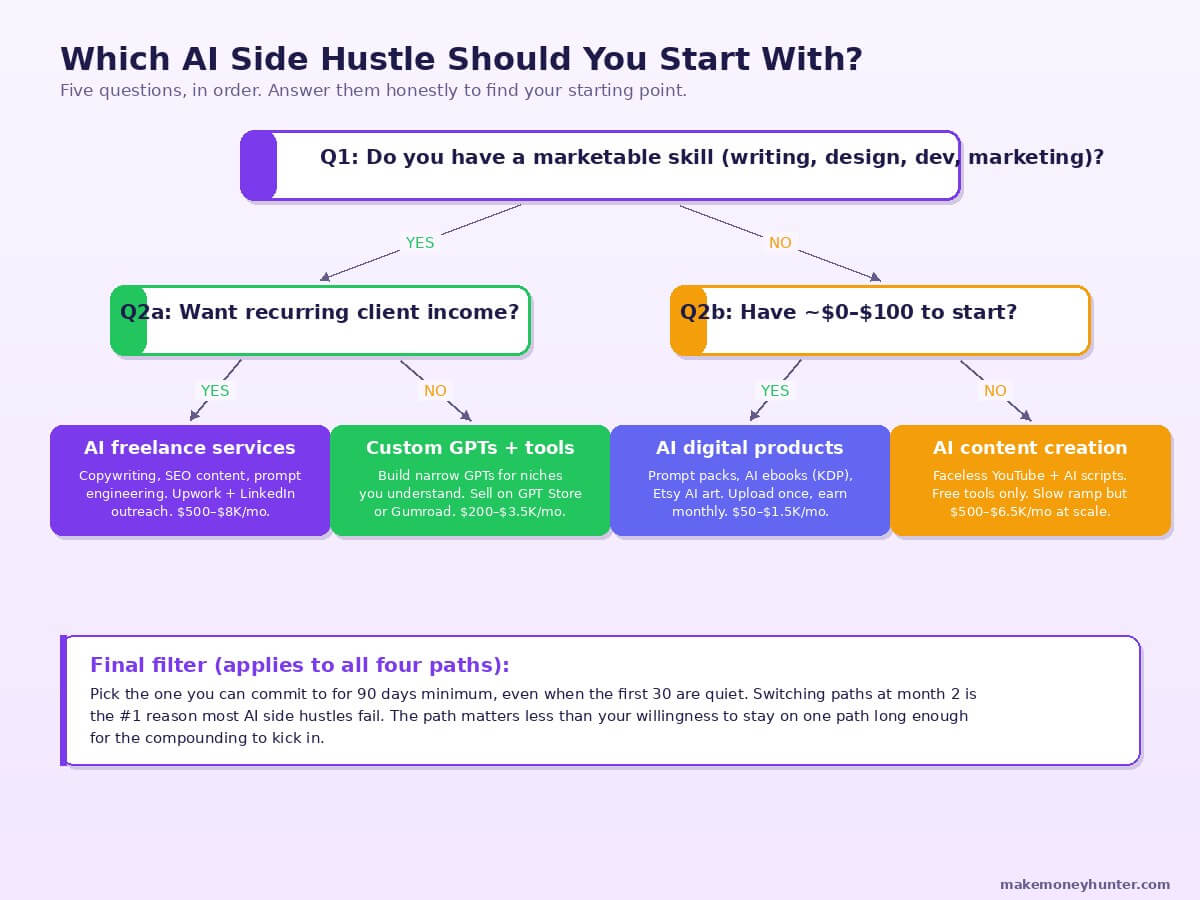
Match your starting state, not the income ceiling. The methods with the highest earning ceilings (workflow automation, consulting, wrapper apps) all require 12+ months of AI experience or pre-existing business skills. Starting there from zero is the fastest path to quitting in 60 days.
If you have a real skill — writing, design, dev, marketing — start with freelance services (#1 or #9). The income ramps in days, not months. If you have $0 and no marketable skill, start with prompt packs (#5) or AI ebooks (#6). Low cost, low risk, modest income, but you’ll learn how digital products actually sell. Then graduate to the bigger methods.
One more filter: pick the method that leverages a market you already understand. If you’ve been a kindergarten teacher for 8 years, your AI side hustle should serve teachers, parents, or schools. The leverage isn’t the AI — it’s your existing context. AI without context is a commodity. Context with AI is a moat. If you’re still trying to figure out which niche to commit to, my guide on choosing a blog niche that actually makes money uses the same logic and applies directly to AI products and services.
The Mistakes That Sink 90% of AI Side Hustles
I’ve watched the same four mistakes wreck people for two years now. None of them are about prompting or technical skills — they’re all about how people relate to the work.
- Mistake #1: Chasing the latest AI tool every week. By the time TikTok is excited about a tool, that tool’s window is closing. The people making real money in 2026 picked one stack 6 months ago and got insanely good at it. Tool-hopping is procrastination dressed up as research.
- Mistake #2: Confusing “I built a thing with AI” with “I built a business.” A custom GPT with no users is not income. A prompt pack with no listing is not income. The product is 20% of the game; distribution is 80%. Most failed AI side hustles built the 20% beautifully and never started the 80%.
- Mistake #3: Quitting at the awkward middle. Months 2 and 3 are brutal. You’ve put in real work, you’ve earned $50, and the YouTube comment section convinces you the method doesn’t work anymore. It does — but the math only kicks in around month 6 for most of these methods.
- Mistake #4: Selling to people who don’t pay. Pricing AI services for college students or struggling solopreneurs guarantees thin margins and demanding clients. The people with budget — small business owners, agencies, mid-sized companies — don’t hang out on Reddit. You have to find them, which is the actual work most beginners skip.
The 2026 Reality Check: What Changed Since 2024
The AI side hustle landscape is wildly different from what 2023–2024 advice suggests. A few shifts that matter:
The “ChatGPT can write you 10 books a day” era is dead. Amazon, Google, and most marketplaces now detect low-quality AI content and either suppress it or remove it outright. The methods that work in 2026 require AI plus human expertise, real research, or genuine niche knowledge. Pure AI slop is a money loser.
Tool subscription costs are real now. ChatGPT Plus, Claude Pro, Midjourney, ElevenLabs — running a serious AI side hustle costs $50–$150/month in tooling. If you can’t get to break-even in month 2, the math compounds against you. Plan accordingly.
“AI” as a marketing word stopped working. Saying “I use AI” doesn’t sell anything anymore — buyers assume everyone does. What sells is the outcome (“blog posts that rank in 90 days”) or the speed (“ad copy delivered in 4 hours”). Drop “AI” from your sales pitch and your conversion rate will go up.
Frequently Asked Questions
How fast can I realistically start earning from an AI side hustle?
For service-based methods (AI copywriting, prompt engineering, automation consulting), you can land your first client in 2–6 weeks of consistent outreach. For product-based methods (prompt packs, AI ebooks, art prints), expect 1–3 months before your first $100, and 6–12 months before meaningful income. Anyone promising you $5K in your first 30 days is selling a course, not a method.
Do I need to be technical to make money with AI in 2026?
No. Eight of the 12 methods on this list require zero coding. The technical methods (custom GPTs without code, AI wrapper apps, workflow automation) have been dramatically simplified by tools like Cursor, Bolt, and Make.com — most are accessible to non-developers willing to learn. What you actually need is patience, niche knowledge, and the discipline to ship before things are perfect.
Will Google’s AI Overviews kill AI-written content?
It’s already killed lazy AI content. Sites that publish AI articles which simply summarize what’s already ranking have lost 60–80% of their traffic since the March 2026 core update. Sites publishing AI-assisted content built around original research, real testing, expert interviews, or unique angles are still ranking — and in many cases ranking better. The “information gain” signal is the new bar. AI is your assistant, not your strategist.
What’s the lowest-risk AI side hustle to test in my first month?
AI copywriting freelance gigs on Upwork or Contra. You start earning within 1–2 weeks of consistent applications, the startup cost is just an AI subscription, and you’ll learn fast whether you actually like AI-assisted work. If freelancing isn’t your thing, your second-best option is launching a single prompt pack on Gumroad — minimal cost, real product experience, and you’ll know within 60 days whether digital products are your style.
Can I run AI side hustles alongside a full-time job?
Yes — and you should, until you’ve validated income. The methods on this list that pair best with a 9-to-5 are prompt packs, AI ebooks, custom GPTs, and AI digital art (all asynchronous, none require client meetings during business hours). Avoid AI consulting and workflow automation as a side gig until you can quit — those involve real-time client work that conflicts with a day job.
Final Thoughts: The AI Side Hustle Worth Starting
If I were starting from zero in 2026 with no skills and a 9-to-5 job, here’s what I’d actually do — not what looks good in a YouTube thumbnail.
I’d pick one method from this list. I’d give it 90 days, full commitment. I wouldn’t read another guide on AI side hustles for those 90 days (yes, even this one). I’d track my hours and earnings honestly. At day 90, I’d evaluate: is this getting better, stagnant, or worse? Better → keep going. Stagnant → try one specific change. Worse → quit and pick the next method.
The boring secret of AI side hustles in 2026 is the same boring secret as passive income online in any decade: the people earning serious money picked one method, stuck with it through the awkward middle months, and stopped chasing the next shiny thing while everyone else was still picking. The AI tools changed. The discipline didn’t.
One method. Ninety days. No exceptions. The rest of the internet wants you to keep clicking — your bank account wants you to keep building.