
I almost gave up on proofreading after my third week. I’d sent out 47 applications, heard back from four clients, and earned a grand total of $62. My then-girlfriend asked if I was being scammed by my own side hustle. Fair question.
Eight months later, that same side hustle was paying me $2,800–$3,400 a month — without a degree, without an English major background, and without quitting my day job. Here’s the part nobody tells you in those YouTube videos: the difference wasn’t talent. It was knowing exactly where to find clients who pay real rates, and which jobs to skip entirely.
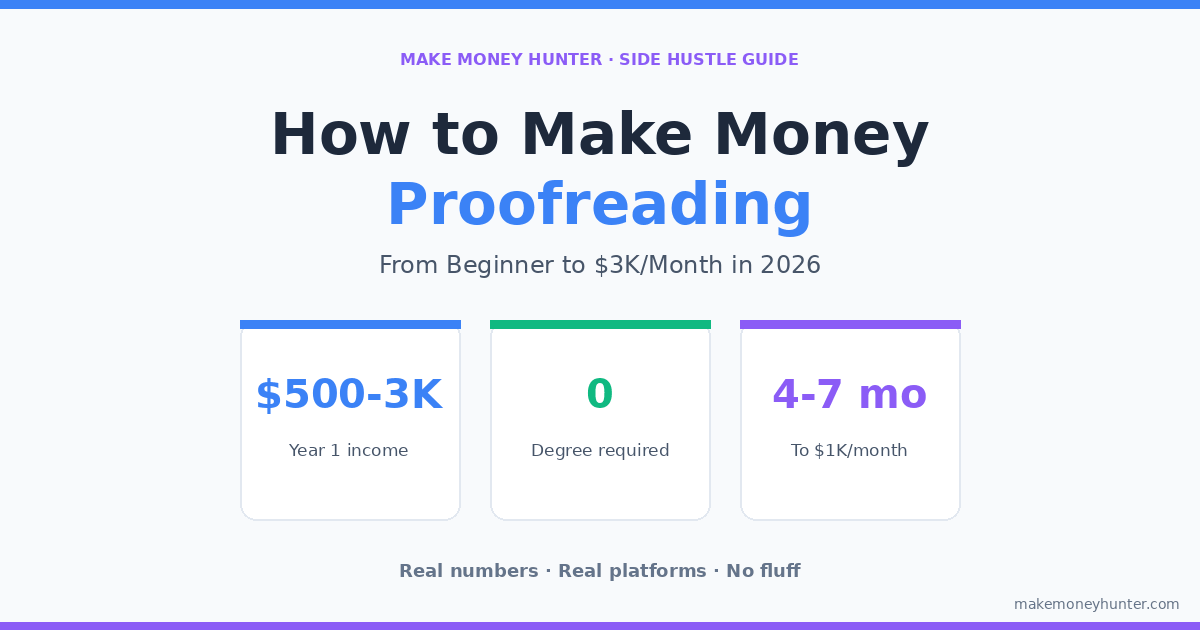
If you’re wondering how to make money proofreading in 2026 — when AI tools like ChatGPT and Grammarly seem to be doing the job for free — the short answer is yes, you absolutely can. The realistic income range is $500–$3,000/month within your first year, and $4K–$6K/month if you specialize and stay consistent for 18+ months. But only if you build it like a real freelance business, not as a “fill out a form and wait” gig.
In this guide, I’ll walk you through the exact path I used — the platforms that actually paid me, the rates I charged at each stage, the certification debate (spoiler: most aren’t worth it), and an honest take on whether AI is about to make this whole side hustle disappear.
What Does a Proofreader Actually Do (And What They Don’t)?
Most people use “editing” and “proofreading” like they’re the same job. They’re not. And confusing them is the fastest way to underprice yourself or take on work you’re not qualified for.
Proofreading is the final pass before publication. You’re catching typos, grammar errors, punctuation mistakes, formatting inconsistencies, and small wording issues. You’re not rewriting sentences or restructuring arguments. Average time: 1,000–1,500 words per hour for clean copy, slower for messy material.
Editing (copy editing or line editing) involves rewriting sentences for clarity, fixing awkward phrasing, restructuring paragraphs, and sometimes fact-checking. It takes 2–4× longer and pays 2–3× more — but it requires actual writing chops, not just attention to detail.
Here’s what surprised me when I started: most “proofreading jobs” on freelance platforms are actually light copy editing in disguise. Clients don’t know the difference and expect you to “fix” their writing. You’ll need to either accept that or politely scope the project before accepting it. I learned this the hard way after spending nine hours on a job I quoted for three.
Skills You Actually Need (Hint: Not an English Degree)
The Bureau of Labor Statistics lists proofreaders and copy markers as part of the broader editing profession. According to BLS data, the median hourly wage in this category is around $22, with top earners crossing $35/hour. None of those numbers require a specific degree.
What you do need:
- Genuine attention to detail — the kind where typos on a restaurant menu actually bother you
- Strong grammar instincts — not perfection, but the ability to know when something’s wrong even if you can’t name the rule
- One style guide familiarity — AP for journalism, Chicago for books, APA for academic work. You don’t need all three. Pick one based on your target niche.
- Reading speed and stamina — you’ll be reading 8,000–15,000 words on a busy day
- Comfort with software — Microsoft Word’s Track Changes, Google Docs comments, sometimes PDF annotation tools
I’d argue the most important trait is something nobody mentions: the willingness to be wrong politely. Half this job is suggesting changes to people who think their writing is perfect. Tone matters more than your technical skill.
How Much Do Proofreaders Make? (Real Rates by Platform and Experience)
This is the part where most guides get cagey. They say things like “rates vary widely” and move on. Let me give you actual numbers based on what I’ve seen and earned across different platforms over the past three years.
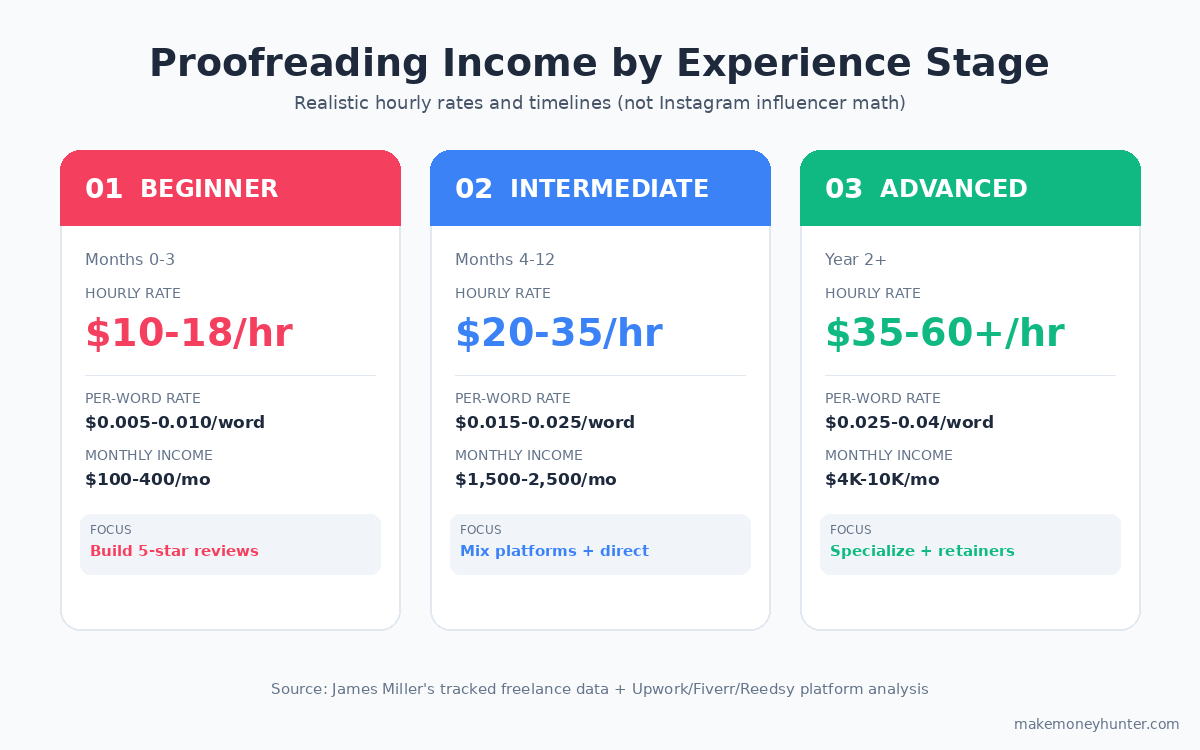
Beginner Stage (Months 0–3): $10–$18/hour
This is the platform-and-prove-yourself phase. You’ll be on Upwork, Fiverr, or similar marketplaces taking smaller jobs to build a portfolio and ratings. Expect to charge $0.005–$0.010 per word ($5–$10 per 1,000 words). Yes, it’s low. Yes, you’ll work for it. The point isn’t to get rich here — it’s to get five-star reviews fast.
My first month total: $187. My second month: $410. Not life-changing money, but it proved the model worked.
Intermediate Stage (Months 4–12): $20–$35/hour
Once you have 8–15 solid reviews, you can raise rates significantly. This is also when direct clients (referrals from past clients, outreach to small publishers, blogs needing regular work) become a bigger share of your income. Expect $0.015–$0.025 per word.
This is where the math starts to feel real. At 20 hours per week and $25/hour average, that’s $2,000/month — without quitting your day job.
Advanced Stage (Year 2+): $35–$60+/hour
By now you’ve specialized (more on that below) and you’re working mostly with retainers or repeat clients. Rates here are highly niche-dependent. Academic proofreading for PhD students or journal submissions can hit $50–$70/hour. Legal proofreading pays similarly. General blog content rarely crosses $40/hour, even at the top end.
The income ceiling here is roughly $4K–$6K/month working part-time, $7K–$10K/month if you go full-time. Not Instagram-influencer money, but a real, sustainable career.
Where to Find Proofreading Jobs (Ranked by What Actually Worked for Me)
I tested most major platforms. Here’s the honest ranking, from “actually useful” to “skip entirely.”
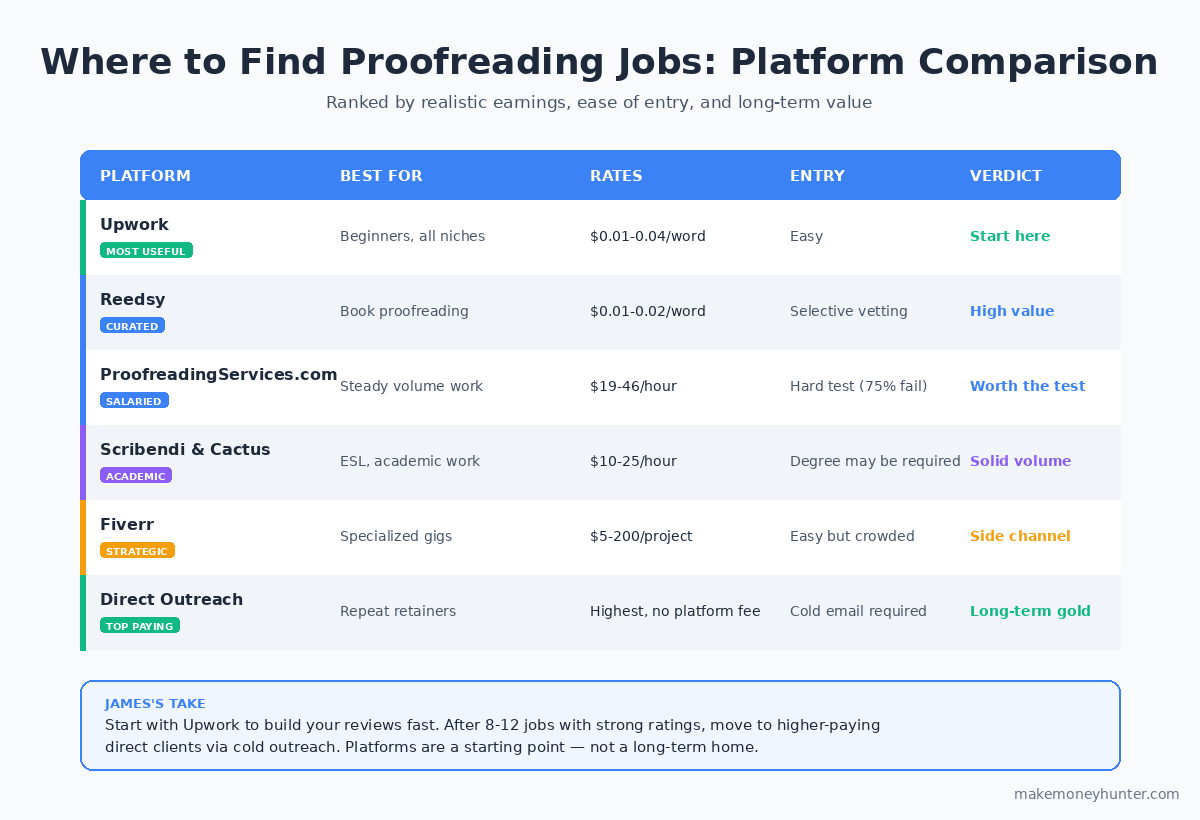
1. Upwork (Best for Beginners, Despite What People Say)
Upwork takes a 10% cut, but it’s where most legitimate clients with budgets actually look. The trick is to filter aggressively. Skip anything tagged “entry-level” with a $5 fixed price — those clients want a magic trick, not a professional. Apply for jobs paying $0.01+ per word, write personalized proposals (not templates), and quote a clear scope.
If you search “Proofreading” on Upwork’s talent directory, you’ll see what professional proofreaders actually look like on a working profile — the kind you want yours to resemble within 6 months.
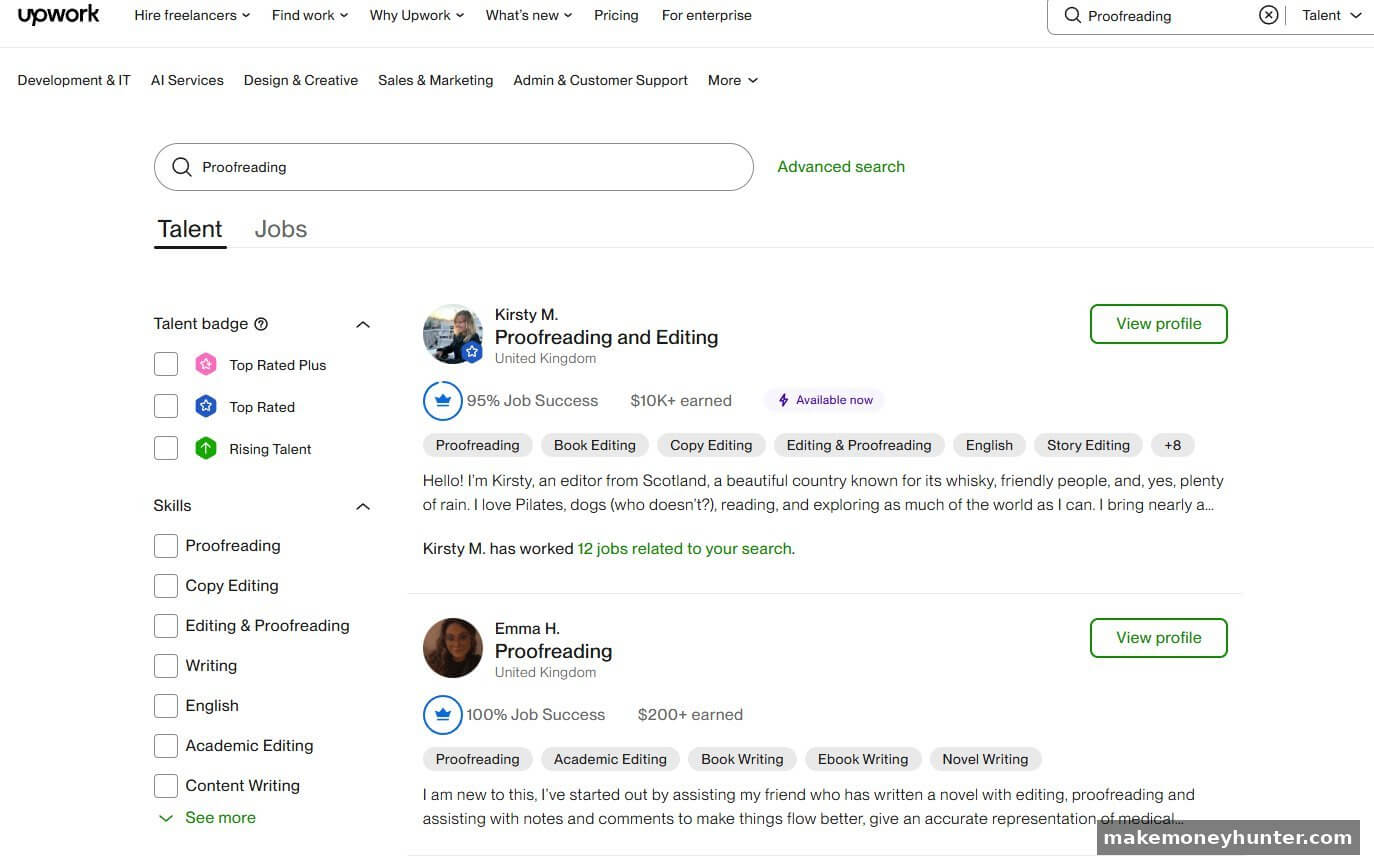
Notice what the top profiles have in common: clear niche tags (Book Editing, Copy Editing, Editing & Proofreading), Job Success Score percentages, real earnings displayed, and specific bios that mention concrete experience. This is your six-month target. The second profile in the screenshot shows a freelancer just starting out — only $200+ earned, 100% Job Success, generic bio. Both can win clients, but the top-tier profile is who you’re competing against once you raise your rates.
My Upwork stats after 18 months: 89 completed jobs, 4.97-star average, $0.02 average per-word rate. Most of my long-term clients started there before moving to direct invoicing.
2. Reedsy (Best for Book Proofreading)
Reedsy is curated — they vet your application before letting you in. Once you’re approved, the platform connects you with self-published authors needing book proofreading. Rates are typically $0.01–$0.02 per word, but books are 60K–90K words, so single projects pay $600–$1,800.
The catch: their approval process is selective. I was rejected the first time I applied. Reapplied a year later with a stronger portfolio and got in.
3. ProofreadingServices.com
This company hires proofreaders directly. They pay $19–$46/hour depending on turnaround speed (faster work = higher pay). The test is hard — about 75% of applicants fail it — but if you pass, the work is steady and the rates are honest.
4. Scribendi and Cactus Communications
Both hire freelance proofreaders, mostly for academic and ESL work. Scribendi requires a four-year degree (one of the few platforms that does). Cactus is more flexible. Rates run $10–$25/hour, but they provide consistent volume.
5. Fiverr (Use Strategically, Not as a Main Channel)
Fiverr’s race-to-the-bottom pricing makes it a tough place to start. But the smart move is to look at what’s actually working there before you build your own gigs.
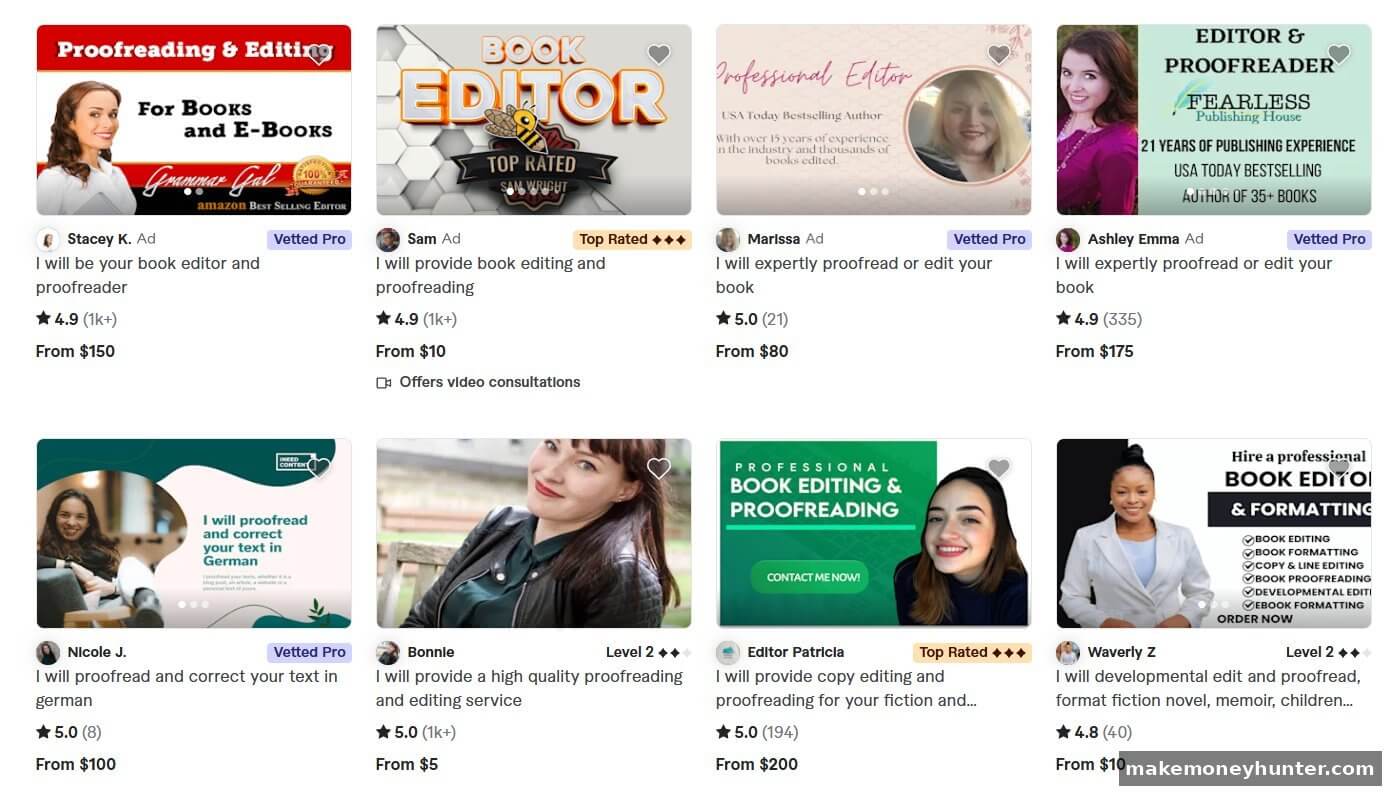
Look at this snapshot of book editing and proofreading gigs on Fiverr. The pricing range tells you everything you need to know: from $5 (Bonnie’s basic gig) all the way up to $200 (Editor Patricia, Top Rated). The exact same surface-level service — “I will proofread your book” — sells for 40× the price. The difference isn’t proofreading skill. It’s positioning.
Notice what the higher-priced sellers do: they specialize (German texts, Top Rated badges, “21 years of publishing experience”), they show review counts in the thousands, and they package their offer specifically (book editing for fiction, copy & line editing, developmental editing). The $5 gigs are competing on price alone. The $150–$200 gigs are competing on expertise.
The takeaway: don’t try to enter Fiverr at the bottom price tier. You’ll be racing 200 other sellers offering the same thing. Build 2–3 hyper-specialized gigs (“proofreading for tech startup pitch decks,” “academic paper proofreading for ESL writers,” “memoir proofreading”), price them at $50+ minimum, and let the cheap competition fight over the basement. I made about $1,400 there in my second year using exactly this approach — it was never my main income, but it consistently produced higher-quality clients than the platform’s average.
6. Direct Outreach (Highest Long-Term Value)
The clients who paid me the best never came from a platform. They came from cold emails to small publishers, content marketing agencies, and blogs that publish a lot of content but don’t have an in-house editor. A simple template that worked for me:
“Hi [Name], I noticed your team publishes 4–5 articles per week on [topic]. I’m a proofreader specializing in [niche], and I’d love to take some of the editorial burden off your plate. Happy to do a free trial on your next piece — no strings attached. Best, [Your name]”
I sent 60 of these over two months in 2025. Got 11 responses, did 6 free trials, landed 3 retainer clients worth a combined $1,800/month. Not a quick method, but the ROI is enormous compared to bidding on Upwork. If you want a similar playbook for other writing-based income streams, my breakdown on how to make money writing from home covers the same outreach strategy applied to broader writing services.
Do You Need a Proofreading Certification?
Short answer: usually no. Long answer: it depends on your goal.
The most well-known program is Proofread Anywhere, run by Caitlin Pyle. It’s the most heavily marketed proofreading course online, and it’s been featured in Business Insider, Forbes, and The Penny Hoarder.
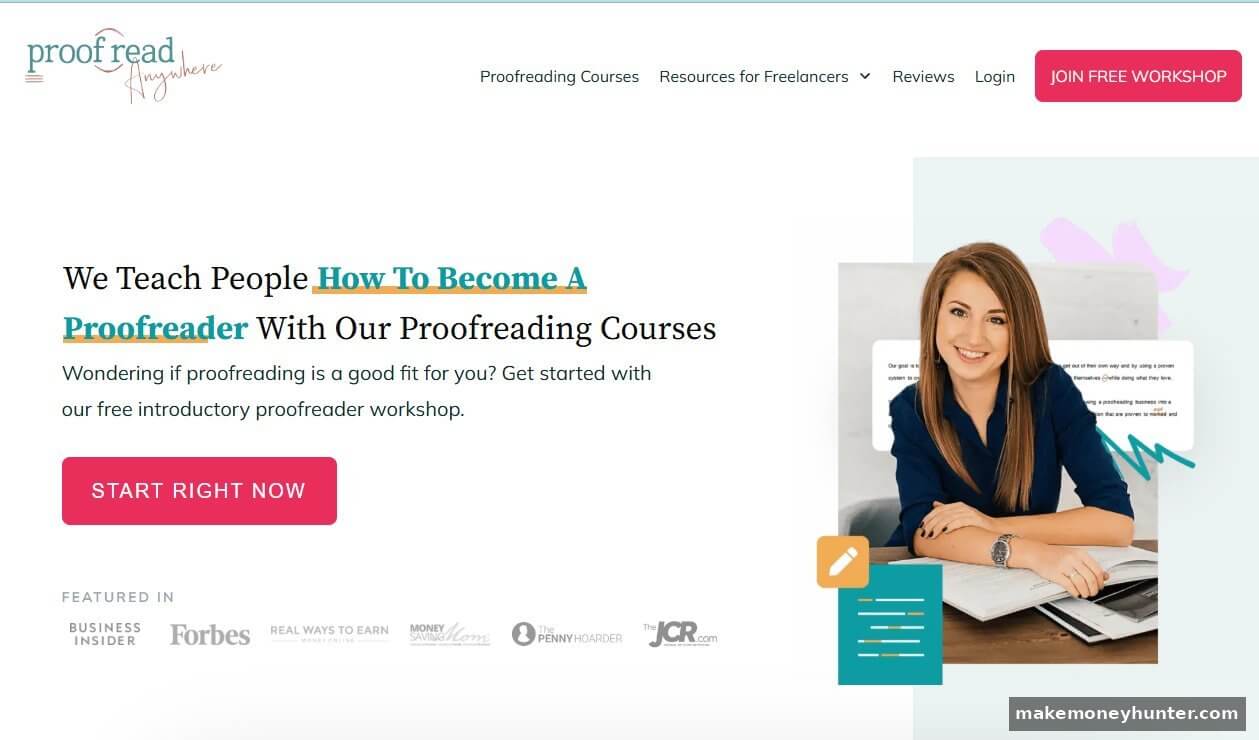
The free intro workshop on their site is genuinely useful — even if you don’t buy the paid course, it answers the “is this for me” question honestly. The Proofread Anywhere general track costs around $497, and the transcript proofreading specialty costs $1,197. Whether it’s worth the investment depends on whether you’d actually use the structure and accountability, or whether you’d absorb the same lessons from free resources and trial-and-error.
What you’re really paying for isn’t the proofreading information — that’s available in books and free tutorials. You’re paying for the business side: how to set up your freelance operation, how to find clients, how to scope and price projects, and the community of other proofreaders to bounce questions off of. That’s genuinely valuable for some learners and totally redundant for others.
Other options include the Editorial Freelancers Association courses and the Poynter Institute’s grammar courses. None of them are gatekeepers — meaning no client has ever asked me which course I took. They’re useful for confidence and skill-building, not credentialing.
Here’s my honest framework for deciding:
- Skip the certification if you have strong grammar instincts already, can self-direct your learning, and aren’t allergic to figuring things out as you go
- Consider the certification if you need external accountability, want a clear curriculum, or are targeting a specialty (court transcripts, medical proofreading) where formal training genuinely helps
I never took a paid course. I read The Copyeditor’s Handbook by Amy Einsohn, studied AP style for two weeks, and learned the rest from job feedback. That’s not me bragging — it’s me saying you don’t need permission to start.
The 7 Steps to Make Money Proofreading (Realistic Timeline Included)
Step 1: Pick a Niche (Week 1)
“General proofreader” is the lowest-paying tier. Specialized proofreaders earn 2–4× more for the same hours. Good niches to consider:
- Academic and ESL — high volume, dependable clients, $25–$40/hour ceiling
- Blog and content marketing — easy entry, low ceiling ($15–$25/hour), but predictable retainer work
- Self-published books — high project value, longer timelines, $0.01–$0.02 per word
- Legal documents — high pay ($35–$60/hour), but requires familiarity with legal style
- Transcripts — court reporting transcripts pay well but require specialized training and a certificate
Pick one based on your existing knowledge or genuine interest. Don’t pick “the highest paying” if you can’t speak the language of that industry.
Step 2: Build a Portfolio (Weeks 2–3)
You don’t need paid clients to build a portfolio. Find 4–5 pieces of public writing in your niche (Medium articles, blog posts, sample academic papers) and proofread them. Create a simple PDF showing the original and your tracked changes. This is what you’ll show prospective clients.
Pro tip: ask three friends or acquaintances to let you proofread something they’ve written — a resume, an essay, a business proposal. Get a one-paragraph testimonial from each. Real testimonials, even small ones, dramatically increase your application response rate.
Step 3: Set Up Your Workspace and Tools (Week 3)
You need very little. The non-negotiables:
- Microsoft Word (Track Changes is the industry standard)
- Grammarly Premium — useful as a second-pass safety net, not a replacement for your eye
- A style guide reference (AP Stylebook online subscription or the Chicago Manual)
- A simple invoicing tool — I used Wave (free) for years before switching to QuickBooks
Don’t over-invest in gear or software before you have clients. You can run this entire business on a 5-year-old laptop.
Step 4: Create Profiles on 2–3 Platforms (Week 4)
Don’t try to be everywhere. Pick two — I recommend Upwork plus one specialty platform (Reedsy if you’re doing books, ProofreadingServices.com if you want salaried-style work). Spend real time on your profile copy. The headline and first two sentences matter more than the rest combined.
Your profile should answer one question fast: why should they pick you over the 200 other proofreaders here? Specificity beats credentials. “I proofread blog content for SaaS companies and have edited 80+ articles” beats “Experienced proofreader available for various projects.”
Step 5: Land Your First 10 Jobs (Months 1–3)
This is the brutal phase. You’ll apply to 30–60 jobs to land the first one. Don’t get discouraged — almost every successful freelancer has the same story. The goal in this stage isn’t profit, it’s five-star reviews. Take small jobs, overdeliver, ask for written feedback.
Track everything: jobs applied to, responses, interviews, jobs won, hourly rate equivalent. After 30 days, you’ll have actual data on what’s working.
Step 6: Raise Your Rates (Months 4–6)
After 8–12 completed jobs with strong reviews, raise your rates by 25–40%. Yes, you’ll lose some price-sensitive clients. Yes, that’s the point. The clients who pay better are usually less demanding and more stable. Stop optimizing for the bottom of the market.
Step 7: Diversify Beyond Platforms (Months 6–12)
Platforms are a great start, but they’re a tax on your income (Upwork takes 10%, Fiverr takes 20%). Once you have enough work to be selective, start moving clients to direct invoicing. Build an email list of past clients. Send a quarterly “still available for projects” note. Most of my income from year two onward came from this kind of repeat and referral business.
If you’re considering proofreading specifically because you want a flexible work-from-home job that doesn’t involve customer-facing work, I covered a broader list in my guide on non-customer service jobs that actually pay well. Proofreading sits squarely in that category — quiet, focused, no Zoom calls required.
Is AI Going to Kill Proofreading as a Side Hustle?
This is the question I get most often, especially since late 2024 when ChatGPT and Claude started getting genuinely good at copy editing. Let me give you the honest answer: yes and no, and the difference matters a lot.
What AI has killed: the bottom tier. The $0.001-per-word “fix typos in this blog post” market is gone. Clients who used to pay $20 for that work now run their text through ChatGPT for free. If your entire offering was “I find typos,” AI is your competitor and it doesn’t sleep.
What AI hasn’t touched (and probably won’t for years):
- Style guide compliance — AI doesn’t know which AP rule trumps which Chicago rule for your specific publication
- Voice preservation — AI tends to flatten distinctive voices into a generic register
- Context-aware judgment calls — knowing when an “error” is intentional, when a deviation works, when to push back on the author
- Specialized fields — legal, medical, court transcripts, academic citations
- Liability — a publisher can’t sue ChatGPT when a typo makes it to print, but they can sue you. That’s why they still want a human
The proofreaders being squeezed are the ones who were always doing the easiest work. The proofreaders thriving are the ones who specialized, built relationships, and positioned themselves as humans-in-the-loop for important content — not as cheap labor competing with software.
If anything, AI tools have made my work faster, not less valuable. I use Grammarly for the first pass to catch the obvious stuff, then I spend my time on the judgment calls that actually require a human brain. My effective hourly rate has gone up, not down, since 2023.
For a broader look at how women in particular are using flexible online skills like this to build sustainable income, my guide on flexible side hustles for women covers similar models applied to different freelance services.
Common Mistakes That Keep New Proofreaders Stuck at $200/Month
I made most of these myself. The lessons stuck because the failures hurt.
Mistake 1: Pricing by the hour from day one. Hourly pricing punishes you for getting faster. After three months of practice, I was reading at twice my original speed but earning the same hourly rate. Per-word or per-project pricing solves this.
Mistake 2: Not scoping the project before quoting. “Can you proofread this?” can mean anything from “fix typos” to “rewrite this entire thing.” Always ask for a sample of the work and clarify the scope in writing before sending a price.
Mistake 3: Working with cheap clients. The lowest-paying clients are almost always the most demanding. They send revisions at midnight, change scope after delivery, and leave 4-star reviews because of vague complaints. Fire them early. Their replacement will pay double and complain half as much.
Mistake 4: No system for tracking work. When you have one client, you remember everything. When you have eight, things slip — and slipped deadlines kill your ratings. A simple spreadsheet tracking job, deadline, word count, and rate saved me from disaster.
Mistake 5: Quitting too early. The first three months are statistically the worst they’ll ever be. The math gets better month over month if you stay consistent. Most people quit at the moment things would have turned around. If you’re going to commit, commit to at least six months before evaluating.
Frequently Asked Questions
Can you really make money proofreading without a degree?
Yes. The vast majority of proofreading work — freelance, platform-based, or direct — doesn’t require any specific degree. Some specialized employers (Scribendi for academic editing) require a bachelor’s degree, but it doesn’t have to be in English. Strong skills and a portfolio matter more than credentials.
How much can a beginner proofreader make in the first month?
Realistically, $100–$400 in your first month if you’re applying daily and accepting low-rate jobs to build reviews. Don’t compare yourself to bloggers showing $5K screenshots — those are outliers or people who’ve been at it for 18+ months. The first month is for proof of concept, not income.
Is proofreading still a viable side hustle in 2026 with AI tools?
Yes, but the entry-level “fix typos” market has shrunk. The viable path now is specialization — book editing, academic work, legal proofreading, or high-stakes content for publishers who need human accountability. General “I’ll fix anything” proofreaders are getting squeezed by AI tools.
What’s the difference between proofreading and copy editing?
Proofreading is the last pass — catching typos, grammar errors, and formatting issues without rewriting. Copy editing involves restructuring sentences, improving clarity, and ensuring consistency of voice and style. Copy editing takes longer and pays more, but requires writing skills, not just attention to detail.
Which proofreading certification is actually worth the money?
Most aren’t, for most people. Proofread Anywhere is the most reputable paid program if you need structure and want the business-side training. If you’re disciplined and self-directed, free resources plus a copy of The Copyeditor’s Handbook can get you most of the way there. No client has ever asked me which certification I have.
How long does it take to make $1,000/month proofreading?
For most people, 4–7 months of consistent part-time effort (10–15 hours per week). The path is roughly: month 1 building reviews, months 2–3 raising rates to $20+/hour, months 4–7 stacking enough steady clients to cross $1K/month. Faster is possible with aggressive outreach and a strong niche; slower is normal if you’re treating it as truly part-time.
Final Thoughts: Should You Actually Do This?
One last thing — ignore anyone who tells you proofreading is passive income. It’s not. It’s front-loaded income. You work hard in months 1–6 to build reviews, refine your process, and find the right clients. After that, the math starts working in your favor: same hours, more pay, less stress, repeat business.
That’s actually a much better deal than passive income. Passive income takes years to build and disappears the moment a platform changes its rules. A real freelance skill, once you have it, belongs to you. Nobody can deplatform you out of knowing how to proofread.
If you’ve got a sharp eye for detail, 5–10 hours a week, and the patience to grind through the first three months, this is one of the most realistic paths to $2K–$3K/month in extra income I know of. Not glamorous. Not viral. Just real.
Pick a niche today. Set up one platform profile this week. Apply to ten jobs. That’s the entire starting line.