

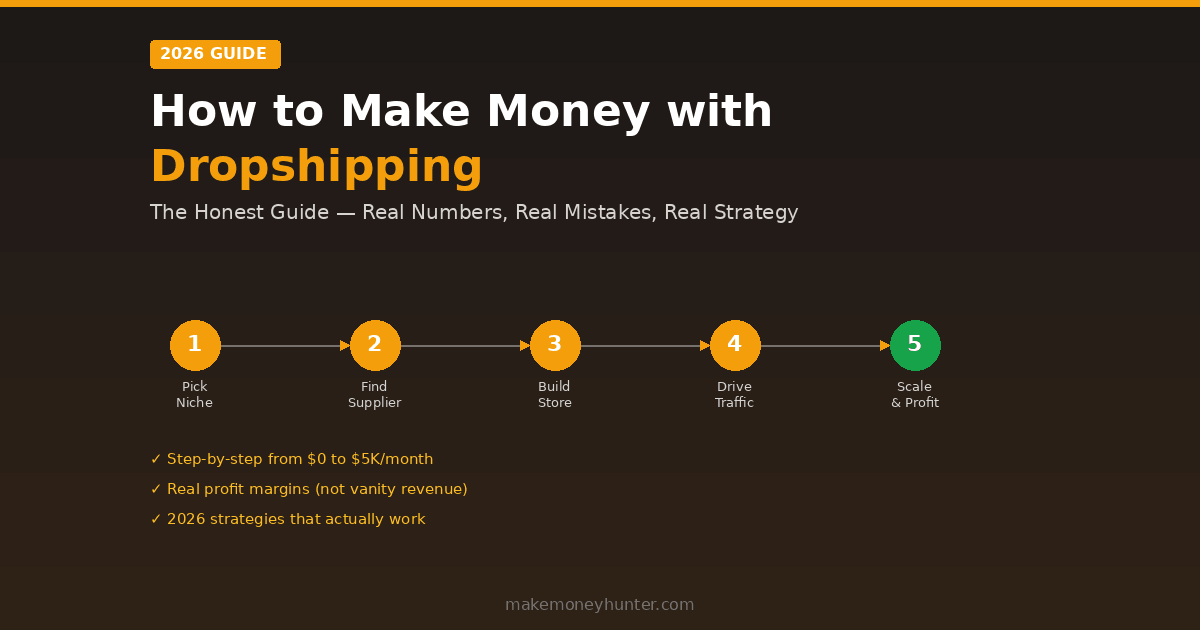
My first Shopify store lasted exactly 74 days. I spent $1,400 on Facebook ads, sold 23 phone cases with motivational quotes on them, and walked away with a net loss of $890. The store is still sitting in my Shopify archive, collecting digital dust. That was 2019, and it taught me more about dropshipping than any YouTube guru ever could.
So when people ask me how to make money with dropshipping, I don’t start with the success story. I start with what actually went wrong — because understanding the failure mechanics is the only way to build something that lasts.
The short answer: yes, you can still make money with dropshipping in 2026. Realistic numbers are $1,000–$5,000/month in profit after 6–12 months of consistent work. But the game has changed dramatically. The “find a viral product on AliExpress, run TikTok ads, and print money” era is functionally dead. What works now looks very different from what the gurus are selling.
In this guide, I’ll break down the actual business model, walk you through how to start step by step, and share the specific mistakes that cost me nearly a thousand dollars before I figured things out.
Dropshipping is a retail fulfillment model where you sell products without holding any inventory. When a customer orders from your online store, the order gets forwarded to a third-party supplier who ships the product directly to the customer. You never touch the product. Your profit is the difference between what the customer pays and what the supplier charges.
That sounds clean on paper. In reality, it’s messier than most people expect.
You’re essentially a middleman with a website. The supplier handles manufacturing, storage, and shipping. You handle everything else — finding products, building the store, driving traffic, handling customer service, managing returns, and dealing with the inevitable “where’s my order?” emails when a package from China takes 18 days to arrive.
The barrier to entry is extremely low. A Shopify subscription starts at $39/month. You can have a store live in a weekend. That accessibility is both the appeal and the problem — because when everyone can do it, competition becomes the defining challenge.
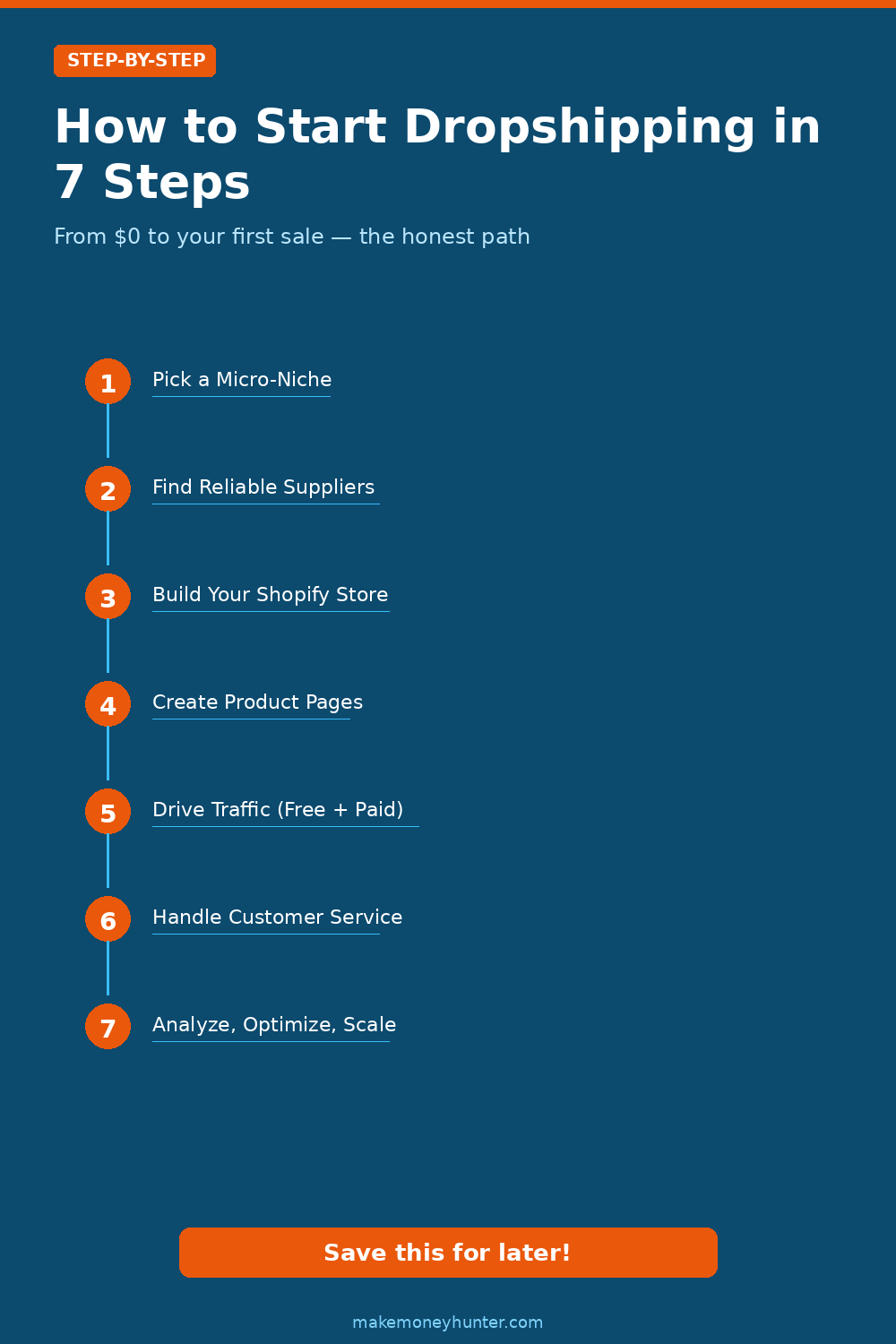
📌 Pin the image below so you can follow these steps when you’re ready to start.
How Does Dropshipping Actually Make Money?
The money flow is straightforward, but the margins tell the real story.
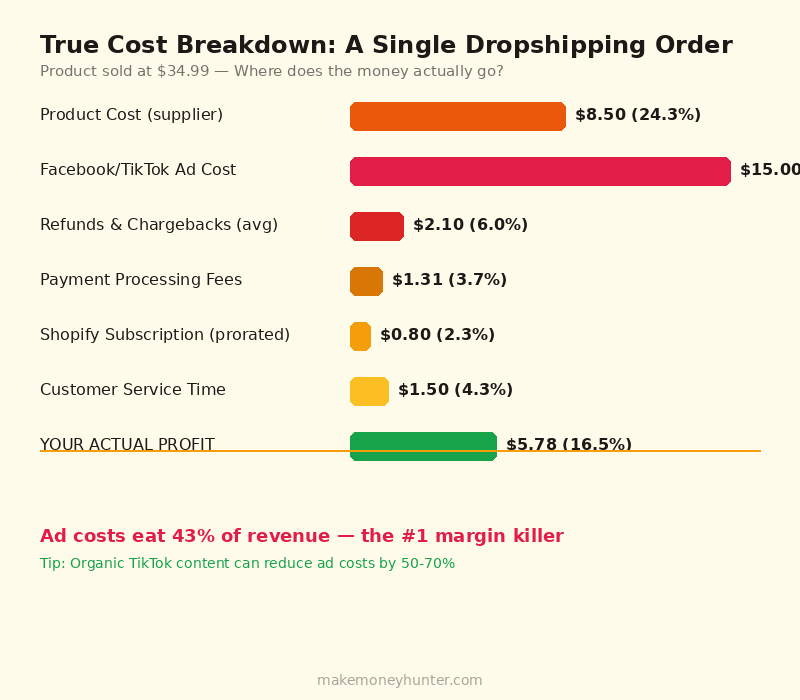
Let’s say you sell a posture corrector for $34.99. Your supplier on CJdropshipping charges $8.50 including shipping. That looks like $26.49 in profit. Incredible, right?
Not so fast. Here’s where the math gets uncomfortable:
- Product cost: $8.50
- Shopify subscription (prorated per order): ~$0.80
- Payment processing (Shopify Payments, ~2.9% + $0.30): ~$1.31
- Facebook/TikTok ad cost per acquisition: $12–$18 (this is where it hurts)
- Refunds and chargebacks (industry average 5–8%): ~$2.10
- Customer service time (your time has value): ~$1.50
Actual profit per sale: roughly $3–$8. Not $26.
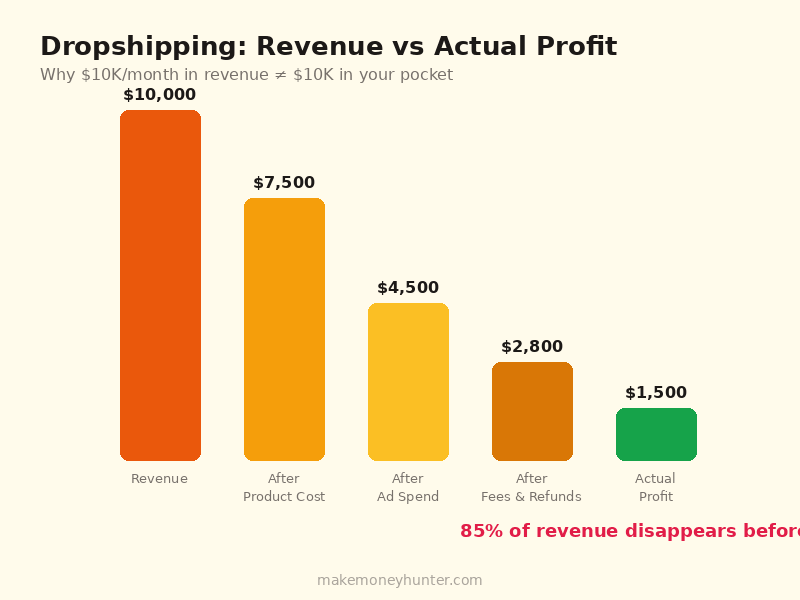
This is the single biggest disconnect in the dropshipping space. Gurus show you revenue screenshots — “$47,000 in 30 days!” — but they’re not showing you the ad spend, the refund rate, or the 14-hour days handling customer complaints. Most dropshippers making “$10K/month in revenue” are actually taking home $1,000–$2,000 in profit. Some are losing money.
That doesn’t mean it’s not worth doing. It means you need to go in with realistic expectations and a strategy that prioritizes profit margins over vanity revenue numbers.
Is Dropshipping Still Profitable in 2026?
Yes — but the winners look very different from what they looked like three years ago.
The dropshipping landscape in 2026 has shifted in three major ways:
First, customer expectations have caught up. People know what dropshipping looks like now. A generic store with stock photos, no brand story, and 15–25 day shipping times gets abandoned instantly. Consumers expect fast shipping (7 days or less), real product photos, and a store that looks like an actual brand — not a weekend project.
Second, ad costs have continued climbing. Facebook CPMs have increased roughly 30% since 2023 in most ecommerce categories. TikTok ads, which were cheap in 2022–2023, have normalized to competitive rates. This means the “spray and test 50 products with $5/day budgets” approach burns money faster than ever.
Third, the winners are building brands, not stores. The profitable dropshippers I’ve studied in 2026 aren’t running generic “one-product wonder” stores. They’re building niche brands with 15–30 curated products, investing in branded packaging through suppliers, and treating dropshipping as the fulfillment method — not the entire business model.
If you’re thinking about starting an online business from home, dropshipping is still one of the lowest-cost entry points. But the “low cost” part only applies to inventory — you’ll still need to invest real time, energy, and ad budget to make it work.
How to Start a Dropshipping Business Step by Step
Here’s the exact process I’d follow if I were starting from scratch today — knowing everything I know now, including the $890 I lost learning the hard way.
Step 1: Pick a Micro-Niche (Not a “Trending Product”)
This is where 90% of new dropshippers go wrong. They start with a product. They should start with an audience.
The old playbook was: find a viral product on AliExpress → build a one-product store → blast Facebook ads → hope it sells. That worked in 2018. In 2026, it’s a money pit.
The new approach: pick a micro-niche audience first, then find products they already want.
A micro-niche isn’t “fitness.” It’s “home gym owners who train in small apartments.” It’s not “pets.” It’s “first-time French Bulldog owners.” It’s not “kitchen.” It’s “meal prep enthusiasts who batch-cook on Sundays.”
Why does this matter? Because when you know exactly who you’re selling to, three things get easier:
- Your ad targeting becomes surgical instead of spray-and-pray
- Your product selection becomes obvious (you’re solving specific problems for specific people)
- Your store branding has a clear voice and identity
Spend at least a week researching your niche before touching Shopify. Browse Reddit communities. Read Amazon reviews in your category — the 3-star reviews are gold because they tell you what people wish existed. Check Google Trends to confirm the niche has sustained interest, not just a temporary spike.
Step 2: Find Reliable Suppliers (This Makes or Breaks You)
Your supplier relationship determines your customer experience. Period. If your supplier ships late, sends wrong items, or uses terrible packaging, your customers blame you — not the supplier.
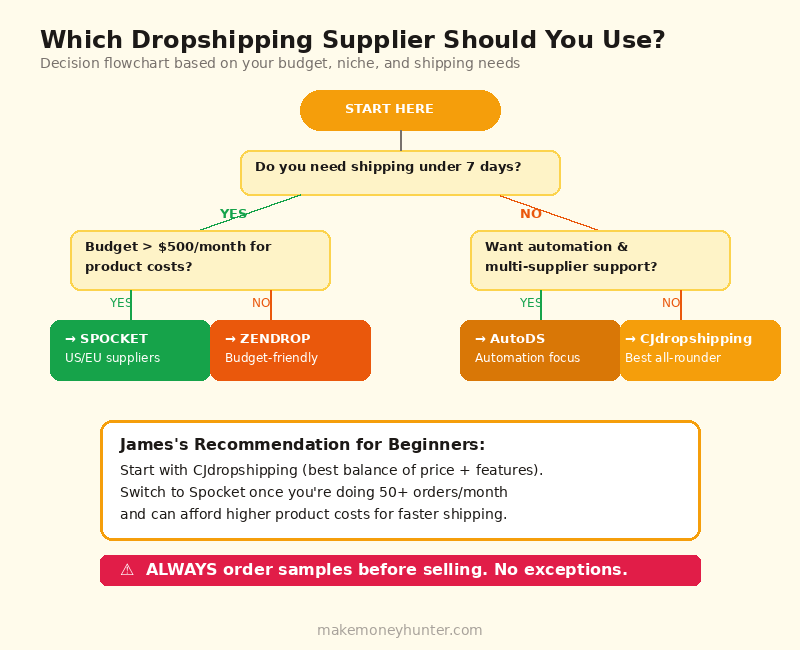
Here are the supplier platforms worth considering in 2026:
| Platform | Best For | Shipping Speed | Pricing |
|---|---|---|---|
| CJdropshipping | General products, custom packaging | 7–15 days (US warehouse: 3–7 days) | Competitive, often cheaper than AliExpress |
| Spocket | US/EU-based suppliers for faster shipping | 2–7 days | Higher product cost, better margins on premium items |
| Zendrop | Beginners, branded packaging options | 5–12 days | Mid-range |
| AutoDS | Automation and multi-supplier management | Varies by supplier | Subscription-based ($24.90+/mo) |
| AliExpress | Product research (not ideal for fulfillment in 2026) | 15–30 days | Lowest prices, highest headaches |
My recommendation: Start with CJdropshipping or Spocket. Order samples before selling anything. I can’t stress this enough — I skipped this step on my first store, and the product quality was noticeably worse than what the listing photos showed. Your customers will notice too.
Step 3: Build Your Store on Shopify
Shopify remains the go-to platform for dropshipping in 2026, and for good reason. The app ecosystem is unmatched, the checkout conversion rates are among the highest in ecommerce, and the learning curve is manageable for beginners.
Here’s what your store needs to look professional (not like a dropshipping store):
- A real brand name — not “BestDealsShop” or “TrendyFinds.” Something that could be an actual company
- A clean theme — Dawn (free) or Sense work fine. Don’t spend $350 on a premium theme before making your first sale
- Custom product photos — order samples and shoot your own lifestyle photos. This alone puts you ahead of 80% of dropshipping stores
- A real About page — people check. A blank or generic About page kills trust
- Clear shipping expectations — be honest about delivery times. “7–12 business days” is better than lying and saying “3–5 days” when it actually takes two weeks
- A contact page with a real email — not a contact form that goes nowhere
The Shopify Basic plan at $39/month is all you need to start. Don’t upgrade until you’re doing consistent sales. Every dollar you save on overhead is a dollar that can go toward ad testing.
Step 4: Set Up Your Product Pages for Conversion
Your product pages do the selling. This is where most dropshippers get lazy and it costs them everything.
Write real product descriptions. Don’t copy-paste from AliExpress. Those descriptions are written by non-native English speakers and read like instruction manuals. Instead, write descriptions that answer three questions: What does this product do? Why does the customer need it? What makes it different from the other options?
Use benefit-driven headlines. Not “Adjustable Posture Corrector” but “Stop Slouching at Your Desk — Without Thinking About It.”
Include social proof. If you’re just starting and don’t have reviews yet, use product review import apps (like Loox or Judge.me) to import reviews from the AliExpress listing. This is standard practice and legitimate as long as the reviews are real.
Add urgency carefully. “Only 3 left!” when you have unlimited stock is dishonest and customers know it. Instead, use honest scarcity like limited-time bundle pricing or seasonal relevance.
Step 5: Drive Traffic (Without Going Broke on Ads)
This is where the game is won or lost. You can have the best store in the world, but if nobody sees it, you make zero dollars.
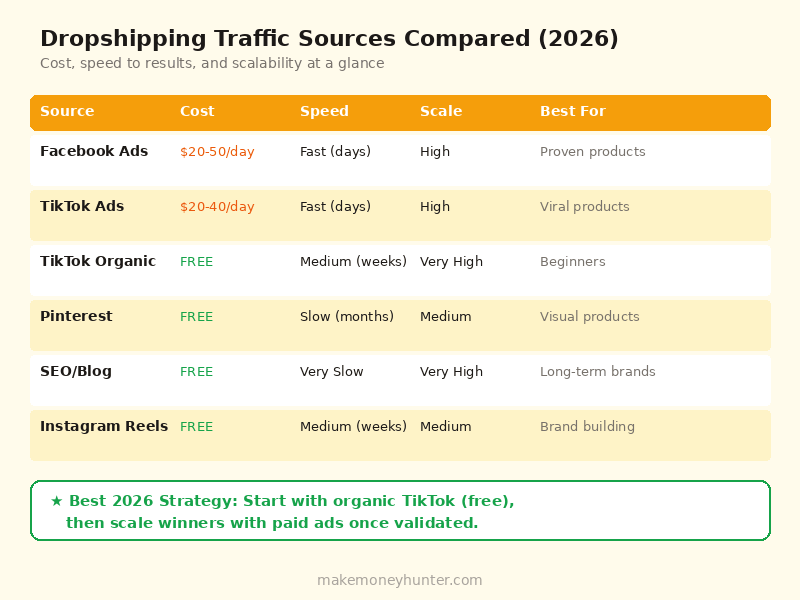
Paid ads (Facebook/TikTok): Start with $20–$30/day on a single campaign. Test one product to one audience. Don’t split $50 across 10 different ad sets — you’ll get garbage data on all of them. Run the test for 3–5 days before making decisions. If your cost per purchase is more than 3x your target, kill the ad and test a new angle (different creative, different audience, different hook).
Organic TikTok content: This is the free traffic cheat code of 2026. Create short videos showing your product in use. You don’t need to show your face. Product demonstrations, unboxing videos, and “POV: when you finally find a [product category] that actually works” style content can generate thousands of views and drive free traffic to your store. I’ve seen new dropshippers get their first sales entirely from organic TikTok without spending a dollar on ads.
Pinterest: Underrated for product-based businesses. Create product pins with lifestyle images. Pinterest users are in buying mode — they’re actively searching for products and ideas. It’s slower than paid ads but the traffic is free and compounds over time.
SEO blog content: Write 5–10 blog posts targeting long-tail keywords related to your niche. “Best home gym equipment for small apartments” or “French Bulldog winter care guide.” This takes months to pay off but builds a free traffic engine that reduces your dependence on paid ads.
Step 6: Handle Customer Service Like a Real Business
Here’s the unsexy truth nobody wants to talk about: dropshipping customer service is exhausting. You’ll deal with late shipments, damaged products, wrong sizes, lost packages, and the occasional angry customer who demands a refund before their order even arrives.
Set up a system early:
- Auto-response emails for order confirmation and shipping updates (Shopify does this natively)
- A clear refund policy on your website — 30-day money-back guarantee builds trust and actually reduces refund requests because it lowers purchase anxiety
- Response time under 24 hours — use a shared inbox tool like Gorgias or just a dedicated Gmail account
- Pre-written templates for common issues (shipping delays, refund requests, wrong items)
Good customer service is a competitive advantage because most dropshippers are terrible at it. When I ran my phone case store, I lost at least 5 potential repeat customers because I was slow to respond to simple questions. Don’t make the same mistake.
Step 7: Analyze, Optimize, Scale
After your first 30 days, you should have enough data to make real decisions:
- Which products are actually selling? Double down on winners, cut losers fast
- What’s your real profit margin per order? Factor in everything — product cost, shipping, ads, fees, refunds
- Where is your traffic coming from? If organic TikTok is working, create more content. If Facebook ads are bleeding money, test new creatives before increasing budget
- What’s your return rate? If it’s above 10%, you have a product quality problem
Scaling doesn’t mean throwing more money at ads. It means improving your conversion rate (so each visitor is more likely to buy), increasing your average order value (through bundles and upsells), and reducing your cost per acquisition (through better ad targeting and organic content).
Dropshipping Pros and Cons: The Honest Version
| Pros | Cons |
|---|---|
| Low startup cost ($100–$500 to get started) | Thin profit margins (often 15–30% after all costs) |
| No inventory risk — you only pay when you sell | Zero control over shipping speed and quality |
| Location-independent — run it from anywhere | Heavy customer service load for one person |
| Easy to test products and niches quickly | High competition — low barriers mean crowded markets |
| Scalable without proportional cost increase | Ad platforms can shut down accounts unexpectedly |
| Good entry point for learning ecommerce | Building a brand takes time — most people quit too early |
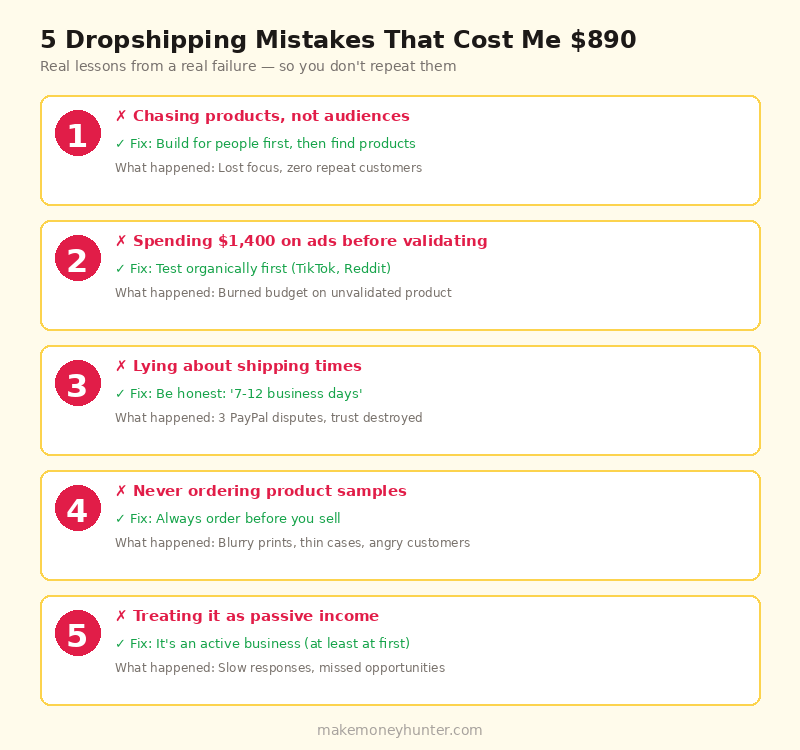
5 Mistakes That Cost Me $890 (So You Don’t Have to Repeat Them)
Let me save you the tuition I paid the hard way.
Mistake #1: Chasing “winning products” instead of building for a real audience. I picked phone cases because someone on YouTube said they were “hot.” I had zero connection to the niche, zero understanding of the audience, and zero reason for someone to buy from me instead of Amazon. Build for people, not for products.
Mistake #2: Spending $1,400 on Facebook ads before validating the product organically. If people won’t buy your product when you show it to them for free (through TikTok content, Reddit posts, or Facebook groups), throwing paid ads at it won’t fix the problem. Validate first, then scale with ads.
Mistake #3: Lying about shipping times. I listed “5–7 business days” when the actual delivery was 18–22 days from China. Three of my 23 customers opened PayPal disputes. The trust damage wasn’t worth the few extra conversions the fake shipping promise generated.
Mistake #4: Ignoring product research entirely. I never ordered a sample. The first time I saw my own product was in a customer’s complaint photo — the print quality was blurry and the case was thinner than advertised. Always, always order samples.
Mistake #5: Treating it as passive income. Dropshipping is not passive. It’s an active business that requires daily attention — ad monitoring, customer emails, supplier communication, content creation. The people making real money treat it like a job, at least in the first 6–12 months.
Dropshipping vs. Other Online Business Models
Is dropshipping the right choice for you? That depends on what you’re optimizing for.
| Model | Startup Cost | Time to First Dollar | Profit Margin | Long-Term Scalability |
|---|---|---|---|---|
| Dropshipping | $100–$500 | 2–8 weeks | 15–30% | Medium (brand-dependent) |
| Print on Demand | $50–$200 | 2–6 weeks | 20–40% | Medium (design-dependent) |
| Affiliate Marketing | $50–$200 | 3–12 months | High (no product costs) | High (content compounds) |
| Blog/Content Site | $50–$100 | 6–18 months | Very high | Very high (passive once established) |
| Amazon FBA | $2,000–$10,000 | 1–3 months | 20–35% | High (Amazon handles logistics) |
If you’re completely new to making money online, dropshipping is a solid starting point because the feedback loop is fast — you can test an idea and get real data within weeks. Building a content site (which is what I eventually pivoted to after my dropshipping store failed) takes much longer to generate income, but the profit margins and long-term value are significantly higher.
Many successful online entrepreneurs actually start with dropshipping to learn ecommerce fundamentals — paid traffic, conversion optimization, customer psychology — and then transition into higher-margin models once they have the skills and capital.
The 2026 Dropshipping Playbook: What Actually Works Now
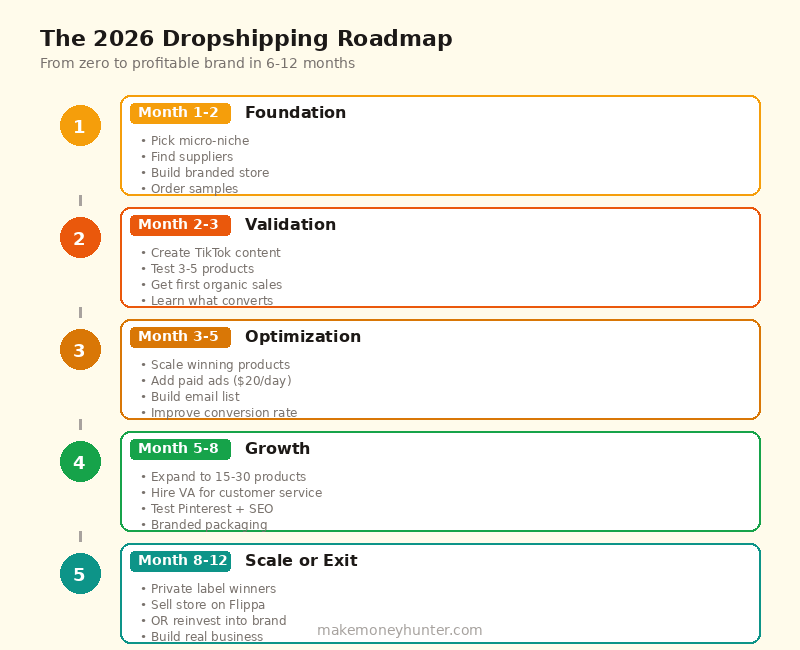
If I were starting a dropshipping business today from zero, here’s exactly what I’d do differently:
Build a niche brand, not a generic store. Pick one micro-niche. Name the store something that sounds like a real brand. Create an Instagram and TikTok account for the brand before launching the store. Post content for 2–3 weeks to build a small audience. This pre-launch audience gives you organic sales on day one without spending a dollar on ads.
Use US/EU-based suppliers from day one. Yes, they cost more. But 3–7 day shipping vs. 15–25 day shipping is the difference between a customer who orders again and a customer who opens a dispute. The slightly higher product cost gets offset by lower refund rates and higher repeat purchase rates.
Invest in content, not just ads. Create organic TikTok and Instagram Reels showing your products in use. This costs nothing but time, and a single viral video can generate more sales than a $500 ad campaign. I’ve watched new store owners get 50+ orders from one TikTok that took 20 minutes to film.
Build an email list from day one. Use a pop-up offering 10% off for email signup. Every email you collect is a free marketing channel. When you launch a new product or run a sale, you’re not starting from zero — you have an audience that already bought from you or showed interest.
Plan your exit strategy. The smartest dropshippers I know use dropshipping as a testing ground. They find products that sell consistently, then transition to buying inventory in bulk (private labeling) for 3–5x better margins. Or they sell the entire store on a marketplace like Empire Flippers or Flippa once it’s generating consistent revenue. Dropshipping is a great chapter one — it’s not meant to be the whole book.
Frequently Asked Questions
How much money can you realistically make with dropshipping?
Most successful dropshippers make between $1,000 and $5,000 per month in actual profit after 6–12 months. Top performers can reach $10,000–$30,000/month, but that usually requires significant ad spend, a strong brand, and multiple winning products. Be very skeptical of anyone claiming $100K/month — they’re usually showing revenue, not profit, and the two are wildly different in dropshipping.
How much does it cost to start dropshipping?
You can technically start for under $200 — Shopify plan ($39/month), a domain name ($12/year), and a small ad budget ($100–$150 for initial testing). Realistically, budget $500–$1,000 for your first three months to give yourself enough runway to test products and learn the process without running out of money mid-test.
Is dropshipping legal?
Yes, dropshipping is completely legal. It’s a standard retail fulfillment method used by major retailers. However, you do need to handle sales tax collection properly (Shopify automates most of this), follow advertising regulations (don’t make false claims about your products), and comply with consumer protection laws regarding refunds and shipping disclosures.
Can you do dropshipping without Shopify?
You can use WooCommerce (WordPress), BigCommerce, or even sell on marketplaces like eBay or Amazon. However, Shopify remains the most popular choice because of its app ecosystem, reliability, and the sheer number of dropshipping tools built specifically for it. The platform fee is worth the convenience, especially when you’re starting out.
What’s the biggest reason dropshipping stores fail?
Unrealistic expectations and quitting too early. Most new dropshippers expect to find a “winning product” in the first week and start making $5,000/month by month two. The reality is that you’ll probably test 5–10 products before finding one that works, and your first profitable month might be month 4 or 5. The people who succeed are the ones who treat the early losses as learning investments, not failures.
Final Thoughts
Dropshipping in 2026 is not the gold rush it was in 2018. The easy money is gone. But that’s actually good news for anyone willing to put in real work — because it means the space isn’t flooded with low-effort stores anymore. The bar has risen, and the people who clear it have less competition than ever.
One last thing that I think matters more than any tactic in this guide: stop thinking about dropshipping as a “passive income” model. It’s not. It’s a business that requires active management, creative problem-solving, and continuous optimization. The “passive” part only comes later — after you’ve built systems, hired help, and created a brand that sustains itself. Until then, it’s real work. And honestly? That’s a much better deal than passive. Because the skills you build doing this — paid advertising, copywriting, customer psychology, supply chain management — are transferable to literally any business you start next.
If you’re going to try it, try it properly. Pick a niche. Order samples. Build something that looks like a real brand. Be honest with your customers. And give it at least six months before you decide whether it works or not.