

You’ve watched the YouTube videos. You’ve scrolled through the Reddit threads. You’ve seen friends post about their “side hustle” — and yet every time you actually try to sign up for something, the same wall hits you: “You must be 18 or older.” Or worse, the platform takes your account two weeks later when it figures out your real age.
I’ve spent the last year helping my 16-year-old nephew test online income methods, and I learned something most “teen money guides” leave out: the age-gate problem is the whole game. Pick the wrong method and you’ll waste three weekends for $0. Pick the right one and you can realistically pull in $50–$500 a month before you finish your sophomore year.
So this guide does what most others don’t. For every method below, I tell you the actual minimum age, whether you’ll need a parent’s account or signature, and how fast you can realistically get to your first $50.
Some of these I tested myself back when I was 17 (long before “creator economy” was a phrase). Others I’ve watched real teens use in 2025 and 2026. None of them require a credit card, a business license, or a “secret hack.” Let’s get into it.
Quick Answer: How Much Can a Teenager Realistically Make Online?
Honest range based on what I’ve actually seen working teens earn: $50–$500 per month in the first 3 months for simple methods (surveys, tutoring, content clipping), and $500–$3,000+ per month after 6–12 months for skill-based methods (freelance design, YouTube, niche websites).
Nobody making $10,000/month at 15 is being honest about month-1 results. The teens who actually win are the ones who pick one method, stick with it through the boring middle, and don’t try to do all fifteen at once.
The bigger split in this list isn’t “easy vs. hard” — it’s “needs a parent’s help vs. doesn’t.” If you’re 13–15, you’ll need a parent or guardian to set up most payment accounts (PayPal requires 18+, Stripe requires 18+, most bank accounts require a co-signer until 18).
That’s not a bug — it’s federal law (COPPA + state-level financial regulations). Pick a method that matches your situation, not your fantasy.
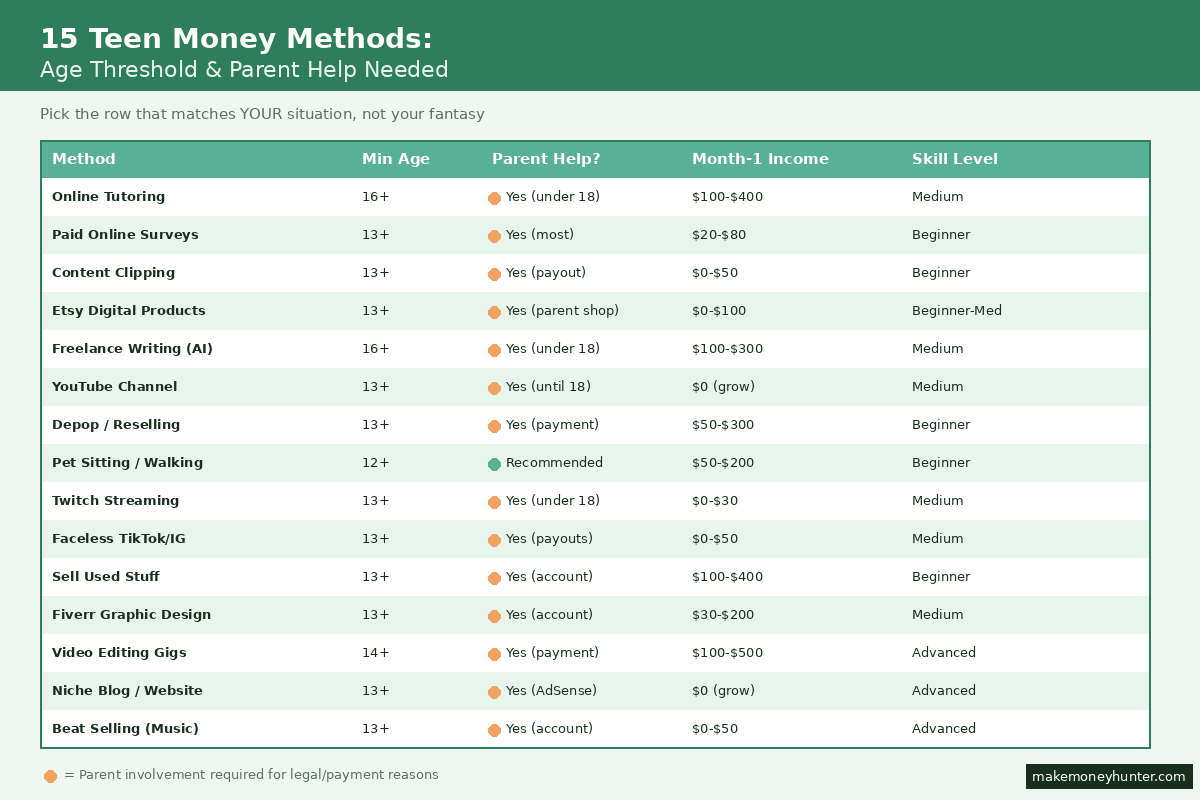
Here’s the at-a-glance breakdown for all 15 methods — bookmark this image and come back to it whenever you’re deciding what to try next:
1. Online Tutoring (Best for: ages 16+, school subjects you’re already good at)
Age requirement: Most platforms require 16+ (Wyzant: 18+, Preply: 18+, but you can tutor through your school or local network at any age). Parent help needed: Yes, for platform sign-up under 18.
Here’s the thing about tutoring as a teen — you have a structural advantage older tutors don’t. You just took the SAT. You just survived AP Calculus. You remember exactly which problems are confusing because you were confused six months ago. Parents pay a premium for tutors who can speak the language of a struggling 8th grader, not a retired math teacher who’s been out of high school for 30 years.
Realistic rate: $15–$30/hour through word-of-mouth, $20–$45/hour through Wyzant or local tutoring agencies. If you tutor 6 hours a week at $20/hour, that’s $480/month. The best part: you’re getting paid to re-learn material that helps your own grades.
- How to start without a platform: Tell your parents, tell your school counselor, post on your neighborhood Facebook group (have a parent post for you). Most successful teen tutors I’ve seen never use a platform — they get clients through their parents’ networks.
- Best subjects to tutor: Math (algebra through pre-calc), SAT/ACT prep, AP Biology, AP US History, intro Spanish. These have the highest demand and the highest rates.
- Worst subjects: Anything “general” — “I tutor English” is a hard sell. “I tutor SAT writing section, scored a 760” is an easy sell.
2. Paid Online Surveys (Best for: ages 13+, very low time commitment)
Age requirement: Swagbucks accepts 13+ with parental permission. Most others (Survey Junkie, InboxDollars, LifePoints) require 18+. Parent help needed: Yes, in most cases either to co-sign or to receive payouts.
Let me be straight with you: surveys are not a real income source. The teens who tell you they make “$500/month doing surveys” are either lying or counting hours that earned them $2/hour. Realistic earnings are $20–$80/month with maybe 5 hours of weekly effort. That said, surveys are one of the few methods where 13-year-olds can legitimately make their first few dollars online, which has real psychological value — the first $10 you earn changes how you see the internet.
Of all the survey sites I’ve tested with teens, Swagbucks is the only one that actually pays out small balances quickly enough to keep a 14-year-old motivated. The dashboard mixes short paid surveys (5–25 SB each, roughly 5–25 cents) with bonus offers, video tasks, and product trials, so when surveys run out you’re not stuck waiting.
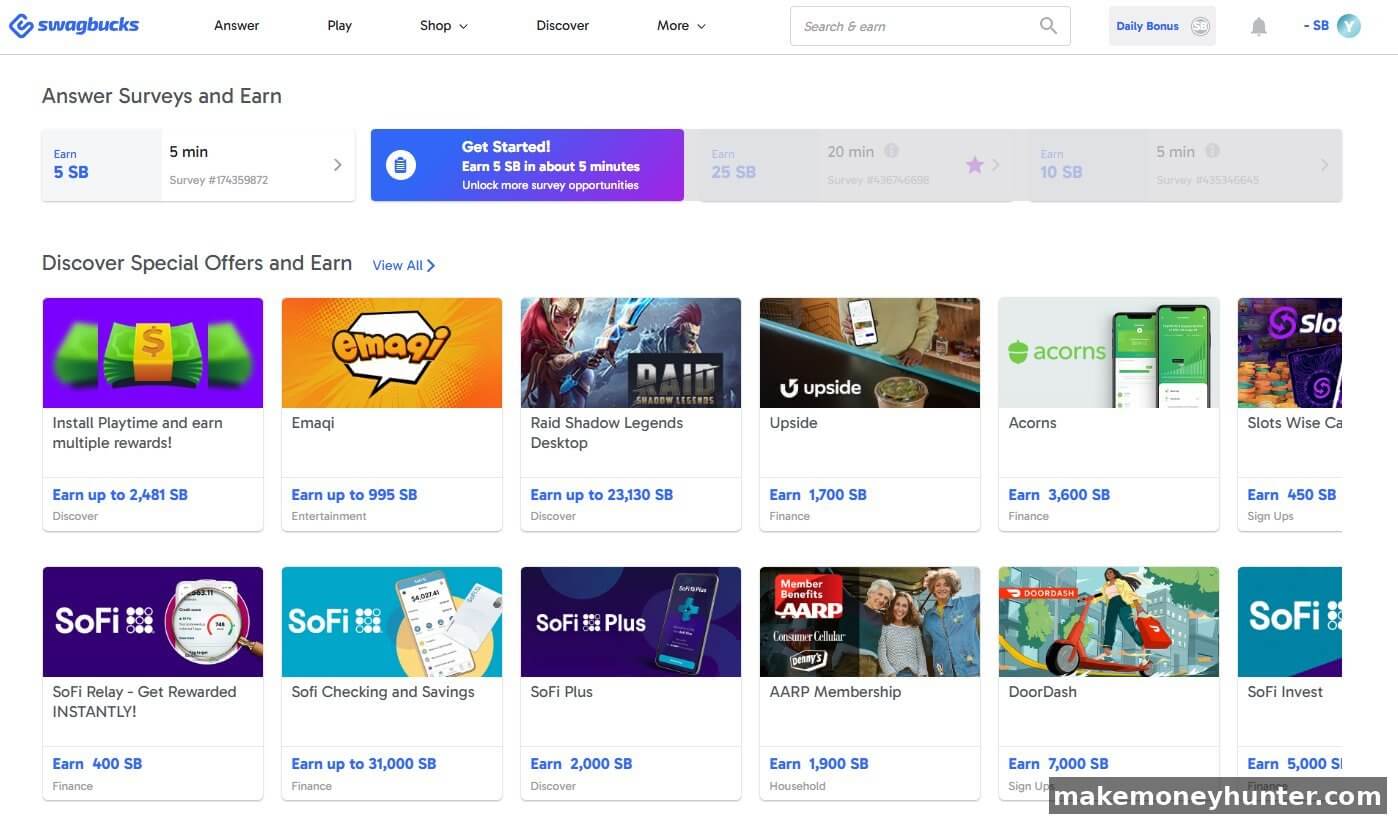
The screenshot above shows what a real Swagbucks dashboard looks like — those “5 SB” and “25 SB” rectangles at the top are individual surveys you can knock out in 5–20 minutes, and the offers below (Acorns, DoorDash, SoFi) are higher-paying tasks if you’re 18 or your parent helps you sign up. 100 SB ≈ $1, and you can cash out to PayPal or gift cards (Amazon, Target, Starbucks) starting at $3.
One tactical note for teens specifically: focus on the “Daily Goal” streak. Hit it every day for a week and you get a small bonus on top of your earnings. That’s where the $80/month ceiling actually becomes reachable — not from any single high-paying survey, but from the cumulative streak math. Sign up free at Swagbucks here and use a parent’s email for the account if you’re under 18, then disclose your real age to the parent so they can manage the PayPal payout.
Treat surveys as “pocket money while you wait in the car”, not a side hustle. The hourly rate is too low to justify dedicated time, but if you’d otherwise be scrolling TikTok, it’s free money. For a deeper breakdown of which Swagbucks tasks pay best, see my full Swagbucks earnings guide.
3. Content Clipping (Best for: ages 13+, the highest-leverage option for younger teens)
Age requirement: Most clipping platforms require 13+ (with parental account for payouts). Parent help needed: Yes, for the PayPal or Stripe account that receives payouts.
This is the method I’d pick if I were 15 today. Content clipping means you take long videos from creators or brands (with their explicit permission, through programs like Whop Clips), cut them into 30-60 second short-form clips, post them on TikTok/Instagram Reels/YouTube Shorts, and earn $1–$5 per 1,000 views. No camera, no face on screen, no original content required.
The reason this works for teens specifically: you already understand short-form pacing in a way most adults don’t. You scroll TikTok 3 hours a day. That’s not wasted time — that’s market research. The teens who win at clipping are the ones who already have a feel for what hooks people in the first 1.5 seconds.
- Realistic month-1 earnings: $0–$50. Most clips flop. You’re learning the algorithm.
- Realistic month-3 earnings: $100–$800 if you post consistently (5–10 clips per day).
- Watch out for: Programs that ask you to pay upfront to “join.” Real clipping programs are free to join — they pay you, not the other way around.
4. Selling Digital Products on Etsy (Best for: ages 13+ with parent’s account, creative teens)
Age requirement: Etsy technically requires 18+ to open a shop, BUT teens 13–17 can sell through a parent’s Etsy shop with parental supervision (this is explicitly allowed in Etsy’s policy). Parent help needed: Yes — the shop is technically in their name.
Digital products are perfect for teens because there’s zero inventory, zero shipping, and zero physical risk. Look at what’s actually selling on Etsy right now if you search “goodnotes templates”:
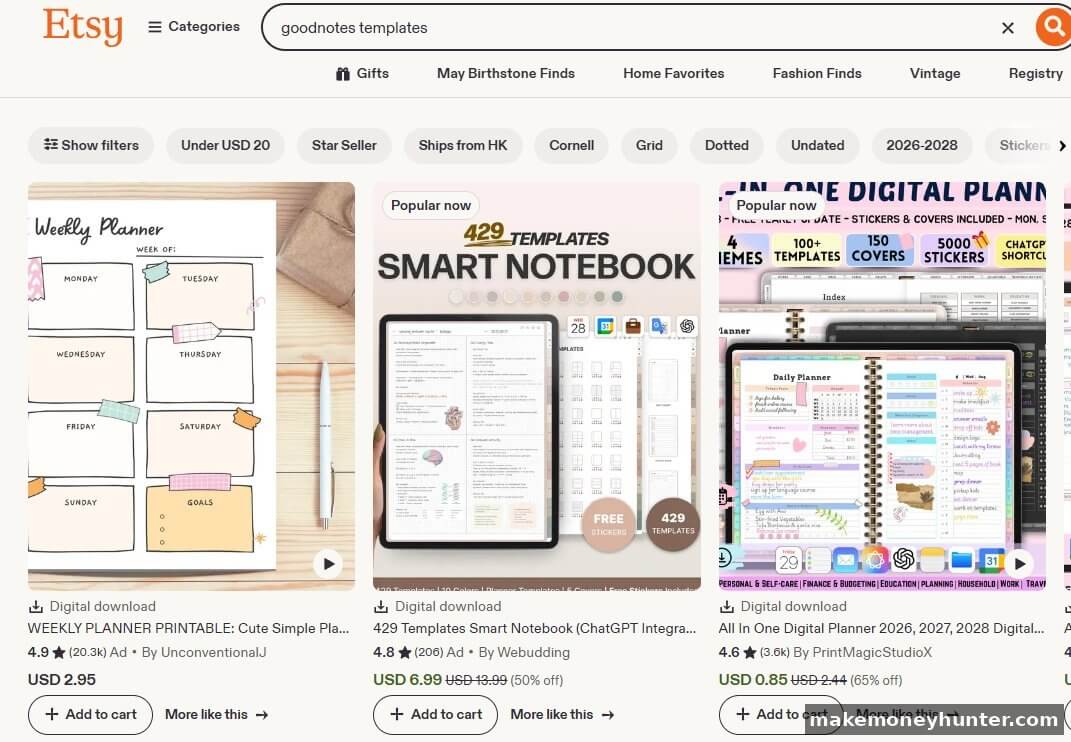
Three things to notice in that screenshot. First, the prices: $0.85 to $13.99. These aren’t luxury items — they’re impulse buys for high school and college students who want to feel organized. Second, look at the review counts (20.3k, 206, 3.6k). Each one of those reviews represents at least one real sale, which means there’s massive proven demand. Third, the top sellers aren’t art masterpieces — they’re clean, simple, well-categorized templates. You don’t need to be an “artist” to make these.
Things that sell well right now:
- Aesthetic study planners (Notion templates, GoodNotes templates) — $3–$12 per download
- Wallpaper packs for phones and laptops — $2–$8 per pack
- Printable wall art (designed in Canva) — $3–$10 per print
- Discord server templates for gaming communities — $5–$20 each
- Procreate brushes if you’re into digital art — $4–$15 per set
A teen I know started selling Notion study templates in late 2024. By month 6 she was averaging $180/month in pure passive income — products she made once, selling on autopilot. The kicker: she made them as a procrastination project during finals week. For more on what to sell and how to price, my complete Etsy guide for beginners walks through the full setup.
5. Freelance Writing with AI Assistance (Best for: ages 16+, strong English skills)
Age requirement: Fiverr requires 13+, Upwork requires 18+. Parent help needed: Yes, for payment processing under 18.
AI tools like ChatGPT have changed the math here. A 16-year-old with decent writing instincts and an AI assistant can now produce a 1,500-word blog post in under 90 minutes — work that would have taken a human writer 4 hours in 2022. Small businesses pay $25–$75 per article for this kind of content. Two articles a week = $200–$600/month.
The catch: AI-only content gets rejected fast. Clients want articles that don’t sound like AI. Your job is to take the AI draft, fix the robotic sentences, add specific examples, and inject personality. The exact prompting workflow that gets results is covered in my ChatGPT money methods guide — same process applies whether you’re 16 or 60.
6. YouTube Channel (Best for: ages 13+, but monetization at 18+)
Age requirement: You can start a YouTube channel at 13 (with parental supervision under YouTube’s terms). YouTube Partner Program (ads) requires 18+, but you can earn through brand sponsorships and affiliate links at any age with a parent managing the account. Parent help needed: Yes, account ownership must be a parent’s until 18.
YouTube is the slowest-paying method on this list and also the highest ceiling. Don’t expect anything for 6–12 months. After that, it can become serious money — teen creators in niches like gaming commentary, study-with-me videos, beauty/skincare, and educational explainers regularly earn $1,000–$10,000/month by year two.
If you actually search “teen youtuber” right now, you’ll see what’s working:
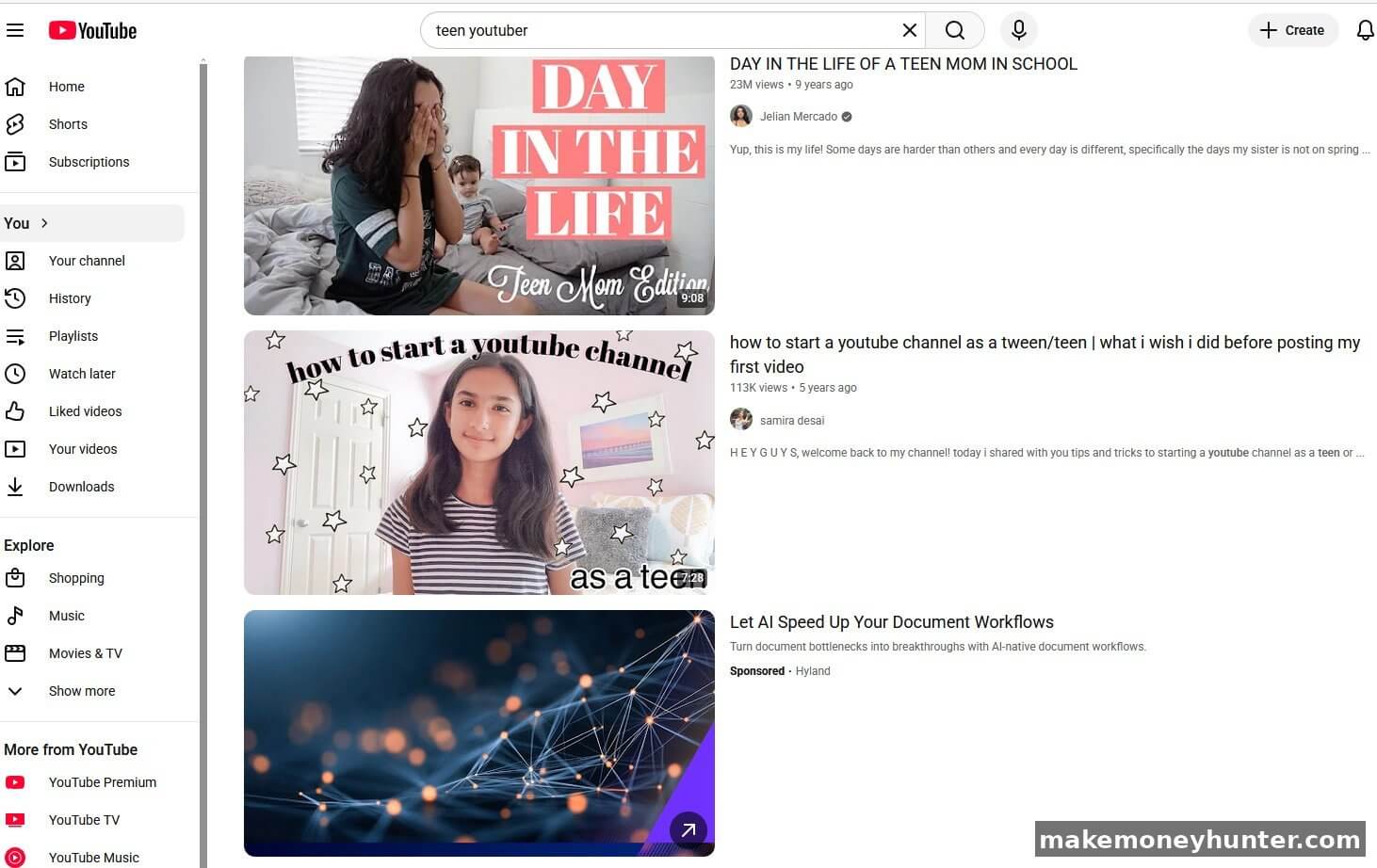
Notice something important in those results: the top video has 23 million views. That’s not a niche channel — that’s a real audience hungry for relatable teen content. Also notice the second result: “how to start a youtube channel as a tween/teen” with 113K views from 5 years ago. That single video has been earning ad revenue passively for half a decade. That’s the YouTube math you’re betting on — not viral hits, but evergreen videos that keep paying year after year.
The winning teen niches in 2026 specifically:
- Faceless gaming commentary — Minecraft, Roblox, Fortnite analysis (no on-camera reveal needed)
- Study-with-me / aesthetic study — surprisingly large audience of high schoolers and college students
- Stop-motion or animation channels — your generation grew up watching this, you have instincts
- Subject-specific educational — “AP Chem in 60 seconds” type content
If you’re serious about this path, see my full breakdown of how YouTube monetization actually works — it covers the revenue stack (AdSense + sponsorships + affiliates + memberships) you’ll need to layer.
7. Selling on Depop / Poshmark (Best for: ages 13+, fashion-conscious teens)
Age requirement: Depop allows 13+ with parental permission. Poshmark requires 18+. Parent help needed: Yes for payment.
This works for two specific types of teens: (1) those whose parents have a closet full of vintage stuff nobody’s wearing, and (2) those who can spot deals at thrift stores. A friend of mine’s daughter has been thrifting Y2K-era pieces ($3–$8 per item at Goodwill) and reselling on Depop for $25–$80 each. Her monthly take is around $300–$600.
The skill you’re really learning here isn’t fashion — it’s pricing psychology and product photography. Both transfer to literally every other online business.
8. Pet Sitting and Dog Walking (Best for: ages 12+, the most accessible method)
Age requirement: Rover requires 18+, but most clients hire teens 12+ directly. Parent help needed: Recommended for safety, but not strictly required.
I’m including this offline method because it’s the single fastest path to your first $100 if you’re under 16. Neighbors trust local teens with pets more than they trust strangers from an app. Realistic rate: $15–$25 per dog walk, $30–$60 per day of pet sitting, $10–$20 per hour of cat-sitting.
Make a flyer. Hand-deliver it to 30 houses in your neighborhood. I’ve watched this exact method generate 3–5 regular clients within two weeks for every teen who actually does it. The “I’ll just post online and hope” approach almost never works at this scale.
9. Twitch Streaming (Best for: ages 13+, gaming-focused teens)
Age requirement: Twitch allows 13+ to stream with parental consent. Twitch Affiliate status (where you earn money) requires 13+ as well, but payouts go to a parent’s account until 18. Parent help needed: Yes.
Twitch is brutal in 2026 — the platform is more competitive than ever. The big channels at the top (28K viewers for PGL Counter-Strike, 18K for ESLCS, 13K for yourragegaming) are essentially full-time professionals or esports orgs. You’re not competing with them. But look at the smaller live channels in the same browse view:
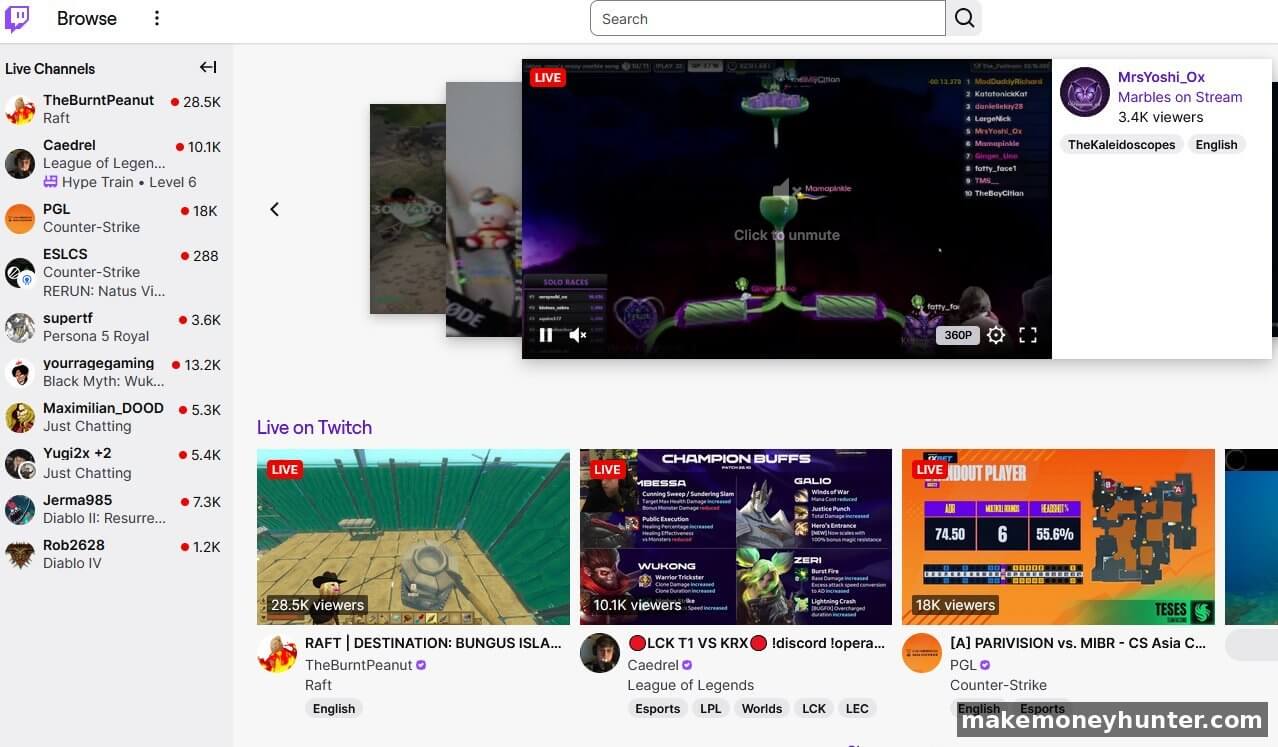
See that “Rob2628 — Diablo IV — 1.2K viewers” listing? Or “supertf — Persona 5 Royal — 3.6K viewers”? Those are the channels you can realistically compete with as a teen. A few thousand concurrent viewers earning $200–$2,000/month from subs, bits, and donations — that’s not a fantasy, that’s just niche game dedication.
The real opportunity is in niche game communities rather than trying to compete in Fortnite or League. Think Stardew Valley, Hollow Knight playthroughs, retro Pokémon randomizers, indie game discovery streams. Smaller pond, easier to get noticed.
Realistic earnings for a serious teen streamer year one: $0–$200/month. Year two with consistent 3-streams-per-week schedule: $200–$1,500/month from subscriptions, bits, and donations. This is a long game. My deeper guide on how Twitch streamers actually get paid breaks down the Affiliate vs. Partner tiers and exactly what you need to hit each.
10. Creating Faceless TikTok / Instagram Accounts (Best for: ages 13+, the highest “stealth” income option)
Age requirement: 13+ with parental account for monetization. Parent help needed: Yes for payouts.
“Faceless” content accounts have exploded since 2024 and are perfect for teens who don’t want classmates seeing their content. Examples:
- Quote/motivation accounts (slideshow format)
- Recipe accounts (just hands and food shown)
- Travel accounts (using stock B-roll + your voice)
- Study tips accounts (text overlays on aesthetic backgrounds)
- “Did you know” fact accounts (text + stock footage)
Monetization happens through TikTok Creator Rewards (requires 18+ to receive payouts, so parent’s account needed under 18), brand sponsorships, and affiliate marketing. A 16-year-old I follow runs a faceless study-tips account that hit 80K followers in 9 months and now earns roughly $400–$1,200/month through Amazon affiliate links to study products. My full TikTok monetization breakdown covers the math on follower-count vs. real income.
11. Selling Used Textbooks and Tech (Best for: ages 13+, end-of-semester timing)
Age requirement: Most marketplaces (Facebook Marketplace, eBay) require 18+ technically but functionally many teens use parents’ accounts. Parent help needed: Yes for account, no for the actual selling.
This isn’t a sustainable income method — it’s a one-time cash injection twice a year that can get you $100–$400 per cycle. End of every semester, sell your textbooks, your old gaming console, the iPad you don’t use anymore, that calculator you bought for one class. Combined value is usually higher than you think — most teens have $500–$1,500 of resellable stuff sitting around. For ideas on what to look for in your closet, I keep an updated list of things to sell to make money online.
The discipline this teaches (taking photos, writing descriptions, dealing with buyers) is the foundation for nearly every other online business model. Treat it as paid training.
12. Graphic Design Gigs on Fiverr (Best for: ages 13+ with Canva skills)
Age requirement: Fiverr allows 13+ with parental supervision. Parent help needed: Yes for account and payments.
You don’t need Photoshop or Adobe Illustrator. Canva (free version) is enough for 80% of what small businesses actually need: logo concepts ($15–$50), Instagram post templates ($10–$30), YouTube thumbnails ($5–$20), business card designs ($10–$25).
Start by designing for free for 5 people you know (parents’ friends, local businesses) to build a portfolio. Then list your gigs on Fiverr. Most teen designers I’ve seen reach $300/month within 3 months if they’re consistent. The ones who fail try to charge premium rates with zero portfolio.
13. Video Editing for Creators (Best for: ages 14+, technical teens)
Age requirement: Most freelance platforms 18+, but creator direct hires often accept 14+. Parent help needed: Yes for payment.
This is one of the highest-paying skill-based methods for teens because demand massively outstrips supply. Every YouTube creator with 50K+ subscribers wants an editor. Most editors are mediocre. A teen who actually learns CapCut, DaVinci Resolve, or Premiere Pro at a real level can charge $50–$200 per edited long-form video, or $20–$60 per short.
Just to show you what real demand looks like — here’s a snapshot of Fiverr’s “repurpose long videos into shorts” category right now:
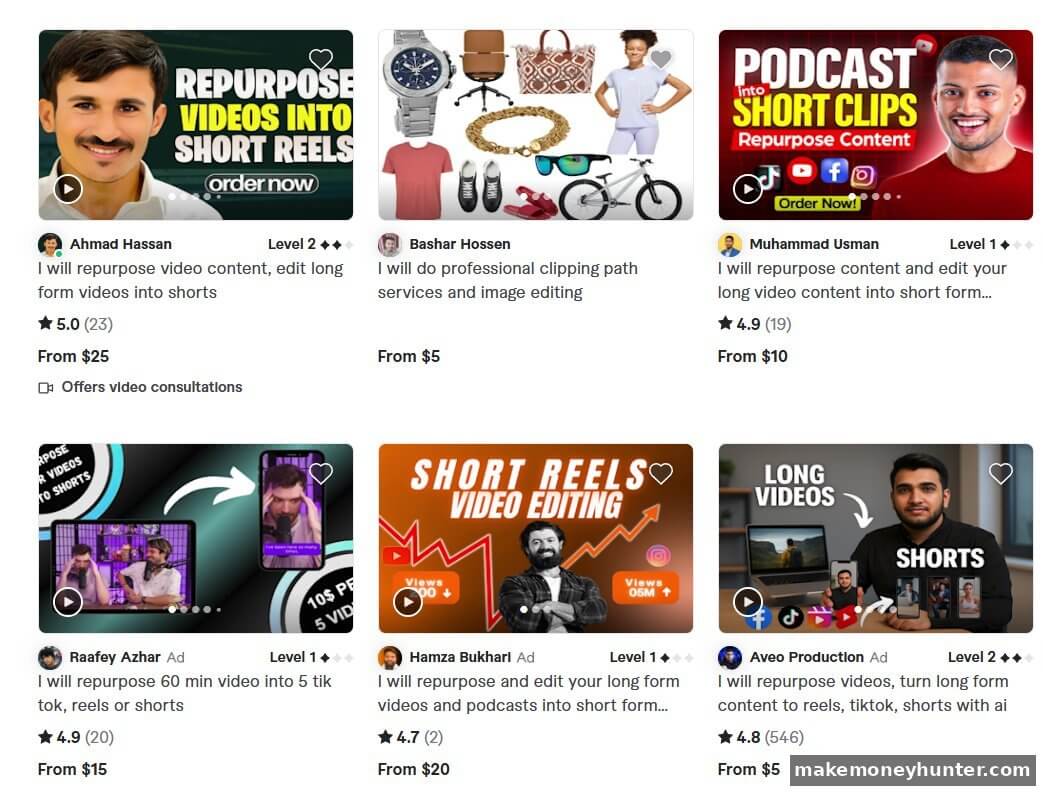
Notice three things in this screenshot. One: the price floor is $5 (which sucks) but skilled editors with reviews are at $20–$25 per gig — that’s where a competent teen can land within 60 days. Two: those star ratings (4.7, 4.8, 4.9, 5.0) with 19–546 reviews? That’s the difference between “$5/gig hobbyist” and “real income freelancer.” Reviews compound. Three: the gigs are extremely specific (“repurpose 60 min video into 5 tik tok, reels or shorts”) — that’s the template you copy. Specific offers convert; “I edit videos” doesn’t.
How to land your first client: edit a free sample for a creator with 5K–20K subscribers (small enough that they actually need help, big enough that they have some money). Send it to them as a “gift.” Maybe 1 in 10 will hire you. Two clients editing 3 videos a week each = $1,200–$2,400/month at modest rates.
14. Niche Blog or Website (Best for: ages 13+, patient teens with long-term thinking)
Age requirement: 13+ to register most platforms, but ad networks like Google AdSense require 18+ to receive payouts. Parent help needed: Yes for AdSense and affiliate payouts.
This is the highest-ceiling, slowest-paying method on the list. Building a niche site is brutal for the first 6 months — you publish, you get zero traffic, you start doubting everything. But the teens who actually push through tend to look back at it as the single best decision they made in high school.
What works for teens specifically: niches you genuinely care about that adults can’t fake. Specific game guides (Stardew Valley deep-dives, Genshin Impact theorycrafting), study niches (specific AP exam guides, study tools reviews), teen-specific lifestyle topics (prom prep, getting into competitive college programs). Adults can’t replicate your authentic voice in these areas.
Realistic timeline: $0 for months 1–6, $50–$200/month around month 9, $500–$2,000/month by year two if you’re consistent. The key is treating it as a 2-year project from day one — anyone going in expecting payoff in 6 months has already lost.
15. Music Production / Beat Selling (Best for: ages 13+, musical teens)
Age requirement: BeatStars and Airbit allow 13+ with parental account. Parent help needed: Yes for payment processing.
If you make beats in FL Studio, GarageBand, or BandLab, you can sell licenses on BeatStars for $15–$50 per non-exclusive license, $200–$2,000+ per exclusive license. The teens who win here treat it like building a catalog — they upload 5+ beats a week and have 200+ beats listed within a year. Most beats earn $0. A few earn surprisingly well. It’s a portfolio game, not a one-hit game.
How to Choose Which Method Is Right for You
Don’t try to do five at once. Here’s the honest decision framework — find your row and start there:
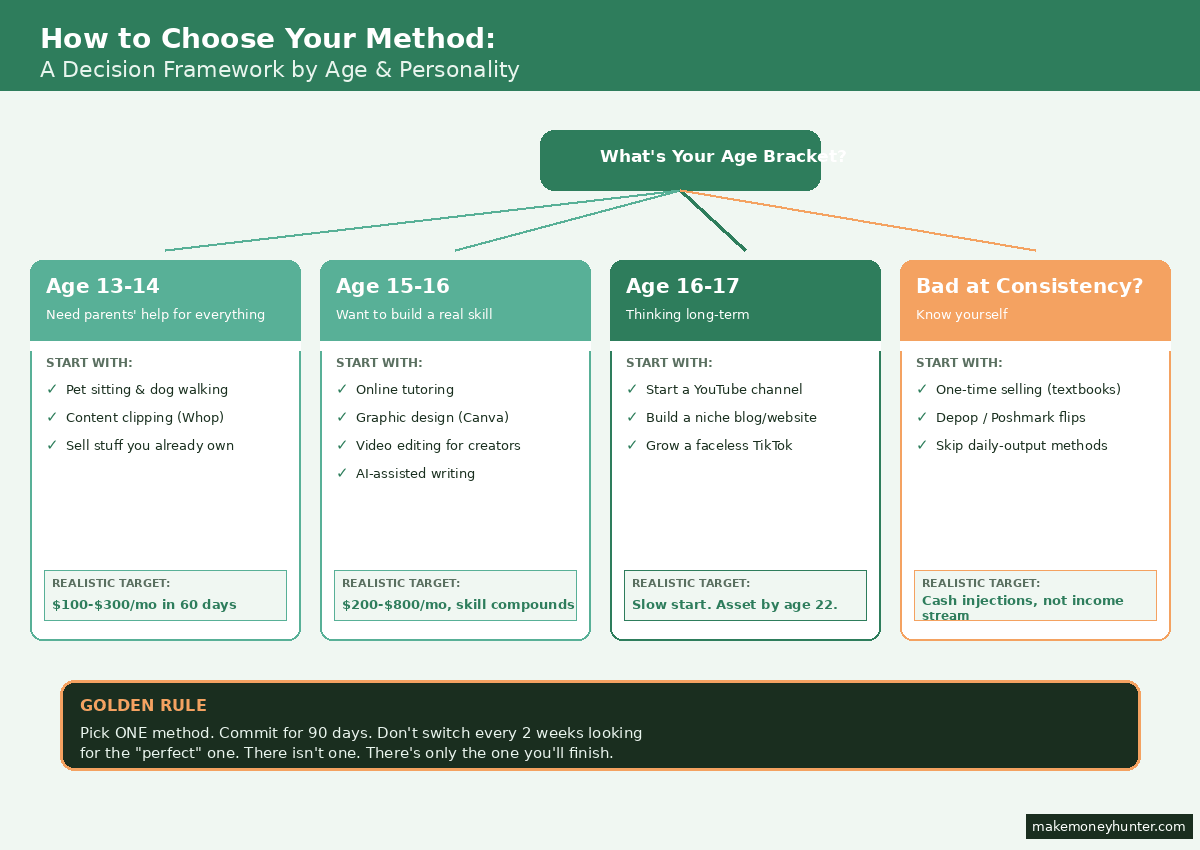
- If you’re 13–14 and need a parent’s help for everything: Start with pet sitting + content clipping + selling stuff you already own. These three together can realistically get you to $100–$300/month within 60 days.
- If you’re 15–16 and want to build a skill: Pick one of these — tutoring, graphic design, video editing, freelance writing. These all create real-world skills that compound for the rest of your life.
- If you’re 16–17 and thinking long-term: Start a YouTube channel or a niche website. You won’t see money for months, but by the time you graduate high school, you’ll have something most college kids don’t: an actual asset that earns money while you sleep.
- If you’re terrible at consistency: Stick with one-time sale methods (selling textbooks, Depop reselling) rather than methods that require daily output. Know yourself.
Common Mistakes Teens Make (And How to Avoid Them)
Mistake 1: Trying to skip the parent involvement. Don’t lie about your age on platforms. They will catch you, freeze your account, and you’ll lose whatever you earned. Get a parent involved — most are surprisingly supportive once they see you’re serious.
Mistake 2: Paying upfront for “training programs.” Any “course” promising to teach you how to make money online while charging $497 upfront is a scam. Real income methods are learnable through free YouTube tutorials and trial-and-error. Save your money.
Mistake 3: Quitting at month 3. Almost every method on this list shows nothing for the first 60–90 days. The teens who actually make money are the ones who keep going while everyone else gives up. This is the single biggest predictor of teen online income success.
Mistake 4: Trying to do all 15 methods at once. Pick one. Go all in for 90 days. If it doesn’t work, switch. If it does, scale. Splitting your time across five methods = succeeding at zero.
FAQ: How to Make Money as a Teenager Online
What’s the easiest way for a 13-year-old to make money online?
Honestly? Content clipping through Whop Clips (with parental help for the payment account) and pet sitting in your neighborhood. Both have low age requirements and can produce real income within 30–60 days. If you want something even simpler with no skill needed, Swagbucks works at 13+ with parental permission and pays out small balances quickly.
Do I need to pay taxes on money I earn as a teenager?
If you earn more than $400 in self-employment income in a year (most online methods count as this), yes — you need to file a tax return in the US. This sounds scary but is much simpler than it sounds. Have a conversation with whichever parent does the taxes; they can usually handle adding your income to the family return.
Can I make money online without my parents knowing?
For payouts above roughly $20–$50, no, not legitimately. Payment platforms require ID verification, and that requires being 18+ or having a parental account. Trying to forge this is a great way to lose all your earnings when the platform locks the account. Just talk to your parents — most are supportive once they understand what you’re doing.
How much money can a teenager realistically make in a year?
A motivated teen working 5–10 hours per week on the right method can realistically earn $1,000–$10,000 in their first year. The top end requires picking a high-leverage method (YouTube, niche site, video editing) and being unusually consistent. The bottom end is achievable with even sporadic effort on simpler methods.
Is making money online safe for teenagers?
The methods on this list are generally safe IF you (1) involve a parent in payment account setup, (2) never share personal info beyond what a platform legitimately needs, (3) never pay upfront for “training,” and (4) be skeptical of anything promising unrealistic income. The internet is full of scams targeting teens specifically — assume any “easy money” offer is fake until proven otherwise.
Final Thoughts
Don’t try to do all fifteen of these. Don’t even try to do five. Pick the one that matches your age, your skills, and your real situation — and commit to it for the next 90 days. That’s how every successful teen earner I’ve ever met got started. The ones who didn’t make it are the ones who jumped from method to method every two weeks, looking for the “perfect” one. There isn’t a perfect one. There’s only the one you’ll actually finish.
The teens who win at this aren’t smarter, luckier, or more talented than you. They just started — and didn’t stop when month 2 was disappointing. Pick your one method right now, sit down with a parent this weekend to set up whatever account you need, and start. Your future self at 22, looking back at the head start this gave you, will thank you.