

Over the past few years, people have been asking me the same question again and again:
Can you really make money from home?
And I’m not talking about making a little pocket money here and there. I mean real income—paid in USD, sustainable, and something you can scale over time.
To be honest, the answer is yes—but only if you’re willing to completely break down your “make money from home” fantasy and rebuild it from scratch.
Because for most people, the moment they hear “work from home,” they immediately picture only two things:
-
some shady scheme or scam
-
or making thousands a day while doing nothing
But the real world doesn’t work like that.
Making money from home is never easy. The difference is, it doesn’t require commuting, it doesn’t require pretending to like your boss, and it doesn’t require selling your time to a fixed location.
At the core, the money you earn online usually comes from information gaps, platform gaps, and mindset gaps—basically, you’re getting paid because you see opportunities other people don’t.
Over the past few years, I’ve seen a lot of everyday people build income streams online.
Some started small—but stayed consistent.
Some moved slowly in the beginning—but later pulled far ahead.
And they all had one thing in common:
They weren’t obsessed with speed.Instead, they focused on one question first:
Can I realistically do this long term?
Because when the direction is right, moving a little slower is often safer—and more sustainable.
One huge advantage of making money online in the global market is this:
People are willing to pay for normal people’s work, content, and efficiency.
Whether you’re providing a service, completing tasks, creating content, or selling a product—if you can help someone solve a specific problem, someone will pay you for it.
And honestly, it has far less to do with your degree or technical skills than most people think.
Next, I’m going to break down 3 ways you can earn money online from home.
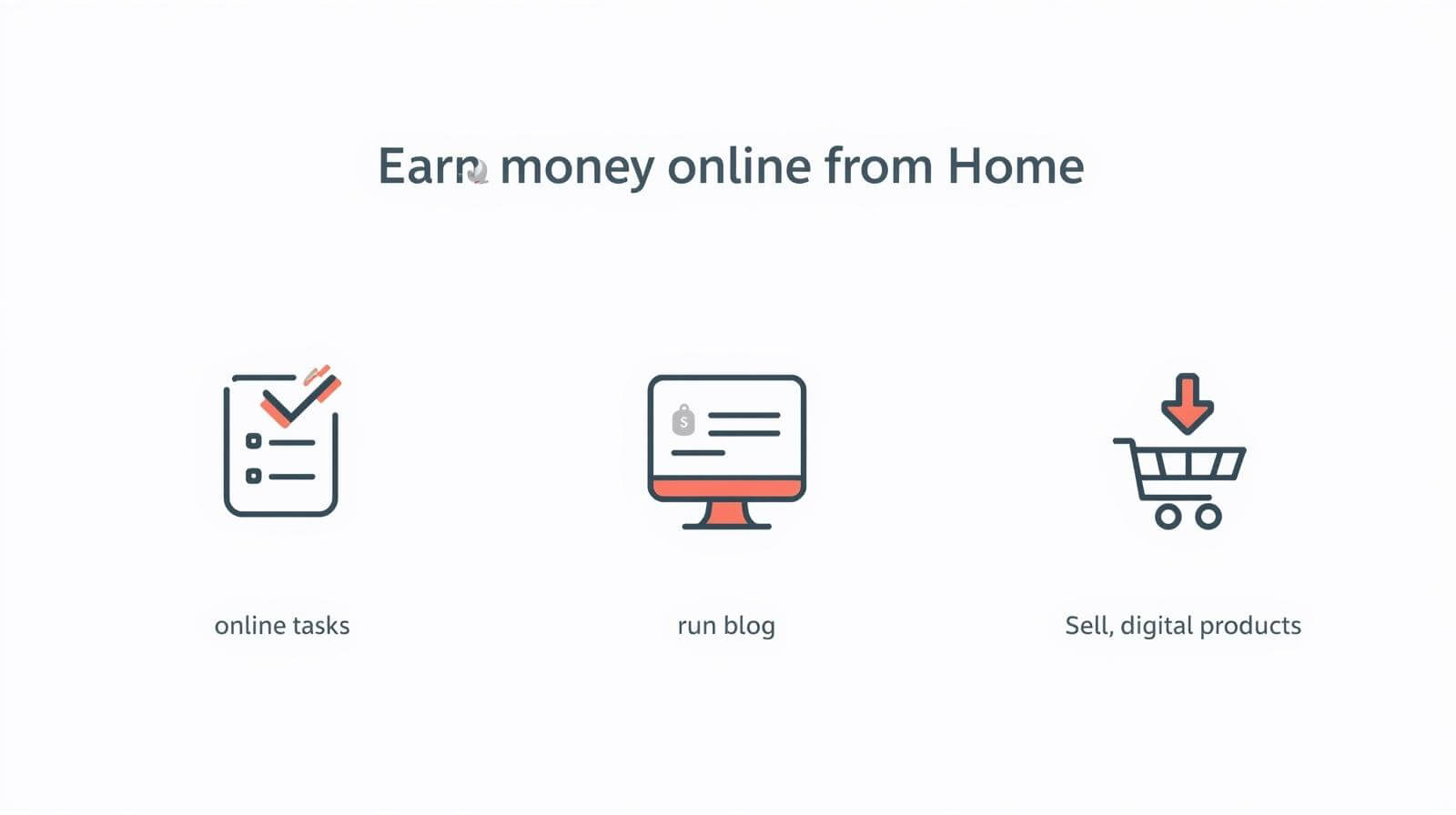
These methods won’t magically make you rich overnight—but they are real, proven, and already working for plenty of people.
If you’re looking for a path that doesn’t require leaving your house—and can genuinely change your income over time through long-term effort—then this is an article worth reading until the end.
Doing Online Tasks for Money
This is one of those work-from-home paths that I usually don’t hype up with big income claims, but it’s extremely useful for beginners to understand one thing:
Making money online doesn’t always mean building a business.
Sometimes, it simply means working on a different platform.
There are tons of online platforms that outsource simple, repetitive, and even boring tasks.
If you have time and patience, you can literally trade that effort for cash.
The most common types of online tasks include things like:
-
CAPTCHA solving
-
watching ads
-
clicking links and completing basic actions
A lot of people look down on this kind of work because the pay seems small—maybe just a few cents or a few dollars.
But you need to understand what these tasks really are:
They’re basically traffic and behavior verification.
Platforms need real human actions and real feedback, and you’re simply completing a behavior.
The difficulty is close to zero:sign up, follow the instructions, and click through the steps.
That’s why this is perfect for anyone who’s trying online income for the first time.
The same logic applies to earning money by playing games.
Many mobile games and browser games in the global market spend real budgets on user acquisition and retention, and part of that budget gets distributed through task platforms.
You just need to reach a required level, complete a certain stage, or log in for a set number of days to earn rewards.
It’s not about skill—it’s about time management and execution.
Some people casually play for a bit after work and can still earn a decent amount of extra spending money each month.
Among all these options, online surveys usually pay a bit more.
The reason is simple:
Data is valuable.
Brands and research companies are willing to pay for real opinions from real users.
All you have to do is fill out your info honestly and complete the survey.
Of course, these platforms filter users, so you’ll often see messages like “Not qualified.”
That’s normal.
Your mindset has to stay steady.
The key is volume: sign up for multiple platforms and do them in parallel—
that’s how you get consistent results.
My opinion on this model has always been very realistic:
It’s not a “get rich” strategy, and it’s not something you should treat as a long-term career.
But it’s perfect for beginners to practice:
-
execution
-
consistency
-
getting paid in USD
-
understanding platform rules
You’ll truly understand what it means to work with international platforms, what “USD payments” actually feel like, and what it means to follow rules first.
And once you can earn stable money from these small tasks, moving up to bigger online income models later becomes a completely different game—both mentally and strategically.
Building and Running Your Own Blog
If you ask me what’s one realistic path to make money from home long-term, with stable results and a high upside, my answer is always the same:
Build and grow your own blog.
It’s not easy—and it’s not a fast way to make money.But it’s incredibly stable. And once you figure it out, the ceiling is almost unlimited.
At its core, owning a website means you’re building a real asset on the internet—something that’s fully under your control.
It’s not a social media account.It’s not something that depends on a platform “deciding” to give you traffic.
It’s a website you own.
Today it can be a blog.Tomorrow it can be a tools site.Next it can be a niche content site.
As long as you choose the right direction and keep publishing consistently, it will slowly start bringing you passive traffic over time.
Of course, this route isn’t beginner-friendly at first.
You’ll need to learn the basics of building a WordPress site, and understand things like:
-
domains
-
hosting
-
themes
-
plugins
You also need to understand how SEO works—how to choose keywords, how to write articles that rank, and how to build a solid site structure.
In the beginning, all of this feels messy, slow, and frustrating.
And because there’s very little feedback early on, it’s easy to quit.
But that’s exactly why it’s valuable.
Most people can’t stay consistent for even three months.
And realistically, a website usually doesn’t start gaining momentum until 6 months to a year later.
If you can push through the early stage—when your income is close to zero and everything runs on pure belief—then every article you publish becomes a long-term asset.
The biggest advantage of owning your own website is that there are so many ways to monetize it:
-
display ads
-
affiliate marketing
-
digital products
-
services
-
building an email list
-
even selling the website later
You’re not working for one platform.
You’re building a machine that can be duplicated, expanded, and scaled over time.
I always say this:
Building a website is really just compound interest on your time.
An article you publish today might still be earning money one year from now—or even two years from now.
This path isn’t for people who want results immediately.
But it’s perfect for anyone who’s willing to play the long game and turn online income into a real business.
If you’re willing to slow down, keep learning, and keep publishing, building your own website is one of the most worthwhile paths you can take.
Selling Digital Products Online
Personally, I think this is one of the highest ROI ways to make money from home.
The reason is simple:
People are very used to paying for digital products that save time, save effort, and improve efficiency.
And digital products don’t require inventory, shipping, or customer service headaches.
You create it once—and you can sell it over and over again.
A lot of people hear “digital products” and immediately assume you need to be super professional, highly original, and spend a ton of time making something perfect.
But that’s not really true anymore.
With AI, you can create things like:
-
eBooks
-
step-by-step guides
-
templates
-
PowerPoint decks
-
Notion templates
-
resume templates
-
prompt packs
-
design or asset packs
-
simple tool-style documents
What you’re selling isn’t just “creativity.”
You’re selling a ready-to-use solution that someone else doesn’t have to organize themselves.
When people buy digital products, their mindset is very clear:
Can I use it immediately? Can it solve my problem right now?
That’s why your product doesn’t need to be fancy. The more specific, the better.
For example:
-
a beginner YouTube channel checklist
-
a collection of ChatGPT prompts
-
an Excel finance template for small businesses
There’s consistent demand for these kinds of products—and honestly, a lot of people already use them every day without realizing they can be sold.
If you’re just getting started, some of the easiest platforms to begin with are:
Gumroad, Etsy, SellNow, and Payhip.
They’re simple to list products on, easy to collect payments, and beginner-friendly if you just want to test the waters.
If you already know how to create content, you can also use platforms like Medium, YouTube, Pinterest, and TikTok to drive traffic and send people to your product page.
The platform handles the transaction—you focus on consistently publishing and launching new products.
But long-term, the best setup is always this:
Sell digital products on your own website.
Platforms can ban accounts, change the rules, or reduce your reach.
But your website is an asset you control.
In the beginning, you can use marketplaces to test products.
Once you find winners, you move them to your own site and drive traffic through SEO, email lists, and content distribution.
That’s how you extend the life of your products as long as possible.
One thing I always emphasize is this:
Digital products are really about selling knowledge + organization + execution.
You don’t have to be an expert. You just need to be one step ahead of your customers and package what they need in a clear, usable way.
If you choose the right direction, keep your products specific, and stay patient, selling digital products online can absolutely become a long-term main income stream.
Final Summary: Making Money from Home
By the time you get here, you’ll probably realize one important thing:
Making money from home isn’t mysterious. It’s not out of reach. And it’s not nearly as hard as most people imagine.
Whether you’re freelancing, doing online tasks, creating content, building your own website, or selling digital products—at the end of the day, you’re doing the same thing:
Using the internet to sell your time, your knowledge, and your ability to execute to the global market.
The only difference is that some people sell it in small, scattered ways—
while others build a system.
Out of these five methods, some are faster, some are slower.
Some have a low barrier to entry, and some have a much higher ceiling.
For some people, starting with simple tasks or basic services makes the most sense—so they can learn the process and earn their first dollars online.
For others, it’s better to start with long-term models from day one—like YouTube, building a website, or digital products.
The key isn’t which one you choose.
The key is whether you can stay consistent long enough to see results.
One thing I always recommend is this:
Don’t chase the “most profitable” option right away.
The most realistic path usually looks like this:
Survive first, then scale.
Start with low-risk methods to build confidence and momentum.
Then slowly shift your time and energy into projects that compound over time—so you don’t burn out or quit halfway.
If you only read and never take action, none of this will matter.
But if you pick just one method and actually start executing, making money from home will quickly stop being something you read about online—and become something you experience for yourself.
Because making money has never been about “figuring it out in your head.”
It’s built—step by step.